
Industrial maintenance and shutdown projects are very different from ordinary construction work. In a new building, scaffolding can often be planned alongside the construction sequence. During a plant shutdown, however, teams may have only a limited window to inspect equipment, repair pipelines, maintain machinery, replace components, work around vessels, or access difficult areas before operations must resume.
That makes scaffolding more than temporary access equipment. It becomes part of the project’s access planning, workflow, safety, and turnaround strategy.
For industrial facilities in Madhya Pradesh, selecting an experienced MS Scaffolding Manufacturer in Madhya Pradesh can support better material planning and supply coordination. But choosing scaffolding should never be based only on how quickly material can reach the site. Component specifications, intended loads, access requirements, site conditions, compatibility, erection planning, inspections, and applicable safety requirements all matter.
So, what should project teams actually consider before scaffolding reaches a shutdown site?
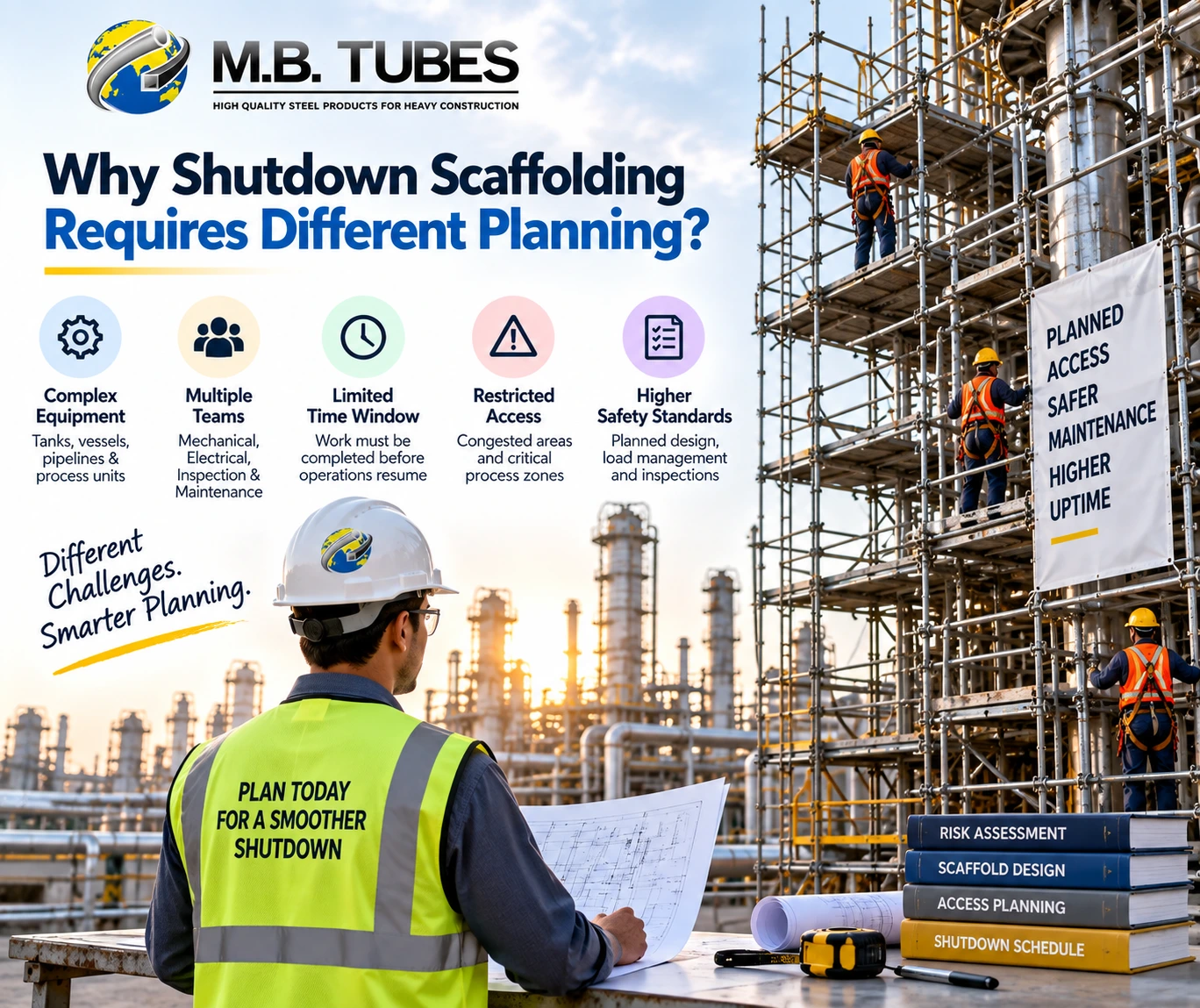
Why Shutdown Scaffolding Requires Different Planning
A shutdown can bring several contractors and maintenance teams into the same industrial facility at once.
Mechanical technicians may need access to one level, inspection teams another, while piping, electrical, insulation, painting, or maintenance work may be happening nearby. Scaffolding that looks straightforward on a drawing can become complicated when actual equipment, pipelines, operating restrictions, access routes, and simultaneous activities are considered.
This is why scaffolding planning should start with the work requirement, not simply with the number of components available.
A useful question is:
“What work must people perform from this scaffold, and what access will allow them to perform it appropriately?”
That question can influence platform locations, access points, scaffold configuration, material quantities, load planning, and erection sequence.
1. Start With an Access Map, Not a Material List
One of the biggest planning mistakes is estimating scaffolding only by quantity.
Industrial plants are rarely simple open spaces. Access may be required around:
- Tanks and vessels
- Pipe racks
- Boilers and process equipment
- Structural steel
- Machinery
- Elevated maintenance points
- Equipment requiring inspection or coating
- Restricted or congested areas
Before preparing the material requirement, the project team should identify where access is required, what work will occur there, who will use the platform, and what equipment or materials may be placed on it.
This creates a more practical scaffold requirement than simply saying, “We need X tonnes of scaffolding.”
Scaffolds should be designed by a qualified person and constructed and loaded according to that design; load limits should not be exceeded.
2. The Right Scaffold Is the One That Fits the Work
There is no single scaffolding arrangement that is automatically suitable for every maintenance project.
A regular access requirement may differ substantially from scaffolding around complex industrial equipment. Similarly, a maintenance platform used by workers with tools has different considerations from a platform intended to support heavier materials.
MS scaffolding systems can include components such as standards, ledgers, braces, frames, base plates, adjustable jacks, walkway planks, couplers, and other accessories depending on the selected system and approved design.
An MS Scaffolding Manufacturer in Madhya Pradesh should therefore be evaluated not simply on whether scaffolding is available, but on whether component specifications and supply capability can support the project’s planned system.
The final configuration should always follow project engineering, site conditions, applicable standards, and competent/qualified-person requirements.
3. Component Consistency Matters More During a Shutdown
A missing component on a normal project may create inconvenience.
During a tightly scheduled shutdown, it can create a bottleneck.
Imagine an erection crew reaching a critical area only to discover that the required braces, base components, planks, or compatible accessories are unavailable. Workers may be ready, maintenance teams may be waiting, and the shutdown clock is still running.
Material planning should therefore include not just primary scaffold members but also required accessories.
Component condition and compatibility are equally important. Improvised substitution should not become the answer to a material shortage.
OSHA guidance, for example, places responsibility on a competent person when components from different manufacturers are intermixed to determine whether the resulting scaffold remains structurally sound.
Shutdown efficiency comes from preparation—not shortcuts.
4. Load Planning Cannot Be an Afterthought
An industrial maintenance scaffold may carry more than people.
Workers can bring tools, maintenance equipment, removed components, consumables, or other materials onto platforms. If this is not considered during planning, actual use can differ from the assumptions behind the scaffold design.
That is why teams need to establish the maximum intended load and loading conditions before use.
As a useful safety reference, OSHA requires scaffold components within its jurisdiction to support their own weight plus at least four times the maximum intended load and prohibits loading beyond the scaffold’s maximum intended or rated capacity. Local Indian regulations and project-specific engineering requirements should be followed for projects in India.
The important principle is universal:
Know what the scaffold is expected to carry before deciding how it should be configured.
5. Safe Access Should Be Designed Into the Scaffold
A platform is only useful if workers can reach and leave it appropriately.
During shutdowns, poor access planning can create congestion, unnecessary climbing, interference between trades, and wasted movement.
Access routes should therefore be considered alongside working platforms.
The project team may need to evaluate ladders, stair access, walkways, platform transitions, entry points, and how workers move between working levels according to the chosen scaffold design and applicable safety requirements.
The goal is not merely to “reach the equipment.”
The goal is to provide planned working access for the task.
6. Inspection Becomes Especially Important in a Changing Worksite
Shutdown environments can change rapidly.
Materials move. Other trades work nearby. Equipment is opened. Components may be added or removed under controlled procedures. Vehicles or lifting operations may occur around work areas.
A scaffold that was acceptable when initially erected should not simply be assumed to remain unchanged throughout the project.
Inspection requirements must follow applicable regulations and site procedures. OSHA’s construction scaffold rules, for example, require a competent person to inspect scaffolds for visible defects before each work shift and after an event that could affect structural integrity.
For industrial projects, this reinforces an important practice:
Scaffold inspection should be part of the work cycle, not just an erection-day activity.
7. Think About Multiple Trades Using the Same Access
Industrial shutdown scaffolding often supports more than one activity.
A platform initially requested for inspection might later be needed for mechanical maintenance, painting, insulation, or another approved activity.
This creates an opportunity for better planning.
Instead of different teams independently requesting temporary access around the same equipment, shutdown planners can identify shared access requirements in advance where appropriate.
This may reduce duplicate erection and dismantling work and make material deployment more efficient.
However, shared use should never mean uncontrolled changes. If the intended use, load, geometry, or working conditions change, the scaffold should be reviewed according to project procedures and applicable requirements.
8. Erection Speed Should Come From Organization
During a shutdown, everyone wants scaffolding ready quickly.
But “faster” should not mean skipping braces, inspections, safe access, fall-protection requirements, or design controls.
A better approach is to remove avoidable delays.
Materials can be sorted by component type. Required quantities can be planned by work zone. Erection priorities can follow the shutdown sequence. Access routes for scaffold material can be coordinated with other site activities. Components can be inspected before they reach critical work areas.
OSHA identifies access, collapse, electrical hazards, falls, instability, and struck-by hazards among common scaffold concerns and emphasizes appropriate training and competent/qualified-person involvement.
In other words:
Save time through logistics, not through safety shortcuts.
9. Regional Supply Can Matter When the Schedule Is Tight
Industrial shutdowns do not always follow the original material forecast perfectly.
Site conditions may reveal additional access requirements. Another maintenance area may be added. More platforms or components may be required as the project progresses.
For projects in Indore, Pithampur, Dewas, Bhopal, Mandideep, Ujjain, Dhar, Ratlam, Jabalpur, Satna, or other industrial locations across Madhya Pradesh, regional sourcing can make communication and planned replenishment more practical.
Working with an MS Scaffolding Manufacturer in Madhya Pradesh may support coordination for quantities, component requirements, phased dispatches, and repeat requirements.
However, proximity alone should never determine supplier selection.
Buyers should also evaluate:
Product specifications, manufacturing consistency, component compatibility, material condition, supply capacity, documentation, required accessories, dispatch planning, and technical requirements.
10. Dismantling Should Be Planned Before Erection Begins
Shutdown planning often focuses intensely on getting scaffolding erected.
But what happens when maintenance finishes?
Poorly coordinated dismantling can interfere with commissioning, housekeeping, inspections, equipment closure, or the return of other areas to service.
Scaffold planning should therefore consider the complete lifecycle:
Requirement → Design → Material Planning → Erection → Inspection → Use → Controlled Modification → Dismantling → Material Recovery
This approach can also improve inventory control because components can be counted, segregated, inspected, and prepared for their next requirement instead of becoming scattered across the site.
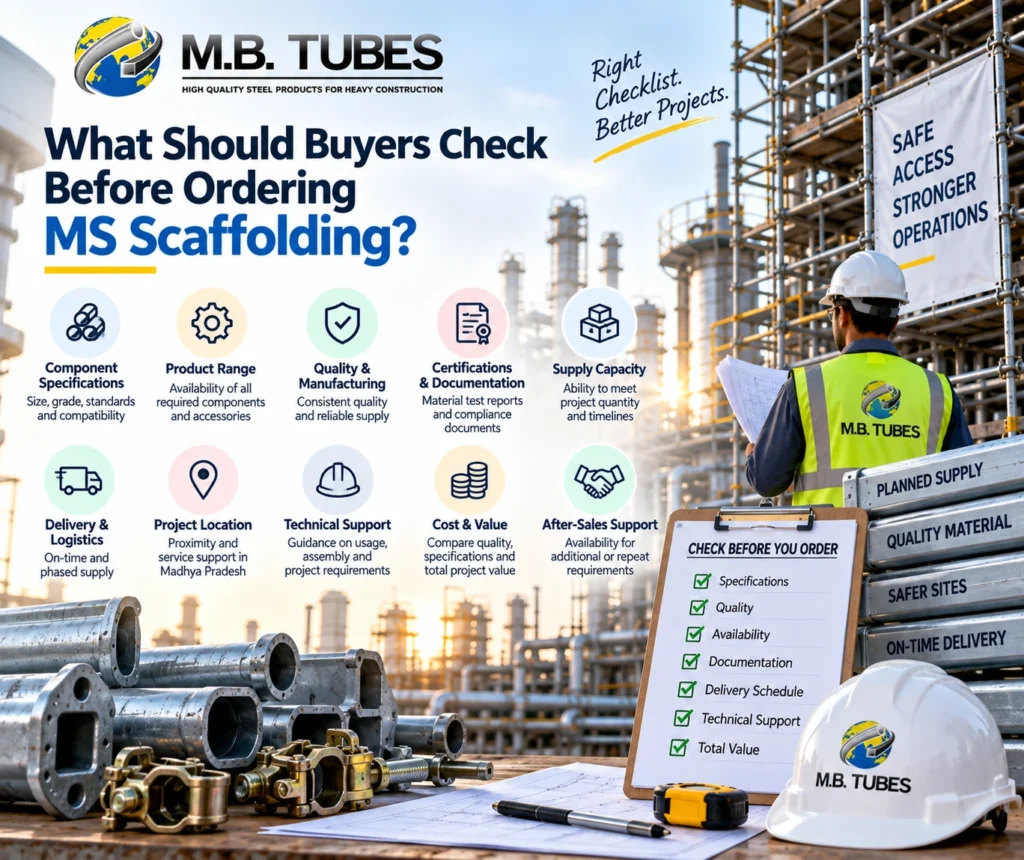
What Should Buyers Check Before Ordering MS Scaffolding?
For an industrial maintenance or shutdown requirement, a purchase or supply enquiry should contain more than the words “MS scaffolding required.”
Share as much relevant project information as possible, including the type of scaffold system required, component specifications, quantities, working/access requirements, project location, expected delivery schedule, required accessories, documentation requirements, and whether supply will be needed in phases.
For specialized or non-standard configurations, engineering and site teams should establish the design and loading requirements before finalizing quantities.
A capable MS Scaffolding Manufacturer in Madhya Pradesh should be able to communicate clearly about product specifications and supply capability rather than encouraging buyers to select components only on price.
The Real Cost of Scaffolding Is Not Just the Material Price
Two scaffolding quotations can look similar on paper while producing very different outcomes at the project level.
The lowest material price may not remain the lowest overall project cost if the supply has missing accessories, inconsistent components, delayed replenishment, unclear specifications, or unsuitable quantities.
For shutdown work, buyers should consider the bigger picture:
Material Cost + Logistics + Erection Efficiency + Availability + Downtime Risk + Rework + Dismantling Efficiency
This is particularly important when every lost hour affects the turnaround schedule.
Final Thoughts
For industrial maintenance and shutdown projects, scaffolding should be treated as part of the project access strategy, not merely as a temporary collection of steel components.
Good outcomes begin before erection.
Understand the maintenance scope. Map access requirements. Establish intended loads. Select a suitable scaffold system. Plan components and accessories. Coordinate material movement. Use trained personnel. Follow approved designs and applicable safety requirements. Inspect appropriately throughout use. Plan dismantling from the beginning.
And when sourcing from an MS Scaffolding Manufacturer in Madhya Pradesh, evaluate more than price per component. Look at specifications, consistency, availability, logistics, project requirements, and the supplier’s ability to support planned quantities across the shutdown schedule.
Because in a time-critical shutdown, the most valuable scaffold is not simply the one that arrives first.
It is the one that is properly planned for the work that needs to happen.
FAQs
1. Why is scaffolding important for industrial shutdown projects?
Scaffolding provides temporary working access to areas such as equipment, pipelines, structures, vessels, and elevated maintenance points. During shutdowns, good access planning can help multiple maintenance activities proceed according to the planned sequence while supporting appropriate working conditions.
2. What should I check when choosing an MS Scaffolding Manufacturer in Madhya Pradesh?
Check component specifications, manufacturing consistency, available scaffold systems and accessories, supply capacity, documentation, compatibility requirements, bulk availability, dispatch planning, and support for phased requirements. Final scaffold selection and use should follow project engineering and applicable safety requirements.
3. Which scaffolding components may be required for industrial maintenance?
Requirements vary by scaffold system and design but can include standards, ledgers, braces, frames, base plates, adjustable jacks, walkway planks, couplers, and related accessories. The actual bill of materials should be determined from the approved scaffold requirement rather than a generic list.
4. How can contractors reduce scaffolding delays during a shutdown?
Early access mapping, zone-wise material planning, component segregation, pre-use checks, planned erection priorities, coordination between trades, suitable inventory, and phased material supply can reduce avoidable delays. Efficiency should come from better preparation rather than removing safety or design controls.
5. Can the same scaffold be used by multiple maintenance teams?
Potentially, if its approved design, access arrangement, intended loads, and site procedures support those activities. Changes in use or loading should be reviewed by the responsible competent/qualified personnel according to applicable requirements; workers should not make uncontrolled modifications.