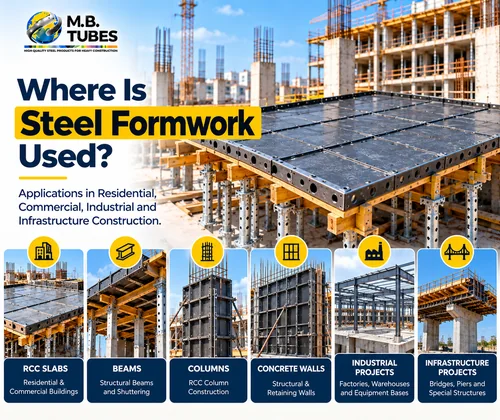

Where Is Steel Formwork Used? Applications, Benefits & Construction Guide
Steel Formwork plays an important role in modern construction, especially where concrete structures require accurate shapes, reliable support and repeated casting. From residential buildings to large industrial projects, steel formwork helps contractors create concrete elements with consistent dimensions.
Imagine constructing a multi-storey building where every floor has similar columns, beams and slabs. Instead of preparing a completely new mould for every concrete pour, contractors can use a reusable Steel Formwork system designed for repeated construction cycles.
But where exactly is Steel Formwork used, and why do construction companies choose it?
This guide explains its major applications, practical benefits, components and selection factors in simple language.
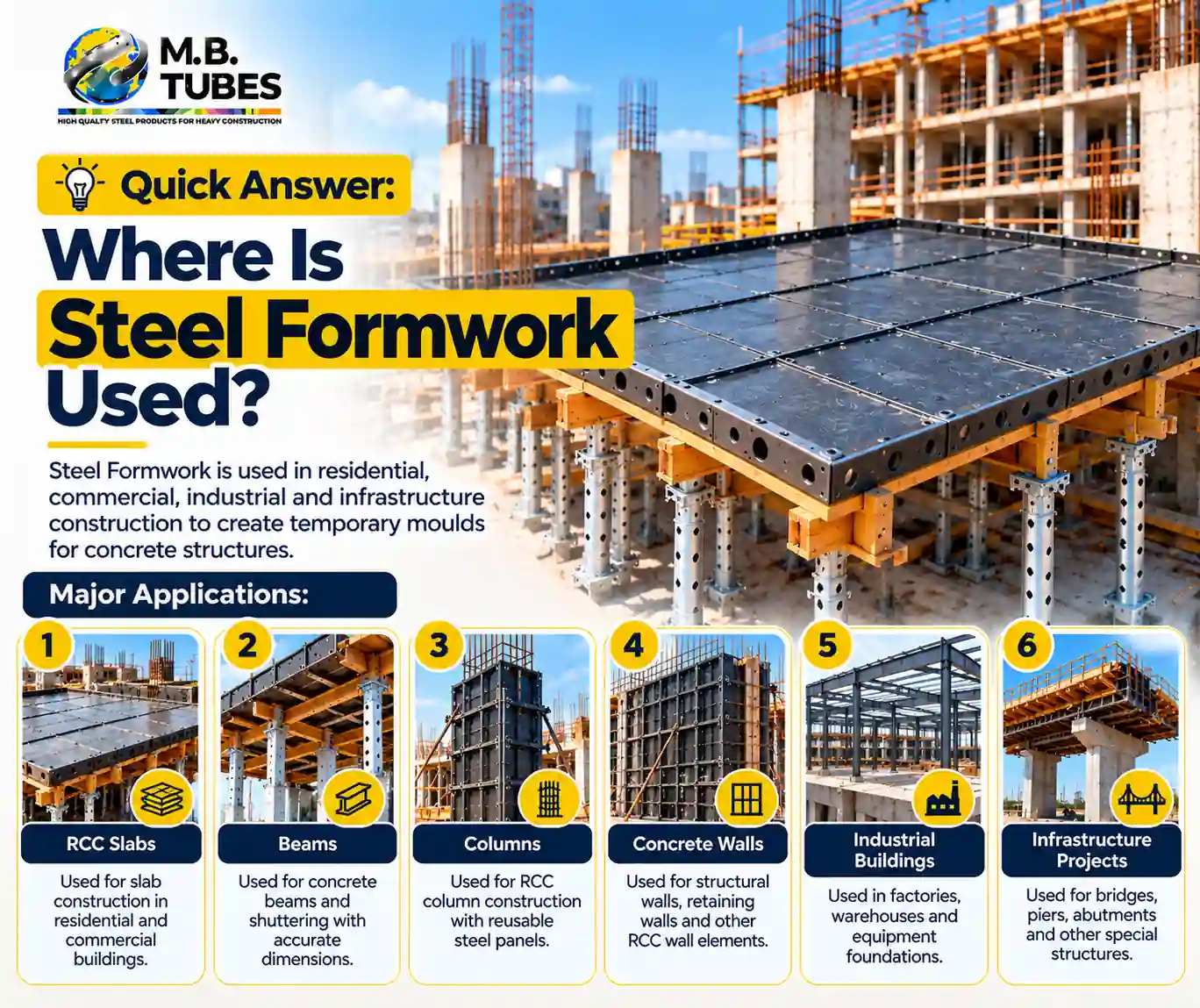
Quick Answer: Where Is Steel Formwork Used?
Steel Formwork is used in residential, commercial, industrial and infrastructure construction to create temporary moulds for concrete structures. It is commonly used for RCC slabs, beams, columns, walls, foundations, bridges and other concrete elements.
Its main purpose is to hold freshly placed concrete in the required shape until it develops sufficient strength for the formwork to be removed safely.
Steel Formwork is particularly useful for projects involving repetitive concrete casting, consistent dimensions and multiple construction cycles.
What Is Steel Formwork?
Steel Formwork is a temporary construction system made from steel panels and supporting components. It provides a mould into which fresh concrete is poured to form the required structural shape.
A typical Steel Formwork System may include:
- Steel Formwork Panels: Create the required concrete shape.
- Shuttering Plates: Provide surfaces for concrete casting.
- Adjustable Steel Props: Provide temporary vertical support.
- Adjustable Spans: Support slab formwork arrangements.
- Formwork Accessories: Help connect, align and secure components.
The exact arrangement depends on the structural drawings, casting sequence and project requirements.
7 Major Applications of Steel Formwork in Construction
1. RCC Slab Construction
One of the most common applications of Steel Formwork is RCC slab construction.
Before concrete is poured, the slab requires a temporary mould and supporting arrangement. Steel shuttering plates and compatible support components help maintain the intended slab shape.
Why is Steel Formwork useful for slabs?
It offers reusable forming surfaces, supports consistent slab dimensions and can simplify planning for repeated floors.
This makes it especially relevant for multi-storey residential and commercial buildings.
2. Beam Construction and Shuttering
Concrete beams require properly aligned formwork to achieve the specified dimensions.
Steel Formwork can be configured around beam sides and soffits, with suitable supports to maintain the required position during casting.
Its benefits include:
- Dimensional consistency across similar beams.
- Reusable components for repeated casting.
- Organized installation when components are correctly planned.
Beam formwork must always be designed for the expected concrete and construction loads.
3. RCC Column Construction
Columns are important structural elements in buildings and industrial facilities.
Steel Column Formwork helps create vertical concrete members with the required cross-sectional shape and dimensions.
For projects with repeated column sizes, reusable steel panels can be particularly practical.
For example, a commercial building may contain numerous columns with similar dimensions across multiple floors. A suitable steel formwork arrangement can be reused as construction progresses.
4. Concrete Wall Construction
Steel Formwork is also used for constructing concrete walls.
These may include structural walls, retaining walls and other reinforced concrete wall elements.
Wall formwork requires careful attention to alignment, connections, bracing and fresh-concrete pressure.
Steel panels can provide consistent forming surfaces, particularly when similar wall sections are constructed repeatedly.
However, the formwork configuration must match the wall dimensions and planned concrete placement method.
5. Industrial Buildings and Warehouses
Industrial construction often involves large concrete foundations, columns, equipment bases and other structural elements.
Industrial Steel Formwork can be used for:
- Factory building construction.
- Warehouse foundations and structural concrete.
- Industrial equipment foundations.
- Repeated concrete structural sections.
For industrial projects, contractors should consider not only panel dimensions but also handling arrangements, support requirements and the planned number of reuse cycles.
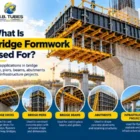
6. Bridges and Infrastructure Projects
Infrastructure construction often requires specialized formwork for concrete elements such as bridge piers, abutments and other engineered structures.
Steel Formwork for Bridge Construction may be selected where dimensional accuracy, repeatability and project-specific shapes are important.
Unlike standard building applications, infrastructure formwork may require customized panel arrangements and carefully engineered support systems.
The final design must follow the project’s structural and temporary-works requirements.
7. Repetitive Multi-Storey Construction
One of the strongest practical reasons to choose Steel Formwork is repetitive construction.
Consider a building with several floors using similar slab and beam layouts.
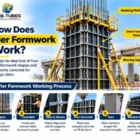
The same formwork components may be used through a planned cycle:
Install → Align → Cast → Allow Concrete to Gain Strength → Remove → Clean → Reuse
This approach can improve material planning and reduce the need to prepare new forming components for every cycle.
The actual reuse potential depends on handling, maintenance, design and site conditions.
Why Is Steel Formwork Preferred for Repetitive Projects?
Steel Formwork offers several advantages when selected and maintained correctly.
Benefit | Practical Value |
Reusability | Components can be used across multiple casting cycles |
Dimensional Consistency | Helps maintain repeated structural shapes |
Durability | Steel panels can withstand repeated handling when properly maintained |
Project Planning | Supports organized casting and reuse schedules |
Customization | Can be manufactured for project-specific requirements |
However, Steel Formwork is not automatically the most economical solution for every project. Small, irregular or one-time applications may require a different approach.
Steel Formwork vs Shuttering Plates: What Is the Difference?
These terms are often used together, but they are not exactly the same.
Steel Formwork refers to the broader moulding arrangement used to shape concrete.
Shuttering Plates are individual components that may form part of that arrangement.
For example, slab formwork can involve shuttering plates, adjustable spans, props and connecting accessories working together.
Understanding this difference helps buyers order the correct components rather than treating one plate as a complete formwork system.
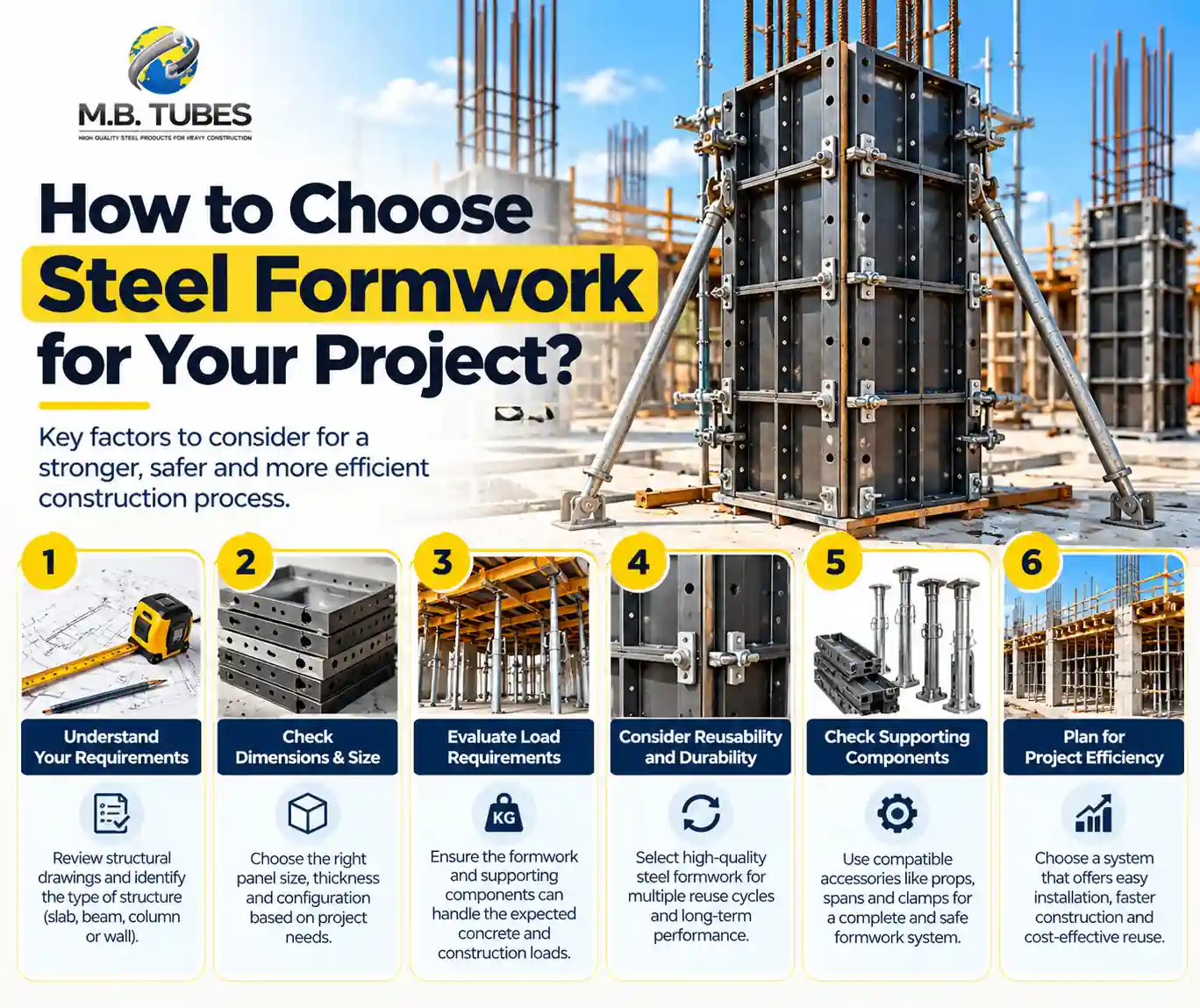
How to Choose Steel Formwork for Your Project
Selecting Steel Formwork should begin with the actual construction requirement.
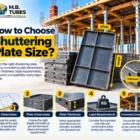
- Identify the application. Determine whether the formwork is required for slabs, beams, columns, walls or specialized structures.
- Check structural dimensions. Confirm the required length, width, height and shape using approved drawings.
- Evaluate loading requirements. Consider fresh concrete pressure, construction loads and the engineered support arrangement.
- Plan the reuse cycle. Estimate how many times the components will be used and how they will be moved between locations.
- Check supporting components. Ensure the proposed panels, props, spans and accessories are compatible with the complete system.
A practical selection process is:
Project Application → Structural Dimensions → Formwork Design → Supporting Components → Quantity Planning
Common Steel Formwork Mistakes to Avoid
Even good-quality components can perform poorly when the system is incorrectly planned.
Common mistakes include selecting panels only by price, ignoring the support arrangement, using damaged components and failing to check dimensions before installation.
Another frequent mistake is assuming that a formwork arrangement suitable for one concrete element can automatically be used for another.
The correct formwork design depends on the specific structure, loading conditions and construction method.
Proper inspection, cleaning and storage also help preserve components for future use.
Steel Formwork Solutions from M.B. Tubes
Khambati Steel & M.B. Tubes provides steel construction products and formwork-related components for residential, commercial, industrial and infrastructure requirements.
Its product range includes Steel Formwork, Shuttering Plates, Adjustable Steel Props, Adjustable Spans and supporting construction components.
For buyers planning repeated concrete work, selecting compatible components and confirming project specifications before ordering can help streamline procurement.
Conclusion
Steel Formwork is used wherever concrete needs to be shaped and supported during construction. Its applications range from everyday RCC slabs and columns to industrial structures and complex infrastructure projects.
The greatest value comes from choosing a system that matches the project rather than simply selecting individual components.
For residential, commercial or industrial construction, M.B. Tubes can be considered for steel formwork and compatible construction support products based on project requirements.
Frequently Asked Questions (FAQs)
Where is Steel Formwork most commonly used?
Steel Formwork is commonly used in RCC slab construction, beam shuttering, column casting, concrete walls, industrial structures and infrastructure projects.
Is Steel Formwork suitable for residential buildings?
Yes. Steel Formwork can be used in residential buildings, especially where similar slabs, beams or columns are constructed repeatedly.
Can Steel Formwork be reused?
Yes. Steel Formwork is designed for reuse, but the number of cycles depends on its condition, design, handling and maintenance.
What is the difference between Steel Formwork and steel shuttering plates?
Steel Formwork refers to the overall concrete moulding system, while shuttering plates are individual components used within certain formwork arrangements.
How do I choose the right Steel Formwork?
Start with structural drawings, concrete element dimensions, load requirements, supporting components and expected reuse cycles. The final system should follow an engineered formwork design.