
What Is Bridge Formwork Used For? Applications, Benefits & Selection Guide
Building a bridge requires more than concrete and steel. Every structural component, from bridge decks and piers to beams and abutments, needs accurate shaping and temporary support during construction. This is where Bridge Formwork plays an important role.
Bridge Formwork helps construction teams create concrete bridge components according to the required dimensions, shapes and structural drawings. It is commonly used in highway bridges, flyovers, railway bridges and other infrastructure projects.
In this guide, we will explore what Bridge Formwork is used for, how it works, its major applications, benefits and the factors to consider when selecting a suitable formwork system.
Quick Answer: What Is Bridge Formwork Used For?
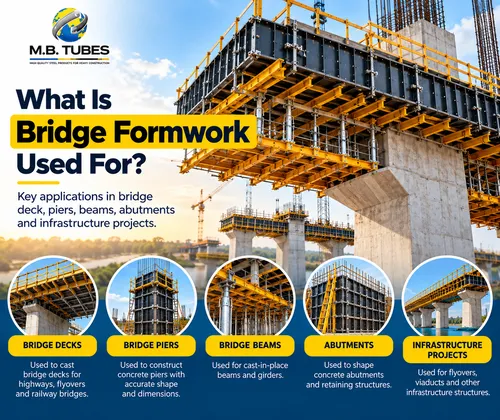
Bridge Formwork is used to shape and temporarily support freshly placed concrete during the construction of bridge decks, piers, columns, abutments, beams and other structural elements.
It acts as a temporary mould that holds concrete in the required position until it develops sufficient strength. Steel Bridge Formwork is particularly useful for projects involving repeated concrete sections, complex structural shapes and large infrastructure requirements.

What Is Bridge Formwork?
Bridge Formwork is a temporary construction system designed to contain freshly poured concrete and maintain its required shape during bridge construction.
It may include steel formwork panels, shuttering plates, supporting frames, bracing, ties and other compatible components.
The main purpose is to create properly aligned concrete structures while supporting construction loads according to the approved formwork design.
The basic process follows six stages:
Planning → Formwork Installation → Alignment → Concrete Pouring → Strength Development → Formwork Removal
The exact installation and removal process depends on the bridge structure, concrete requirements and engineering specifications.
Where Is Bridge Formwork Used?
Bridge Formwork is used in several important parts of bridge construction.
1. Bridge Deck Construction
A bridge deck is the structural surface that carries road or rail traffic.
Bridge Deck Formwork helps create the required deck shape and supports fresh concrete during casting.
Its applications include highway bridges, flyovers, railway bridges and elevated road structures.
The formwork arrangement must be designed for the deck geometry, concrete loads and construction sequence.
2. Bridge Pier Construction
Bridge piers are vertical structural elements that support the bridge superstructure.
Pier Formwork is used to construct concrete piers with the required dimensions and surface finish.
Steel formwork panels are especially useful when a project involves several piers with similar dimensions.
However, the system must be designed to resist fresh-concrete pressure and other construction loads.
3. Bridge Beam Construction
Concrete beams transfer loads from the bridge deck to supporting structural elements.
Beam Formwork helps create the required beam dimensions during casting.
It is used for cast-in-place beams, girders and other concrete beam elements, depending on the structural design.
Accurate alignment, suitable support and secure connections are essential during installation.
4. Bridge Abutments
Abutments are structural supports located near the ends of a bridge.
Abutment Formwork helps shape the concrete walls and supporting sections according to the engineering drawings.
These structures may have different dimensions and reinforcement arrangements, making proper formwork planning important.
5. Flyovers and Elevated Roads
Flyovers often contain repeated concrete components, including piers, pier caps and deck sections.
Reusable Steel Bridge Formwork can be beneficial for such projects because similar components may be cast multiple times.
The system can be planned around repeated dimensions and the construction sequence.
6. Box Culverts and Infrastructure Structures
Bridge-related formwork systems may also be used for box culverts, retaining structures and other reinforced concrete infrastructure elements.
The formwork must be selected according to the specific structure rather than assuming one arrangement will suit every application.
How Does Bridge Formwork Work?
Bridge Formwork provides a temporary mould and support arrangement for concrete construction.
The process generally involves the following steps.
Step 1: Review Structural Drawings
Engineers examine the required dimensions, shape, concrete specifications and construction sequence.
Step 2: Select the Formwork System
Suitable panels, supports, connections and accessories are selected based on the approved design.
Step 3: Install and Align Components
The formwork is assembled, supported, braced and checked for correct positioning.
Step 4: Place Concrete
Fresh concrete is poured according to the approved method while the formwork resists the applicable construction loads.
Step 5: Allow Concrete to Develop Strength
The concrete must reach the specified strength before formwork or temporary supports are removed.
Step 6: Remove and Reuse Formwork
Where permitted by the construction design, the formwork is dismantled, cleaned, inspected and prepared for another casting cycle.
What Are the Benefits of Steel Bridge Formwork?
Steel formwork offers several advantages when it is correctly designed and used.
Benefit | How It Helps |
Reusability | Panels may be reused across repeated casting cycles |
Dimensional Consistency | Helps maintain uniform dimensions in repeated concrete elements |
Durability | Steel components can withstand repeated handling when maintained properly |
Customisation | Panels can be designed for specific bridge shapes and dimensions |
Construction Planning | Repeated formwork arrangements can simplify scheduling |
Concrete Finish | Well-maintained panels can help produce consistent concrete surfaces |
These benefits depend on the quality of the formwork, engineering design, installation practices and maintenance.
Steel Bridge Formwork vs Conventional Formwork
Choosing between steel and other formwork materials depends on the project requirements.
Steel Bridge Formwork is often considered for projects involving repeated structural elements, large quantities and multiple casting cycles.
Conventional timber or plywood-based systems may be suitable for smaller projects, unusual shapes or applications where repeated reuse is limited.
The best option should be evaluated based on the total project requirements, not simply the initial purchase cost.
What Components Are Used in Bridge Formwork?
A complete Bridge Formwork arrangement may involve several supporting components.
Component | Main Function |
Steel Formwork Panels | Shape concrete structural elements |
Shuttering Plates | Provide temporary concrete mould surfaces |
Adjustable Steel Props | Provide temporary vertical support where designed |
Adjustable Spans | Support compatible horizontal formwork arrangements |
Steel Channels | Serve as supporting or stiffening members |
Bracing and Connections | Help maintain the required structural arrangement |
Tie Rods and Nuts | Resist formwork pressure where specified |
Not every component is suitable for every bridge application. The complete arrangement must follow the approved engineering design.
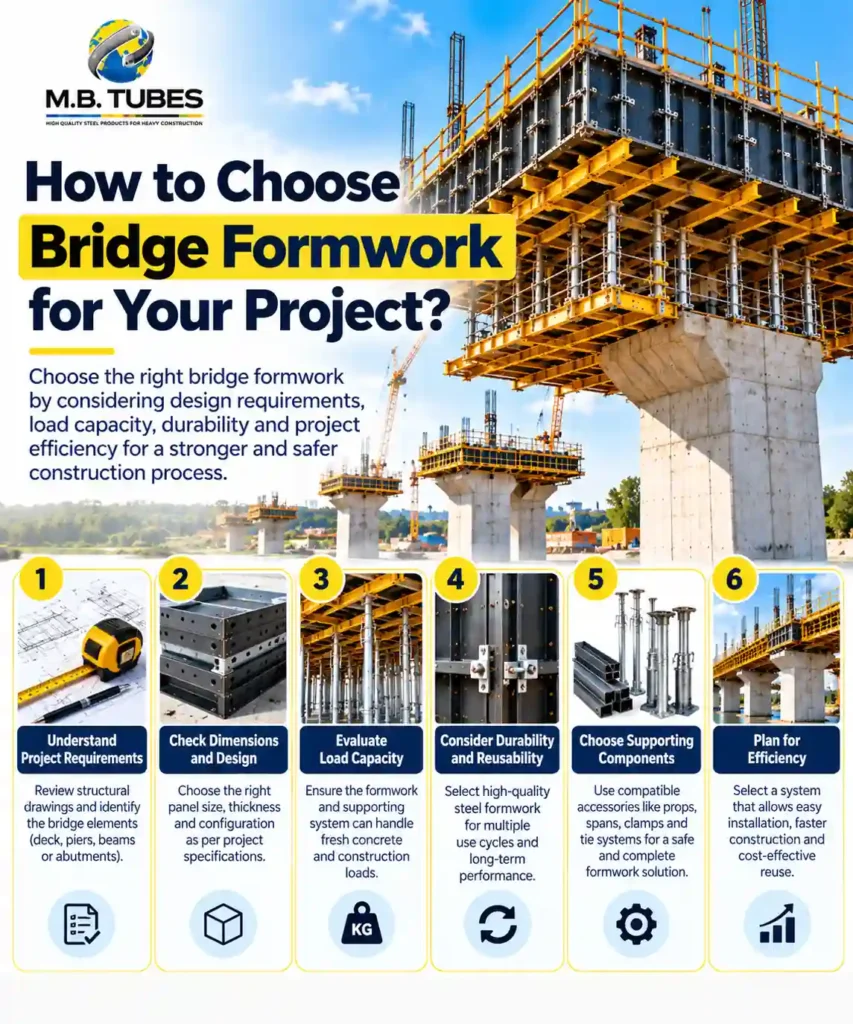
How to Choose Bridge Formwork for Your Project
Selecting suitable Bridge Formwork requires careful evaluation of the project rather than choosing panels based only on appearance or price.
Understand the Structural Application
Identify whether the formwork is required for a bridge deck, pier, beam, abutment or another structural element.
Check Dimensions and Shape
Review the drawings to confirm the required length, width, height, curvature and other geometrical details.
Evaluate Construction Loads
Consider fresh-concrete pressure, construction activities, equipment and temporary loading conditions.
The formwork and support arrangement must be designed and verified for these loads.
Consider Reusability
If the project involves repeated piers or deck sections, evaluate whether reusable steel panels can support multiple casting cycles.
Check Supporting Components
Confirm that the required supports, bracing, ties, connectors and accessories are compatible with the formwork design.
Plan Handling and Installation
Consider transportation, lifting equipment, assembly space, construction access and the planned casting sequence.
Common Mistakes to Avoid When Selecting Bridge Formwork
Some common procurement and planning mistakes include:
- Selecting formwork based only on the lowest purchase price.
- Ordering panels without confirming structural drawings.
- Ignoring fresh-concrete pressure and construction loads.
- Using incompatible supporting components.
- Assuming one formwork system suits every bridge element.
- Neglecting cleaning, inspection and maintenance between casting cycles.
A properly planned formwork system can help reduce unnecessary site modifications, material waste and construction delays.
Bridge Formwork for Infrastructure Projects from M.B. Tubes
Khambati Steel & M.B. Tubes provides steel formwork and construction support products for different infrastructure and concrete construction requirements.
The product range includes steel formwork components, shuttering and centering plates, adjustable props, adjustable spans, steel channels and scaffolding accessories.
For bridge-related requirements, buyers should share structural drawings, dimensions, material specifications, quantities and application details so that suitable product options and any required customisation can be discussed.
Conclusion
Bridge Formwork plays an essential role in constructing concrete bridges, flyovers and other infrastructure structures. From bridge decks and piers to beams and abutments, the right formwork helps create accurately shaped concrete elements while supporting planned construction activities.
When selecting a system, consider structural requirements, formwork dimensions, load conditions, supporting components and reusability.
For construction and infrastructure projects, Khambati Steel & M.B. Tubes offers steel formwork and supporting products that can be evaluated according to specific project requirements.
The right Bridge Formwork starts with the right structural design, compatible components and careful construction planning.
Frequently Asked Questions
What is the main purpose of Bridge Formwork?
The main purpose of Bridge Formwork is to shape and temporarily support freshly placed concrete during bridge construction. It helps create bridge decks, piers, beams, abutments and other concrete structural elements according to the approved drawings.
Is steel formwork suitable for bridge construction?
Yes. Steel Formwork can be suitable for bridge construction, particularly where repeated casting, dimensional consistency and durable reusable panels are required. The suitability of the system depends on the structural design and construction conditions.
Can Bridge Formwork be reused?
Yes, reusable steel Bridge Formwork can be used across multiple casting cycles when the components remain in acceptable condition. Cleaning, inspection, correct handling and maintenance are important for repeated use.
What is the difference between Bridge Formwork and scaffolding?
Bridge Formwork shapes and supports fresh concrete, while scaffolding generally provides temporary access or working platforms. Some engineered temporary works systems may also support formwork, but the two functions are different.
How do you select the right Bridge Formwork?
Start with the bridge’s structural drawings, dimensions, concrete loads, construction sequence and required casting cycles. Then evaluate panel specifications, supporting components, material quality, reusability and the complete temporary works design.