
For a factory, warehouse, PEB structure, production unit, or industrial shed, roofing is a long-term investment. The roof must deal with heat, rain, moisture, dust, wind, and changing weather while protecting equipment, materials, workers, and daily operations.
Two terms buyers frequently encounter are PPGI and PPGL. Both are pre-painted steel products widely used for industrial roofing and cladding, but their metallic base coatings differ. That difference can influence corrosion performance, suitability for different environments, and overall project value. Colour-coated PPGI/PPGL sheets are widely used for factories, warehouses and pre-engineered buildings in India.
For project owners, contractors, fabricators, and procurement teams searching for a Factory Roofing Sheet Supplier in Madhya Pradesh, understanding these differences makes it easier to specify roofing based on actual project conditions instead of choosing only by price or colour.
What Is PPGI Roofing Sheet?
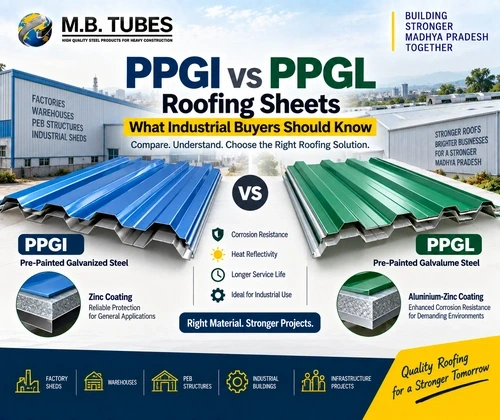
PPGI stands for Pre-Painted Galvanized Iron, although in practical roofing terminology it refers to pre-painted galvanized steel.
The steel substrate receives a zinc-based metallic coating, followed by pretreatment, primer, and a factory-applied paint system. This combination provides corrosion protection along with the colour and finish required for roofing or wall cladding.
PPGI is commonly considered for general industrial and commercial roofing applications, particularly where environmental exposure is not highly aggressive and project economics are important.
Typical applications can include:
- Factory sheds
- Warehouses
- Workshops
- Commercial structures
- Industrial wall cladding
- Storage facilities
- Agricultural and utility buildings
The actual suitability depends on the specified coating, paint system, thickness, profile, exposure conditions, and manufacturer recommendations.
What Is PPGL Roofing Sheet?
PPGL stands for Pre-Painted Galvalume steel.
Instead of a conventional zinc-only metallic coating, PPGL uses an aluminium-zinc alloy coated steel substrate, followed by paint and protective layers.
Aluminium-zinc coated products are designed to provide enhanced corrosion resistance, and the aluminium component can also improve heat reflectivity. These characteristics make PPGL an important option where longer-term corrosion performance or more demanding environmental exposure is a priority.
PPGL is commonly considered for:
- Industrial plants
- Large warehouses
- PEB structures
- Factory roofing
- Industrial cladding
- Infrastructure buildings
- Long-life roofing applications
- More demanding atmospheric conditions
Again, PPGL should not automatically be assumed to be suitable for every environment. The exact product specification and manufacturer guidance remain important.
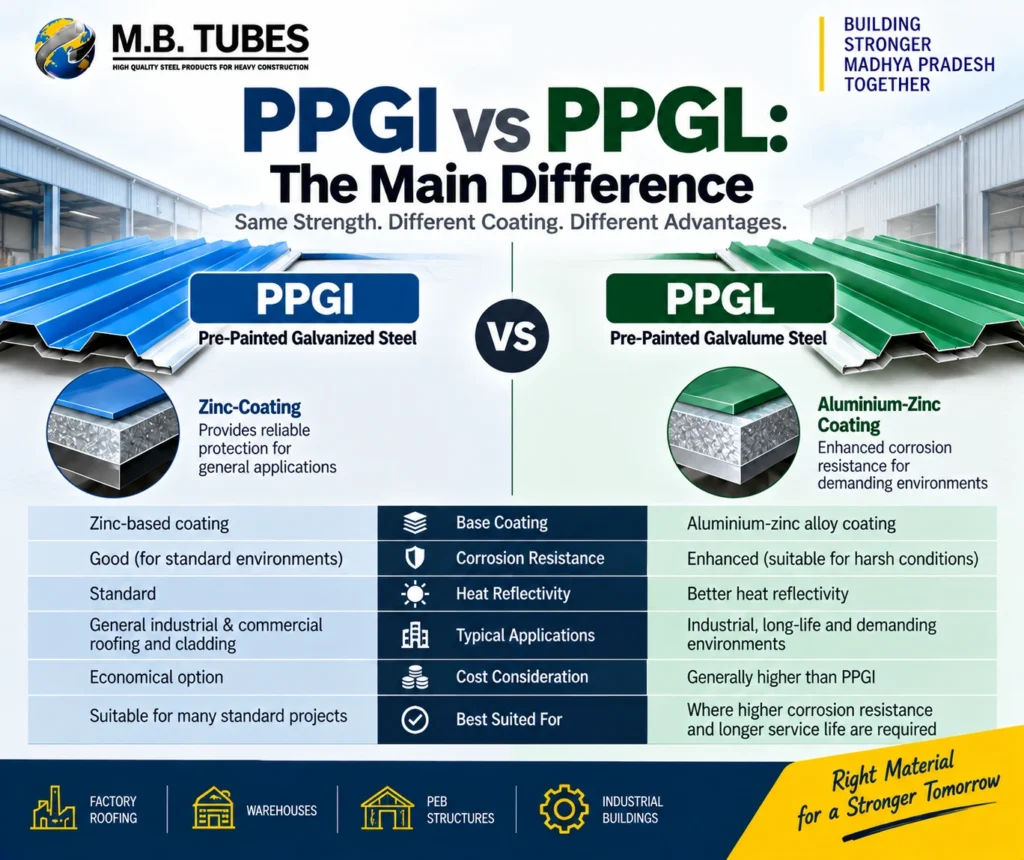
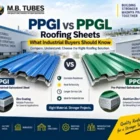
PPGI vs PPGL: The Main Difference
The easiest way to understand the difference is to look beneath the paint.
| Factor | PPGI | PPGL |
| Base coating | Primarily zinc-based | Aluminium-zinc alloy |
| Surface | Pre-painted | Pre-painted |
| Corrosion protection | Good when correctly specified | Generally enhanced, particularly in demanding environments |
| Heat reflectivity | Depends on coating/colour system | Al-Zn substrates can offer improved reflectivity |
| Typical use | General roofing and cladding | Industrial and longer-life roofing applications |
| Selection basis | Environment + specification + budget | Environment + specification + lifecycle requirement |
This comparison is a general guide. Actual performance varies considerably with metallic coating mass, paint system, substrate quality, installation, environmental exposure, and maintenance.
Why the Metallic Coating Matters
Steel itself requires protection from environmental exposure.
The metallic coating forms an important protective layer between the steel substrate and surrounding environment. PPGI relies on galvanized zinc protection, whereas PPGL combines aluminium and zinc in its metallic coating.
Aluminium-zinc coated steel combines aluminium’s barrier properties with zinc’s protective behaviour, which is why it is widely used in modern industrial roofing products.
However, buyers should avoid comparing products based simply on the words “PPGI” or “PPGL.”
Two PPGL sheets from different specifications may not offer identical performance. The same applies to PPGI.
Don’t Buy Roofing Sheets Based on Colour Alone
Colour is important for factory appearance, branding, and architectural consistency, but the visible topcoat is only one part of the roofing system.
Industrial buyers should examine the complete product specification:
Steel Substrate → Metallic Coating → Pretreatment → Primer → Topcoat → Back Coat
The paint itself can also vary. Standard polyester, high-durability polyester, PVDF, and other coating technologies can be selected depending on application and manufacturer availability.
Therefore, two roofing sheets with an identical blue or grey appearance may have very different underlying specifications.
1. Consider the Factory’s Environment
Before deciding between PPGI and PPGL, evaluate where the building is located and what surrounds it.
A normal warehouse environment may have very different roofing requirements from a factory exposed to persistent moisture, industrial emissions, chemicals, or aggressive atmospheric conditions.
For projects across Indore, Pithampur, Dewas, Bhopal, Mandideep, Ujjain, Dhar, Ratlam, Jabalpur, Gwalior, Satna, Rewa, and other Madhya Pradesh industrial areas, environmental exposure should be evaluated at the actual project site.
A professional Factory Roofing Sheet Supplier in Madhya Pradesh should ask about the application and required specification rather than recommending one material universally.
2. Compare Corrosion Requirements
Corrosion is one of the most important considerations in metal roofing.
PPGI can provide appropriate corrosion protection for many general applications when correctly specified and maintained.
PPGL’s aluminium-zinc substrate is commonly selected when enhanced corrosion performance is desired. Current coated-steel guidance describes aluminium-zinc products as particularly suitable for higher-corrosion and long-life roofing applications.
But corrosion resistance is not determined by the substrate name alone.
Cut edges, fasteners, scratches, installation practices, trapped moisture, drainage, incompatible materials, and maintenance can all influence roof performance.
3. Check the Actual Coating Specification
One of the biggest purchasing mistakes is asking only:
“What is the sheet thickness?”
Thickness matters, but so does coating.
Buyers should request technical information covering the metallic coating, paint system, base metal thickness or total coated thickness as applicable, yield strength, profile dimensions, and other relevant specifications.
Some aluminium-zinc roofing products, for example, are offered with explicitly defined coating and paint-layer specifications rather than simply being labelled “PPGL.”
This allows procurement teams to compare specification against specification, rather than name against name.
4. Think About Heat Exposure
Industrial roofs can become extremely hot under direct sunlight.
Roof colour, surface reflectivity, insulation, ventilation, building design, and roofing material can all influence heat entering the building.
Aluminium-zinc coated products can offer improved heat reflectivity compared with conventional zinc-coated steel.
However, PPGL should not be treated as a replacement for insulation where a facility has defined thermal-performance requirements.
Factories requiring controlled indoor temperatures may need additional solutions such as insulation or engineered sandwich-panel systems.
5. Profile Design Is Just as Important
PPGI or PPGL tells you about the coated material—not the entire roofing design.
The sheet still needs an appropriate profile.
Industrial roofing commonly uses trapezoidal, high-rib, corrugated, or specialised roofing profiles depending on project requirements.
Profile geometry can influence water drainage, effective cover width, sheet stiffness, fastening arrangements, and suitability for the designed support spacing.
For this reason, buyers should evaluate:
Material + Coating + Thickness + Profile + Roof Slope + Purlin Spacing + Fastening System
Not just PPGI versus PPGL.
6. Check Sheet Thickness Properly
A quotation showing a lower price may also be based on a different sheet specification.
When comparing suppliers, confirm whether the quoted thickness refers to the same measurement basis and whether both quotations use comparable substrate, coating, paint, and mechanical properties.
A seemingly small specification difference multiplied across thousands of square metres of roofing can materially change both project cost and performance.
Ask your Factory Roofing Sheet Supplier in Madhya Pradesh for clearly documented specifications before approving bulk procurement.
7. Installation Quality Can Change the Outcome
Premium material cannot compensate for poor installation.
Incorrect fasteners, overtightened or undertightened screws, damaged coatings, incorrect overlaps, poor flashing, inadequate drainage, and careless sheet handling can reduce roofing performance.
Industry guidance also notes that incorrect installation and maintenance can reduce the life of steel roofing structures.
Roofing procurement and installation should therefore be treated as connected activities.
8. Consider Maintenance From Day One
Neither PPGI nor PPGL should simply be installed and forgotten.
Industrial roofs should be inspected according to project and manufacturer recommendations.
Maintenance may involve clearing drainage paths, checking fasteners and flashings, inspecting coating damage, removing accumulated debris, and addressing localised corrosion or damage where identified.
A correctly specified roof combined with good installation and planned maintenance provides a stronger basis for long-term performance.
9. Compare Lifecycle Value, Not Just Purchase Price
PPGI may sometimes provide a more economical solution for general-purpose applications, while PPGL may justify a higher initial specification where environmental exposure or lifecycle requirements demand enhanced corrosion resistance.
But there is no universal answer.
A useful purchasing calculation is:
Material Cost + Transport + Installation + Accessories + Maintenance + Repair + Replacement Risk = Lifecycle Cost
A cheaper sheet is not necessarily cheaper over the building’s full operating period.
Similarly, specifying a premium product beyond what the project requires may not always be economically justified.
The objective is appropriate specification, not simply the lowest or highest-priced sheet.
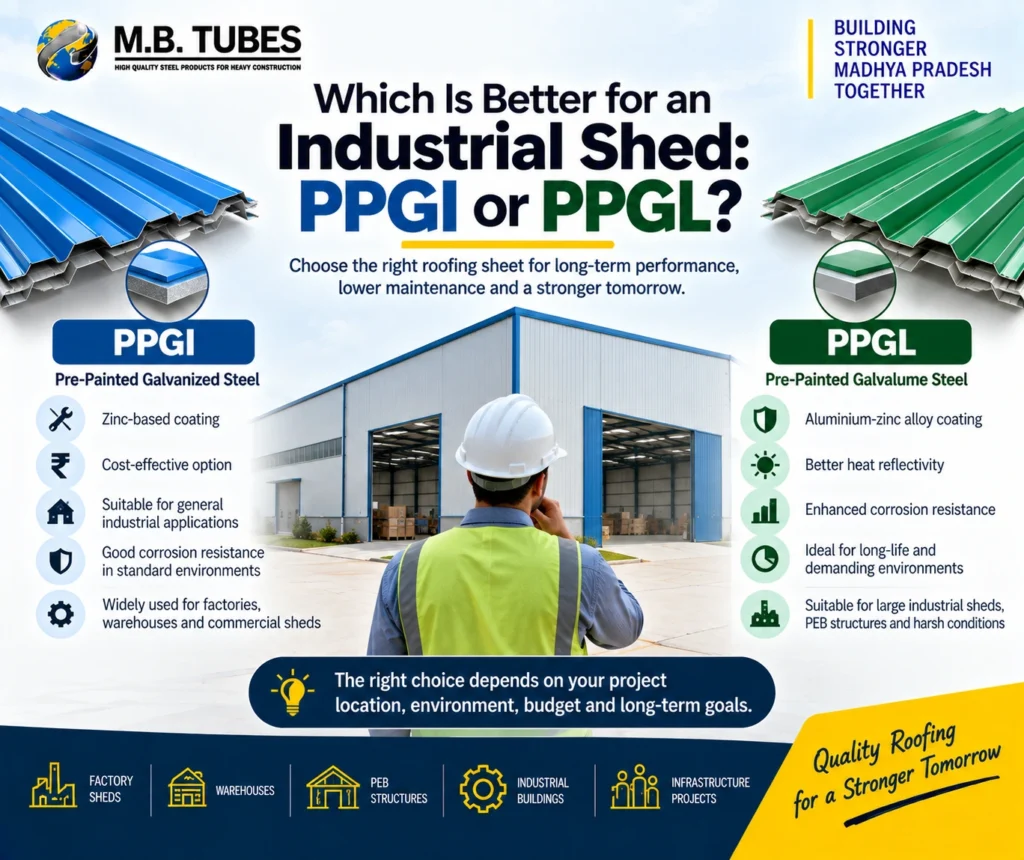
Which Is Better for an Industrial Shed: PPGI or PPGL?
The answer depends on the project.
For a standard inland factory or warehouse with moderate environmental exposure, appropriately specified PPGI may provide a practical solution.
For projects requiring greater corrosion resistance, enhanced heat reflectivity, or longer-term performance under more demanding exposure, PPGL may be worth considering. Aluminium-zinc coated roofing products are specifically marketed for improved corrosion resistance and demanding roofing environments.
The final selection should follow the project’s engineering requirements and the roofing manufacturer’s technical recommendations.
Why Regional Roofing Supply Matters for Madhya Pradesh Factories
Industrial roofing projects often require large quantities of sheets manufactured in project-specific lengths.
Once installation starts, shortages or incorrect specifications can interrupt progress.
Working with a Factory Roofing Sheet Supplier in Madhya Pradesh can potentially simplify:
Specification Coordination: Easier discussion of profiles, lengths, thicknesses, colours, and quantities.
Phased Deliveries: Material can be planned according to construction schedules where supplier capabilities permit.
Logistics: Regional sourcing may simplify transportation for MP projects.
Additional Requirements: Extra sheets, flashings, or related components may be easier to coordinate.
Repeat Supply: Useful for factories undergoing expansion or construction in phases.
Regional location alone, however, is not enough. Product quality, technical specifications, manufacturing consistency, supply capability, and delivery reliability should remain important selection criteria.
What Industrial Buyers Should Ask Before Ordering
Before issuing a purchase order, ask the supplier to clearly specify:
- PPGI or PPGL substrate
- Base metal / applicable thickness specification
- Metallic coating specification
- Paint system and coating details
- Yield strength where relevant
- Roofing profile
- Effective cover width
- Sheet length
- Colour and finish
- Required accessories
- Applicable standards and test documentation
- Quantity and delivery schedule
For colour-coated steel products, industry guidance recommends checking applicable standards and requesting relevant test documentation for the supplied batch.
Clear specifications make quotation comparison much more meaningful.
Choosing a Factory Roofing Sheet Supplier in Madhya Pradesh
A dependable supplier should do more than provide a price per sheet.
Industrial buyers should look for a supplier that can clearly communicate product specifications, profile options, available thicknesses, coating systems, production capabilities, dispatch planning, and bulk-order requirements.
For factory roofing, warehouses, industrial sheds, PEB structures, and manufacturing facilities, consistency across the entire order is particularly important.
When evaluating a Factory Roofing Sheet Supplier in Madhya Pradesh, compare technical suitability, material consistency, logistics capability, and total project value alongside price.
Final Thoughts
The PPGI vs PPGL decision should not become a simple contest over which material is “better.”
PPGI can be an effective solution for many general roofing and cladding applications, while PPGL’s aluminium-zinc substrate can provide advantages where enhanced corrosion resistance and heat reflectivity are important.
The right industrial roofing solution depends on the complete system:
Environment + Substrate + Metallic Coating + Paint System + Thickness + Profile + Installation + Maintenance
For buyers searching for a Factory Roofing Sheet Supplier in Madhya Pradesh, focusing on these specifications will lead to a more informed purchasing decision than comparing price, colour, or sheet thickness alone.
Frequently Asked Questions (FAQs)
1. What is the main difference between PPGI and PPGL roofing sheets?
The main difference is the metallic coating beneath the paint. PPGI uses a galvanized zinc-coated steel substrate, while PPGL uses an aluminium-zinc alloy-coated steel substrate. Both can be used for industrial roofing, but their suitability depends on environmental exposure, coating specification, profile, and project requirements.
2. Which is better for factory roofing: PPGI or PPGL?
There is no single option that is best for every factory. PPGI can be suitable for many general industrial roofing applications, while PPGL is often considered where enhanced corrosion resistance and heat reflectivity are important. Buyers should select according to the project’s technical and environmental requirements.
3. What should buyers check when choosing a Factory Roofing Sheet Supplier in Madhya Pradesh?
Buyers should check the supplier’s PPGI/PPGL specifications, sheet thickness, metallic coating, paint system, roofing profiles, effective cover width, manufacturing consistency, bulk supply capability, documentation, and delivery schedule. Comparing complete specifications is more useful than comparing price alone.
4. Are PPGL roofing sheets more corrosion-resistant than PPGI sheets?
PPGL’s aluminium-zinc alloy coating generally provides enhanced corrosion resistance compared with conventional galvanized steel in many environments. However, actual service life also depends on coating mass, paint system, installation quality, environmental exposure, drainage, maintenance, and handling.
5. Which roofing sheet is suitable for industrial sheds in Madhya Pradesh?
The appropriate roofing sheet depends on the factory location, roof design, environmental exposure, purlin spacing, required profile, sheet thickness, coating system, budget, and expected service conditions. A reliable Factory Roofing Sheet Supplier in Madhya Pradesh can provide product specifications, while final selection should align with project engineering requirements.