
What Is MS ERW Pipe Used For? Applications, Benefits & Buying Guide
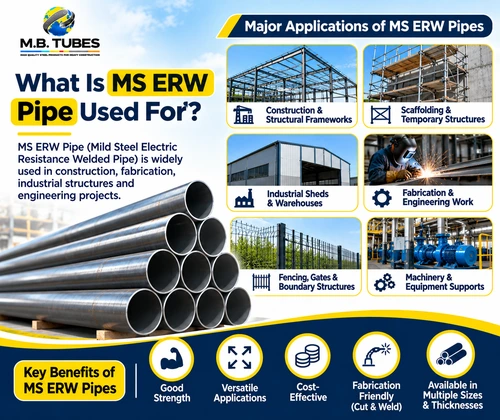
MS ERW Pipe is widely used in construction, fabrication, industrial structures and engineering projects. Its combination of strength, availability and versatility makes it a practical choice for different steel requirements.
But where exactly is MS ERW Pipe used? Is it suitable for structural applications? And how do you choose the right pipe for your project?
This guide explains MS ERW Pipe uses, manufacturing, benefits, applications and selection factors in simple language to help contractors, fabricators, engineers and industrial buyers make informed decisions.
Quick Answer: What Is MS ERW Pipe Used For?
MS ERW Pipe is used in construction, structural fabrication, industrial frameworks, scaffolding, fencing, machinery supports and general engineering applications.
ERW stands for Electric Resistance Welded, while MS means Mild Steel. These pipes are manufactured by forming steel strips into a tubular shape and welding their edges using electric resistance.
Their suitability depends on the pipe diameter, wall thickness, steel grade, manufacturing standard and project requirements.
What Is an MS ERW Pipe?
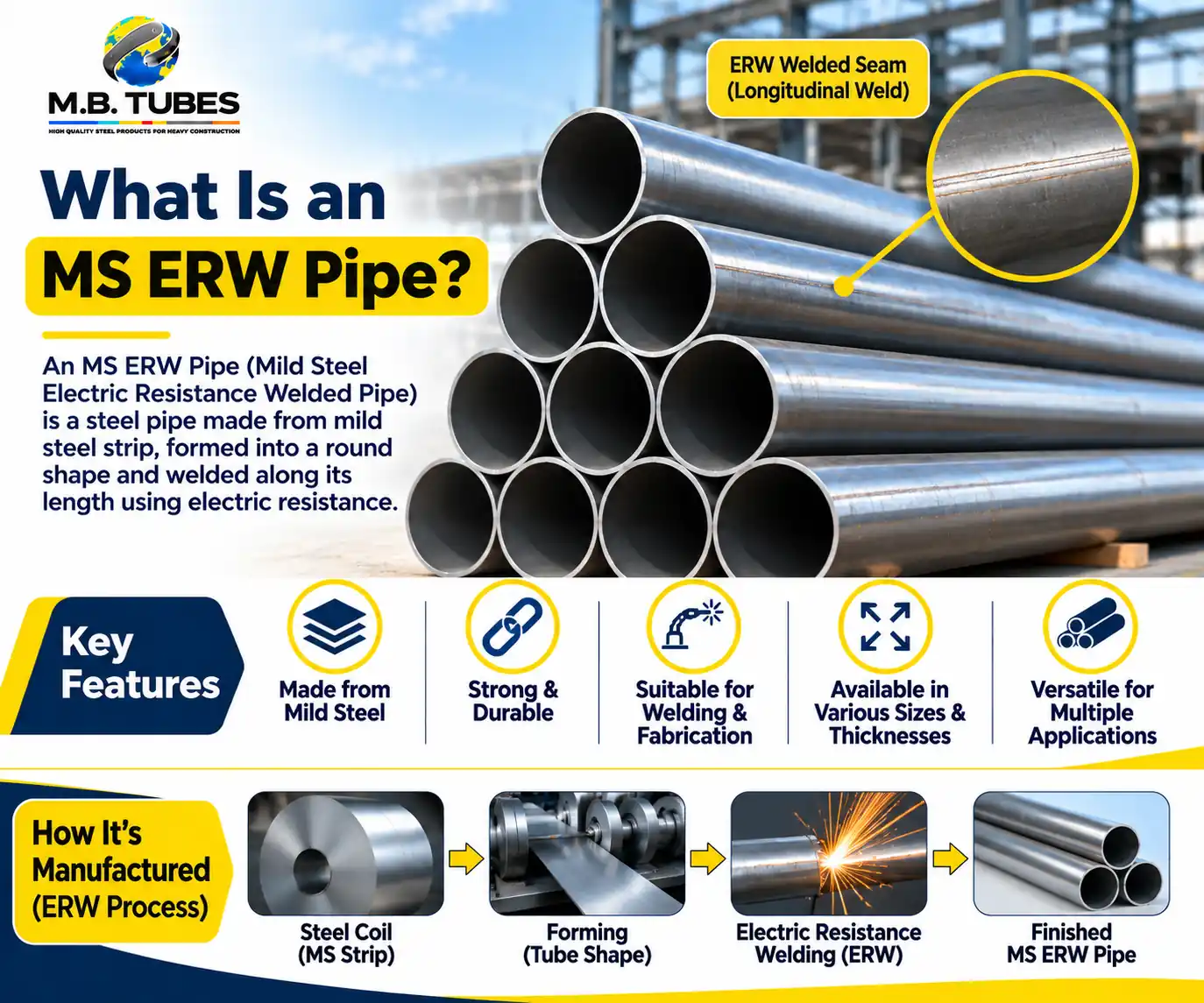
An MS ERW Pipe is a mild steel pipe manufactured through the Electric Resistance Welding process.
Unlike seamless pipes, ERW pipes are produced from steel strips or coils. The material is shaped into a round tube, and its edges are joined through a controlled welding process.
The result is a steel pipe suitable for various industrial and construction applications, provided it meets the relevant specifications.
Key characteristics include:
- Consistent pipe dimensions
- Availability in different diameters and thicknesses
- Suitability for welding and fabrication
- Practical use in structural and general engineering work
- Different finishing options based on requirements
How Is MS ERW Pipe Manufactured?
Understanding the manufacturing process helps buyers evaluate pipe quality.
The process generally follows these stages:
Steel Coil → Strip Forming → Electric Resistance Welding → Weld Finishing → Sizing → Cutting → Inspection
First, a mild steel strip passes through forming rollers to create a cylindrical shape.
The strip edges are then heated using electrical resistance and pressed together to create a longitudinal welded joint.
After welding, the pipe undergoes sizing, straightening and cutting operations.
Depending on the required specification, additional inspections and testing may be performed before dispatch.
Important: Pipe quality depends on material selection, welding control, dimensional accuracy and compliance with the applicable standard.
7 Major Applications of MS ERW Pipes
1. Construction and Structural Frameworks
One important MS ERW Pipe use is in construction-related fabrication.
These pipes may be used for:
- Structural frames
- Supporting frameworks
- Fabricated steel assemblies
- Temporary construction structures
- Industrial building components
The appropriate pipe must be selected according to the structural design and expected loads.
2. Scaffolding and Temporary Structures
MS ERW pipes are commonly used to manufacture certain scaffolding tubes and components.
They can be incorporated into temporary access and support arrangements where the specified pipe grade, dimensions and system design permit.
For scaffolding applications, buyers should verify outside diameter, wall thickness, material specification and system compatibility.
A general-purpose ERW pipe should not automatically be treated as a certified scaffolding tube.
3. Industrial Sheds and Warehouses
Industrial buildings require steel components for various fabrication purposes.
MS ERW pipes can be used in suitable secondary frameworks, supporting members and fabricated assemblies.
Applications may include warehouse structures, industrial sheds and equipment-related frameworks.
However, their structural suitability depends on engineering calculations rather than pipe dimensions alone.
4. Fabrication and Engineering Work
MS ERW pipes are useful for fabrication workshops because they can be cut, welded and assembled into different configurations.
Common applications include:
- Fabricated frames
- Machinery support structures
- Steel racks
- Industrial equipment assemblies
- General engineering components
Their versatility makes them useful for manufacturers working with different project designs.
5. Fencing, Gates and Boundary Structures
MS ERW pipes are frequently used in fencing and metal fabrication.
Typical applications include boundary fencing, gate frames, railings and protective barriers.
For outdoor applications, suitable surface protection is important because untreated mild steel can corrode when exposed to moisture.
6. Machinery and Equipment Supports
Industrial machinery often requires fabricated steel support arrangements.
MS ERW pipes may be selected for equipment frames, supporting structures and other non-pressure engineering applications.
Selection should consider vibration, loading, connections and operating conditions.
7. General Industrial Applications
MS ERW pipes are also used across manufacturing and industrial projects where tubular steel sections are required.
Depending on the grade and standard, ERW pipes may serve different purposes.
For pressure, fluid or gas applications, only pipes specifically manufactured, tested and approved for the intended service should be used.
Why Are MS ERW Pipes Popular in Construction?
The popularity of MS ERW Pipes comes from their practical characteristics.
Versatility: They can be used across different fabrication and construction requirements.
Availability: Multiple diameter, thickness and length options support different project specifications.
Fabrication convenience: Suitable grades can be cut, welded and processed for custom assemblies.
Cost considerations: ERW manufacturing can offer an economical solution for applications where the specified pipe meets performance requirements.
Dimensional consistency: Controlled manufacturing supports predictable dimensions, subject to applicable tolerances.
These advantages make ERW pipes a common choice for contractors and industrial buyers.
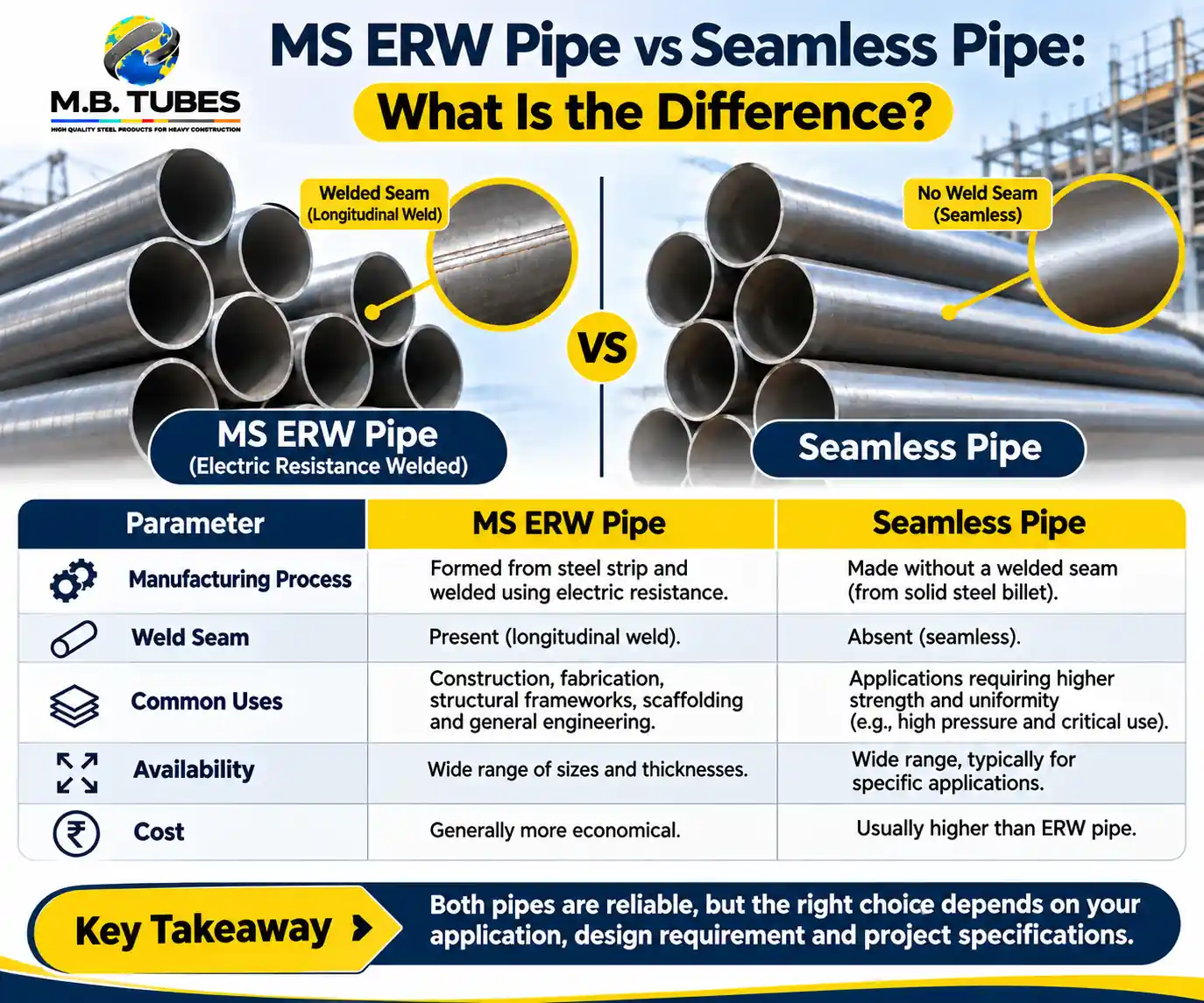
MS ERW Pipe vs Seamless Pipe: What Is the Difference?
Both are steel pipes, but their manufacturing processes differ.
Feature | MS ERW Pipe | Seamless Pipe |
Manufacturing | Steel strip formed and welded | Produced without a longitudinal welded seam |
Weld seam | Present | Absent |
Common uses | Fabrication, structures, general engineering | Applications specified for seamless construction |
Availability | Various dimensions | Various dimensions |
Selection | Based on grade, standard and intended use | Based on grade, standard and intended use |
Neither type is automatically suitable for every application. The correct choice depends on service conditions, engineering requirements and applicable standards.
How to Choose the Right MS ERW Pipe
Choosing the right pipe requires more than comparing prices.
Check the Pipe Diameter
The outside diameter affects fit, connections and suitability for the intended structure.
Verify Wall Thickness
Wall thickness influences the pipe’s weight and structural properties.
However, thicker pipes are not automatically the best choice for every application.
Confirm Material Grade
Different projects require different material properties. Buyers should confirm the specified steel grade and applicable manufacturing standard.
Evaluate Surface Finish
Depending on exposure conditions, pipes may require painting, galvanizing or another protective treatment.
Consider the Application
A pipe selected for fencing may have different requirements from one intended for a load-bearing structure.
Check Quality Documentation
For critical projects, request relevant dimensional, material and testing documentation.
Best selection approach:
Application → Engineering Requirements → Material Grade → Diameter → Thickness → Finish → Quantity
Common Mistakes When Buying MS ERW Pipes
Buyers sometimes focus only on the quoted price without checking the complete specification.
Common mistakes include choosing the wrong diameter, overlooking wall thickness, ignoring corrosion protection and comparing products with different grades.
Another mistake is assuming that all ERW pipes have identical strength or performance.
For better procurement decisions, compare pipes using the same grade, dimensions, thickness, length, finish and applicable standard.
MS ERW Pipes from Khambati Steel & M.B. Tubes
Khambati Steel & M.B. Tubes provides steel pipe and tube solutions for construction, fabrication and industrial requirements.
Its product range includes MS ERW pipes and tubes alongside other steel products used in structural and engineering applications.
When requesting a quotation, buyers should share the required pipe diameter, thickness, length, quantity, material specification, finish and delivery location.
Providing complete requirements helps the supplier identify an appropriate product and prepare a more accurate quotation.
Conclusion
MS ERW Pipe is a versatile steel product used in construction, fabrication, industrial frameworks, fencing and engineering projects.
Its usefulness comes from the availability of different dimensions, fabrication flexibility and suitability for a broad range of specified applications.
The most important buying decision is not simply choosing a thicker or cheaper pipe. It is selecting the correct diameter, wall thickness, steel grade and finish for the intended purpose.
For construction and industrial requirements, Khambati Steel & M.B. Tubes can be considered when sourcing MS ERW pipes and related steel products.
A well-defined specification helps improve purchasing accuracy, project planning and material suitability.
Frequently Asked Questions (FAQs)
What is the main use of MS ERW Pipe?
MS ERW Pipe is commonly used in construction frameworks, fabrication, industrial structures, fencing, machinery supports and general engineering applications. The exact application depends on the pipe’s specifications.
Is MS ERW Pipe suitable for construction?
Yes. MS ERW pipes can be used in suitable construction applications when their material grade, dimensions and performance meet the project design and relevant standards.
Can MS ERW Pipes be used outdoors?
MS refers to Mild Steel, which describes the material. ERW refers to Electric Resistance Welding, which describes the manufacturing process. An MS ERW Pipe is a mild steel pipe produced using ERW technology.
Can MS ERW Pipes be used outdoors?
Yes, but suitable corrosion protection is important. Painting, galvanizing or other protective finishes may be needed depending on environmental exposure and maintenance requirements.
How do I select the correct MS ERW Pipe size?
Start with the intended application and engineering specifications. Then confirm the required outside diameter, wall thickness, steel grade, pipe length, surface finish and applicable standard before ordering.