
How to Choose MS ERW Pipe Thickness? A Practical Buying Guide
Choosing the right MS ERW Pipe Thickness is an important decision in construction, fabrication and industrial projects. A pipe that is too thin may not meet the required strength or performance needs, while an unnecessarily thick pipe can increase material weight and overall project cost.
The right choice depends on more than pipe diameter. You also need to consider application, load requirements, wall thickness, steel grade, pipe length and project specifications.
This guide explains how to select suitable MS ERW pipe thickness in simple language, with practical examples and a buying checklist.
Quick Answer: How to Choose MS ERW Pipe Thickness?
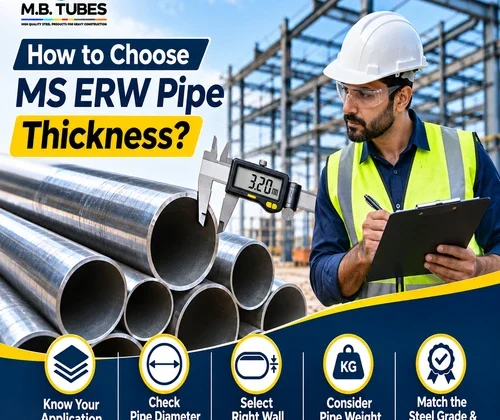
To choose the right MS ERW Pipe Thickness, first identify where the pipe will be used. Then check its outside diameter, expected loads, required strength, steel grade and applicable project standards. Compare available wall thickness options and confirm the final specification against engineering requirements.
Remember: A thicker pipe is not automatically the best pipe. The correct thickness is the one that meets your project’s requirements without unnecessary material use.
What Is MS ERW Pipe Thickness?
MS ERW Pipe stands for Mild Steel Electric Resistance Welded Pipe. It is manufactured by forming steel strip into a tubular shape and joining its edges through electric resistance welding.
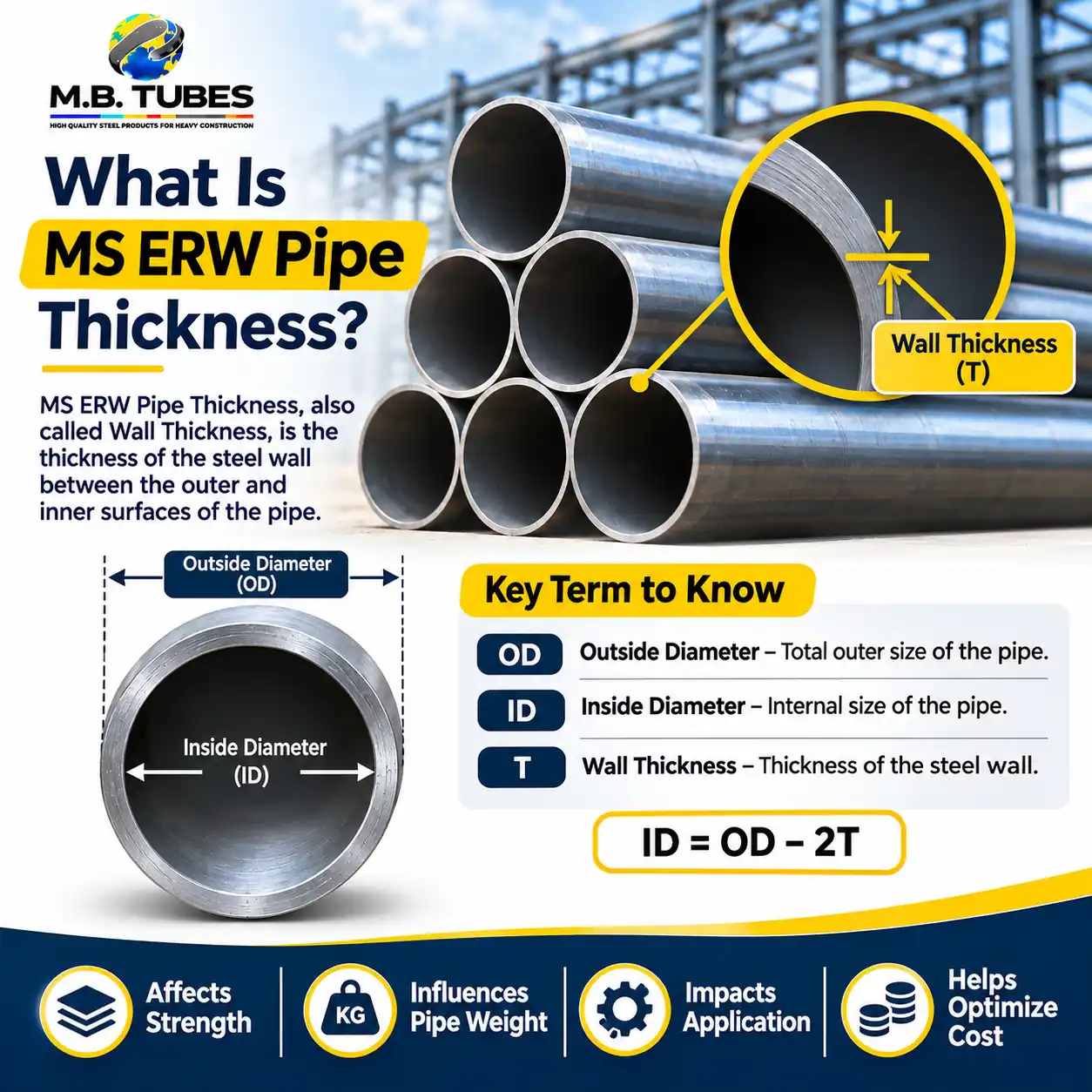
Pipe thickness, also called wall thickness, refers to the thickness of the steel material between the outer and inner surfaces of the pipe.
For example, a pipe may have:
- Outside Diameter (OD): 48.3 mm
- Wall Thickness: 3.2 mm
- Length: 6 metres
Here, 3.2 mm represents the nominal wall thickness.
Two pipes can have the same outside diameter but different wall thicknesses, resulting in different weights and structural properties.
Why Does MS ERW Pipe Thickness Matter?
Wall thickness influences several important aspects of pipe performance.
Strength and load resistance: Depending on the application, thickness affects the pipe’s resistance to bending, compression and other forces.
Material weight: Increasing wall thickness generally increases steel consumption and pipe weight when the outside diameter remains unchanged.
Fabrication: Thickness can influence cutting, drilling, welding procedures and handling requirements.
Project cost: A thicker pipe usually requires more steel, which can increase material and transportation costs.
Service suitability: For pipes carrying fluids, wall thickness must also account for pressure, temperature, corrosion allowance and applicable specifications.
The objective is to select a pipe that meets the required performance criteria rather than choosing thickness based on appearance or price alone.
How to Choose MS ERW Pipe Thickness: Step by Step
1. Identify the Application
Start by understanding the purpose of the pipe.
MS ERW pipes are commonly used in:
- Construction and structural frameworks
- Scaffolding systems
- Industrial sheds and warehouses
- Fabrication and engineering projects
- Fencing, gates and boundary structures
- Machinery and equipment support frames
Each application has different loading and performance requirements.
For example, a pipe used for a decorative gate may have different thickness requirements from one used in a structural framework.
Selection tip: Identify the actual working conditions before comparing pipe sizes.
2. Check the Outside Diameter
Outside Diameter (OD) and wall thickness are two different specifications.
A pipe with a larger outside diameter is not necessarily suitable for every heavier-duty application. Its performance depends on the combination of diameter, thickness, steel grade, unsupported length and loading conditions.
For a round pipe:
ID=OD-2T
Where:
- ID = Inside Diameter
- OD = Outside Diameter
- T = Wall Thickness
For example:
Specification | Pipe A | Pipe B |
Outside Diameter | 48.3 mm | 48.3 mm |
Wall Thickness | 2.5 mm | 3.2 mm |
Calculated Inside Diameter | 43.3 mm | 41.9 mm |
Both pipes have the same outside diameter, but their internal dimensions and steel quantities differ.
3. Evaluate the Load Requirements
One of the most important factors in selecting MS ERW Pipe Thickness is understanding the expected load.
Consider whether the pipe will experience:
- Axial compression or tension
- Bending forces
- Impact or vibration
- Repeated loading
- Internal pressure, where applicable
For structural applications, thickness selection must also account for member length, connections, buckling, lateral support and the overall structural design.
Important: Wall thickness alone cannot establish the safe load capacity of a pipe. Final selection for load-bearing applications should follow approved engineering calculations and relevant standards.
4. Understand How Thickness Affects Pipe Weight
Thickness directly affects the approximate weight of an MS ERW pipe.
For a round mild steel pipe, a commonly used theoretical weight formula is:
Weight(kg/m)=0.02466T(OD-T)
Here, OD and T are measured in millimetres.
Consider two pipes with an outside diameter of 48.3 mm:
Wall Thickness | Approx. Weight per Metre | Approx. Weight for 6 m |
2.5 mm | 2.82 kg | 16.94 kg |
3.2 mm | 3.56 kg | 21.36 kg |
4.0 mm | 4.37 kg | 26.22 kg |
Illustrative theoretical weights based on mild steel density. Actual product weights can vary because of manufacturing tolerances and specifications.
This comparison demonstrates why even a small increase in thickness can significantly affect bulk procurement weight.
5. Check the Steel Grade and Applicable Standard
Two pipes with identical dimensions may have different mechanical properties if their steel grades differ.
Before finalizing an order, confirm:
- Required material grade
- Applicable Indian or project standard
- Nominal wall thickness
- Permitted dimensional tolerances
- Testing and inspection requirements
- Surface finish or protective coating
For example, different construction and structural pipe applications may refer to standards such as IS 1161 or IS 4923, depending on the product type and intended use.
Always confirm the correct specification for the actual application rather than assuming one standard applies to every MS ERW pipe.
Does a Thicker MS ERW Pipe Always Mean Better Performance?
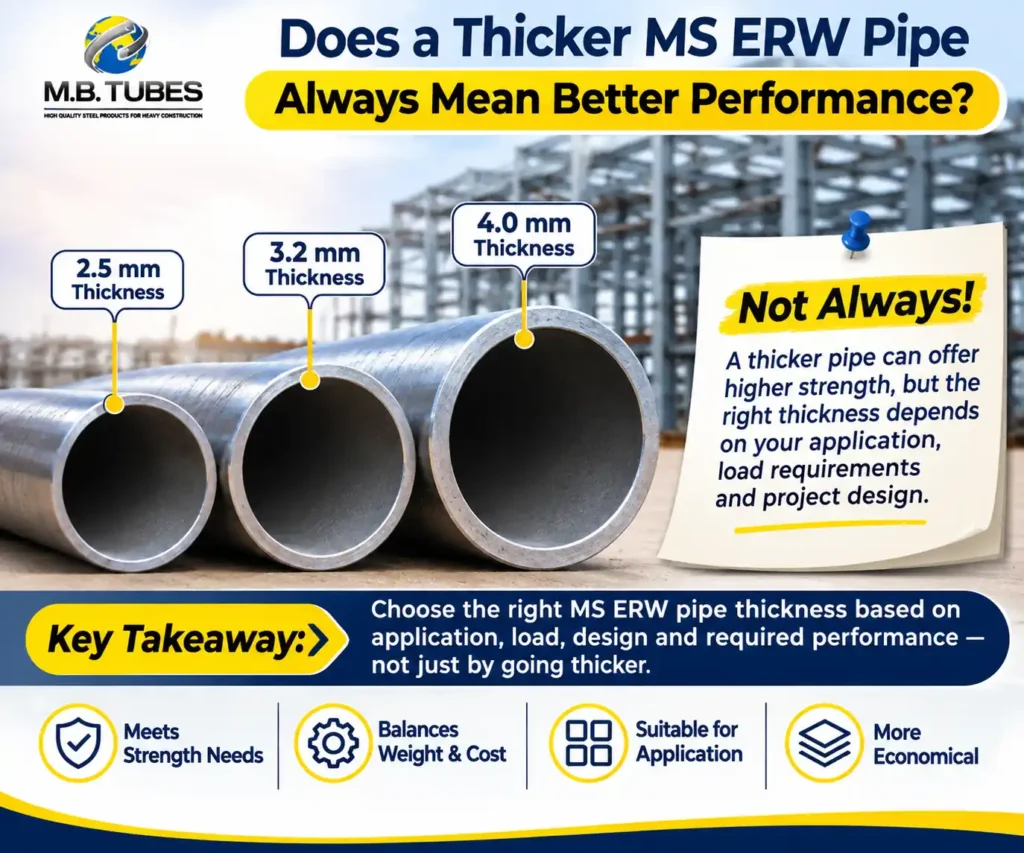
Not necessarily.
Increasing thickness generally increases the steel cross-sectional area, but suitability depends on the complete design.
A thicker pipe may increase weight, transportation requirements and fabrication costs without providing a useful advantage for a particular application.
On the other hand, choosing a thinner pipe simply to reduce cost may result in a product that does not meet project requirements.
A better approach is:
Application → Engineering Requirements → Pipe Diameter → Steel Grade → Wall Thickness → Weight and Cost
This process helps balance technical suitability and procurement efficiency.
Common Mistakes When Selecting MS ERW Pipe Thickness
Buyers sometimes make decisions using only the quoted price or outside diameter.
Avoid these common mistakes:
Comparing different specifications: Always compare pipes with matching diameter, grade, length and finish before evaluating prices.
Ignoring thickness tolerances: Nominal thickness and actual measured thickness may differ within the permitted manufacturing tolerance.
Confusing pipe weight with load capacity: Weight is useful for estimating material quantities, but it does not determine safe structural performance on its own.
Ignoring environmental conditions: Outdoor and industrial environments may require suitable protective finishes or corrosion allowances.
Ordering without drawings: For structural applications, approved drawings and specifications should guide the final selection.
MS ERW Pipe Thickness Checklist Before Ordering
Use this checklist when requesting a quotation.
Parameter | What to Confirm |
Application | Construction, scaffolding, fabrication or industrial use |
Outside Diameter | Required OD in millimetres |
Wall Thickness | Required nominal thickness in millimetres |
Steel Grade | As per project specification |
Length | Required length per pipe |
Quantity | Number of pipes or total metres |
Surface Finish | Black, painted, galvanized or specified finish |
Testing | Applicable quality and inspection requirements |
Delivery | Project location and required schedule |
Providing these details helps suppliers prepare more accurate quotations and reduces the risk of ordering unsuitable material.
MS ERW Pipes from Khambati Steel & M.B. Tubes
Khambati Steel & M.B. Tubes offers steel pipe and tube solutions for construction, industrial and fabrication requirements.
Its product range includes MS ERW pipes, structural steel tubes, round pipes and square and rectangular hollow sections.
When planning a bulk requirement, buyers should share the required outside diameter, wall thickness, grade, length, quantity and application so that available products can be matched with project specifications.
Conclusion
Choosing the right MS ERW Pipe Thickness requires a balance between technical performance, material weight, fabrication needs and project cost.
Rather than selecting the thickest or cheapest pipe, focus on the specification that matches the intended application and engineering requirements.
For construction, industrial and fabrication projects, Khambati Steel & M.B. Tubes can help buyers identify available MS ERW pipe options based on their required dimensions and specifications.
The right pipe selection begins with accurate requirements—not guesswork.
Frequently Asked Questions (FAQs)
What is the standard thickness of an MS ERW pipe?
MS ERW pipes are manufactured in different wall thicknesses depending on their outside diameter, product standard and application. There is no single standard thickness suitable for every project. Buyers should refer to the required product specification and approved drawings before choosing a thickness.
Is a 3 mm MS ERW pipe suitable for construction?
A 3 mm wall thickness may be suitable for certain construction and fabrication applications, but suitability cannot be determined from thickness alone. Outside diameter, steel grade, member length, loading, connections and structural design must also be evaluated.
How does MS ERW pipe thickness affect weight?
When outside diameter and length remain the same, increasing wall thickness generally increases the amount of steel and the pipe’s weight. Theoretical weight can be estimated using the round steel pipe weight formula, although actual weights may vary.
Can MS ERW pipe thickness affect welding?
Yes. Wall thickness influences welding preparation, heat input, procedure selection and fabrication requirements. Suitable welding procedures should be chosen based on the pipe material, thickness, joint design and intended application.
How do I choose MS ERW pipe thickness for bulk orders?
Start with the approved project specifications. Confirm outside diameter, wall thickness, steel grade, length, surface finish and required quantity. For structural or pressure applications, obtain engineering confirmation before finalizing the order.