
Industrial projects depend on materials that can deliver strength, consistency, durability, and reliable performance over time. Whether the project involves a manufacturing facility, warehouse, industrial shed, fabrication unit, infrastructure development, or structural framework, the quality of the steel components can directly influence the performance of the finished structure.
Among these materials, Mild Steel (MS) pipes are widely used because of their practical combination of strength, fabrication flexibility, availability, and versatility.
However, selecting an MS pipe should not be based only on size or price. For demanding industrial applications, pipe quality matters just as much as pipe specification.
High-quality MS pipes can contribute to structural stability, easier fabrication, better dimensional consistency, and longer-lasting industrial installations. Understanding these factors can help contractors, fabricators, engineers, and procurement teams make more informed purchasing decisions.
What Are MS Pipes?
MS pipes are steel pipes manufactured using mild steel, a low-carbon steel valued for its balance of strength, workability, and fabrication flexibility.
Because mild steel can be cut, welded, formed, and fabricated into different configurations, MS pipes are suitable for a broad range of industrial and construction requirements.
Depending on the required specification and application, they may be used for:
- Industrial structures
- Factory construction
- Warehouse frameworks
- Engineering fabrication
- Support structures
- General construction
- Machinery-related fabrication
- Structural frameworks
- Industrial sheds
- Infrastructure projects
Their versatility makes MS pipes an important material across multiple sectors. But for critical projects, choosing the correct dimensions alone is not enough. Material consistency and manufacturing quality should also be carefully evaluated.
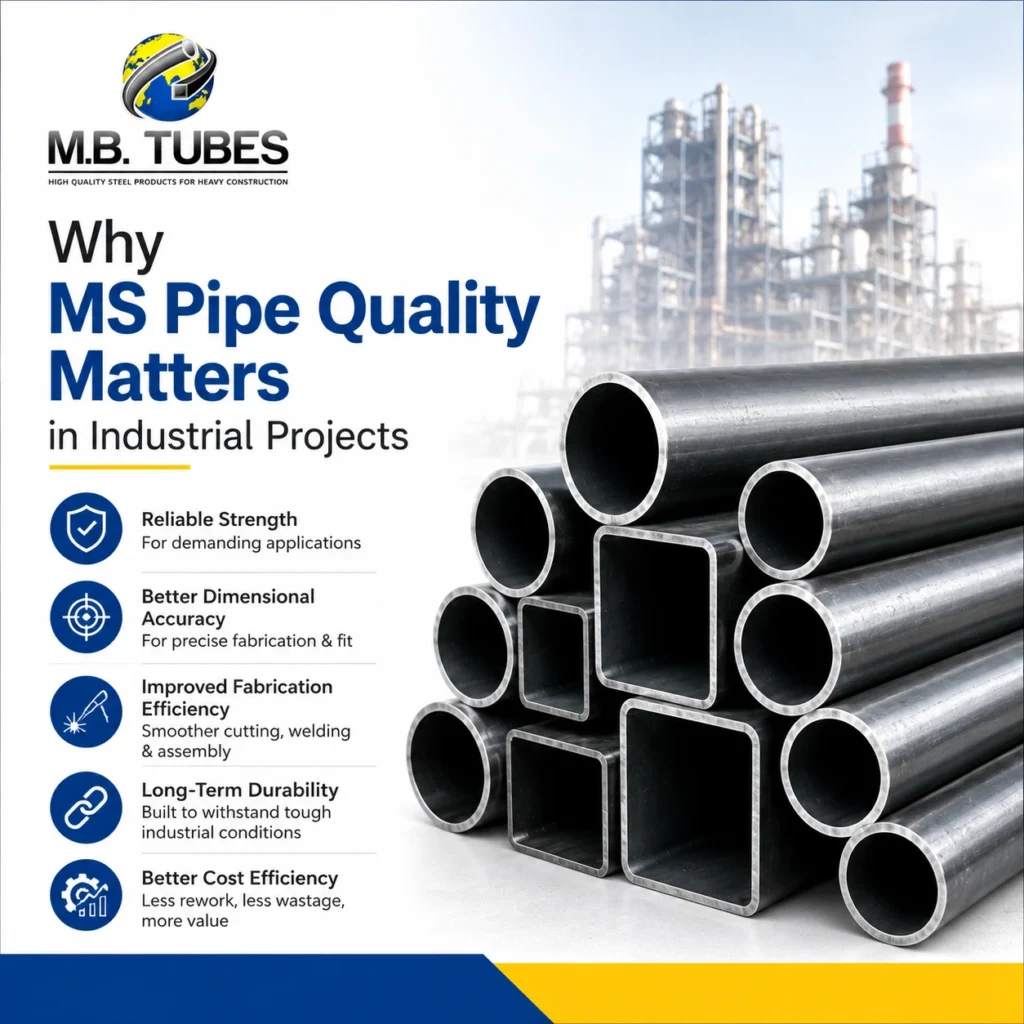
Why MS Pipe Quality Matters in Industrial Projects
An industrial project may be expected to operate for many years while dealing with loads, vibration, environmental exposure, fabrication stresses, and continuous operational demands.
Using inconsistent or unsuitable steel pipes can potentially create problems during fabrication, installation, or long-term use.
High-quality MS pipes help provide a more dependable starting material for engineers and fabricators. Consistent dimensions, appropriate material properties, good surface condition, and reliable manufacturing all make it easier to use the pipe according to the project’s engineering requirements.
Here are some of the major reasons quality should be a priority.
1. Reliable Strength for Demanding Applications
Strength is one of the primary considerations when selecting steel products for industrial applications.
MS pipes can become part of frameworks, supports, fabricated assemblies, equipment structures, sheds, and other applications where loads must be handled safely.
The required pipe should therefore be selected according to factors such as:
- Outside diameter
- Wall thickness
- Grade
- Length
- Loading conditions
- Fabrication requirements
- Intended application
High-quality manufacturing helps maintain greater consistency across these characteristics.
It is important to remember that the required load-bearing performance should always be determined through appropriate engineering calculations rather than assuming that every MS pipe can handle the same load.
2. Better Dimensional Accuracy
Industrial fabrication frequently involves multiple components that must fit together accurately.
Variations in pipe diameter, wall thickness, straightness, or length can make fabrication more difficult. Even relatively small inconsistencies may require additional adjustments during cutting, welding, fitting, and assembly.
Quality MS pipes manufactured with good dimensional control can help fabricators achieve:
Better fitting: Components can be aligned more accurately during fabrication.
Consistent assembly: Standardised dimensions make repetitive fabrication easier.
Reduced rework: Correct dimensions can decrease unnecessary modifications at the fabrication stage.
Improved project efficiency: Predictable material dimensions make planning and execution more manageable.
For large industrial projects involving substantial quantities of pipes, consistency becomes particularly important.
3. Improved Fabrication Efficiency
MS pipes are frequently selected because mild steel offers excellent fabrication flexibility.
Industrial fabricators may need to:
- Cut pipes to specific lengths
- Weld different sections
- Drill or machine components
- Form fabricated assemblies
- Connect pipes with structural components
- Apply protective finishes
When material quality is consistent, these operations can become easier to control.
For example, consistent wall thickness can assist with welding preparation and fabrication planning, while proper straightness can simplify alignment.
Better raw material does not eliminate the need for skilled fabrication, but it provides fabricators with a more reliable foundation for producing accurate components.
4. Long-Term Durability
Industrial buyers should consider more than the initial purchase cost of MS pipes.
The real value of a material becomes clearer throughout the operating life of the project.
Poor material selection can potentially contribute to premature deterioration, maintenance requirements, replacement costs, or operational disruption.
Quality MS pipes, when correctly specified, fabricated, installed, protected, and maintained, can provide dependable long-term service.
Environmental conditions must also be considered. Mild steel can be susceptible to corrosion when exposed to moisture or aggressive environments. Suitable surface preparation, coatings, painting, galvanizing where appropriate, or other corrosion-protection systems may therefore be required.
The correct protection method should be selected according to the actual service environment.
5. Consistency Across Large Industrial Requirements
Industrial projects frequently require steel pipes in substantial quantities.
In such situations, consistency between individual pipes becomes extremely important.
Imagine a fabrication project where pipes from different batches have noticeable variations in dimensions or quality. Fabricators may need to spend additional time checking, sorting, adjusting, or reworking materials.
Consistent MS pipe supply can help improve:
- Material planning
- Fabrication accuracy
- Installation workflow
- Quality control
- Inventory management
- Project scheduling
For procurement teams, dependable product consistency can therefore be as important as competitive pricing.
6. Suitable for a Wide Range of Industrial Applications
One of the biggest advantages of MS pipes is versatility.
The same basic material category can support numerous industrial applications when the correct size, thickness, grade, and specification are selected.
Industrial Buildings
MS pipes can be incorporated into structural and fabricated components used in factories, warehouses, workshops, and industrial sheds.
Engineering & Fabrication
Fabricators use MS pipes to manufacture frames, supports, assemblies, equipment structures, and customised steel components.
Construction Projects
MS pipes can be used in various structural and general construction applications according to project specifications.
Infrastructure
Depending on engineering requirements, MS pipes can form part of supporting structures and fabricated components used in infrastructure development.
Manufacturing Facilities
Factories may require MS pipes for fabricated frameworks, equipment-support structures, maintenance projects, and general engineering applications.
This versatility can simplify procurement when businesses work with a supplier capable of providing multiple steel products for different project requirements.
7. Better Project Cost Efficiency
Choosing the cheapest available pipe does not necessarily result in the lowest overall project cost.
Industrial procurement should consider total project value, not simply material price per unit.
Poor dimensional consistency, unsuitable material, excessive rework, fabrication difficulties, delays, and early replacement can all increase costs.
High-quality MS pipes can potentially contribute to better cost efficiency through:
- Reduced fabrication corrections
- More predictable installation
- Better material utilisation
- Lower unnecessary wastage
- Reduced rework
- Reliable long-term performance
For large industrial projects, even small improvements in fabrication and material efficiency can become significant when multiplied across hundreds or thousands of components.
8. Quality Supports Safer Engineering
Safety is fundamental in industrial and structural projects.
Steel pipes used as part of load-bearing or safety-critical structures should always be selected according to appropriate engineering designs, applicable standards, project specifications, and expected service conditions.
Material quality is one part of that process.
Engineers and procurement teams should verify important characteristics such as:
- Material grade
- Pipe dimensions
- Wall thickness
- Manufacturing quality
- Surface condition
- Applicable standards
- Required testing or documentation
- Suitability for the intended application
Quality should never be treated as a substitute for engineering design. Instead, quality materials and proper engineering should work together.
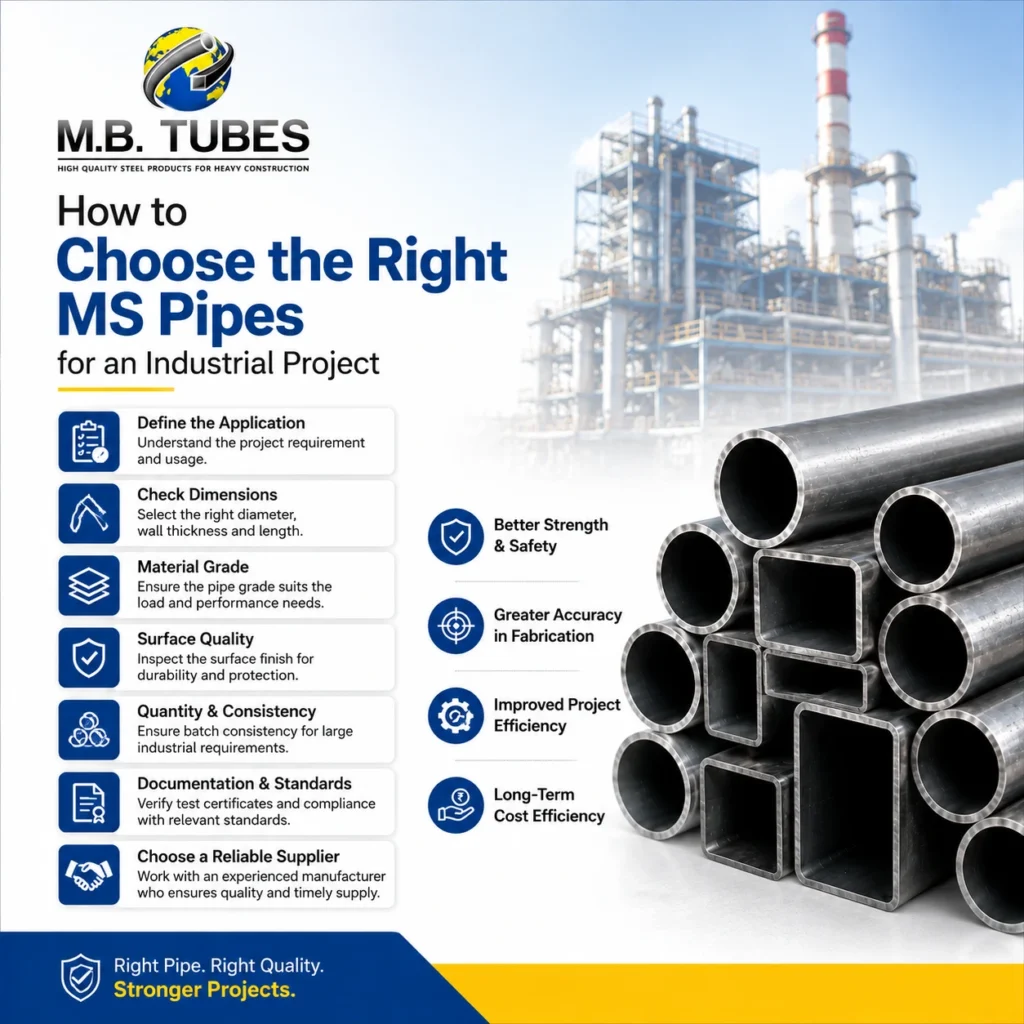
How to Choose the Right MS Pipes for an Industrial Project
Before placing an order, buyers should clearly define the project’s technical requirements.
Start by determining the intended application. A pipe used for general fabrication may have different requirements from one intended for a structural or heavy-duty application.
Next, evaluate the required dimensions and specifications.
Important considerations include:
Diameter: Select the appropriate outside diameter according to the design.
Wall Thickness: Thickness should match structural and application requirements.
Material Grade: Confirm the required mild steel grade or project specification.
Length: Standard or customised lengths may influence fabrication efficiency.
Surface Condition: Check whether additional surface treatment or corrosion protection will be required.
Quantity: Large projects should consider batch consistency and supply planning.
Documentation: Where applicable, request relevant material or quality documentation.
Technical specifications should always be finalised by qualified project professionals.
Quality Checks Buyers Should Consider
Before accepting MS pipes for an important industrial project, a practical inspection process can help identify obvious inconsistencies.
Buyers may evaluate:
Dimensional Consistency
Check diameter, thickness, length, and other specified dimensions.
Straightness
Excessive bending or deformation can affect fabrication and installation.
Surface Quality
Inspect the material for significant defects or damage that could affect its intended use.
Weld Quality
For welded pipes, the weld should be evaluated according to the required manufacturing and project specifications.
Material Documentation
For projects requiring documented material properties or standards compliance, verify the appropriate certificates or records.
Application Suitability
Most importantly, confirm that the selected pipe specification is suitable for its actual engineering application.
These checks help shift procurement decisions away from price alone and toward overall project performance.
High-Quality MS Pipes and Project Productivity
Material quality can also influence how efficiently a project moves from procurement to fabrication and installation.
Consistent pipes are easier to measure, plan, cut, align, and assemble. This can reduce unnecessary interruptions during fabrication.
For industrial contractors working under tight schedules, predictability has real value.
When materials arrive according to the required specifications, teams can focus more effectively on execution rather than correcting avoidable material inconsistencies.
This is why procurement, engineering, fabrication, and quality-control teams should work together when selecting industrial steel products.
Why Supplier Selection Is Equally Important
Selecting the correct MS pipe specification is only one part of the purchasing process. Choosing a reliable manufacturer or supplier is equally important.
A professional steel supplier should be able to understand industrial requirements and provide products according to clearly defined specifications.
Buyers should look for a supplier that prioritises:
- Consistent material quality
- Dimensional accuracy
- Appropriate quality inspection
- Product availability
- Technical understanding
- Reliable communication
- Timely supply
- Multiple industrial steel solutions
For recurring industrial requirements, developing a dependable supply relationship can also make procurement and project planning more efficient.
Khambati Steel & MB Tubes – MS Pipe Solutions for Industrial Requirements
Khambati Steel & MB Tubes provides steel pipes and tubes for industrial, construction, fabrication, and structural applications.
With a product portfolio that also includes structural steel, scaffolding systems, roofing solutions, and other steel products, the company serves diverse requirements across construction and industrial projects.
The focus on material selection, dimensional accuracy, quality inspection, strength, and reliable supply helps businesses source steel products according to their project requirements.
For contractors, fabricators, infrastructure developers, and industrial buyers searching for an MS Pipe Manufacturer in Madhya Pradesh, working with a supplier that understands both product quality and industrial applications can make procurement more dependable.
Final Thoughts
MS pipes may appear to be a straightforward industrial material, but their quality can influence multiple stages of a project—from fabrication and installation to maintenance and long-term performance.
The right MS pipe should provide more than basic dimensions. It should offer consistent manufacturing, appropriate material properties, reliable fabrication characteristics, and suitability for the intended application.
For industrial buyers, the key is to avoid making decisions based solely on the lowest purchase price.
Instead, evaluate the complete picture:
Material Quality + Correct Specification + Reliable Manufacturing + Proper Engineering + Suitable Protection = Better Project Performance
Investing in properly specified, high-quality MS pipes can help industrial projects achieve greater consistency, efficiency, reliability, and long-term value.
Frequently Asked Questions (FAQs)
1. Why are high-quality MS pipes important for industrial projects?
High-quality MS pipes provide better strength, durability, dimensional accuracy, and reliable performance in industrial applications. They help ensure smoother fabrication, improved structural stability, and long-term project efficiency.
2. What are MS pipes commonly used for in industrial applications?
MS pipes are widely used in industrial sheds, factory structures, fabrication work, construction projects, machinery support systems, infrastructure applications, and various structural frameworks.
3. How do high-quality MS pipes improve project performance?
Quality MS pipes offer consistent dimensions, better fabrication flexibility, improved load-handling capability, and reduced chances of material-related issues during installation and operation.
4. What factors should be considered while selecting MS pipes for industrial use?
Important factors include pipe diameter, wall thickness, material grade, application requirements, surface condition, load requirements, and compliance with project specifications.
5. Are MS pipes suitable for heavy-duty industrial applications?
Yes, MS pipes are suitable for many heavy-duty industrial applications when the correct size, thickness, and specification are selected according to engineering requirements.