
A warehouse roof does far more than cover a building. It protects inventory, machinery, electrical systems, workers, and day-to-day operations from India’s heat, monsoon rain, wind, dust, and changing weather conditions.
For warehouse owners, developers, contractors, and industrial project planners, choosing a roofing material purely on initial price can become expensive over the building’s lifetime. The right solution should balance structural requirements, corrosion protection, thermal performance, drainage, maintenance, installation quality, and overall lifecycle cost.
Whether you are developing a logistics facility, manufacturing warehouse, storage shed, distribution centre, or industrial building, working with an experienced Warehouse Roofing Solutions Manufacturer in Madhya Pradesh can help you select roofing specifications that match the actual project environment.
Why Warehouse Roofing Requires a Different Approach
A warehouse can have thousands of square metres of roof exposed continuously to the environment. A small weakness in material selection or installation can therefore become a much larger operational problem.
Industrial roofs commonly need to manage:
- High summer temperatures
- Intense monsoon rainfall
- Wind loads
- Dust and industrial pollutants
- Moisture and condensation
- Large roof spans
- Thermal expansion and contraction
- Long operating cycles
- Maintenance access
- Solar panel or rooftop equipment requirements
The best roofing material is consequently not the same for every warehouse.
A dry-storage warehouse and a temperature-controlled facility, for example, can have completely different roofing priorities.
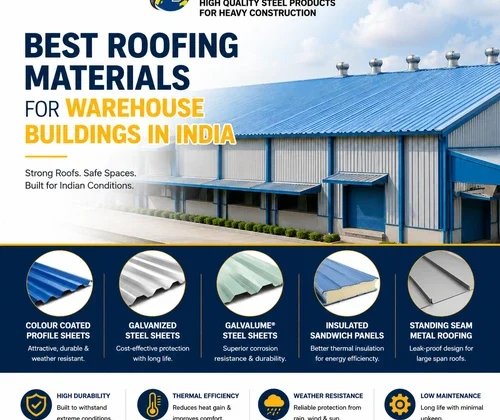
Best Roofing Materials for Warehouse Buildings in India
Let’s examine the major options and where each one can make sense.
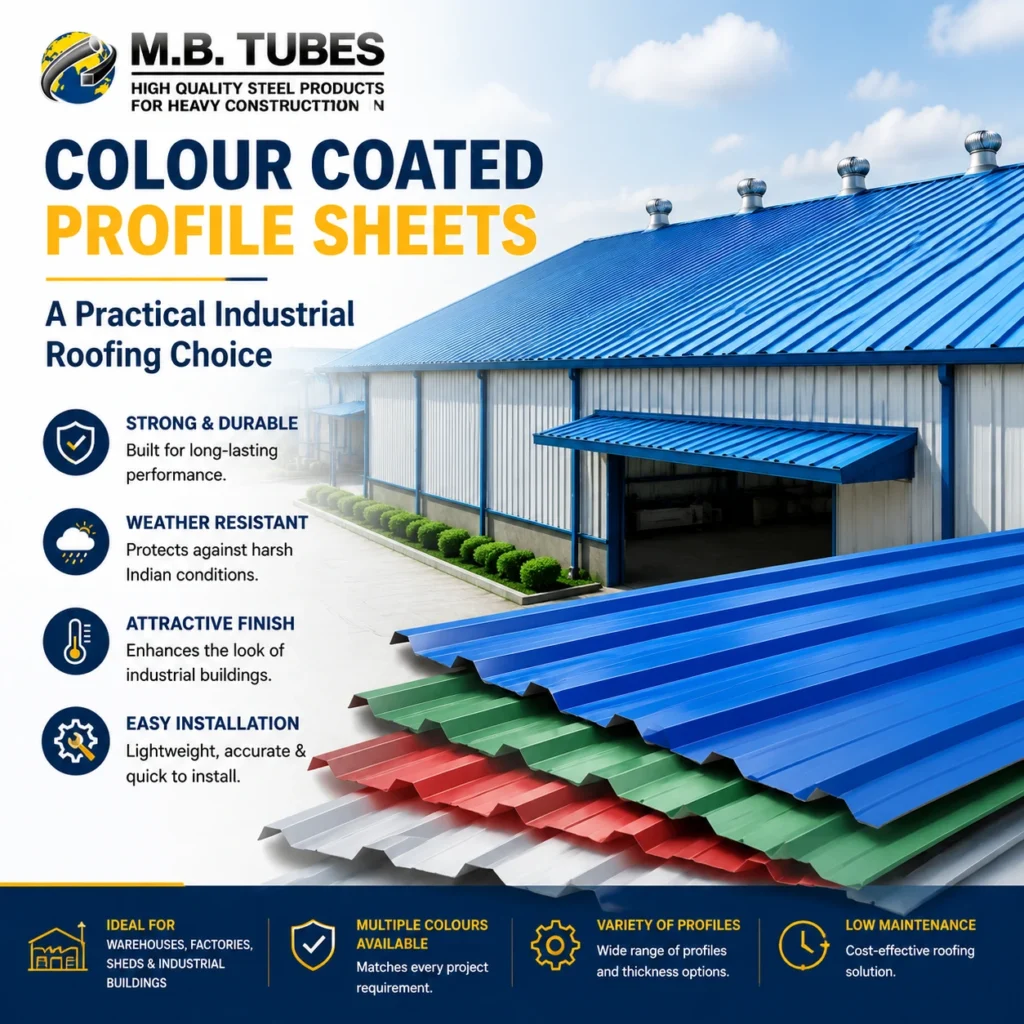
1. Colour Coated Profile Sheets – A Practical Industrial Roofing Choice
Colour coated profile sheets are among the most widely considered options for warehouses, factories, workshops, and industrial sheds.
These sheets typically use a metal substrate with protective metallic and paint coating systems. Their profiled shape provides rigidity while also creating channels for rainwater movement.
Why warehouses use profile sheets
They can offer:
- Relatively low structural weight
- Fast installation
- Large-area roof coverage
- Multiple profile options
- Attractive industrial appearance
- Different thickness and coating specifications
- Good weather protection when correctly specified and installed
Profile roofing is particularly practical for projects where speed, functionality, and lifecycle economics need to be balanced.
However, buyers should not judge sheets only by colour or appearance. Base metal specification, coating system, thickness, profile geometry, fasteners, flashings, and installation quality all influence actual performance.
2. Galvanized Steel Roofing Sheets – Functional and Versatile
Galvanized steel sheets use a zinc-based protective coating to help protect the underlying steel against corrosion.
They have long been used across industrial and agricultural construction because they are functional, relatively lightweight, and available in several profiles.
Suitable applications may include:
- General storage warehouses
- Industrial sheds
- Workshops
- Utility structures
- Agricultural storage buildings
The required coating specification should be selected according to the exposure environment. Warehouses in aggressive industrial or high-moisture environments may require a different protection strategy from buildings in relatively mild inland conditions.
3. Galvalume-Type Roofing – Enhanced Corrosion Protection Options
Aluminium-zinc alloy coated steel sheets are another popular category for industrial roofing.
The metallic coating is designed to provide protection to the steel substrate and can offer strong long-term performance when matched to an appropriate environment and installation system.
These sheets are frequently considered for:
- Large industrial warehouses
- Logistics facilities
- Manufacturing plants
- Distribution centres
- Pre-engineered buildings
The actual service life still depends on coating mass, environment, sheet specification, detailing, handling, installation, and maintenance.
No coating should be treated as universally maintenance-free.
4. Insulated Sandwich Panels – When Temperature Control Matters
Some warehouses require much more than basic rain protection.
Cold storage facilities, food warehouses, pharmaceutical storage, temperature-sensitive logistics centres, and certain manufacturing facilities may need better thermal control.
Insulated sandwich roof panels typically combine metal outer layers with an insulating core.
Depending on the system, insulation materials may include options such as PIR, PUR, mineral wool, or other engineered cores.
Potential benefits include:
- Improved thermal insulation
- Better indoor temperature management
- Reduced external heat transfer
- Cleaner finished appearance
- Integrated roof-and-insulation solution
Their higher initial cost may be justified where energy performance and internal temperature conditions are important operational considerations.
Fire performance, insulation type, joint design, and applicable building requirements should be carefully evaluated.
5. Standing Seam Metal Roofing – For Large and Performance-Focused Roofs
Standing seam systems use raised interlocking seams, often with concealed fastening arrangements.
They can be useful for large industrial roofs where designers want to reduce exposed roof penetrations and accommodate thermal movement through the roofing system.
Why they are considered
A properly designed system can provide:
- Clean roof appearance
- Efficient water shedding
- Reduced exposed fasteners
- Accommodation of thermal movement
- Suitability for long roof runs
Standing seam roofing usually requires specialist design and installation, so workmanship becomes particularly important.
Quick Comparison of Warehouse Roofing Materials
| Roofing Material | Key Advantage | Commonly Considered For |
|---|---|---|
| Colour Coated Profile Sheet | Practical balance of performance and appearance | General industrial warehouses |
| Galvanized Steel Sheet | Functional and economical roofing | Storage and utility buildings |
| Aluminium-Zinc Coated Steel | Enhanced metallic coating protection | Large industrial facilities |
| Insulated Sandwich Panel | Thermal performance | Temperature-sensitive warehouses |
| Standing Seam System | Concealed fastening and large roof applications | Premium/large industrial roofs |
This comparison is only a starting point. Final specifications should be based on structural design, climate, building use, fire requirements, and project-specific engineering.
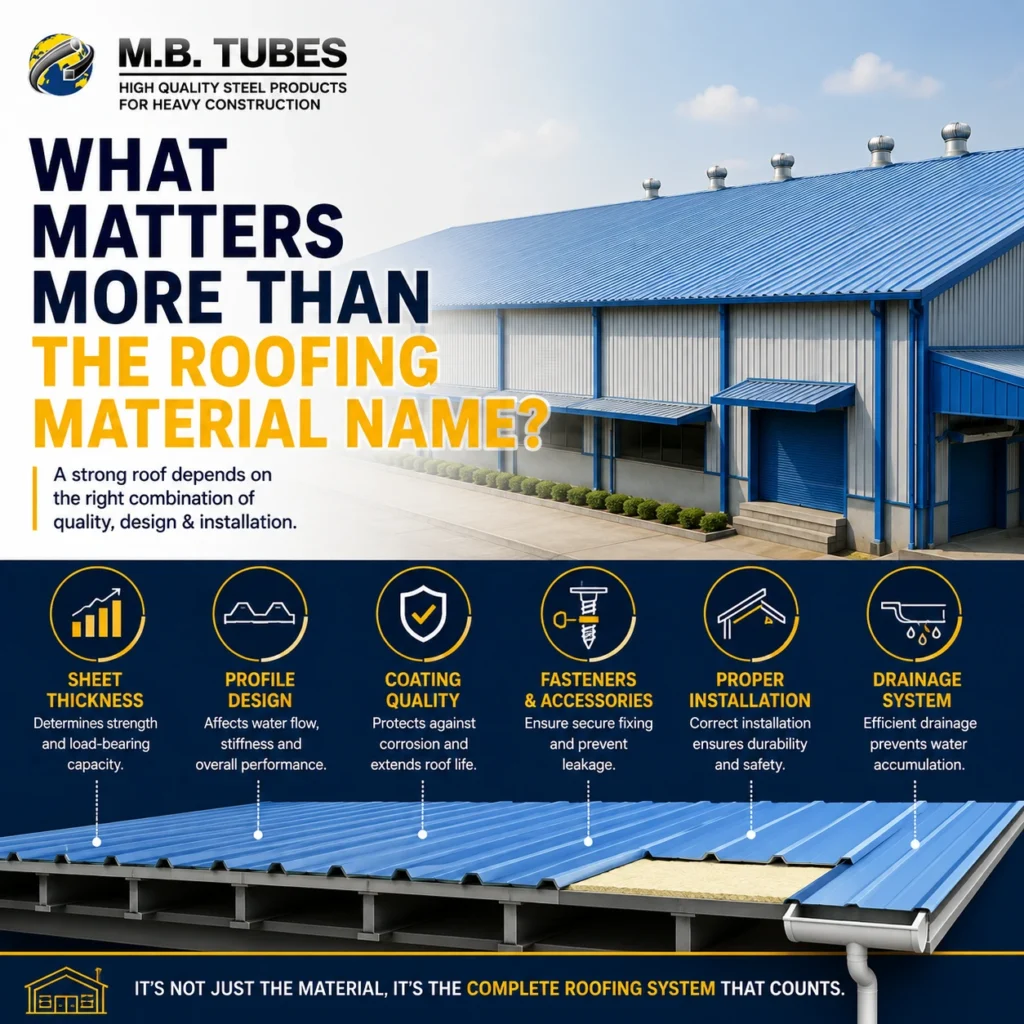
What Matters More Than the Roofing Material Name?
Two warehouses can use the same general type of roofing sheet and still experience very different results.
Why?
Because roof performance depends on the complete roofing system, not simply the sheet material.
Sheet Thickness
The selected thickness should be appropriate for the profile, support spacing, design loads, and manufacturer/engineering requirements.
Using an inadequately specified sheet may contribute to excessive deflection, damage, or reduced performance.
But choosing the thickest available sheet without engineering justification is not necessarily the best solution either.
Profile Geometry
Profile depth, rib design, pitch, and geometry influence sheet stiffness, drainage characteristics, and installation behaviour.
A profile appropriate for one building may not automatically be suitable for another.
Coating System
Protective coatings are especially important because warehouse roofs remain exposed for years.
Selection should consider:
- Humidity
- Industrial pollutants
- Local environmental exposure
- Required appearance
- Maintenance expectations
Cut edges, scratches, incompatible materials, and poor installation practices can also affect corrosion performance.
Fasteners and Washers
A premium sheet installed with inappropriate fasteners can still develop problems.
Fasteners should be compatible with the roofing system and installed correctly. Over-tightening, under-tightening, poor alignment, or damaged sealing washers can create potential leakage points.
Flashings and Roof Penetrations
Leaks frequently occur around details rather than in the middle of an intact sheet.
Critical areas include:
- Ridge sections
- Roof edges
- Valleys
- Skylights
- Ventilation openings
- Pipe penetrations
- Gutters
- Junctions with walls
Good detailing is therefore just as important as sheet selection.
India’s Climate Makes Roof Selection More Important
Summer Heat
Metal roofs exposed to direct sunlight can become very hot.
Where indoor comfort or temperature control matters, project designers may consider:
- Appropriate roof colours/coatings
- Insulation
- Ventilation
- Reflective systems
- Insulated panels
The appropriate strategy depends on building use and energy requirements.
Heavy Monsoon Rain
Warehouse roofs must remove large volumes of rainwater efficiently.
Roof slope, profile geometry, gutter capacity, downpipes, overlaps, and drainage design should work together.
Even excellent roofing material cannot compensate for an inadequate drainage system.
Wind Conditions
Industrial buildings with large roof areas can experience significant wind pressures, including uplift forces.
Roofing sheets, purlins, fasteners, edge zones, and structural connections need to be designed for the project’s applicable wind conditions.
This is an engineering issue—not something that should be estimated visually on site.
Should You Choose the Cheapest Roofing Sheet?
Usually, comparing only the purchase price per square metre gives an incomplete picture.
Consider two roofing options.
The first costs less initially but requires more repairs, experiences premature coating deterioration, or causes repeated leakage issues.
The second has a higher upfront cost but provides more reliable performance and lower maintenance.
The cheaper quotation may therefore become the more expensive roof.
A better comparison considers lifecycle value, including:
Material + Installation + Maintenance + Repair + Operational Disruption + Expected Service Life
For a warehouse protecting valuable inventory, avoiding operational disruption can be especially important.
How to Select Roofing for Different Warehouse Types
General Storage Warehouse
Priorities usually include weather protection, durability, economical installation, and manageable maintenance.
Colour coated or metallic-coated profile sheets may be suitable depending on project specifications.
Logistics and Distribution Centre
Large roof areas make installation efficiency, drainage, durability, and maintenance access important considerations.
Manufacturing Warehouse
The internal environment may contain heat, fumes, moisture, or industrial contaminants. Roofing and coating specifications should reflect those exposure conditions.
Food and Pharmaceutical Storage
Temperature, hygiene, condensation, and insulation may become more important. Insulated roofing systems may therefore deserve greater consideration.
Agricultural Warehouse
Cost efficiency, ventilation, weather protection, and corrosion exposure should be evaluated according to what is being stored.
Common Warehouse Roofing Mistakes to Avoid
A good roofing material can still fail prematurely when the overall project is poorly executed.
Common mistakes include:
Selecting Sheets Only by Price
Low initial cost should not override the required technical specification.
Ignoring the Exposure Environment
The same coating specification may not be ideal for every industrial environment.
Poor Storage Before Installation
Roofing sheets can be damaged before installation if they are improperly stacked or exposed to trapped moisture.
Incorrect Fastener Installation
Improper fastening can compromise both sheet performance and water tightness.
Poor Drainage Planning
Undersized or blocked gutters can cause water accumulation and overflow.
Neglecting Maintenance
Leaves, industrial dust, debris, damaged sealants, and loose components should not be allowed to accumulate unnoticed.
How a Warehouse Roofing Solutions Manufacturer in Madhya Pradesh Can Help
Warehouse roofing projects require coordination between material selection, specifications, fabrication, supply, and installation planning.
Working with an experienced Warehouse Roofing Solutions Manufacturer in Madhya Pradesh can help project teams identify appropriate roofing products according to requirements such as:
- Warehouse application
- Roof dimensions
- Required sheet profile
- Thickness specification
- Coating requirements
- Colour options
- Project quantity
- Environmental conditions
- Delivery schedule
For engineered industrial buildings, the final roof design and structural specification should be confirmed by qualified project professionals.
A manufacturer should complement the engineering process—not replace it.
Questions to Ask Before Ordering Warehouse Roofing Sheets
Before finalising your supplier, ask for clarity on these points:
- What base material and coating system are being supplied?
- What is the specified sheet thickness?
- Which profile is recommended for the project?
- What dimensional tolerances apply?
- Which fasteners and accessories are compatible?
- What are the handling and storage requirements?
- Can the supplier fulfil the complete project quantity consistently?
- What technical documentation is available?
- What is the expected delivery schedule?
- Are matching flashings and roofing accessories available?
Clear specifications make quotations easier to compare and reduce misunderstandings during procurement.
Maintenance Can Add Years to Warehouse Roof Performance
Even well-designed industrial roofs benefit from routine inspection.
A practical maintenance programme should check:
- Loose or damaged fasteners
- Scratches and coating damage
- Corrosion-prone areas
- Sealant deterioration
- Flashings
- Gutters and downpipes
- Debris accumulation
- Roof penetrations
- Signs of leakage
- Damaged or deformed sheets
Inspections are especially useful before and after severe weather seasons or whenever unusual damage is suspected.
Early correction of small issues can prevent larger repair requirements later.
Which Roofing Material Is Best for Your Warehouse?
There is no single roofing material that is automatically best for every warehouse in India.
For many conventional industrial warehouses, properly specified colour coated or metallic-coated profile sheets can provide a practical balance between durability, installation speed, appearance, and cost.
Where thermal control is important, insulated roof panels may be more appropriate. For certain large or specialised projects, standing seam systems can offer advantages.
The final choice should be based on:
Building Use + Climate + Structural Design + Roof Geometry + Corrosion Environment + Thermal Requirements + Budget + Maintenance Strategy
That combination matters much more than simply choosing the lowest-priced sheet.
Conclusion
Warehouse roofing is a long-term infrastructure decision.
The roof must protect valuable assets while continuously handling heat, rain, wind, moisture, and operational demands. Choosing an appropriate roofing material—and ensuring the correct thickness, profile, coating, fasteners, drainage, detailing, and installation—is therefore essential.
For businesses planning industrial or logistics facilities, working with a dependable Warehouse Roofing Solutions Manufacturer in Madhya Pradesh can make material selection and procurement more systematic.
The best warehouse roof is not simply the cheapest or thickest one. It is the roofing system correctly specified for the building, environment, and expected service conditions.
Frequently Asked Questions
Which roofing material is commonly used for warehouses in India?
Colour coated and metallic-coated profile sheets are widely considered for industrial warehouses because they combine relatively low weight, rapid installation, weather protection, and practical lifecycle economics. Final selection should match project specifications.
What thickness of roofing sheet is best for a warehouse?
There is no universal thickness suitable for every warehouse. Required thickness depends on profile geometry, purlin spacing, design loads, material properties, roof configuration, and applicable engineering requirements.
Are colour coated profile sheets suitable for industrial warehouses?
Yes, they can be suitable when the base material, coating, thickness, profile, fasteners, and installation system are correctly specified for the building and exposure conditions.
When should insulated roofing panels be considered?
They are particularly useful when temperature control, reduced heat transfer, or specific indoor environmental requirements are important, such as cold storage and temperature-sensitive warehouses.
How do I choose a Warehouse Roofing Solutions Manufacturer in Madhya Pradesh?
Evaluate product specifications, manufacturing consistency, available profiles and coatings, technical documentation, supply capacity, project support, and delivery capability rather than comparing suppliers only on price.