
Choosing construction scaffolding is not simply about comparing prices and placing an order. Scaffolding becomes an important part of the temporary working and support system on many construction sites, so factors such as material quality, load requirements, dimensions, compatibility, installation, durability, and supplier capability all deserve careful consideration.
Whether you are working on a residential development, commercial complex, industrial facility, infrastructure project, or large-scale civil construction, asking the right questions before purchasing scaffolding can help you make a more informed decision.
For contractors and project teams sourcing scaffolding in Central India, working with an experienced Construction Scaffolding Manufacturer in Madhya Pradesh can also simplify procurement, particularly when projects require consistent quantities, different scaffolding components, or repeat supplies.
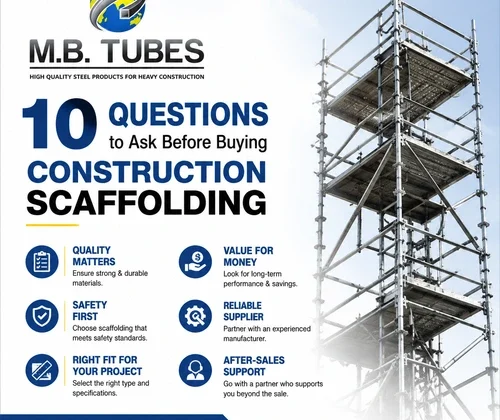
Here are 10 important questions to ask before buying construction scaffolding.
1. What Type of Scaffolding Does My Project Require?
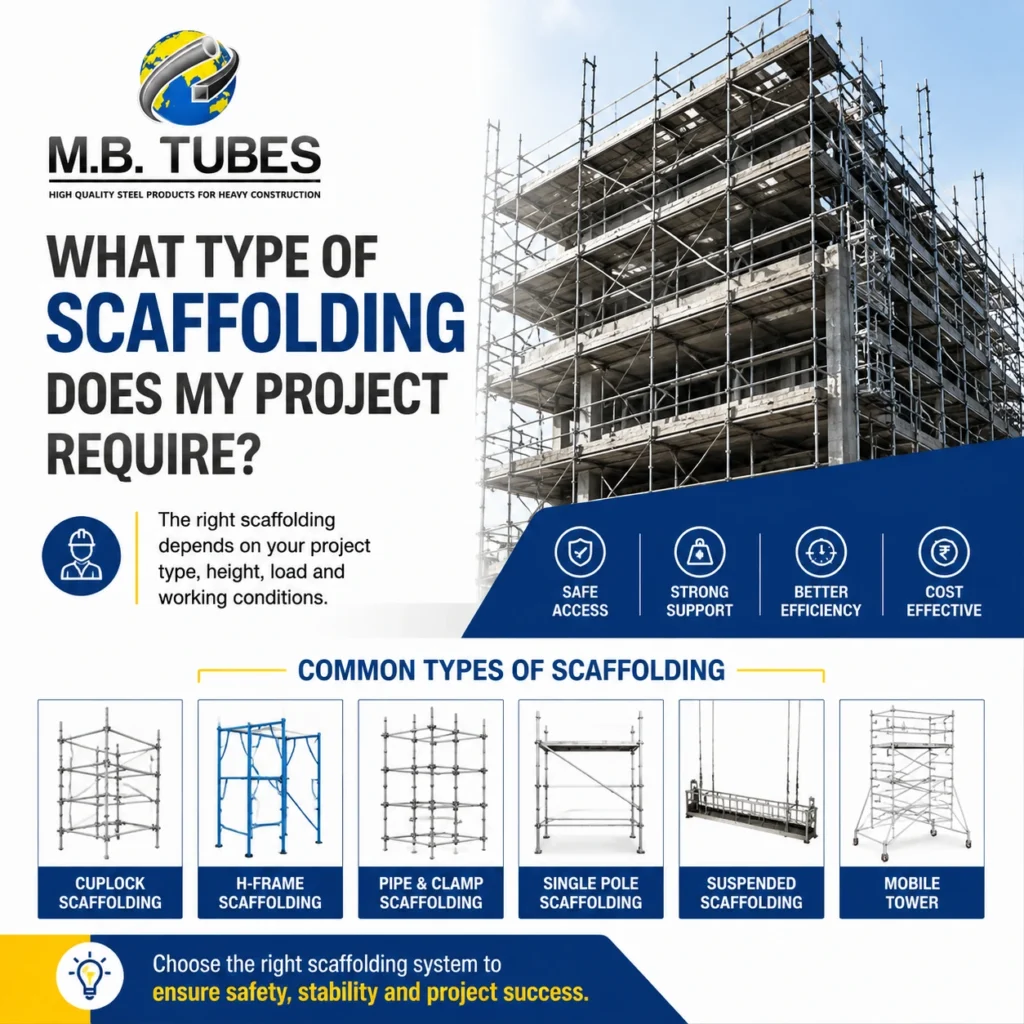
The first question should always be about the application.
Different construction sites can have very different access, working-height, loading, layout, and structural requirements. A scaffolding arrangement suitable for straightforward building work may not necessarily be appropriate for a complex industrial or infrastructure project.
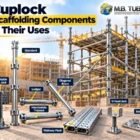
Common scaffolding and supporting components may include:
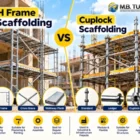
- Cuplock scaffolding
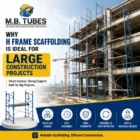
- H-frame scaffolding
- Vertical standards
- Horizontal ledgers
- Adjustable base jacks
- U-head jacks
- Steel props
- Walkways and working platforms
- Bracing and connecting components
Before purchasing, review the project drawings, working conditions, intended use, and engineering requirements.
A manufacturer that understands different construction applications can help you identify available product specifications, but the final scaffolding design and configuration should be determined by competent professionals according to the project requirements.
2. What Material Is Used to Manufacture the Scaffolding?
Material quality is one of the most important factors to evaluate.
Construction scaffolding is repeatedly assembled, dismantled, transported, handled, and exposed to demanding site conditions. Therefore, buyers should understand the material specifications of the components they are purchasing.
Ask the manufacturer about:
- Steel specifications
- Pipe dimensions
- Wall thickness
- Component dimensions
- Manufacturing process
- Surface finish
- Welding quality
- Available technical documentation
Avoid making purchasing decisions based only on the appearance of the scaffolding.
Two components may look similar externally while differing considerably in material specifications, dimensions, fabrication quality, and intended load capacity.
3. What Is the Safe Load Capacity?
Never assume that all scaffolding can support the same load.
Scaffolding may need to accommodate workers, tools, construction materials, platforms, and other loads. The safe working capacity depends on the complete system design, component specifications, configuration, connections, foundations, height, bracing, and several other engineering factors.
Ask for technical information relevant to the specific scaffolding components you intend to purchase.
For load-bearing applications, appropriate engineering verification is essential.
The lowest-priced scaffolding should never be selected at the expense of suitability or safety.
4. Are the Dimensions and Components Consistent?
Dimensional accuracy becomes particularly important when hundreds or thousands of scaffolding components are used across a project.
Poor dimensional consistency can potentially cause difficulties during:
- Assembly
- Alignment
- Connection
- Levelling
- Dismantling
- Reuse
Check whether the manufacturer maintains consistency in important dimensions such as pipe diameter, wall thickness, component length, connection points, and fabricated sections.
For contractors managing multiple sites, standardised and consistent scaffolding components can also make inventory planning and reuse easier.
When evaluating a Construction Scaffolding Manufacturer in Madhya Pradesh, buyers should therefore consider manufacturing consistency alongside price and supply capability.
5. How Good Is the Welding and Fabrication Quality?
Scaffolding components often contain welded joints, connection points, brackets, cups, plates, and other fabricated sections.
The quality of this fabrication matters.
Before purchasing a large quantity, inspect representative samples and pay attention to:
- Weld consistency
- Component alignment
- Joint quality
- Deformation
- Surface condition
- Connection accuracy
- Overall workmanship
Good fabrication contributes to predictable assembly and product consistency.
For major projects, procurement teams may also establish inspection requirements before dispatch.
6. What Surface Protection Is Available?
Construction scaffolding frequently operates in outdoor environments where it may encounter rain, dust, moisture, concrete residue, and repeated handling.
Ask what surface finish or protection is available for the scaffolding being supplied.
Depending on the product and requirement, options may include painted or other treated finishes.
The appropriate choice depends on factors such as:
- Project duration
- Site environment
- Exposure to moisture
- Frequency of reuse
- Storage conditions
- Maintenance practices
- Project specifications
It is important to understand that no finish eliminates the need for correct handling, inspection, maintenance, and storage.
7. Can the Scaffolding Be Reused Across Multiple Projects?
For contractors who regularly undertake construction projects, reusability can have a major impact on overall procurement value.
Quality scaffolding components that are properly specified, handled, inspected, stored, and maintained may be reused where their condition remains suitable for the intended application.
Before buying, ask:
Is the system easy to assemble and dismantle?
Are replacement components readily available?
Can the components be stored efficiently?
Are commonly used sizes available for future requirements?
Can damaged or worn components be identified easily during inspection?
Thinking beyond the current project can help contractors build a more practical scaffolding inventory over time.
8. Can the Manufacturer Handle Bulk and Repeat Requirements?
A construction project may require anything from a small initial quantity to large-scale phased deliveries.
Manufacturing and supply capability therefore matter.
Before finalising your supplier, discuss:
- Required quantities
- Product specifications
- Production capacity
- Dispatch schedule
- Packaging
- Phased supply requirements
- Repeat order availability
- Delivery location
For projects in Indore, Pithampur, Dewas, Bhopal, Ujjain, Mandideep, Ratlam, Dhar and other parts of the state, choosing a Construction Scaffolding Manufacturer in Madhya Pradesh may offer practical advantages in communication, procurement planning, and regional supply coordination.
However, location should not replace proper evaluation of product quality and technical suitability.
9. Does the Manufacturer Offer a Complete Scaffolding Range?
Buying compatible products from a supplier with a broader scaffolding range can simplify procurement.
Instead of coordinating with several vendors for individual components, contractors may benefit from sourcing related products from one established manufacturer.
Depending on your project, you may need:
- Cuplock scaffolding
- H-frame scaffolding
- Ledgers
- Standards
- Adjustable jacks
- Steel props
- Base plates
- Bracing components
- Formwork-related steel products
- Other temporary construction support components
A broader range is particularly useful for contractors managing different types of construction projects.
It can also make repeat purchasing and material planning more organised.
10. Is the Manufacturer Reliable Beyond the Initial Order?
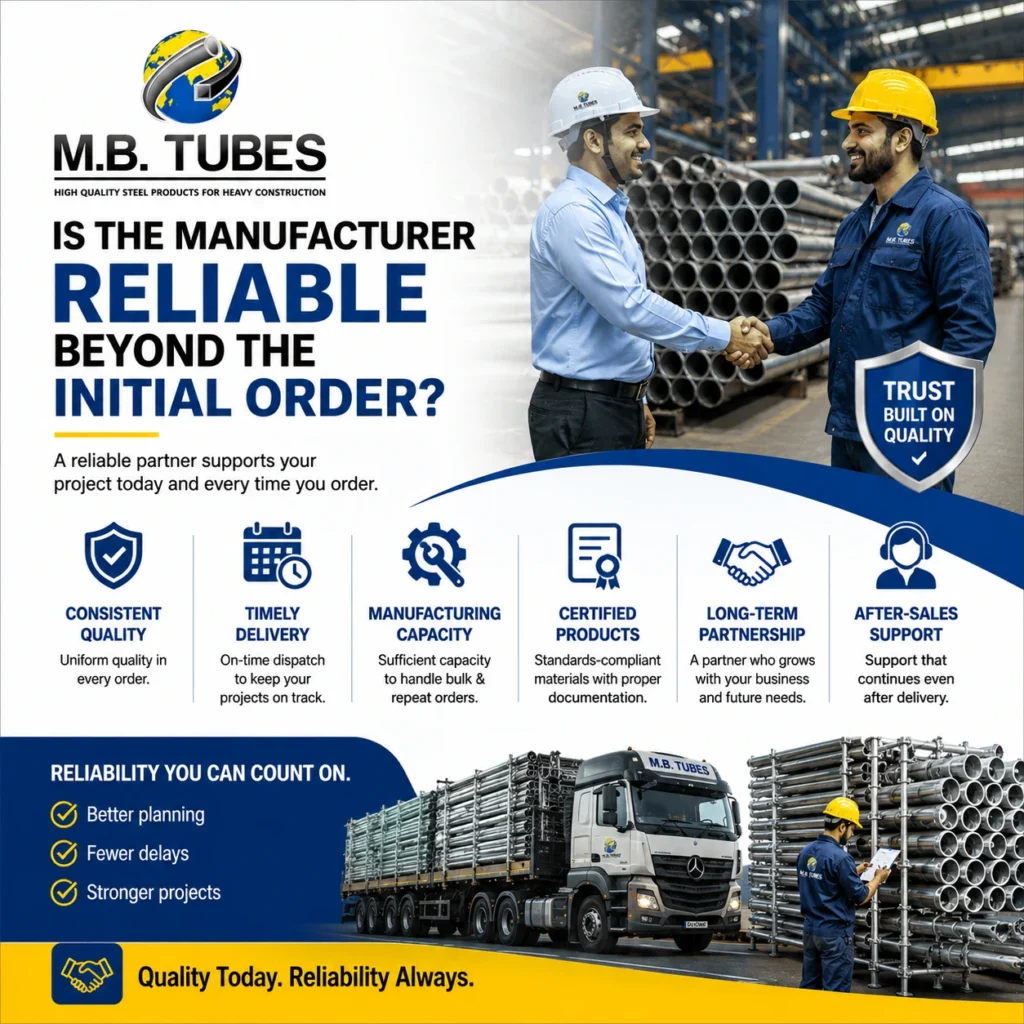
A scaffolding supplier should be evaluated as a long-term project partner rather than only as a source of steel components.
Before placing an order, consider:
Product Consistency
Can the supplier maintain the required specifications across repeat orders?
Communication
Are product specifications, quantities, and dispatch requirements communicated clearly?
Supply Capability
Can the manufacturer support your project schedule and quantity requirements?
Technical Understanding
Does the team understand scaffolding products and their construction applications?
Product Range
Can the supplier support future requirements beyond one particular scaffolding component?
Quality Control
Are appropriate checks carried out during manufacturing and before dispatch?
A slightly lower quotation can lose its value if inconsistent products, supply delays, or specification issues disrupt site operations.
Why Choosing the Right Scaffolding Manufacturer Matters
Scaffolding procurement influences more than the material budget.
The selected products can affect site planning, assembly efficiency, workforce access, material management, project timelines, and overall construction operations.
That is why contractors should evaluate a manufacturer based on a combination of:
Quality + Specification + Consistency + Manufacturing Capability + Supply Reliability
Price remains important, but it should be evaluated alongside these factors.
For companies searching for a dependable Construction Scaffolding Manufacturer in Madhya Pradesh, working with a manufacturer that also understands structural steel and construction support products can make sourcing more efficient.
Construction Scaffolding Manufacturer in Madhya Pradesh – M.B. Tubes
M.B. Tubes, a brand associated with Khambati Steel, provides steel and scaffolding solutions for construction, infrastructure, industrial, and structural requirements.
The product range supports different construction applications, with a focus on dependable manufacturing, dimensional consistency, quality materials, and practical project requirements.
For contractors, builders, fabricators, infrastructure companies, and industrial project teams looking for a Construction Scaffolding Manufacturer in Madhya Pradesh, M.B. Tubes offers scaffolding and related steel solutions for different project requirements.
Whether the requirement is for a new construction project, ongoing site supply, or bulk scaffolding procurement, buyers should clearly communicate the required specifications, quantities, application, and delivery schedule before ordering.
Final Checklist Before Buying Construction Scaffolding
Before finalising your scaffolding order, confirm:
- Required scaffolding type and configuration
- Material and pipe specifications
- Required dimensions and wall thickness
- Engineering and load requirements
- Welding and fabrication quality
- Surface finish or protection
- Component compatibility
- Required quantity
- Quality documentation where applicable
- Delivery and dispatch schedule
- Manufacturer’s production capability
- Availability of replacement or repeat components
A systematic purchasing process can help reduce avoidable procurement problems and ensure that the scaffolding supplied is appropriate for the intended project.
Conclusion
Buying construction scaffolding requires more consideration than simply comparing prices between suppliers.
Start by understanding your project requirements. Then evaluate the material specification, manufacturing quality, dimensions, load requirements, surface protection, compatibility, supply capability, and long-term usability of the system.
Most importantly, work with a manufacturer capable of providing consistent products according to clearly communicated specifications.
If your project is located in Central India, selecting an experienced Construction Scaffolding Manufacturer in Madhya Pradesh can help streamline sourcing and provide access to scaffolding and related steel products for ongoing construction requirements.
M.B. Tubes – High Quality Steel Products for Heavy Construction
Short FAQs
1. What should I check before buying construction scaffolding?
Check material quality, load capacity, dimensions, durability, and manufacturer reliability.
2. Which scaffolding is best for construction projects?
The right type depends on project height, load, site conditions, and application.
3. Why is scaffolding quality important?
Quality scaffolding supports better stability, durability, and reliable project performance.
4. How do I choose a scaffolding manufacturer in Madhya Pradesh?
Choose a manufacturer offering consistent quality, reliable supply, proper specifications, and project support.
5. Does M.B. Tubes provide construction scaffolding?
Yes, M.B. Tubes provides scaffolding and steel solutions for various construction and industrial requirements.