
GI Pipe vs MS Pipe: Which Is Better for Your Project?
Choosing between GI Pipe and MS Pipe is an important decision for construction, fabrication, industrial and infrastructure projects. Both are widely used steel pipes, but they differ in surface protection, corrosion resistance, maintenance requirements and cost.
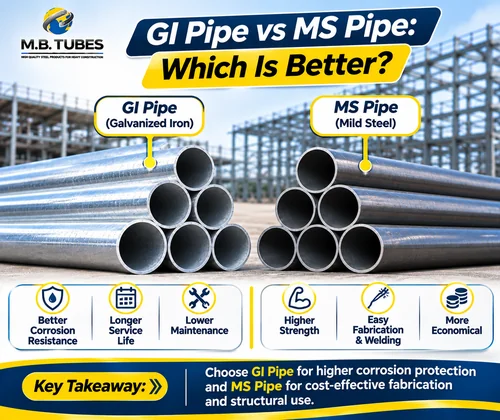
GI Pipe (Galvanized Iron Pipe) has a protective zinc coating that helps resist corrosion. MS Pipe (Mild Steel Pipe) is generally supplied without galvanization and is commonly selected for fabrication, structural frameworks and engineering applications.
So, which is better?
The answer depends on where the pipe will be installed, how it will be used and what performance the project requires.
Quick Answer: GI Pipe vs MS Pipe
GI Pipe is generally better when corrosion resistance is a major requirement, particularly for outdoor installations and moisture-exposed environments.
MS Pipe can be a more economical choice for fabrication and structural applications, especially where the pipe will receive suitable painting, coating or other corrosion protection.
Neither is automatically stronger or better in every situation. The correct choice depends on steel grade, dimensions, wall thickness, coating, applicable standards and design requirements.
What Is a GI Pipe?
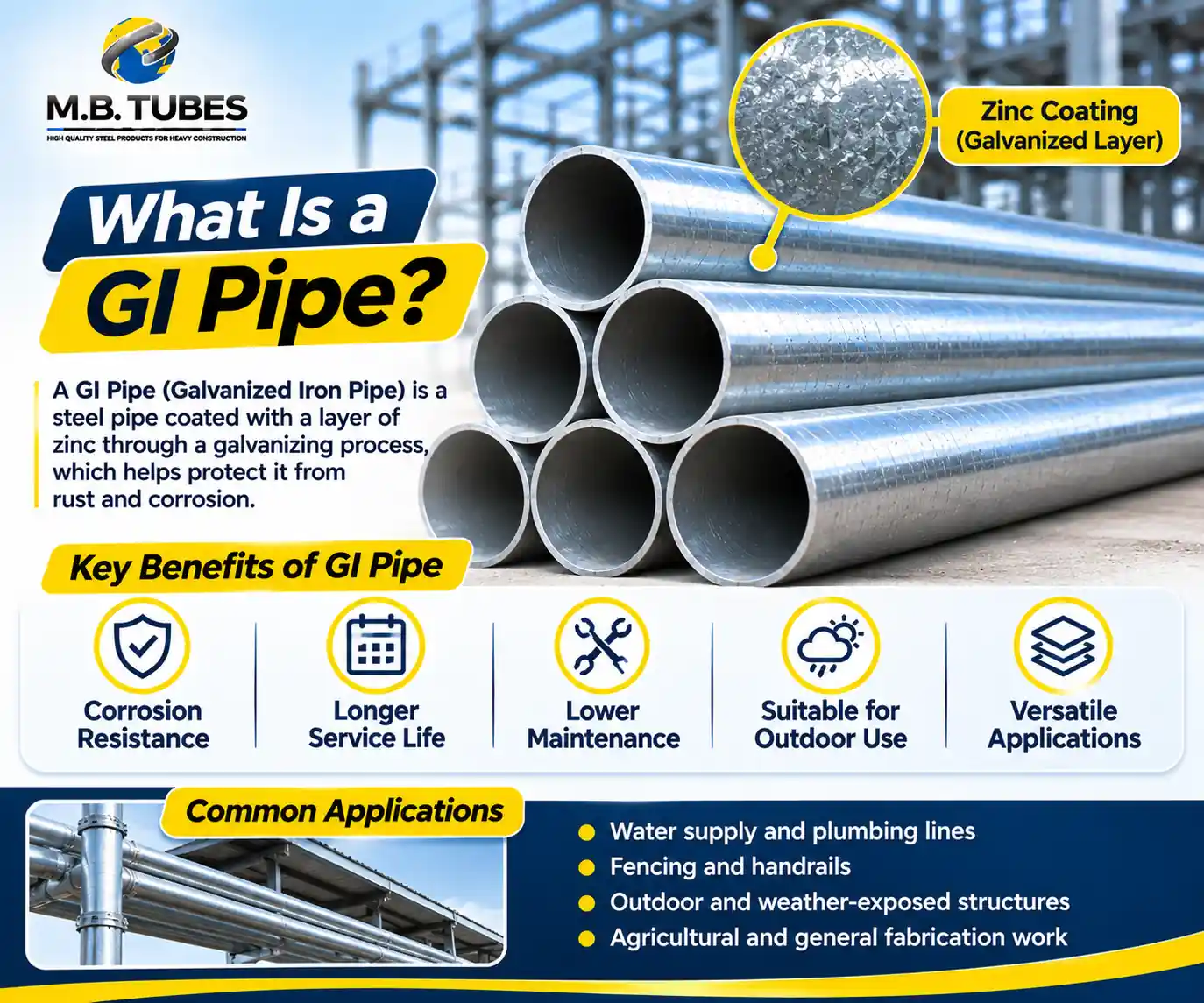
A GI Pipe is a steel pipe coated with zinc through a galvanizing process. The zinc layer helps protect the underlying steel from rust and corrosion.
GI pipes are commonly used in applications where exposure to moisture, changing weather or outdoor conditions is expected.
Key Features of GI Pipes
- Corrosion Resistance: Zinc coating helps protect the steel surface.
- Outdoor Suitability: Useful for exposed installations when the coating is appropriate for the environment.
- Lower Maintenance: May reduce the need for frequent repainting.
- Multiple Applications: Used in fencing, structures, utilities and industrial projects.
- Long-Term Protection: A suitable coating can improve service life under the intended exposure conditions.
However, galvanized pipes are not completely corrosion-proof. Their performance depends on coating thickness, environmental exposure and installation quality.
What Is an MS Pipe?
An MS Pipe is manufactured using mild steel, a material valued for its workability, weldability and versatility.
MS pipes are available in different diameters, wall thicknesses and lengths. They are widely used in construction, engineering, fabrication and industrial applications.
Key Features of MS Pipes
- Fabrication Friendly: Suitable for cutting, welding and shaping.
- Versatile Applications: Used in structural frameworks, machinery supports and construction.
- Cost-Effective: Uncoated MS pipes generally have a lower initial price than comparable galvanized pipes.
- Multiple Sizes: Available in different dimensions and thicknesses.
- Customizable Finish: Can be painted or protected using a suitable coating system.
Unprotected mild steel can rust when exposed to moisture and oxygen. Appropriate surface protection is therefore important for many applications.
GI Pipe vs MS Pipe: Key Differences
Comparison | GI Pipe | MS Pipe |
Material | Steel pipe with zinc coating | Mild steel pipe, typically uncoated |
Surface finish | Galvanized | Black, bare, painted or otherwise coated |
Corrosion resistance | Better initial protection due to zinc coating | Requires suitable protection in corrosive environments |
Welding | Possible with coating-related precautions | Generally easier to weld in uncoated condition |
Initial cost | Usually higher | Usually lower |
Maintenance | Often lower under suitable exposure conditions | Depends on the protective coating and environment |
Common uses | Outdoor structures, fencing, utilities | Fabrication, structural frameworks, machinery supports |
Service life | Depends on zinc coating and exposure | Depends on protection, environment and maintenance |
Important: Galvanization primarily improves corrosion protection. It does not automatically make a pipe structurally stronger than an MS pipe of a different grade or specification.
1. Which Pipe Is Better for Corrosion Resistance?
When comparing GI Pipe vs MS Pipe, corrosion resistance is one of the biggest differences.
GI pipes have a zinc coating that acts as a protective barrier and also provides sacrificial protection to the underlying steel.
MS pipes without suitable protection can develop rust when exposed to water, humidity and other corrosive conditions.
For outdoor applications, GI pipes may offer a practical advantage.
However, coating selection should still consider the installation environment. Highly corrosive industrial or coastal locations may require additional protection or a different specification.
2. Which Pipe Is Stronger: GI or MS?
A common misconception is that GI pipes are always stronger than MS pipes.
The strength of a pipe depends primarily on its steel grade, diameter, wall thickness, manufacturing quality and structural design.
A galvanized pipe and an ungalvanized pipe made from equivalent steel and having equivalent dimensions can have broadly similar structural properties.
The zinc coating mainly provides corrosion protection.
For load-bearing applications, evaluate the pipe’s technical specifications rather than choosing it only because it is galvanized.
3. GI Pipe vs MS Pipe: Which Is Better for Construction?
Both pipe types have important construction applications.
GI Pipe Applications
GI pipes may be suitable for:
- Outdoor fencing and boundary structures
- Exposed steel frameworks
- Certain utility installations
- Outdoor support structures
- Projects requiring zinc-coated steel components
MS Pipe Applications
MS pipes are commonly used for:
- Structural steel fabrication
- Industrial sheds and warehouses
- Machinery and equipment supports
- Construction frameworks
- Engineering and fabrication projects
- Scaffolding components designed for the intended system
For structural work, pipe selection must follow engineering drawings and applicable specifications.
Best approach: Choose the pipe based on the actual application, environmental conditions and required structural performance.
4. Which Is More Cost-Effective: GI Pipe or MS Pipe?
MS pipes generally have a lower initial purchase cost because they do not include the galvanizing process.
GI pipes may cost more initially but can reduce future maintenance in suitable environments.
For example, an outdoor structure made from unprotected MS pipe may require painting and periodic maintenance. A properly galvanized alternative may reduce some of those requirements.
When comparing costs, consider:
Total Project Cost = Material Cost + Surface Protection + Installation + Maintenance + Expected Replacement Cost
The cheapest pipe at purchase is not always the most economical option over the project’s service life.
5. Which Pipe Is Better for Welding and Fabrication?
MS pipes are generally convenient for fabrication because uncoated mild steel can be cut, welded and shaped using appropriate procedures.
GI pipes can also be fabricated, but welding galvanized steel requires special precautions.
The zinc coating around the weld area must be managed correctly, and suitable fume controls and ventilation are necessary. Damaged coating areas may also need restoration after fabrication.
For projects involving extensive cutting and welding, uncoated MS pipe may offer a simpler fabrication workflow.
Where corrosion resistance is required, the fabricated assembly can be protected using an appropriate coating process.
6. How to Choose Between GI Pipe and MS Pipe
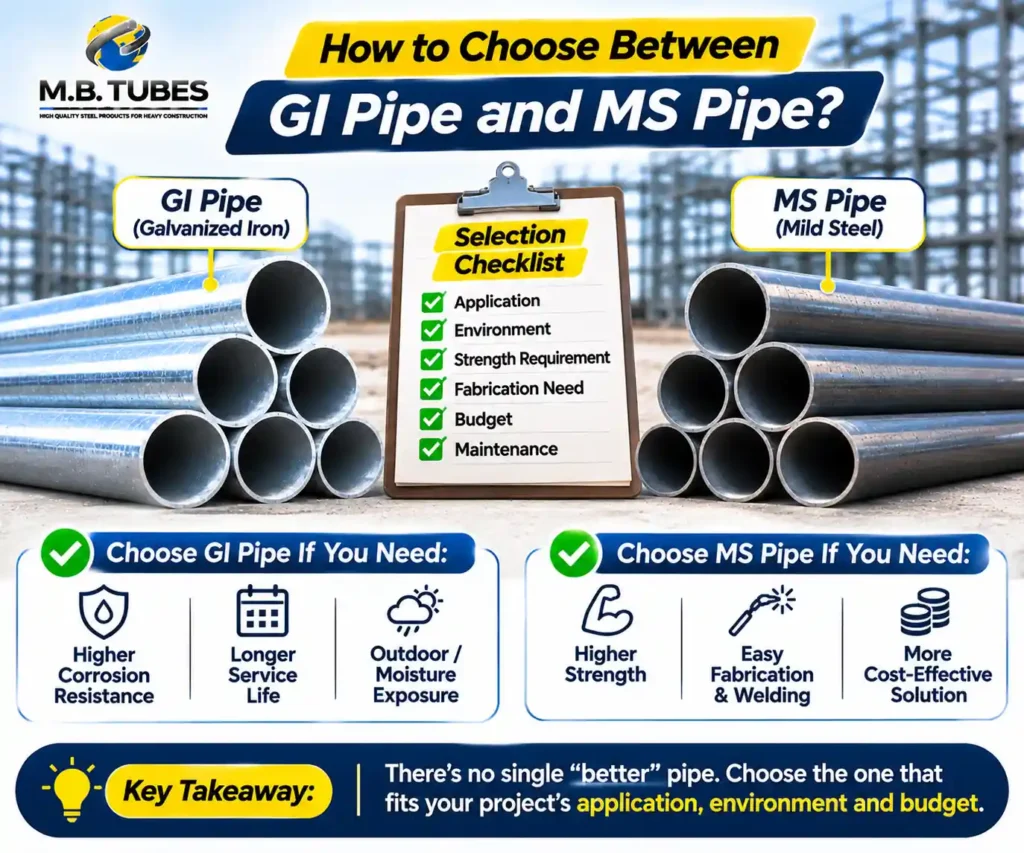
Before ordering pipes, consider these six factors.
- Identify the application. Determine whether the pipe is required for structural support, fabrication, fencing, utilities or another purpose.
- Evaluate the environment. Consider indoor or outdoor exposure, moisture, weather and possible corrosive conditions.
- Check the dimensions. Confirm outside diameter, wall thickness, length and other relevant specifications.
- Verify the steel grade. Select a material grade that meets the project’s engineering requirements.
- Compare total costs. Include protective coating, installation, maintenance and expected service life.
- Review applicable standards. Ensure the selected product meets the specifications required for its intended use.
A practical selection process is:
Application → Environment → Pipe Grade → Dimensions → Coating → Total Cost
Common Mistakes When Choosing GI and MS Pipes
One common mistake is selecting GI pipes only because they are corrosion-resistant, without checking whether their steel grade and dimensions suit the application.
Another is selecting MS pipes only because they cost less, while ignoring the expense of corrosion protection and future maintenance.
Buyers should also avoid comparing prices for pipes with different wall thicknesses, lengths, grades or coating specifications.
For an accurate comparison, request quotations based on matching technical requirements.
GI Pipes and MS Pipes from Khambati Steel & M.B. Tubes
Khambati Steel & M.B. Tubes supplies steel pipes and tubes for construction, industrial and fabrication requirements.
Its product range includes MS ERW Pipes, GI Pipes, MS Square and Rectangular Tubes and other structural steel solutions.
When selecting pipes for a project, buyers should confirm the required diameter, wall thickness, length, material specification, surface finish and quantity.
Choosing the correct specification helps improve material planning, fabrication efficiency and project suitability.
Conclusion: GI Pipe vs MS Pipe — Which Should You Choose?
Both GI and MS pipes have important roles in construction and industrial projects.
Choose GI Pipe when suitable zinc-coated corrosion protection is a priority. Choose MS Pipe when fabrication flexibility, structural specifications and initial material cost are the main considerations.
The final decision should be based on application, environment, steel grade, pipe dimensions, protective finish and long-term project cost.
For project-specific steel pipe requirements, consult Khambati Steel & M.B. Tubes to discuss suitable product specifications and available options.
Frequently Asked Questions (FAQs)
Which is better, GI Pipe or MS Pipe?
GI Pipe is often preferable where corrosion resistance is important. MS Pipe may be more suitable for economical fabrication and structural applications where appropriate corrosion protection can be provided. The best choice depends on project requirements.
Is GI Pipe stronger than MS Pipe?
Not necessarily. Galvanization provides corrosion protection, not an automatic increase in structural strength. Pipe strength depends on steel grade, dimensions, wall thickness and manufacturing specifications.
Can MS Pipe be used outdoors?
Yes. MS Pipe can be used outdoors when it has a suitable protective coating and is specified for the application. Regular inspection and maintenance may also be required.
Why is GI Pipe generally more expensive?
GI Pipe includes an additional galvanizing process that applies a protective zinc coating. This generally increases the initial price compared with an otherwise comparable uncoated MS pipe.
Which pipe is better for industrial fabrication?
MS Pipe is often convenient for fabrication involving cutting and welding. GI Pipe may be selected when corrosion resistance is a priority, provided suitable fabrication procedures and coating protection are followed.