
Large industrial and construction projects place enormous demands on structural materials. A pipe that performs perfectly in a light fabrication job may behave very differently when it becomes part of a heavily loaded structure, support framework, industrial facility, or infrastructure project.
This is where heavy-duty MS (mild steel) pipes become important. Their combination of strength, practical fabrication characteristics, availability in different dimensions, and suitability for structural applications makes them widely used across the construction and engineering sectors.
However, the term heavy duty should not simply be associated with a thick-looking pipe. Actual performance under load depends on the steel grade, outside diameter, wall thickness, section properties, manufacturing quality, connection design, unsupported length, and type of loading.
For contractors and project buyers searching for a dependable Heavy Duty MS Pipe Manufacturer in Madhya Pradesh, understanding these factors makes it easier to select pipes according to real project requirements rather than price or appearance alone.
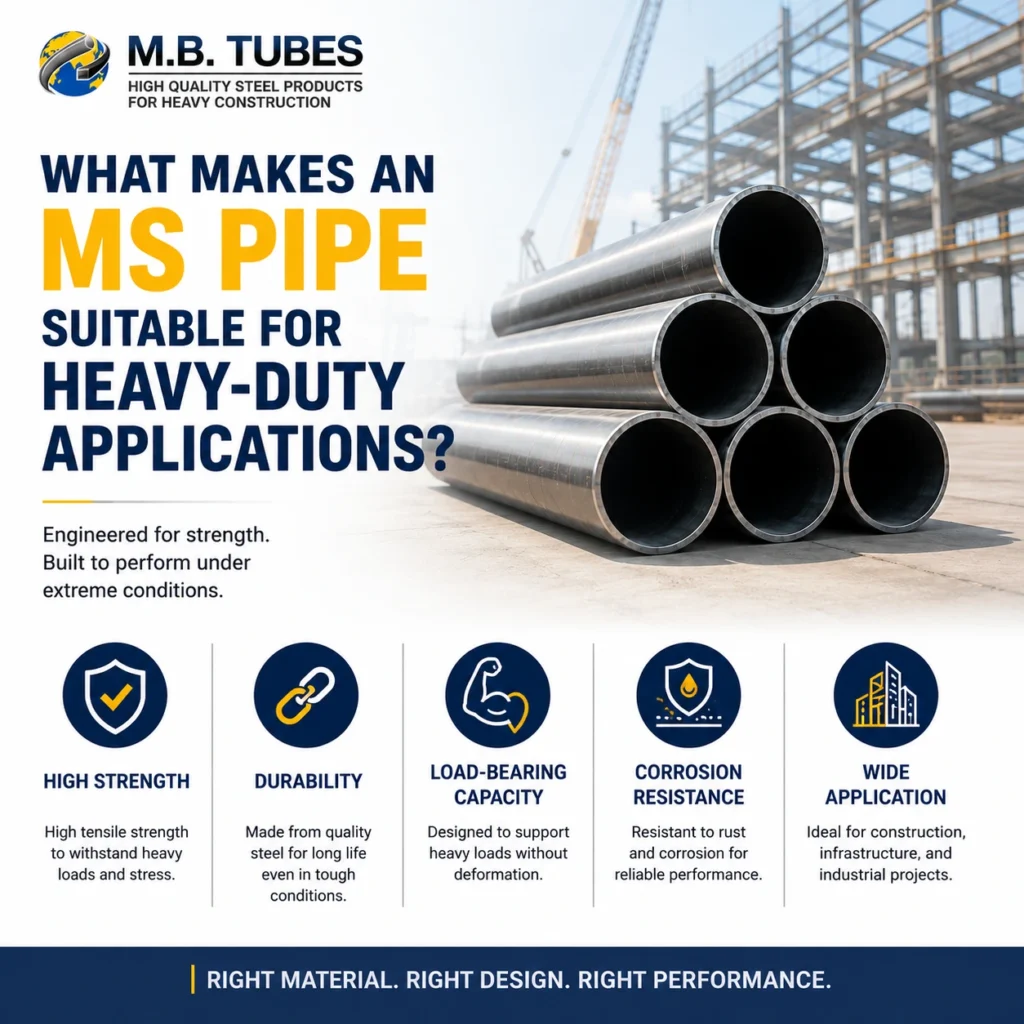
What Makes an MS Pipe Suitable for Heavy-Duty Applications?
Heavy-duty performance begins with proper engineering.
An MS pipe intended for demanding structural work needs to resist the forces acting on it without unacceptable deformation, instability, or failure. Depending on the application, those forces may include compression, tension, bending, shear, torsion, impact, vibration, or a combination of several loads.
Three factors are particularly important.
1. Material Properties
The specified steel grade determines important mechanical characteristics such as yield strength and tensile strength. The material must be appropriate for the intended application and applicable design requirements.
2. Pipe Geometry
Outside diameter and wall thickness strongly influence the pipe’s cross-sectional properties. Changing either can significantly alter how the member behaves under load.
3. Structural Design
Even a strong pipe can perform poorly if its unsupported length, connections, bracing, or load path are incorrectly designed.
Therefore, heavy-duty performance is achieved through the right combination of material, dimensions, manufacturing, and engineering.
What Actually Happens When an MS Pipe Carries a Heavy Load?
A steel pipe does not respond to every load in the same way. Understanding the basic load conditions helps explain why pipe selection must be application-specific.
Compression: When the Pipe Is Being Pushed
MS pipes used as columns, props, supports, or vertical structural members may experience compression.
For relatively short members, material strength can be an important limit. As the unsupported length increases, however, buckling can become a critical consideration.
This means that selecting a pipe based only on its wall thickness is not sufficient. Engineers must also consider factors such as:
- Effective length
- End conditions
- Bracing
- Outside diameter
- Wall thickness
- Section properties
- Material grade
A properly designed tubular member can provide efficient resistance to compression while keeping the structure relatively economical in weight.
Bending: When Loads Try to Curve the Pipe
Beams, frames, supports, and fabricated structures frequently expose pipes to bending.
Under bending, one side of the section experiences tension while the opposite side experiences compression. The geometry of a hollow circular section places much of the material away from the centre, which can make tubular sections structurally efficient for many applications.
The pipe’s diameter, thickness, span, connection conditions, and applied loads all influence bending performance.
This is particularly relevant for industrial frameworks and fabricated structural assemblies.
Tension: When the Pipe Is Being Pulled
Some structural arrangements subject members to tensile forces.
Under tension, the pipe must safely transfer the required force through both the member and its connections. Welds, bolts, end plates, or other connection details can therefore be just as important as the pipe itself.
A strong member with a poorly designed connection does not create a strong structural system.
Combined Loading: The Reality on Construction Sites
Real structures rarely experience perfectly isolated loads.
A pipe may simultaneously experience compression and bending, or axial load together with wind-induced forces and vibration. Industrial environments may also introduce repeated or dynamic loading.
For this reason, heavy-duty MS pipe selection should be based on the actual structural design rather than a single generic load-capacity figure.
Why Circular MS Pipes Can Perform Efficiently Under Load
The circular hollow geometry of MS pipes offers useful structural characteristics.
Because material is distributed around the central axis, circular hollow sections can provide efficient properties in multiple directions. Their closed shape also gives them useful torsional characteristics compared with many open sections.
These properties make MS pipes suitable for a wide variety of engineered structures, including:
- Structural frames
- Industrial sheds
- Support systems
- Scaffolding components
- Equipment frameworks
- Fabricated structures
- Infrastructure applications
The final suitability always depends on the specific pipe and structural design.
Wall Thickness: Important, But Not the Whole Story
A common purchasing assumption is:
“Thicker pipe means stronger pipe.”
Increasing wall thickness can increase cross-sectional area and affect several structural properties. But thickness alone cannot determine whether a pipe is suitable for a heavy-duty application.
Consider two pipes with different outside diameters and wall thicknesses. The thinner-walled pipe with the larger diameter may, in some applications, have section properties that make it more appropriate than a smaller but thicker pipe.
That is why professional selection considers the complete specification rather than one measurement.
Before procurement, review:
Outside Diameter + Wall Thickness + Steel Grade + Length + Loading Condition + Support Arrangement + Connection Design
This gives a far more useful picture of expected performance.
Buckling: A Critical Concern in Long Pipe Supports
One of the most important issues in compression members is buckling.
A long, slender pipe can become unstable under compression before the steel itself reaches its full material strength. This behaviour makes the member’s geometry and unsupported length extremely important.
For columns and temporary support applications, engineers therefore consider slenderness and stability as part of the design.
Simply replacing a pipe with another pipe of similar weight does not guarantee equivalent structural behaviour.
This is particularly important in heavy construction, where seemingly small specification changes can alter performance.
Manufacturing Accuracy Matters Under Heavy Loads
Heavy-duty performance begins long before a pipe reaches the construction site.
Manufacturing consistency can influence dimensional accuracy, fit-up, fabrication, and ultimately how effectively the finished structural system is assembled.
A professional Heavy Duty MS Pipe Manufacturer in Madhya Pradesh should focus on maintaining appropriate quality controls for the specified product.
Depending on the pipe type and applicable requirements, important considerations may include:
- Dimensional consistency
- Wall thickness tolerance
- Straightness
- Surface condition
- Weld consistency for welded pipes
- Material specification
- Appropriate testing and inspection
Buyers should request relevant technical documentation rather than relying only on visual inspection.
Connections Can Decide the Strength of the Entire System
The pipe itself is only one part of a structure.
How it connects to other members is equally important.
Poor welding, unsuitable connection plates, incorrect bolt arrangements, local damage, or improper fabrication can create weak points even when high-quality pipes are used.
Heavy-duty structures therefore require coordination between:
Material selection → Structural design → Fabrication → Connection detailing → Installation → Inspection
Ignoring any one of these stages can reduce the reliability of the finished structure.
How Heavy Duty MS Pipes Handle Repeated Loads
Factories, industrial equipment supports, and certain infrastructure applications may experience repeated loading or vibration.
Repeated stress cycles can introduce fatigue considerations, particularly around connections, weld details, abrupt geometry changes, or other stress concentrations.
Where fatigue is relevant, designers need to consider more than static strength.
Good detailing, appropriate fabrication practices, and inspection become particularly important in these environments.
Environmental Conditions Also Affect Long-Term Performance
High load capacity alone does not guarantee a long service life.
MS steel can corrode when exposed to moisture and aggressive environments without appropriate protection. Over time, significant material loss can reduce the effective section available to carry load.
Depending on the project environment, protective measures may include suitable coatings, surface preparation, drainage detailing, and planned inspection and maintenance.
For exposed industrial structures, corrosion protection should be considered as part of the structural life-cycle strategy rather than an afterthought.
Where Heavy Duty MS Pipes Are Commonly Used
The versatility of MS pipes allows them to serve many structural and industrial applications.
| Application | Why MS Pipes Are Considered |
| Industrial structures | Efficient structural support and fabrication |
| Factory sheds | Suitable for engineered framing applications |
| Warehouses | Useful in structural and supporting systems |
| Scaffolding components | Tubular geometry suits modular systems |
| Temporary supports | Can be engineered for compression applications |
| Equipment structures | Suitable for fabricated support frameworks |
| Infrastructure | Available in multiple structural specifications |
| General fabrication | Good adaptability for cutting and joining |
The appropriate grade and dimensions should always be selected according to the individual project.
Heavy-Duty Performance Starts With the Right Specification
Purchasing MS pipes by weight or price alone can create problems later.
Before ordering material for a high-load application, the project team should establish the required specifications.
Important questions include:
What loads will the member carry?
Understand whether the primary demand is compression, tension, bending, torsion, dynamic loading, or a combination.
What is the unsupported length?
This is particularly important for members subjected to compression.
What pipe dimensions are specified?
Check outside diameter, wall thickness, and length against the engineering requirements.
What material grade is required?
Do not substitute grades without appropriate technical approval.
How will the pipe be connected?
Connection details need to transfer the required forces safely.
What environment will it operate in?
Outdoor, humid, industrial, or corrosive conditions may require additional protection.
Why Quality MS Pipes Can Improve Project Economics
The lowest material price does not necessarily produce the lowest project cost.
Incorrectly specified or inconsistent material can contribute to fabrication difficulties, site modifications, rejected components, additional inspections, delays, or premature maintenance.
Correctly specified quality MS pipes can support better project economics by helping provide:
- Predictable fabrication
- Consistent fit-up
- Efficient installation
- Reliable structural performance
- Reduced avoidable rework
- Better long-term serviceability
The objective is not simply to purchase more steel. It is to purchase the appropriate steel product for the job.
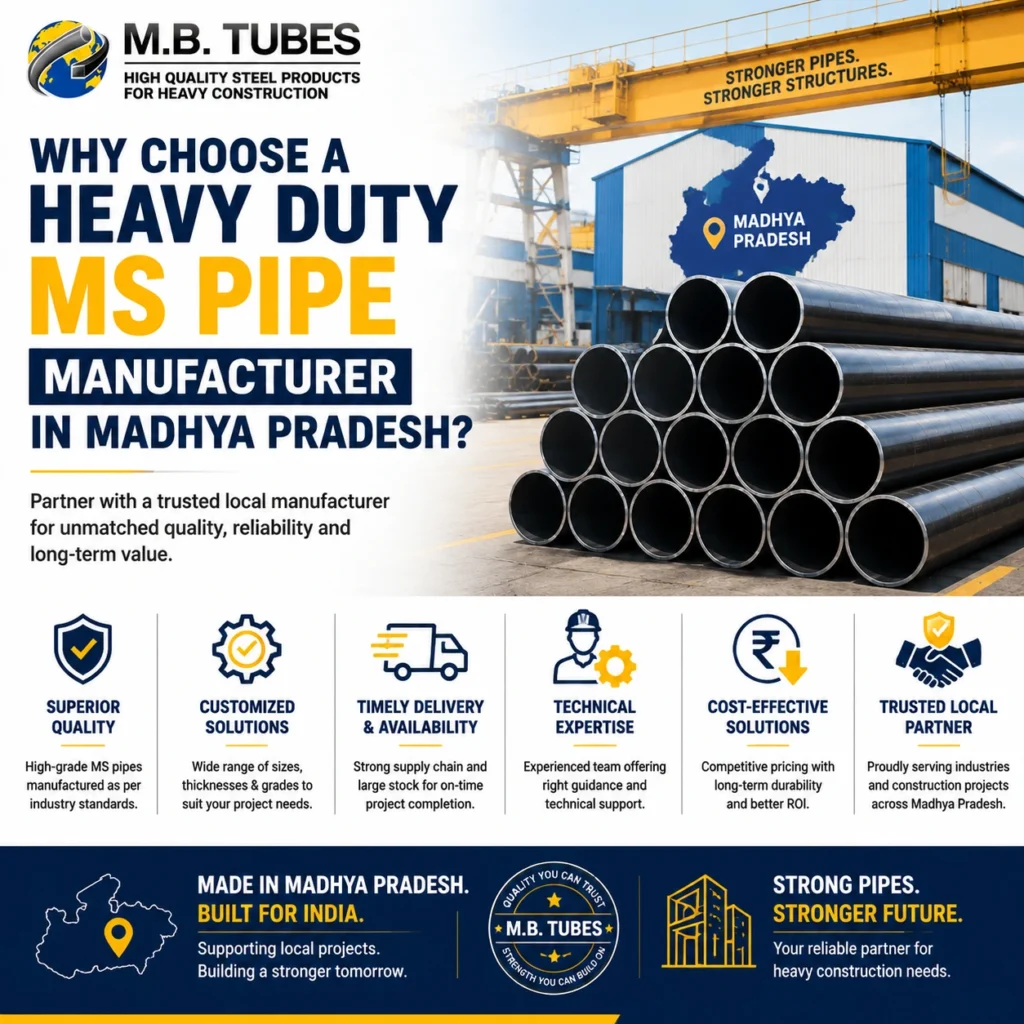
Why Choose a Heavy Duty MS Pipe Manufacturer in Madhya Pradesh?
For projects across Madhya Pradesh, working with a dependable manufacturer can simplify procurement while helping maintain consistency across larger orders.
When evaluating a Heavy Duty MS Pipe Manufacturer in Madhya Pradesh, buyers should look beyond price and consider:
- Manufacturing capability
- Product specification consistency
- Available sizes and thicknesses
- Quality-control procedures
- Applicable standards
- Supply capability for bulk requirements
- Technical product information
- Delivery reliability
For structural applications, product selection should ultimately match the specifications provided by the project’s qualified engineering professionals.
Quality Pipe + Correct Engineering = Better Performance
There is no single MS pipe that is automatically suitable for every heavy-load condition.
Reliable performance comes from combining:
Correct Steel Grade + Suitable Diameter + Required Wall Thickness + Proper Structural Design + Strong Connections + Quality Fabrication + Correct Installation + Maintenance
This is the more useful way to evaluate heavy-duty steel products.
A pipe that is properly selected for one application may be unsuitable for another—even when both projects appear similar from the outside.
Final Thoughts
Heavy-duty MS pipes can perform exceptionally well in demanding structural and industrial applications when they are correctly specified, manufactured, fabricated, installed, and maintained.
Their tubular geometry offers efficient structural characteristics, while the availability of different diameters, wall thicknesses, and specifications gives engineers considerable design flexibility.
But heavy-load performance should never be judged from appearance or thickness alone.
For contractors, fabricators, industrial buyers, and project developers searching for a Heavy Duty MS Pipe Manufacturer in Madhya Pradesh, the priority should be clear technical specifications, consistent manufacturing quality, and material appropriate to the engineered application.
Heavy loads demand more than heavy steel—they demand the right steel, designed for the right job.
Frequently Asked Questions
1. Are MS pipes suitable for heavy-load structural applications?
Yes, MS pipes can be used in many heavy-duty structural applications when their grade, diameter, wall thickness, connections, and overall structural design are appropriate for the required loads.
2. Does increasing MS pipe thickness always increase load capacity?
Increasing wall thickness changes the pipe’s structural properties, but load capacity cannot be determined from thickness alone. Diameter, grade, member length, loading type, supports, connections, and buckling behaviour also matter.
3. Why is buckling important for heavy-duty MS pipes?
Long pipes subjected to compression can become unstable through buckling. Their effective length, diameter, thickness, restraint, and structural arrangement therefore need to be considered during design.
4. What should buyers check before purchasing heavy-duty MS pipes?
Buyers should verify the required material grade, outside diameter, wall thickness, length, applicable standard, dimensional tolerances, surface requirements, and relevant quality documentation according to project specifications.
5. How do I select a Heavy Duty MS Pipe Manufacturer in Madhya Pradesh?
Evaluate manufacturing capability, product consistency, specification availability, quality control, technical documentation, bulk supply capability, and delivery reliability. Structural pipe specifications should match the project’s engineering requirements.