
Scaffolding is designed to provide temporary access and working platforms, but temporary does not mean maintenance-free.
On an active construction or industrial site, scaffolding components can be repeatedly erected, dismantled, transported, stacked, exposed to weather, and handled by different crews. Over time, components may develop corrosion, deformation, damaged connections, or other visible defects. Site conditions can also change after erection.
The important question is therefore not simply:
“Is the scaffolding still standing?”
A better question is:
“Is the scaffolding still suitable for its intended use and current site conditions?”
For contractors, builders, infrastructure companies, and industrial project teams, recognizing warning signs early can help determine when a scaffold needs a competent-person inspection and when damaged components should be removed from service for assessment, repair, or replacement.
If you are sourcing equipment from a Construction Scaffolding Manufacturer in Madhya Pradesh, component quality and consistency matter—but proper inspection, erection, use, maintenance, and site supervision remain equally important.
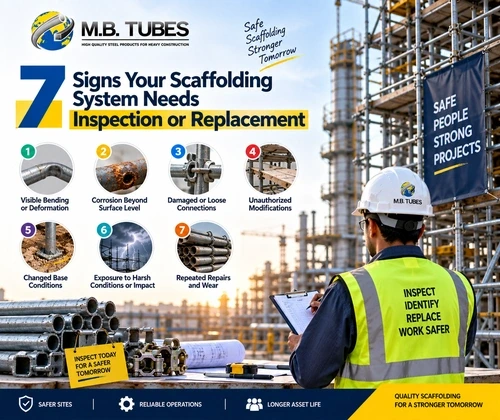
Here are seven warning signs project teams should never ignore.
1. Visible Bending, Cracks or Deformation in Components
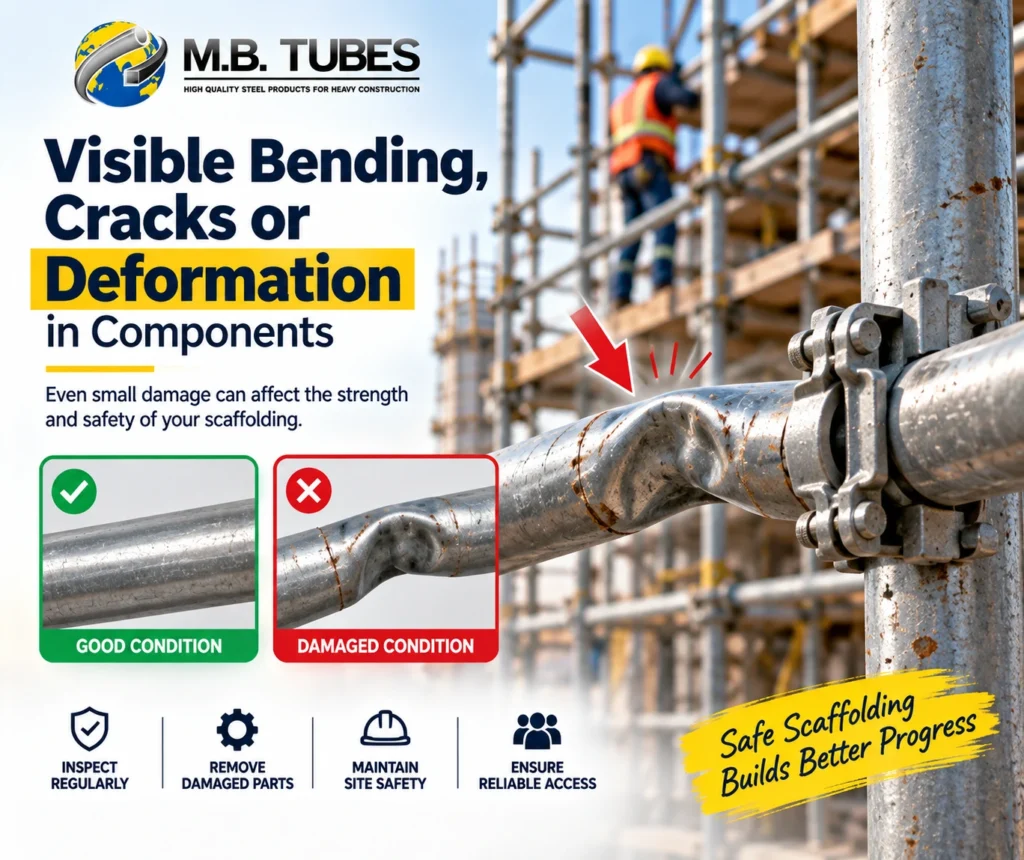
One of the clearest reasons to stop and inspect a scaffold is visible physical damage.
Standards, ledgers, frames, braces, tubes, platforms, base components, couplers, or other structural parts should not be assumed usable simply because they can still be assembled.
Watch for signs such as:
bent tubes, distorted frames, cracked welds, damaged ends, twisted members, deformed connection points, or components that no longer sit correctly.
A bent member may indicate that it has previously been overloaded, struck, dropped, incorrectly stored, or otherwise damaged.
The key principle is simple:
A component that no longer matches its intended condition should not be “made to fit” on site.
Where damage is identified, the affected component should be removed from service and assessed according to applicable requirements and manufacturer/project guidance.
For example, OSHA’s construction scaffold rules require damaged or weakened scaffold parts to be immediately repaired, replaced, braced, or removed from service until appropriately addressed.
2. Corrosion Is Becoming More Than a Surface Issue
Steel scaffolding commonly works outdoors, where it may encounter rain, humidity, dust, chemicals, storage exposure, and repeated handling.
Not every visible mark automatically means a component must be discarded. However, significant corrosion, pitting, section loss, or deterioration around important connections deserves attention.
The difference between cosmetic surface rust and meaningful material deterioration should not be decided casually by an unqualified worker.
Pay particular attention to areas around:
- Welded joints
- Connection points
- Tube ends
- Couplers and locking areas
- Base components
- Frequently exposed surfaces
If corrosion appears to have affected the integrity of a component, it should be isolated and evaluated by appropriately competent personnel.
When buying from a Construction Scaffolding Manufacturer in Madhya Pradesh, ask about material specifications, manufacturing consistency, finish/coating options where relevant, handling guidance, and storage recommendations.
Good procurement and good maintenance should work together.
3. Connections No Longer Lock or Fit Properly
A scaffold is a system, not a collection of independent steel pieces.
Its performance depends on components connecting and functioning as intended.
If couplers slip, locking mechanisms do not engage correctly, connection points appear worn, pins are damaged, or components require excessive force to assemble, the problem should not be ignored.
Workers should not compensate with improvised fixes.
A useful site rule is:
If a connection does not work as intended, investigate why before continuing.
Possible causes may include damaged components, contamination, wear, deformation, incompatible parts, or incorrect assembly.
This is also why mixing components without proper evaluation can create problems. OSHA guidance notes that components from different manufacturers should not be intermixed unless they fit together without force and the resulting scaffold’s structural integrity is maintained.
Compatibility deserves attention during both procurement and inspection.
4. The Scaffold Has Been Modified After the Original Setup
This warning sign is sometimes less visible than corrosion or a bent tube.
Imagine a scaffold that was properly erected for one activity. Later, another trade needs access. A platform is shifted. A brace is disturbed. Materials are placed on a working level. An access route changes.
The scaffold may look almost the same.
But its actual conditions of use may have changed.
Modifications should therefore be controlled and reviewed according to the scaffold design, site procedures, and applicable safety requirements.
Workers should not independently remove or reposition structural or safety-critical components simply because they interfere with the job.
This becomes particularly important on busy construction and industrial sites where multiple contractors may use the same access system.
The safest mindset is:
Changed scaffold = reason to verify the scaffold again.
5. The Scaffold Has Been Exposed to an Event That Could Affect It
Sometimes the warning sign is not a damaged component—it is an event.
For example, scaffolding may be affected by severe weather, impact from site equipment, falling materials, nearby work, ground disturbance, or another incident capable of affecting its integrity.
Even if obvious damage is not immediately visible, the event itself can justify another inspection.
OSHA requires scaffolds and scaffold components under its construction standard to be inspected for visible defects by a competent person before each work shift and after any occurrence that could affect structural integrity.
This gives project teams an important principle:
Do not wait for visible failure before deciding that an inspection is necessary.
If something happened that could reasonably have affected the scaffold, treat that event as a trigger for evaluation under your applicable procedures.
6. Base Conditions or Scaffold Alignment Have Changed
Sometimes the scaffold components themselves may appear acceptable, but the structure no longer looks or sits as originally intended.
Warning signs can include unusual leaning, settlement around support areas, changes at the base, movement, unexpected gaps, or a noticeable difference in alignment.
These signs deserve immediate attention.
Scaffold stability depends not only on individual components but also on factors such as foundations, base support, bracing, ties, geometry, loading, and site conditions.
A scaffold erected on a stable surface can face different conditions later if the surrounding ground or work environment changes.
OSHA’s scaffold requirements state that supported scaffold poles, legs, posts, frames, and uprights must bear on base plates and mud sills or another adequate firm foundation.
Therefore, inspections should not focus only on what is happening at eye level.
Look from the base upward.
7. Repeated Repairs Are Becoming the Normal Routine
A component requiring appropriate repair does not automatically mean the entire scaffold system needs replacement.
However, repeated defects across the same inventory can reveal a bigger issue.
Imagine a contractor repeatedly finding bent frames, worn connections, heavily corroded pieces, damaged platforms, or components that continually need to be segregated.
At that point, the question should shift from:
“Can we repair this one component?”
to:
“Is this inventory still practical and appropriate for continued service?”
A structured inventory review can help separate serviceable components from those requiring further assessment, authorized repair, or replacement.
This is particularly important for contractors using scaffolding repeatedly across multiple projects.
Older does not automatically mean unsafe, and newer does not automatically mean suitable.
Condition, specification, compatibility, design, use, and inspection matter more than age alone.
Inspection vs Repair vs Replacement: Know the Difference
These terms should not be treated as interchangeable.
An inspection determines whether visible conditions, configuration, and other relevant factors require action according to the applicable procedure.
A repair should restore an eligible component appropriately and should not be an improvised site modification.
Replacement removes a damaged or unsuitable component and substitutes an appropriate component meeting the required specifications.
The decision should be made by the responsible competent/qualified personnel according to applicable regulations, engineering requirements, manufacturer guidance, and site procedures—not by guessing from appearance alone.
This distinction is especially important for high-use construction scaffolding inventories.
Why a Scaffolding Inspection System Matters
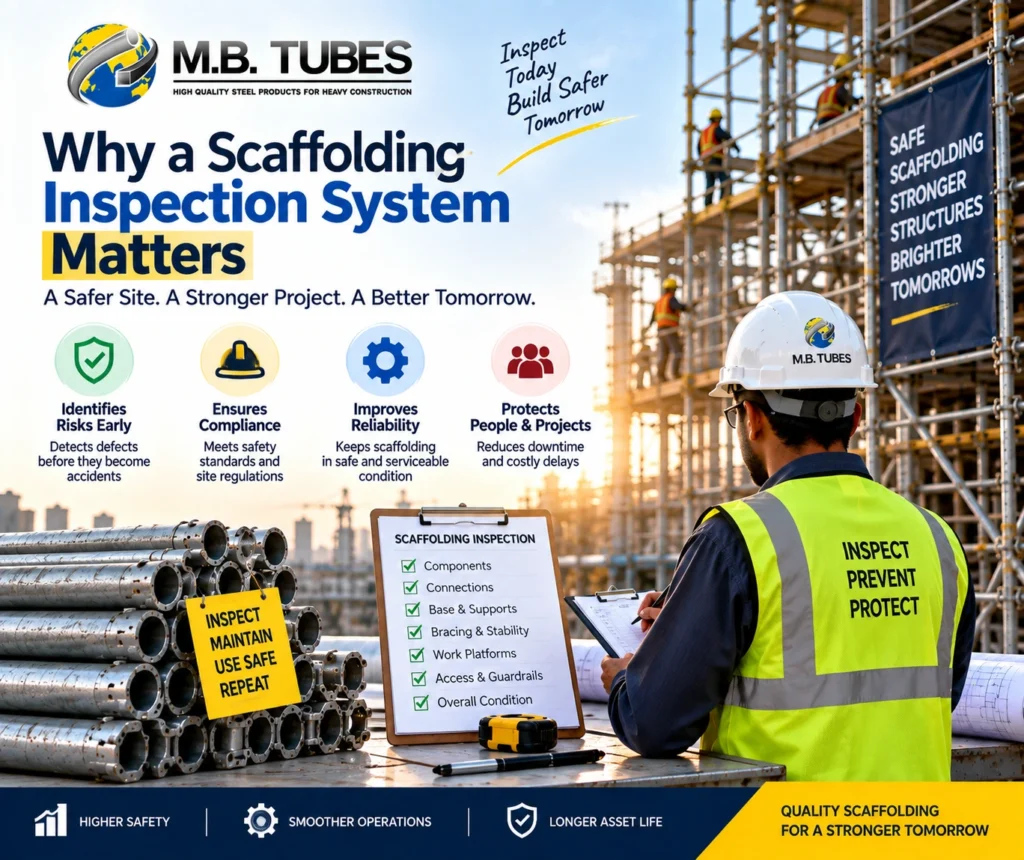
Inspection works best when it is part of normal project management rather than an emergency response.
A practical process can include checks at required intervals, after erection or approved modification as applicable, after events capable of affecting integrity, and whenever damage or unusual conditions are observed.
Records can also help organizations identify recurring problems.
For example, if the same component type is frequently being damaged during transportation, the real problem might involve handling or storage rather than the scaffold’s normal use.
If base-related problems repeatedly occur, site preparation may need attention.
If incompatible components repeatedly reach erection crews, inventory segregation and procurement controls may need improvement.
In this way, inspection does more than find defects.
It can reveal why those defects keep happening.
Storage and Handling Can Affect Scaffolding Condition Too
Scaffolding maintenance does not start when erection begins.
Components may spend considerable time being transported or stored between projects.
Poor storage can expose materials to unnecessary moisture, contamination, impact, and disorganization. Rough loading and unloading can damage connection points or deform components.
A more organized approach includes segregating component types, keeping damaged material clearly separated from usable stock, avoiding uncontrolled dropping or impact during handling, and following suitable storage and manufacturer recommendations.
This can make the next project easier because erection teams receive a more organized inventory rather than discovering problems during installation.
What to Check When Buying New Construction Scaffolding
Replacement is also an opportunity to improve procurement.
Instead of buying only the cheapest available components, contractors should consider the complete system requirement.
Before placing an order with a Construction Scaffolding Manufacturer in Madhya Pradesh, buyers can evaluate:
material and dimensional specifications, scaffold system type, component compatibility, manufacturing consistency, required accessories, documentation, quantity availability, delivery capability, and project-specific requirements.
If your project uses H-Frame, Cuplock, props, walkway planks, base jacks, adjustable jacks, couplers, or related scaffolding accessories, verify that the supplied components correspond with the intended system and approved project requirements.
For projects across Indore, Pithampur, Dewas, Bhopal, Mandideep, Ujjain, Dhar, Ratlam, Jabalpur, Satna, Rewa, and other parts of Madhya Pradesh, regional supply may also help with planned dispatches and repeat material requirements.
But proximity should complement—not replace—technical evaluation.
Don’t Let a Small Defect Become a Bigger Site Problem
Scaffolding problems do not always announce themselves dramatically.
Sometimes the first warning is a slightly bent member.
A connection that suddenly feels different.
Unexpected movement.
Corrosion that looks worse than before.
A base that appears to have shifted.
Or a scaffold that was altered since its previous inspection.
These observations should not be dismissed because the project is busy.
The purpose of inspection is to identify concerns before they become more serious.
Final Thoughts
Scaffolding should never be judged only by whether it still looks usable from a distance.
Visible deformation, significant corrosion, unreliable connections, uncontrolled modifications, potentially damaging events, changed base/alignment conditions, and repeated component defects are all reasons to take a closer look.
When a concern is identified, stop relying on assumptions. Follow the project’s inspection procedure and applicable requirements, involve the appropriate competent or qualified personnel, and remove unsuitable components from service as required.
Similarly, when purchasing replacement material from a Construction Scaffolding Manufacturer in Madhya Pradesh, focus on more than price. Evaluate specifications, manufacturing consistency, compatibility, component range, documentation, availability, and supply requirements.
A strong scaffolding program is not simply about owning enough steel.
It is about knowing the condition of the equipment you expect people to work from.
FAQs
1. How do I know when construction scaffolding needs inspection?
Scaffolding should be inspected according to applicable regulations and site procedures. Visible damage, unusual movement, modifications, changed support conditions, or an event that could affect structural integrity are important reasons for additional evaluation. Under OSHA’s construction requirements, a competent person inspects scaffolds before each work shift and after an occurrence that could affect structural integrity.
2. Does rust mean an MS scaffolding component must be replaced?
Not every surface mark automatically requires replacement. However, significant corrosion, pitting, material loss, or deterioration around structural connections should be evaluated by appropriately competent personnel. Components whose strength or suitability is in question should not simply be returned to service without assessment.
3. Can damaged scaffolding components be repaired instead of replaced?
This depends on the component, type and extent of damage, applicable requirements, and approved repair method. Damaged or weakened components should be removed from normal use until appropriately repaired, replaced, braced, or otherwise addressed in accordance with applicable requirements.
4. What should I check when choosing a Construction Scaffolding Manufacturer in Madhya Pradesh?
Check product specifications, manufacturing consistency, scaffold system and component range, compatibility, accessories, documentation, quantity capability, delivery planning, and suitability for your project requirements. Supplier location is useful for logistics, but technical suitability should remain a priority.
5. Should scaffolding be inspected after modification or severe weather?
Yes, changes or events that could affect scaffold integrity should trigger appropriate review or inspection according to applicable requirements and site procedures. This can include modifications, impact, severe weather, ground changes, or other events that could affect stability or structural integrity.