
Large construction projects require more than skilled manpower and good planning. They also need reliable access and temporary working systems that help teams carry out work efficiently at different heights.
From commercial buildings and residential developments to industrial facilities and infrastructure projects, scaffolding plays an important role in providing temporary access and working platforms during various stages of construction.
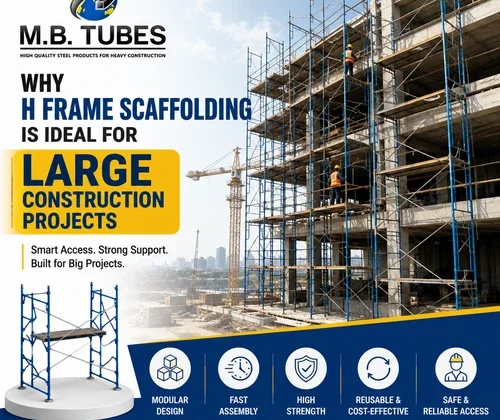
Among the commonly used scaffolding systems, H Frame Scaffolding is valued for its straightforward configuration, practical assembly, versatility, and suitability for repetitive construction work.
For contractors and developers searching for an H Frame Scaffolding Manufacturer in Madhya Pradesh, understanding how the system works and where it can be used is important before making a purchase.
This guide explains the major advantages of H Frame Scaffolding and the factors buyers should consider when selecting it for large construction projects.
What Is H Frame Scaffolding?
H Frame Scaffolding is a modular scaffolding system built around prefabricated steel frames shaped similarly to the letter “H.”
The frames are typically connected using cross braces and other compatible components to create a temporary scaffolding structure.
Depending on the system design and project requirements, an H Frame scaffolding setup may include:
- H frames
- Cross braces
- Connecting pins
- Base plates
- Adjustable base jacks
- Working platforms
- Guardrails
- Toe boards
- Access components
- Other supporting accessories
Its modular configuration allows scaffolding sections to be assembled in a systematic manner across suitable construction areas.
However, the actual configuration, height, loading, bracing, anchoring, foundation and access arrangement should always be determined according to the project’s engineering and safety requirements.
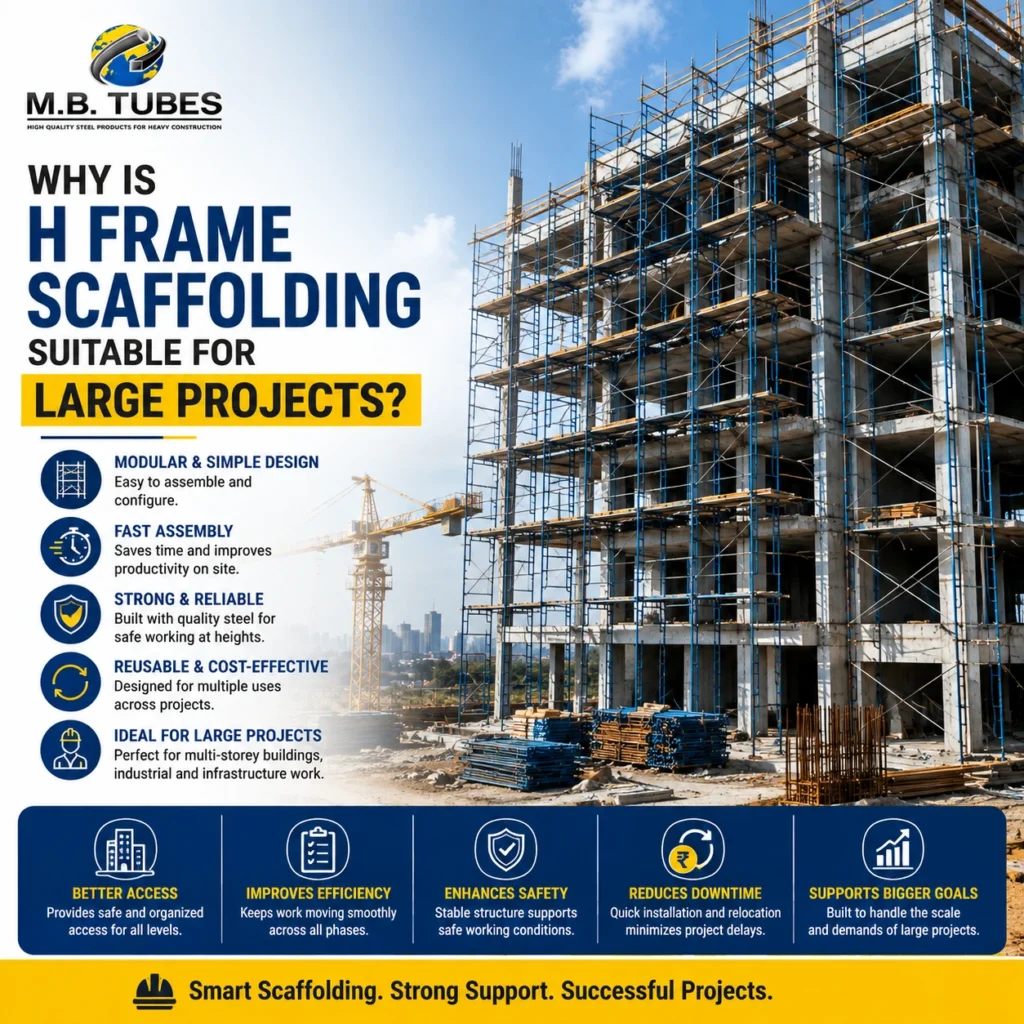
Why Is H Frame Scaffolding Suitable for Large Projects?
Large construction projects involve repetitive work across multiple floors, elevations, walls or building sections.
A practical scaffolding system should therefore provide a balance between accessibility, installation efficiency, component consistency and adaptability.
H Frame Scaffolding can be particularly useful where contractors require repeated scaffolding arrangements across relatively regular building elevations.
Let’s examine its major advantages.
1. Simple Modular Design
One of the biggest advantages of H Frame Scaffolding is its relatively straightforward modular construction.
Instead of fabricating an entirely new temporary structure for every working area, standard frames and compatible components can be assembled into the required arrangement.
For large projects, this modular approach can make:
- Material planning easier
- Component identification simpler
- Assembly more systematic
- Dismantling more organised
- Storage more manageable
- Repeat installation more practical
A standardised system can be especially valuable when similar scaffolding arrangements are required repeatedly across a project.
2. Faster Assembly and Dismantling
Construction schedules are often tight, particularly on commercial and infrastructure projects.
Scaffolding that takes excessive time to assemble, relocate or dismantle can affect site productivity.
H Frame systems use prefabricated components, which can make assembly comparatively straightforward when performed by trained personnel according to an approved scaffolding plan.
Once work in one section is completed, reusable components can potentially be dismantled, inspected and moved to another suitable area.
This can help contractors manage temporary access requirements efficiently throughout different construction phases.
Speed, however, should never come at the expense of correct assembly, bracing, anchoring, inspection or safe working practices.
3. Suitable for Repetitive Building Work
Large residential and commercial projects often contain repetitive building elevations and floor layouts.
H Frame Scaffolding can be particularly practical for activities carried out across long or relatively uniform building surfaces.
Typical applications may include:
Exterior Finishing
Workers may require temporary access for plastering, painting, cladding or finishing work.
Masonry Work
Scaffolding can provide working access at different heights during suitable masonry applications.
Repair and Maintenance
Existing commercial and industrial buildings may require temporary access for repair, renovation or maintenance activities.
Facade Work
Large building elevations often require organised working access across multiple levels.
The final scaffolding arrangement must always match the specific site and application.
4. Provides Organised Working Access
Large construction projects may involve multiple teams working on different areas of a structure.
An appropriately designed H Frame scaffolding arrangement can provide organised working levels and access routes for suitable activities.
This can make it easier to plan:
- Working platforms
- Vertical access
- Different working levels
- Material movement
- Work zones
- Inspection points
The scaffolding should include all required safety components and access provisions according to applicable project requirements.
5. Strong Steel Construction
H Frame Scaffolding is commonly manufactured using steel components designed for repeated construction use.
The quality of the steel, pipe dimensions, wall thickness, welding, fabrication and overall manufacturing consistency all influence the characteristics of the finished components.
This is why contractors should avoid selecting scaffolding solely on the basis of price.
When evaluating an H Frame Scaffolding Manufacturer in Madhya Pradesh, ask about:
- Material specifications
- Frame dimensions
- Pipe thickness
- Welding quality
- Cross-brace specifications
- Surface finish
- Manufacturing tolerances
- Quality inspection
- Available technical documentation
The required specifications should always correspond with the intended application and engineering requirements.
6. Consistent Dimensions Support Easier Installation
Dimensional consistency becomes increasingly important as the scale of a project grows.
Imagine a project requiring hundreds of H Frames. If frame dimensions, connection points or braces vary significantly between components, site teams may face unnecessary fitting and alignment problems.
Consistent manufacturing helps ensure better compatibility between components.
It can contribute to:
Better alignment – Frames can be positioned more systematically.
Component compatibility – Matching braces and accessories can connect as intended.
Reduced adjustments – Site teams spend less time dealing with avoidable dimensional variations.
Efficient inventory management – Standard components are easier to organise and identify.
For bulk orders, buyers should therefore evaluate consistency across production batches.
7. Reusable for Suitable Future Projects
Scaffolding is a temporary construction system, but that does not necessarily mean it is a one-time-use product.
Quality H Frame Scaffolding may be reused across suitable projects when components remain in acceptable condition and are correctly handled, inspected, maintained and stored.
This can make the system commercially practical for contractors who regularly undertake building projects.
Before reusing any component, it should be checked for issues such as:
- Bending
- Cracks
- Damaged welds
- Excessive corrosion
- Distortion
- Damaged connection points
- Missing components
Any component that does not satisfy the required condition should not simply be returned to service without appropriate evaluation.
8. Easier Transportation and Storage
Large construction companies frequently move scaffolding between project sites.
The modular nature of H Frame Scaffolding can make transportation and storage more organised compared with irregular temporary structures.
Frames, braces and accessories can be sorted by type and size.
Good storage practices can also help:
- Reduce component loss
- Simplify inventory counting
- Identify damaged components
- Improve loading and unloading
- Prepare materials for the next project
Proper handling and storage can contribute to longer usable product life.
9. Suitable for Different Construction Environments
H Frame Scaffolding can be considered for various projects where its configuration is appropriate.
Applications may include:
- Residential buildings
- Commercial complexes
- Institutional buildings
- Industrial facilities
- Warehouses
- Building renovation
- Facade work
- Maintenance projects
- General civil construction
However, no single scaffolding system is ideal for every construction environment.
Irregular structures, unusual elevations, heavy loading requirements, confined areas or specialised industrial work may require another scaffolding configuration.
The system should therefore be selected according to the actual project rather than simply because it is commonly available.
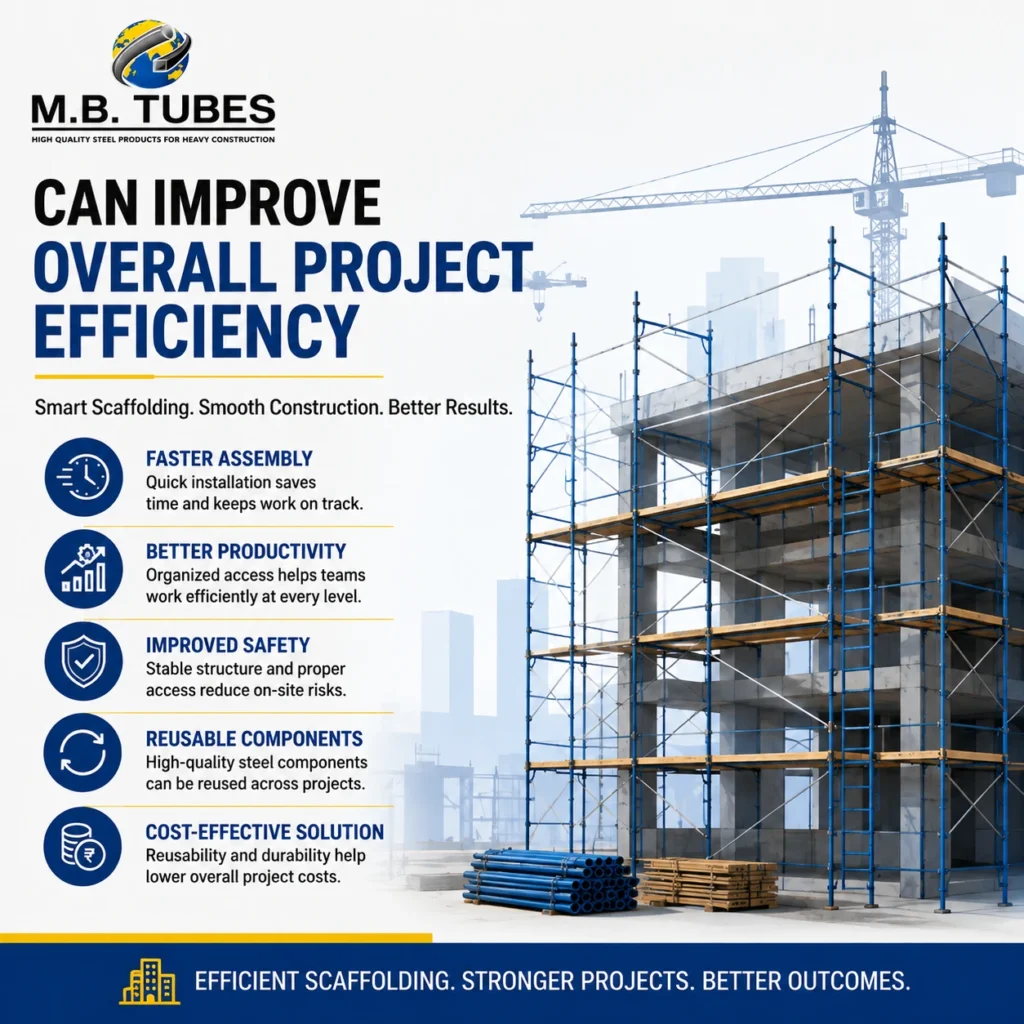
10. Can Improve Overall Project Efficiency
Efficiency in a large construction project is influenced by hundreds of small operational decisions.
Scaffolding is one of them.
A properly planned modular scaffolding system can help construction teams organise access, working areas, material requirements and project sequencing.
H Frame Scaffolding can contribute to efficient site operations through:
- Systematic assembly
- Repetitive component use
- Organised working access
- Easier material planning
- Practical dismantling
- Component reuse
- Simplified storage
For contractors managing several projects simultaneously, standardising suitable scaffolding components can also make procurement and inventory planning easier.
H Frame Scaffolding vs Other Scaffolding Systems
Different scaffolding systems serve different construction requirements.
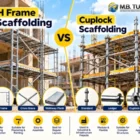
H Frame Scaffolding
Often suitable for relatively regular building elevations, general construction, facade access and repetitive building work.
Cuplock Scaffolding
A modular system commonly considered for construction and industrial applications where different configurations may be required.
Pipe and Clamp Scaffolding
Can provide flexibility for irregular structures but typically involves individual tubes and connecting clamps.
The correct system depends on factors such as:
- Structure geometry
- Working height
- Required loading
- Access requirements
- Project duration
- Site conditions
- Intended work
- Engineering design
Rather than asking which scaffolding system is universally “best,” contractors should determine which system is most appropriate for their specific project.
How to Choose Quality H Frame Scaffolding
Before placing an order, procurement teams should prepare a clear technical requirement.
Consider the following factors.
Material Quality
Confirm the required steel and component specifications.
Frame Dimensions
Verify height, width, pipe diameter and other required dimensions.
Wall Thickness
Pipe thickness should correspond with the required product and engineering specification.
Welding Quality
Inspect fabricated joints and connection areas for manufacturing consistency.
Cross Braces
Ensure braces are compatible with the selected frames and intended configuration.
Surface Finish
Select an appropriate finish based on project environment, storage and usage conditions.
Load Requirements
Never estimate load capacity based on appearance. Obtain appropriate technical information and engineering verification.
Quantity
Plan the number of frames, braces, platforms, jacks and accessories required for the complete system.
Quality Inspection
For bulk orders, establish appropriate inspection requirements before dispatch.
Why Manufacturer Selection Matters
Even a well-designed scaffolding concept depends on properly manufactured components.
A reliable manufacturer should be able to maintain consistency across dimensions, fabrication, welding and supply.
Before selecting a supplier, ask:
- Does the manufacturer understand construction scaffolding?
- Can they handle bulk requirements?
- Are dimensions consistent?
- What quality checks are performed?
- Are product specifications clearly communicated?
- Can repeat requirements be supplied?
- Are related scaffolding components available?
- Can deliveries be planned according to project requirements?
Contractors should consider the complete supply relationship rather than evaluating only the first quotation.
H Frame Scaffolding Manufacturer in Madhya Pradesh – M.B. Tubes
For contractors, builders, infrastructure companies and industrial project teams looking for an H Frame Scaffolding Manufacturer in Madhya Pradesh, M.B. Tubes provides scaffolding and steel solutions for different construction requirements.
With experience in steel products and construction support solutions, the focus is on providing products according to clearly defined customer and project specifications.
Businesses sourcing H Frame Scaffolding in Madhya Pradesh should communicate important requirements such as:
- Required frame dimensions
- Quantity
- Pipe specifications
- Accessories
- Surface finish
- Application
- Delivery location
- Project schedule
Clearly defined requirements help manufacturers and buyers coordinate more effectively before production and dispatch.
Applications Across Madhya Pradesh
Construction activity across Madhya Pradesh includes residential development, industrial expansion, warehouses, commercial buildings and infrastructure projects.
H Frame Scaffolding requirements may therefore arise across industrial and construction locations such as:
Indore, Pithampur, Dewas, Bhopal, Mandideep, Ujjain, Ratlam, Dhar, Jabalpur, Gwalior, Sagar, Rewa, Satna and other parts of Madhya Pradesh.
For contractors operating across several locations, working with an H Frame Scaffolding Manufacturer in Madhya Pradesh can make regional procurement and repeat supply coordination more convenient.
Supplier location, however, should always be considered alongside product specifications, quality and manufacturing capability.
Final Thoughts
H Frame Scaffolding remains a practical option for many large construction projects because of its modular design, straightforward assembly, repetitive usability and organised working configuration.
Its effectiveness ultimately depends on choosing the correct system and specifications for the intended project.
Before purchasing, evaluate:
Material Quality + Dimensions + Fabrication + Compatibility + Engineering Requirements + Manufacturer Reliability
Choosing appropriate scaffolding from a dependable H Frame Scaffolding Manufacturer in Madhya Pradesh can help contractors create a more organised and efficient scaffolding procurement process for large construction requirements.
For project-specific requirements, discuss dimensions, quantities, specifications and application details with M.B. Tubes before placing your order.
Frequently Asked Questions (FAQs)
1. Why is H Frame Scaffolding suitable for large construction projects?
H Frame Scaffolding offers a modular design, easy assembly, organised working access, and reusable components, making it practical for large construction projects.
2. Where is H Frame Scaffolding commonly used?
It is commonly used for residential buildings, commercial complexes, industrial facilities, facade work, renovation, and general construction projects.
3. How do I choose quality H Frame Scaffolding?
Check the steel quality, frame dimensions, pipe thickness, welding, cross braces, surface finish, and required load specifications before purchasing.
4. Is H Frame Scaffolding reusable?
Yes. Quality H Frame Scaffolding can be reused when components are properly handled, inspected, maintained, and remain suitable for use.
5. How do I choose an H Frame Scaffolding Manufacturer in Madhya Pradesh?
Choose an H Frame Scaffolding Manufacturer in Madhya Pradesh that provides consistent quality, accurate dimensions, reliable manufacturing, bulk supply capability, and suitable scaffolding components.