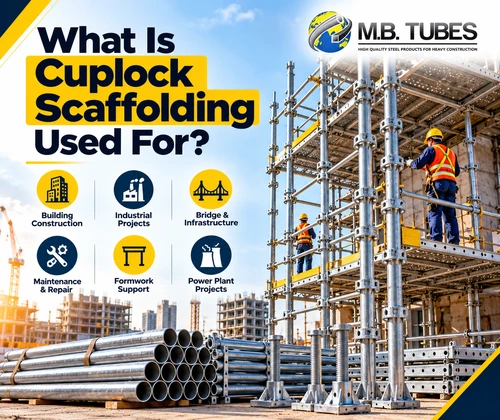

What Is Cuplock Scaffolding Used For?
On a construction site, scaffolding is not simply a collection of steel tubes. It has to create practical access, working platforms and, in suitable configurations, temporary support around the actual work being carried out. This is where Cuplock Scaffolding becomes useful.
Cuplock Scaffolding is a modular steel scaffolding system used across building construction, industrial plants, bridges, infrastructure projects, maintenance work and suitable formwork-support applications. Its cup-and-blade connection allows compatible horizontal and vertical members to form an organized scaffold structure without using separate nuts and bolts at every standard connection. M.B. Tubes lists Cuplock among its core scaffolding systems and offers standards, ledgers, transoms, braces, jacks, planks and related components for different project requirements. MB Tubes
What Is Cuplock Scaffolding?
Cuplock Scaffolding is a modular scaffolding system built mainly around vertical standards and horizontal ledgers.
The feature that gives the system its name is the cup-and-blade locking mechanism. Horizontal members connect to cups positioned on the vertical standards. This creates a systematic connection between the main scaffold members and reduces dependence on numerous loose nuts and bolts at these standard joints. MB Tubes
A typical Cuplock system can include:
Cuplock Standards — Main vertical members of the scaffold.
Cuplock Ledgers — Horizontal members connecting the standards.
Intermediate Transoms — Help support scaffold boards between ledgers and distribute platform loads.
Diagonal Braces — Add rigidity and help control unwanted movement.
Base Plates or Adjustable Base Jacks — Provide support at the bottom and allow adjustment where required.
U Head Jacks — Used at the top in suitable formwork arrangements to support beams, slabs or shuttering.
Steel or Walkway Planks — Create working-platform areas.
The exact combination should always be selected according to the project, scaffold design, working height, loading and access requirements.
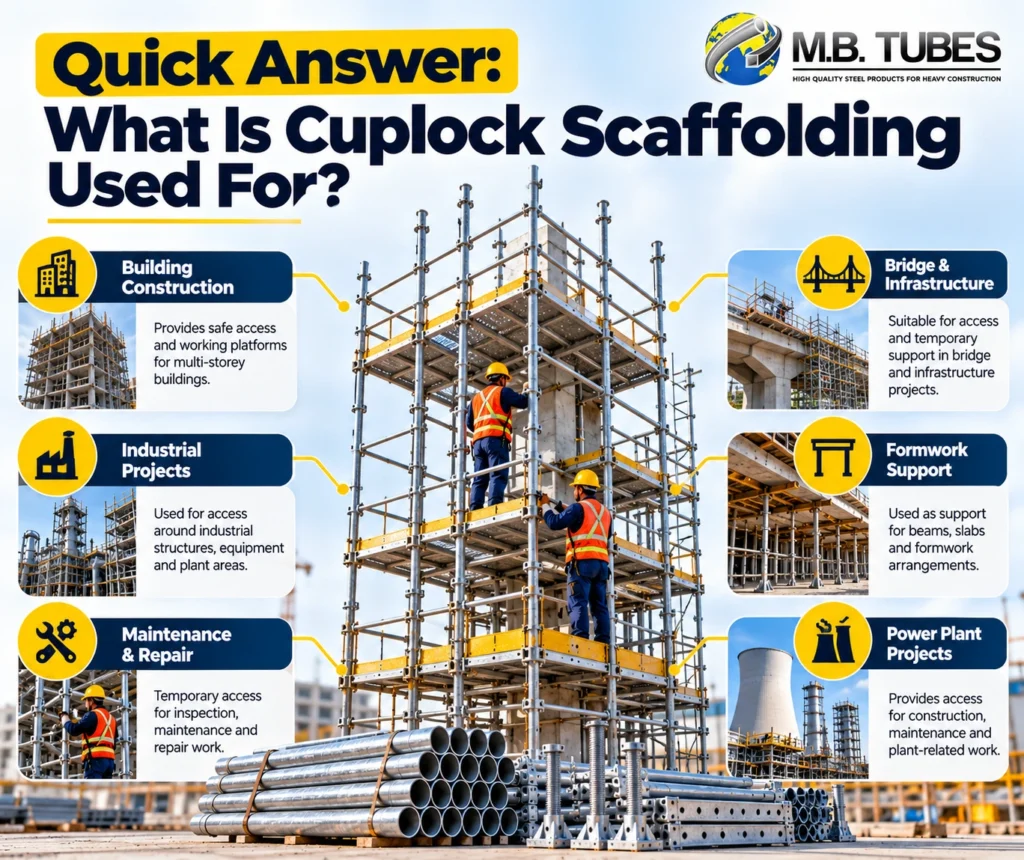
Quick Answer: What Is Cuplock Scaffolding Used For?
Cuplock Scaffolding is primarily used where a project needs a modular temporary access or support system that can be assembled in planned configurations.
Its common applications include:
Application | How Cuplock Scaffolding Is Used |
Building Construction | Access and working platforms around structures |
High-Rise Projects | Repeated scaffold arrangements across different levels |
Industrial Plants | Access around industrial structures and work areas |
Bridges | Access and suitable temporary support arrangements |
Infrastructure | Modular scaffolding for different project zones |
Formwork | Support arrangements when appropriately designed |
Maintenance | Temporary access for inspection and repair activities |
Power Plants | Access around plant structures and maintenance areas |
Warehouses | Construction and structural work access |
M.B. Tubes specifically identifies applications including high-rise buildings, commercial complexes, industrial plants, factories, warehouses, power plants, bridges, metro projects, infrastructure, maintenance and repair work. MB Tubes
1. Cuplock Scaffolding for Building Construction
One of the most common uses of Cuplock Scaffolding is building construction.
Think about a multi-storey building. Work is rarely limited to ground level. Different teams may need access for masonry, structural work, installation, finishing or other construction activities at different elevations.
A modular scaffold can be arranged around the required working zones to create accessible working levels.
For repetitive building layouts, the workflow can become:
Assemble → Use → Inspect → Dismantle → Shift → Reassemble
This repeatability is particularly useful on projects where similar scaffold arrangements are required across multiple floors or work zones. M.B. Tubes also highlights modularity and reuse as important characteristics of Cuplock systems for repetitive construction. MB Tubes
2. Cuplock Scaffolding for High-Rise Projects
High-rise projects bring a different challenge: the work location keeps moving upward.
The scaffolding system therefore needs to be planned around working levels, access requirements, platform arrangements, bracing and the changing construction sequence.
Cuplock’s standardized components make it suitable for creating modular arrangements where the project design permits.
However, “high-rise” should never be interpreted as simply adding more components vertically.
As scaffold height and configuration change, factors such as bracing, connections, foundations, access, loading and engineering requirements become increasingly important.
The scaffold must be designed for the actual site configuration rather than selected only because Cuplock is a modular system.
3. Cuplock Scaffolding for Industrial Plants
Industrial sites often contain equipment, pipe routes, structural steel, machinery and work areas at multiple elevations.
This makes access planning more complex than simply placing scaffolding against a straight building wall.
Cuplock Scaffolding can be used for suitable access and maintenance applications around industrial structures. M.B. Tubes lists industrial plants, factories, power plants, petrochemical facilities and similar industrial environments among Cuplock applications. MB Tubes
For an industrial project, the better question is therefore not:
“How much scaffolding do we need?”
It is:
Work Area → Required Access → Working Height → Platform Requirement → Scaffold Configuration → Components Required
That approach makes procurement more closely connected to the actual job.
4. Cuplock Scaffolding for Bridge & Infrastructure Projects
Bridges and infrastructure projects can involve large working areas, changing elevations and different temporary-access requirements.
Cuplock’s modular arrangement can make it suitable for selected bridge and infrastructure applications when the system is properly configured for the project.
M.B. Tubes identifies bridges, metro projects and infrastructure developments among applications for its Cuplock systems. MB Tubes
Here again, modularity is useful—but project-specific planning remains essential.
Dimensions, support conditions, required working levels, intended loading and component arrangement should be established before ordering material.
5. Cuplock Scaffolding for Formwork Support
Cuplock is not limited to providing access for workers.
Appropriately designed configurations can also form part of temporary support arrangements for formwork, beams, slabs and shuttering systems.
For example, M.B. Tubes describes the U Head Jack as a top component used with Cuplock systems for slab formwork, beam and shuttering support.
A simplified support arrangement may look like:
Base Support → Cuplock Standards → Ledgers & Bracing → U Head Jack → Beam/Formwork
But this should be understood as a functional concept rather than a universal scaffold design.
Formwork loads and temporary-support requirements need to be considered for the specific structure.
6. Cuplock Scaffolding for Maintenance & Repair
Not every scaffold is installed while constructing something new.
Existing buildings, factories, power plants and industrial structures also need inspection, maintenance and repair.
Workers may need temporary access to elevated or difficult-to-reach locations.
In such cases, Cuplock Scaffolding can provide a modular access arrangement for suitable maintenance activities. M.B. Tubes lists maintenance and repair work among its Cuplock applications. MB Tubes
The configuration may be very different from one used for new construction because maintenance access has to work around the existing structure, equipment and available space.
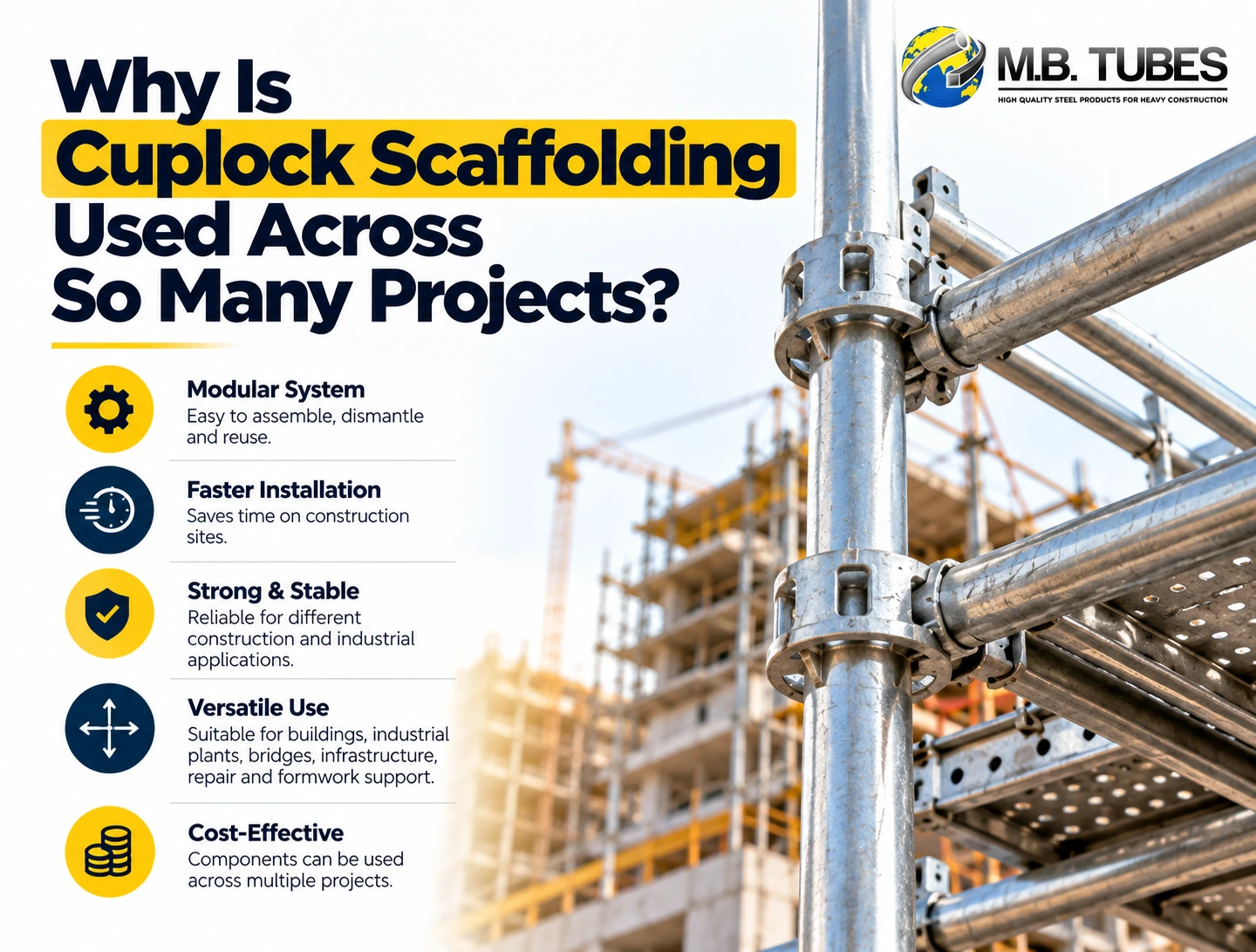
Why Is Cuplock Scaffolding Used Across So Many Projects?
The answer comes down to its system-based design.
Cuplock Scaffolding is not one product doing every job. It is a combination of compatible components that can be configured according to different project requirements.
Its practical advantages include modular construction, systematic connections, reusable components, easier material organization and suitability for different construction and industrial applications. MB Tubes
A useful way to understand it is:
One system. Different configurations. Different applications.
That is also why choosing the correct components matters as much as choosing the system itself.
Cuplock Scaffolding Components and Their Purpose
A complete scaffold should be considered as a system rather than only standards and ledgers.
For example:
Standards provide vertical support.
Ledgers connect the standards horizontally.
Transoms help support the working-platform arrangement.
Diagonal braces improve rigidity.
Base jacks provide bottom adjustment and support.
U Head Jacks serve suitable top-support applications.
Steel planks create working surfaces.
M.B. Tubes also supplies related scaffolding accessories for Cuplock and other scaffolding/formwork systems. MB Tubes
This means procurement should focus on the complete required configuration, not simply the number of steel pipes.
How Do You Choose Cuplock Scaffolding for a Project?
Start with the application rather than immediately asking for a price.
Before requesting a quotation, identify:
Project Type → Work Area → Required Working Height → Scaffold Length & Width → Intended Use → Working Platform Requirement → Expected Loading → Required Components → Quantity → Surface/Finish Requirement → Delivery Schedule
For repetitive projects, also consider how the components will be dismantled, stored, moved and reused between different work zones.
This creates a much clearer purchase requirement and reduces the risk of ordering an incomplete combination of components.
A Common Buying Mistake: Comparing Only Price
Two Cuplock quotations may look similar while representing different specifications or component combinations.
Instead of comparing only the final rate, compare:
Material + Dimensions + Component Type + Quantity + Surface Finish + Compatibility + Required Configuration + Manufacturing Quality
Another important mistake is assuming that one load figure applies to every Cuplock arrangement.
For example, one specific M.B. Tubes MS Scaffolding product page currently lists a 1200 kg/m² system load capacity, along with a 48.3 mm pipe outer diameter, 0.6 m platform width and IS 1161 material specification. Those specifications belong to that listed product and should not automatically be treated as the rating for every Cuplock configuration or project. MB Tubes
Cuplock Scaffolding from M.B. Tubes
M.B. Tubes’ scaffolding range includes Cuplock Scaffolding, H Frame Scaffolding, Telescopic Steel Props, Scaffolding Pipes & Tubes, Scaffolding Towers, Walkway Planks, Shuttering Plates, Bridge Formwork, Adjustable Jacks, Adjustable Spans and Scaffolding Accessories.
For Cuplock specifically, available components listed by the company include standards, ledgers, intermediate transoms, diagonal braces, base jacks/base plates, U Head Jacks and other compatible components.
The right combination should be selected according to the project’s actual application rather than treating every construction site as requiring the same setup.
Final Thoughts
So, what is Cuplock Scaffolding used for?
It is used wherever a project needs an organized modular scaffolding system for temporary access, working platforms or appropriately designed support arrangements—from buildings and industrial plants to bridges, infrastructure and maintenance projects.
The real advantage of Cuplock Scaffolding is not simply that it can be assembled from steel components. It is that those components work together as a system that can be planned around different project requirements.
For better results, follow a simple approach:
Understand the Work → Plan the Access → Select the Configuration → Choose the Components → Verify Requirements → Install & Inspect
That turns scaffolding procurement from “buying material” into planning a system for the actual job.
Frequently Asked Questions
What is Cuplock Scaffolding mainly used for?
Cuplock Scaffolding is used for temporary access, working platforms and suitable support arrangements in building construction, high-rise projects, industrial plants, bridges, infrastructure, power plants and maintenance work. The exact scaffold configuration depends on the project and intended application.
Why is Cuplock Scaffolding popular in construction?
Its modular components and cup-and-blade connection make it practical for systematic assembly, dismantling and reuse. It can also be configured for different construction and industrial applications, subject to the project’s design and loading requirements.
Can Cuplock Scaffolding be used for formwork?
Yes. Appropriately designed Cuplock configurations can form part of temporary formwork-support arrangements. Components such as U Head Jacks can be used for suitable beam, slab and shuttering support applications. The actual arrangement should match the project’s structural and temporary-works requirements.
What are the main components of Cuplock Scaffolding?
Common components include Cuplock Standards, Ledgers, Intermediate Transoms, Diagonal Braces, Base Plates or Adjustable Base Jacks, U Head Jacks and Steel/Walkway Planks. The required components depend on the intended scaffold configuration.
What should I check before buying Cuplock Scaffolding?
Check the intended application, dimensions, working height, loading requirements, platform arrangement, component compatibility, quantity, material specifications, surface finish and project schedule. Buyers should compare the complete system requirement rather than making a decision only on price.