
Cuplock Scaffolding Components & Their Uses
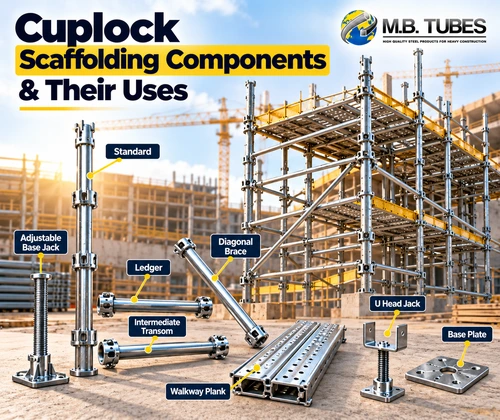
A Cuplock Scaffolding system may look simple from a distance, but every component has a specific job. Standards carry the vertical arrangement, ledgers connect the system horizontally, braces improve rigidity, while jacks and platforms help create a practical working setup.
Understanding these components is important before ordering scaffolding because buying the right system is not only about quantity. The components need to work together according to the required height, platform arrangement, access needs and project configuration.
This guide explains the main Cuplock Scaffolding Components, what they do and where they are commonly used—in straightforward language for contractors, engineers, procurement teams and project buyers.
What Are Cuplock Scaffolding Components?
Cuplock Scaffolding Components are the individual steel members and accessories assembled together to create a modular scaffolding system.
Unlike treating scaffolding as a collection of separate pipes, Cuplock works as an interconnected system. Its characteristic cup-and-blade connection allows compatible horizontal members to connect with vertical standards at predetermined points.
A typical system may include:
Standards → Ledgers → Transoms → Diagonal Braces → Base Jacks → U Head Jacks → Walkway Planks → Accessories
Not every project requires exactly the same combination. The final arrangement depends on whether the scaffolding is being used for construction access, maintenance, industrial work, infrastructure or an appropriately designed formwork-support application.
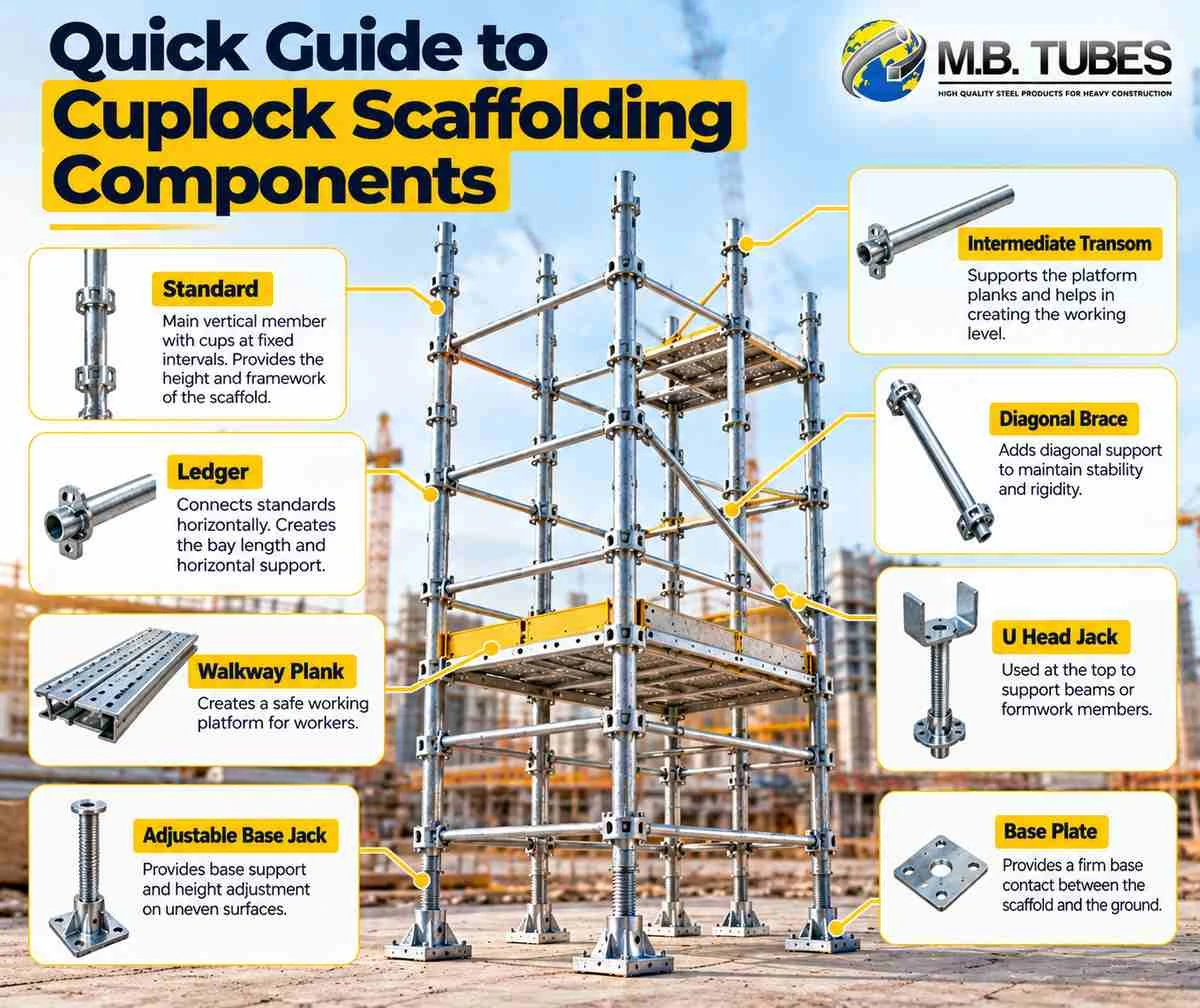
Quick Guide to Cuplock Scaffolding Components
Component | Main Function | Typical Position |
Cuplock Standard | Main vertical member | Vertical |
Cuplock Ledger | Connects standards horizontally | Horizontal |
Intermediate Transom | Supports platform arrangement | Horizontal |
Diagonal Brace | Adds diagonal restraint | Diagonal |
Adjustable Base Jack | Base support and adjustment | Bottom |
Base Plate | Provides base contact | Bottom |
U Head Jack | Supports suitable top members | Top |
Walkway Plank | Creates working surface | Platform level |
Couplers & Accessories | Connections and special requirements | As required |
This table gives a quick answer, but choosing the components correctly requires understanding what each one contributes to the complete system.
1. Cuplock Standards — The Vertical Members
The Cuplock Standard is one of the most important parts of the system.
Standards are installed vertically and form the main upright framework of Cuplock Scaffolding. Cups are positioned along the standard at defined intervals so compatible horizontal components can be connected.
Think of the standards as the vertical skeleton of the scaffold.
Their main uses include creating scaffold height, providing vertical connection points, forming repeated bays and working with ledgers, braces and other compatible components.
A project may require standards of different lengths depending on the working height and scaffold configuration.
The important point is that standard length should not be selected independently. The overall scaffold geometry, base condition, required working levels and design requirements should be considered together.
2. Cuplock Ledgers — The Horizontal Connection
If standards create the vertical framework, Cuplock Ledgers create the horizontal framework.
Ledgers connect one standard to another and help establish the length and bay arrangement of the scaffold.
Their role can be understood simply:
Standards = Vertical Framework
Ledgers = Horizontal Framework
Ledgers are available in different lengths to suit different scaffold layouts. The required ledger length therefore depends on the bay size and project configuration.
When planning material quantity, buyers should avoid ordering standards first and treating ledgers as an afterthought. Both work together to define the basic scaffold arrangement.
3. Intermediate Transoms — Supporting the Working Platform
Workers need more than a steel framework—they need a properly arranged working surface.
This is where Intermediate Transoms become relevant.
Transoms are horizontal members positioned across the scaffold arrangement. Depending on the system configuration, they can help support scaffold boards or planks and contribute to the working-platform arrangement.
A simplified layout is:
Standard + Ledger + Transom + Platform
The required number and spacing should be determined according to the actual system and platform configuration rather than applying one standard quantity to every project.
4. Diagonal Braces — Helping Maintain Rigidity
A scaffold made only from vertical and horizontal members does not explain the complete stability arrangement.
Diagonal Braces are used diagonally between scaffold members to help maintain rigidity and control unwanted movement in the system.
They are particularly important as the scaffold becomes larger or more complex.
Their purpose is not simply to “add more steel.” They form part of the scaffold’s overall bracing arrangement.
A useful way to remember their role is:
Standards create height → Ledgers create bays → Braces help maintain the arrangement.
The correct bracing requirement depends on the scaffold design, dimensions, height and site conditions.
5. Adjustable Base Jacks — Adjustment Starts at the Bottom
Scaffolding needs an appropriate base arrangement before workers ever reach the platform.
An Adjustable Base Jack is installed at the bottom of a scaffold standard and provides controlled vertical adjustment within the applicable system limits.
It is especially useful where minor level adjustments are required.
The basic arrangement is:
Supporting Surface → Base Jack → Standard → Scaffold Structure
However, a base jack should not be considered a solution for unsuitable ground conditions. The supporting surface itself must be appropriate for the scaffold arrangement.
This distinction is important:
Base Jack = Bottom adjustment
U Head Jack = Top support application
Confusing the two is a common procurement mistake.
6. Base Plates — Creating the Bottom Contact Point
A Base Plate is another component used at the bottom of a scaffold.
Its role is to provide a contact point between the vertical member and the supporting arrangement below.
Whether a project requires a fixed base plate, adjustable base jack or another engineered base arrangement depends on the scaffold configuration and site requirements.
The base should never be treated as a minor accessory. Everything above it ultimately depends on an appropriately planned foundation and support condition.
7. U Head Jacks — Support at the Top
While the base jack works at the bottom, the U Head Jack is generally used at the top of a suitable support arrangement.
Its U-shaped head can receive compatible beams or formwork members.
It is commonly associated with suitable temporary support applications involving slabs, beams, shuttering and formwork.
A simplified arrangement may be:
Base Jack → Vertical Support → U Head Jack → Beam/Formwork
This does not mean every Cuplock scaffold requires a U Head Jack. It is selected when the particular application requires top support.
8. Walkway Planks — Creating a Working Surface
A scaffold only becomes useful for many access applications when workers have an appropriate platform from which to perform their tasks.
Scaffolding Walkway Planks or steel planks are used to create working surfaces within suitable scaffold arrangements.
They may be required for activities such as construction, inspection, installation, maintenance and repair.
When choosing walkway planks, buyers should consider compatibility, dimensions, platform layout and the intended application rather than simply purchasing planks based on length.
Platform planning should be considered as part of the complete scaffold configuration.
9. Scaffolding Couplers and Accessories
Even a modular system can require additional scaffolding accessories depending on the project.
M.B. Tubes’ broader scaffolding range includes components such as fixed couplers, swivel couplers, joint pins, sleeve couplers, ladder clamps, beam or girder couplers and related accessories.
These can serve different connection or project-specific requirements.
The important buying principle is:
Do not add an accessory simply because it is commonly used in scaffolding. Add it because the planned system requires it.
Compatibility between components should always be checked before procurement.
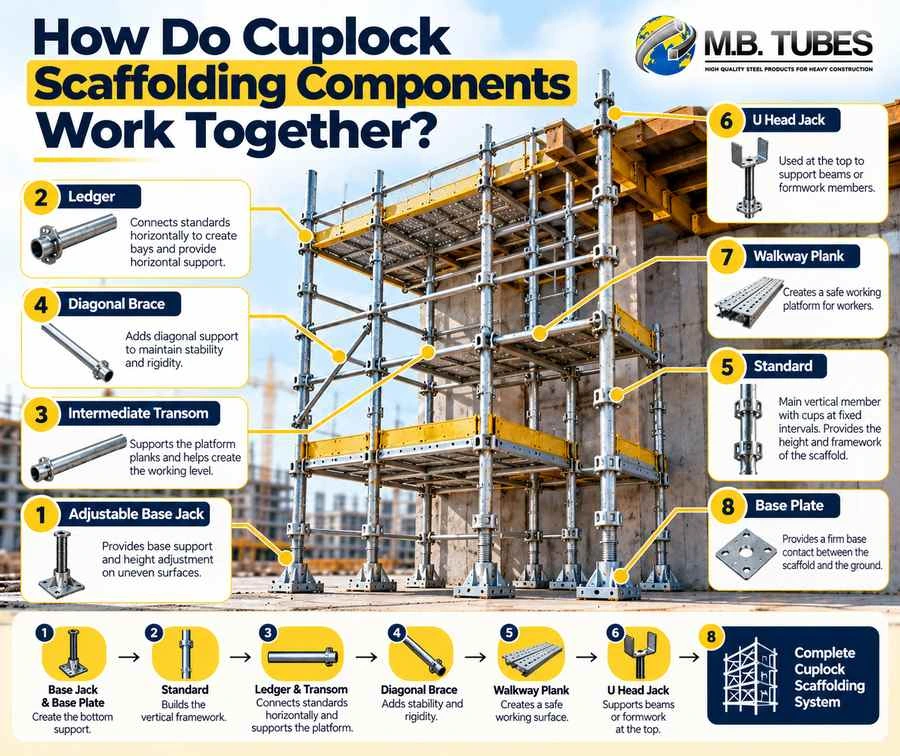
How Do Cuplock Scaffolding Components Work Together?
The easiest way to understand Cuplock is to stop looking at each component individually.
Imagine constructing one scaffold bay.
First, the base arrangement establishes the bottom support.
Next, standards create the vertical framework.
Ledgers connect those standards horizontally.
Transoms help establish the platform-support arrangement.
Diagonal braces contribute to rigidity.
Walkway planks create the required working surface.
Where an appropriately designed top-support application is required, U Head Jacks may become part of the system.
So the complete logic becomes:
Base → Vertical Framework → Horizontal Connections → Bracing → Platform → Access/Support Requirement
This system-based thinking makes procurement much clearer.
Where Are Cuplock Scaffolding Components Used?
Cuplock systems can be configured for a wide variety of projects.
Common applications include building construction, commercial projects, industrial plants, factories, warehouses, high-rise developments, bridges, infrastructure projects, power plants, maintenance and repair work.
Appropriately designed configurations may also be used with formwork and temporary support systems.
The components required for a building façade scaffold may therefore differ considerably from those required around industrial equipment or for a temporary support arrangement.
Same system does not mean same configuration.
That distinction is important when preparing a material list.
How to Choose the Right Cuplock Scaffolding Components
Before requesting a quotation, prepare a simple project requirement.
Start with:
Application → Required Height → Scaffold Length & Width → Bay Arrangement → Platform Requirement → Intended Loading → Base Condition → Required Components → Quantity → Finish → Delivery Location
If technical drawings or a component schedule are available, use them during procurement.
Also check component dimensions and compatibility. A lower-priced component that does not correctly match the rest of the system may create more problems than it solves.
Instead of asking only:
“What is the price of Cuplock Scaffolding?”
Ask:
“Which Cuplock Scaffolding Components does my planned configuration require?”
That is a much more useful buying question.
Common Mistakes When Ordering Cuplock Components
One common mistake is purchasing only standards and ledgers while overlooking braces, platform components, jacks and required accessories.
Another is mixing components without confirming compatibility.
Buyers may also assume that one component size, load figure or arrangement works for every scaffold. In reality, scaffold performance depends on the complete configuration, including dimensions, connections, bracing, platforms, supporting conditions and intended loading.
Finally, avoid comparing suppliers only by price per piece. Compare equivalent specifications, dimensions, material requirements, finish and complete system requirements.
Cuplock Scaffolding Components from M.B. Tubes
M.B. Tubes offers Cuplock Scaffolding as part of its wider construction and scaffolding product range.
The system includes key components such as Cuplock Standards, Ledgers, Intermediate Transoms, Diagonal Braces, Base Jacks, U Head Jacks and compatible scaffolding accessories.
The broader range also includes scaffolding pipes and tubes, walkway planks, adjustable props, adjustable spans, shuttering plates and other products for construction and industrial applications.
For project procurement, component requirements should be prepared according to the intended scaffold configuration, quantity and application.
Conclusion
Understanding Cuplock Scaffolding Components makes it much easier to plan, purchase and organize a complete scaffolding system.
The simplest way to remember the system is:
Standards build vertically. Ledgers connect horizontally. Transoms support the platform arrangement. Braces add diagonal restraint. Base Jacks provide bottom adjustment. U Head Jacks serve suitable top-support applications. Walkway Planks create working surfaces.
Rather than purchasing individual components in isolation, plan them as one connected system.
Understand the Project → Plan the Configuration → Select Components → Confirm Compatibility → Calculate Quantity → Procure the Complete System
That approach keeps the focus on what the project actually needs instead of simply buying more scaffolding material.
Frequently Asked Questions
What are the main Cuplock Scaffolding Components?
The main Cuplock Scaffolding Components include standards, ledgers, transoms, diagonal braces, base plates or adjustable base jacks, U Head Jacks and walkway planks. Additional couplers and accessories may be required depending on the scaffold configuration and application.
What is a Cuplock Standard used for?
A Cuplock Standard is the primary vertical member of the system. It provides connection points for compatible horizontal components and helps establish the height and vertical framework of the scaffold.
What is the difference between a standard and a ledger?
A standard is installed vertically, while a ledger connects standards horizontally. In simple terms, standards establish scaffold height and ledgers help create the horizontal bay arrangement.
Are Base Jacks and U Head Jacks the same?
No. Adjustable Base Jacks are generally positioned at the bottom for base-level adjustment, while U Head Jacks are used at the top in suitable support applications to receive compatible beams or formwork members.
How do I know which Cuplock components I need?
Start with the scaffold’s application, required dimensions, working height, platform arrangement, intended loading and site conditions. From these requirements, prepare a component schedule covering standards, ledgers, braces, transoms, jacks, platforms and any required accessories.