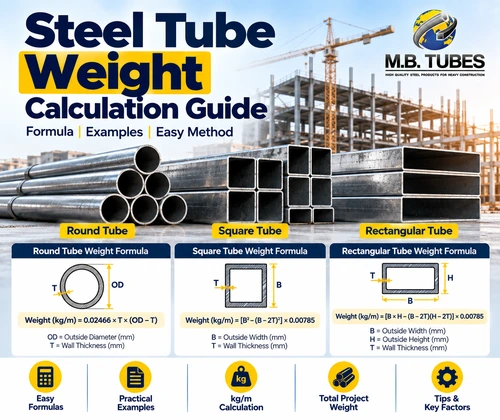

Steel Tube Weight Calculation Guide: How to Calculate Steel Tube Weight Accurately
When ordering steel tubes for a construction, fabrication, industrial, or structural project, dimensions are only part of the requirement. Buyers also need to understand Steel Tube Weight.
Weight affects material estimation, transportation planning, handling, procurement quantity, project costing, and fabrication planning. A small difference in wall thickness or tube size can create a significant difference when hundreds or thousands of metres are required.
The good news is that Steel Tube Weight can be estimated using the tube dimensions and steel density. The calculation changes slightly depending on whether the tube is round, square, or rectangular.
This guide explains the formulas in simple language, with practical examples and buying tips.
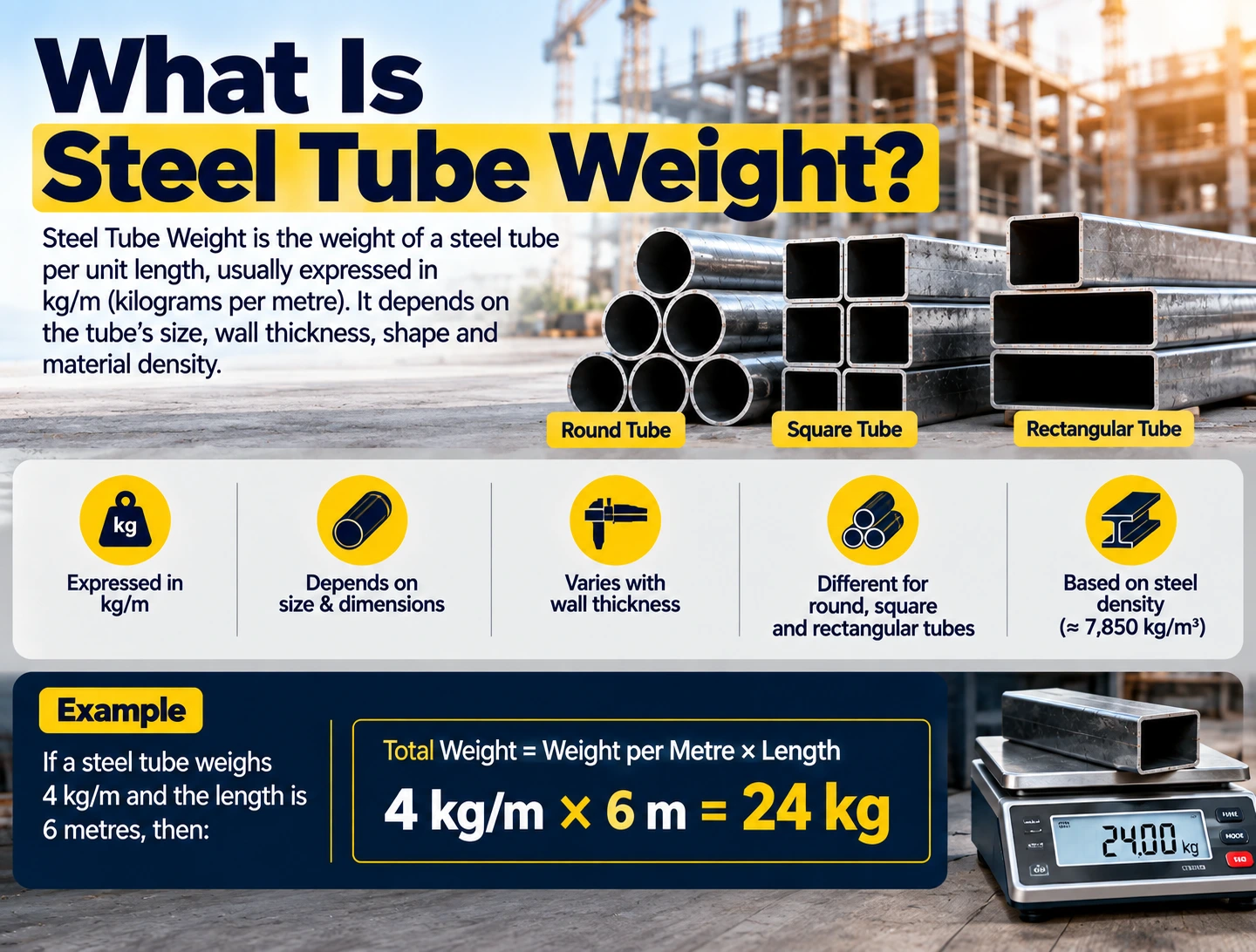
What Is Steel Tube Weight?
Steel Tube Weight is generally expressed as weight per unit length, such as kg/m (kilograms per metre).
For example, if a steel tube weighs 4 kg/m and you require a 6-metre length:
Total Weight = Weight per Metre × Length
4 × 6 = 24 kg
For 100 such tubes:
24 × 100 = 2,400 kg
This simple calculation helps convert a tube specification into an approximate total project quantity.
But before calculating total weight, you first need to know the tube’s weight per metre.
Why Is Steel Tube Weight Important?
Steel Tube Weight is not just a technical number on a specification chart. It can influence several practical decisions.
1. Material Quantity
Knowing kg/m helps estimate how much steel is required for a specific project length.
2. Procurement Planning
When steel is purchased or compared by weight, the estimated total tonnage becomes important for preparing enquiries and evaluating quantities.
3. Transportation
A 50-metre requirement and a 5,000-metre requirement need completely different loading and transportation planning.
4. Fabrication and Handling
Individual tube weight affects lifting, movement, storage, cutting, and fabrication arrangements.
5. Project Estimation
Engineers, contractors, fabricators, and procurement teams can use theoretical weight as one input while preparing material estimates.
A useful workflow is:
Tube Size → Wall Thickness → kg/m → Required Length → Total Weight
Steel Tube Weight Calculation Formula
Steel weight calculations are based on the cross-sectional area of steel, tube length, and density of the material.
For common calculations, the density of mild steel is typically taken as approximately:
7,850 kg/m³
Instead of performing the complete density conversion every time, simplified formulas are commonly used.
The correct formula depends on the tube shape.
Round Steel Tube Weight Formula
For a round tube, you need:
- Outside Diameter (OD)
- Wall Thickness (T)
- Length
A commonly used theoretical formula is:
Weight (kg/m) = 0.02466 × T × (OD − T)
Where:
- OD = outside diameter in mm
- T = wall thickness in mm
Example
Suppose:
OD = 48.3 mm
Wall Thickness = 3.2 mm
Then:
Weight = 0.02466 × 3.2 × (48.3 − 3.2)
≈ 3.56 kg/m
For a 6-metre tube:
3.56 × 6 ≈ 21.36 kg
So the theoretical weight of one 6-metre tube would be approximately 21.36 kg.
This is an estimation formula. Actual product mass can vary according to manufacturing tolerances and the applicable product specification.
Square Steel Tube Weight Calculation
Square hollow sections require a different calculation because their cross-section is rectangular rather than circular.
A simplified theoretical formula is:
Weight (kg/m) ≈ [B² − (B − 2T)²] × 0.00785
Where:
- B = outside width in mm
- T = wall thickness in mm
- 0.00785 converts the calculated cross-sectional area into approximate kg/m for steel.
Example: 40 × 40 × 2 mm Square Tube
Outer area:
40 × 40 = 1,600 mm²
Approximate inner dimension:
40 − (2 × 2) = 36 mm
Inner area:
36 × 36 = 1,296 mm²
Steel area:
1,600 − 1,296 = 304 mm²
Weight:
304 × 0.00785 ≈ 2.39 kg/m
Therefore, the simplified theoretical weight is approximately:
2.39 kg/m
For a 6-metre tube:
2.39 × 6 ≈ 14.34 kg
In real hollow sections, corner radii and manufacturing geometry mean catalogue or specified mass may differ from this simplified calculation. For purchasing, use the applicable product specification or confirmed supplier weight.
Rectangular Steel Tube Weight Calculation
For rectangular hollow tubes, use the outside width, outside height, and wall thickness.
A simplified theoretical formula is:
Weight (kg/m) ≈ [B × H − (B − 2T)(H − 2T)] × 0.00785
Where:
- B = outside width in mm
- H = outside height in mm
- T = wall thickness in mm
Example: 60 × 40 × 2 mm Rectangular Tube
Outer area:
60 × 40 = 2,400 mm²
Approximate inner dimensions:
56 × 36 mm
Inner area:
56 × 36 = 2,016 mm²
Steel area:
2,400 − 2,016 = 384 mm²
Approximate weight:
384 × 0.00785 ≈ 3.01 kg/m
For a 6-metre length:
3.01 × 6 ≈ 18.06 kg
Again, this is a simplified theoretical calculation rather than a guaranteed finished-product mass.
Quick Steel Tube Weight Calculation Table
Tube Type | Required Dimensions | Basic Calculation Method |
Round Tube | OD + Thickness | Calculate circular hollow section |
Square Tube | Width + Thickness | Outer area − inner area |
Rectangular Tube | Width + Height + Thickness | Outer area − inner area |
Total Tube Weight | kg/m + Length | kg/m × length |
Project Weight | Tube weight + Quantity | Weight per tube × quantity |
This makes it easier to remember what information you need before starting the calculation.
How to Calculate Total Steel Tube Weight for a Project
Once you know the weight per metre, project calculation becomes much easier.
Use:
Total Weight = Weight per Metre × Total Length
Suppose your selected tube is:
3.5 kg/m
And the project requires:
1,200 metres
Then:
3.5 × 1,200 = 4,200 kg
Convert kilograms to metric tonnes:
4,200 ÷ 1,000 = 4.2 tonnes
Therefore, the estimated requirement is approximately 4.2 tonnes.
This method is particularly useful when preparing preliminary material requirements.
What Factors Change Steel Tube Weight?
Two tubes can look similar but have different weights. The most important factors are:
Outside Dimensions
Larger outside dimensions generally mean more material, assuming other variables remain comparable.
Wall Thickness
Wall thickness can significantly change Steel Tube Weight. Even a small increase becomes important across a large project quantity.
Tube Shape
Round, square, and rectangular tubes have different cross-sectional geometries, so the same outside dimension does not automatically mean the same weight.
Length
kg/m remains the same for a given specification, but total weight increases directly with tube length.
Manufacturing Tolerances
Actual dimensions and finished mass can vary within the tolerances permitted by the relevant product specification. Therefore, theoretical calculation should not automatically be treated as the exact dispatch weight.
Theoretical Weight vs Actual Weight: Understand the Difference
This distinction is important for buyers.
Theoretical Steel Tube Weight is calculated using nominal dimensions and an assumed material density.
Actual Weight is the physical weight of the manufactured tube.
They may not be identical.
Manufacturing tolerances, wall thickness variation, dimensional tolerances, coating, section geometry, and applicable standards can create differences.
Therefore:
Use formulas for estimation. Use the applicable specification or confirmed product mass for final procurement decisions.
For bulk requirements, confirm whether the quotation is based on theoretical weight, actual weight, per-metre quantity, per-piece quantity, or tonnage.
Don’t Select a Steel Tube by Weight Alone
A heavier tube is not automatically the best tube for every application.
Steel Tube Weight is a quantity parameter—not a complete structural design criterion.
For structural applications, engineers may also consider:
- Steel grade
- Outside dimensions
- Wall thickness
- Section properties
- Loading conditions
- Unsupported length
- Connections
- Bracing
- Applicable standards
- Project design requirements
This distinction is especially important in structural and safety-critical applications.
The correct approach is:
Application → Engineering Requirement → Tube Specification → Weight Calculation
Not:
Highest Weight → Best Tube
Common Steel Tube Weight Calculation Mistakes
One common mistake is confusing outside diameter with inside diameter when calculating round tubes.
Another is forgetting that thickness is present on both sides of square and rectangular hollow sections. This is why the approximate internal width is calculated as:
Outer Width − 2 × Thickness
Buyers also sometimes calculate kg/m correctly but forget to multiply it by the complete required length.
Another mistake is treating theoretical weight as guaranteed actual supply weight. For estimates, formulas are useful; for final orders, verify the applicable product specification and supplier data.
Finally, do not compare two quotations only by “price per piece” without confirming tube dimensions, wall thickness, length, grade, and weight basis.
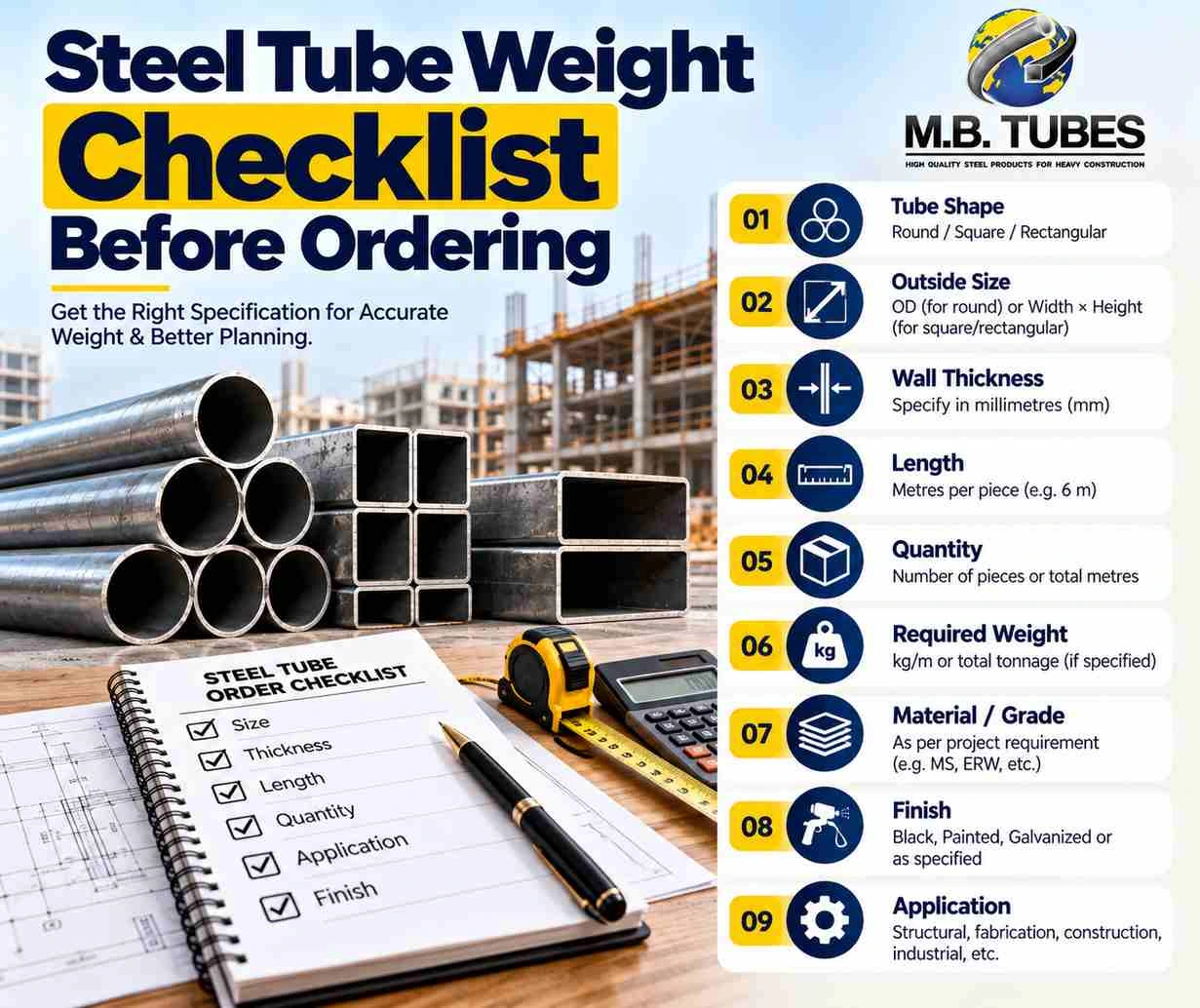
Steel Tube Weight Checklist Before Ordering
Before requesting a quotation, prepare the following information:
Shape: Round / Square / Rectangular
Outside Size: OD or width × height
Wall Thickness: mm
Length: metres per piece
Quantity: number of pieces or total metres
Required Weight: kg/m or total tonnage, if specified
Material/Grade: as required by project
Finish: black, painted, galvanized, or specified finish
Application: structural, fabrication, construction, industrial, etc.
Providing these details makes product comparison much clearer.
Steel Tubes from M.B. Tubes
M.B. Tubes offers steel pipe and tube solutions in round, square, and rectangular profiles for construction, structural, industrial, engineering, and fabrication requirements.
The available product range includes MS ERW black pipes and tubes, GI pipes, MS square and rectangular tubes, heavy structural pipes, large-diameter pipes, and other steel tube solutions.
For buyers, the key is to select the tube according to the actual project specification and then use Steel Tube Weight to estimate total material requirements.
For bulk enquiries, providing dimensions, wall thickness, length, quantity, application, and required specification can make the quotation process more accurate.
Final Thoughts
Understanding Steel Tube Weight makes steel procurement much easier. Instead of looking only at tube size or price per piece, buyers can compare dimensions, thickness, kg/m, required length, and total project quantity in a structured way.
Remember the simple workflow:
Identify Shape → Check Dimensions → Confirm Wall Thickness → Calculate kg/m → Multiply by Length → Calculate Total Quantity
For estimation, theoretical formulas are extremely useful. For final structural selection and purchasing, however, always work from the required project specification and confirm the applicable product weight and tolerances.
That combination gives contractors, fabricators, engineers, and procurement teams a much clearer picture of how much steel their project actually requires.
Frequently Asked Questions About Steel Tube Weight
How do I calculate Steel Tube Weight?
Steel Tube Weight is calculated from the cross-sectional steel area, material density, and length. For quick estimation, different simplified formulas are used for round, square, and rectangular tubes. Once kg/m is known, multiply it by the required length to estimate total weight.
What is the density used for steel tube weight calculations?
For common theoretical calculations involving mild steel, approximately 7,850 kg/m³ is generally used. Actual finished tube weight can still differ because of dimensional and manufacturing tolerances.
How do I calculate the weight of a 6-metre steel tube?
First determine the tube’s kg/m. Then multiply it by 6. For example, a tube weighing 5 kg/m would have an estimated 6-metre weight of 30 kg.
Does increasing wall thickness increase Steel Tube Weight?
Yes. If the outside dimensions remain the same, increasing wall thickness generally increases the amount of steel in the cross-section and therefore increases weight per metre. It can also affect structural properties, so thickness should follow project requirements rather than weight alone.
Is theoretical Steel Tube Weight the same as actual weight?
Not necessarily. Theoretical weight is an estimate based on nominal dimensions and assumed density. Actual manufactured tubes can vary because of permitted dimensional tolerances, section geometry, coating, and manufacturing conditions. Final procurement should therefore use the applicable specification and confirmed product data.