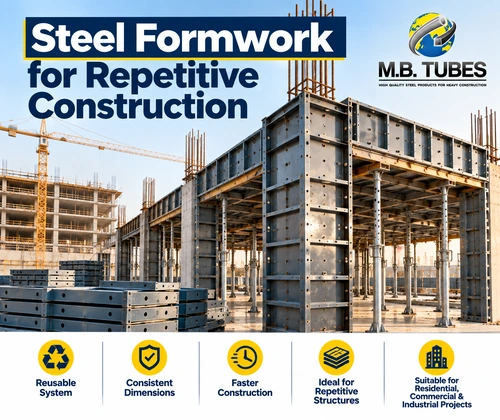

Steel Formwork for Repetitive Construction: Benefits, Uses & Selection Guide
When the same slab, wall, column or structural element has to be cast repeatedly, formwork planning becomes a major part of project efficiency. Contractors need a system that can be installed, removed, shifted and reused while maintaining consistent dimensions.
This is where Steel Formwork becomes especially useful.
Steel Formwork is a reusable temporary mould system used to shape and support freshly poured concrete until it develops sufficient strength. Its rigid construction, dimensional consistency and reusability make it particularly relevant for multi-storey buildings, industrial projects, bridges and other construction where similar concrete elements are repeated. M.B. Tubes also manufactures steel formwork and related components for residential, commercial, industrial and infrastructure applications. MB Tubes
What Is Steel Formwork?
Steel Formwork is a temporary mould or shuttering system manufactured from steel and used to hold fresh concrete in the required shape during casting.
Depending on the project, the complete arrangement may include steel panels, centering plates, shuttering plates, adjustable props, spans and other supporting components.
Its job is straightforward:
Set the Form → Support It → Pour Concrete → Allow Concrete to Develop Strength → Remove → Reuse
The important difference in repetitive construction is the final step: reuse.
Instead of planning a completely new formwork arrangement for every similar casting cycle, reusable steel components can move through a planned sequence across floors, bays or repeated structural elements.
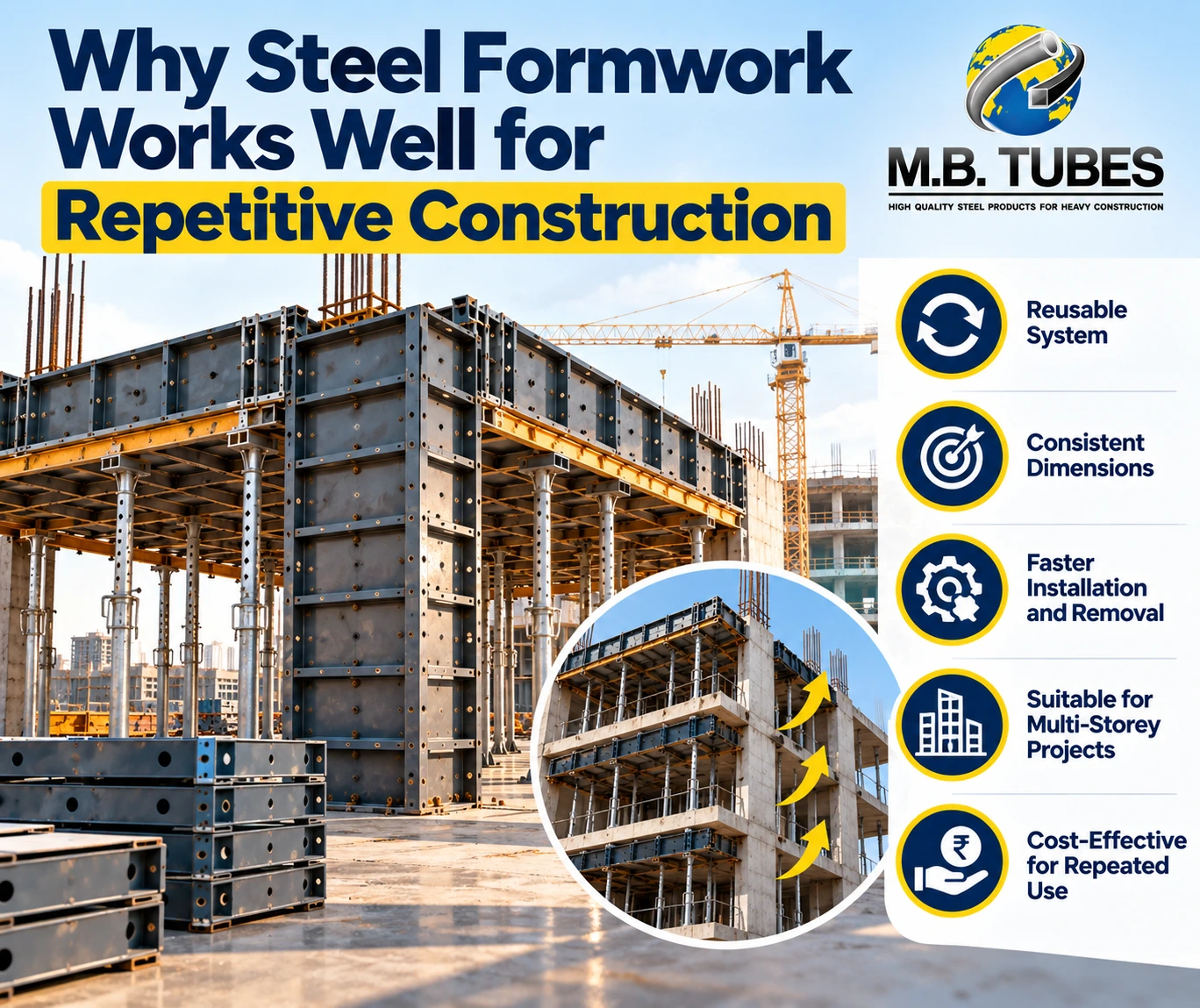
Why Steel Formwork Works Well for Repetitive Construction
Imagine a multi-storey building where several floors have similar slab layouts.
The formwork team may repeat essentially the same cycle:
Install → Align → Cast → Remove → Clean → Shift → Reinstall
When the components are standardized and remain in serviceable condition, workers become familiar with the installation sequence. This can make repetitive operations easier to organize.
Steel centering plates supplied by M.B. Tubes are specifically described as suitable for repeated use in concrete and slab formwork, while its steel formwork systems are offered in modular designs and custom configurations. MB Tubes
Actual cycle time, however, still depends on the project design, concrete requirements, workforce, lifting and handling arrangements, and site conditions.
1. Reusability Is the Main Advantage
For repetitive projects, formwork should not be evaluated only by its initial purchase cost.
A more useful question is:
How effectively can the system be reused across the required construction cycles?
Steel components are designed for repeated use when correctly handled, cleaned, inspected and maintained. This can make Steel Formwork practical where the same or similar structural dimensions occur repeatedly.
Reusability is particularly valuable in projects involving:
- Multi-storey buildings
- Repeated RCC slabs
- Similar columns or walls
- Industrial structures
- Bridges and infrastructure work
- Large commercial developments
The greater the repetition, the more important formwork planning becomes.
2. Consistent Dimensions Help Repeated Casting
Repetitive construction depends on consistency.
If similar structural elements are being cast across several floors or sections, irregular formwork dimensions can create additional adjustment work.
Precision-fabricated steel components can provide a more standardized basis for repeated formwork layouts. M.B. Tubes describes its steel formwork as precision-engineered for dimensional accuracy, while its centering plates use rigid steel construction and standardized formwork characteristics. MB Tubes
This does not mean formwork automatically guarantees dimensional accuracy. Correct erection, alignment, support and inspection remain essential.
The benefit is that a consistent component gives the site team a repeatable starting point.
3. Steel Formwork Can Support Better Concrete Finishing
The surface of the formwork directly contacts fresh concrete.
A clean, properly maintained steel form face can help produce a more consistent concrete surface. M.B. Tubes’ mild-steel centering plates use a plain face and are intended to support concrete casting while helping achieve a smooth slab surface. MB Tubes
However, concrete finish is not controlled by the formwork material alone.
It can also depend on concrete quality, joints, alignment, release practices, vibration, form cleanliness and workmanship.
Therefore, the better strategy is to think of Steel Formwork as part of the complete concrete casting process, rather than treating it as an isolated product.
4. Easier Planning Across Repetitive Floors or Sections
One major advantage of repetition is predictability.
Suppose a project has several similar floors. The contractor can plan a formwork cycle around:
Formwork Area → Required Components → Support Arrangement → Casting Sequence → Stripping → Cleaning → Next Location
Once the team understands the component arrangement, planning subsequent cycles can become more systematic.
This is why modular Steel Formwork can be useful in projects with repetitive geometry.
Instead of looking only at individual panels, procurement teams should evaluate the complete system and determine how components will move from one casting location to another.
5. Where Is Steel Formwork Commonly Used?
Steel Formwork can be used across different concrete construction applications.
M.B. Tubes lists its steel formwork for residential buildings, commercial complexes, industrial plants, warehouses, high-rise buildings, bridges, flyovers and infrastructure projects. Its broader formwork range also includes components for slabs, beams, columns, walls, bridge piers and box culverts. MB Tubes
For repetitive work, it can be particularly useful where structural layouts repeat frequently.
The correct system should always be selected according to the actual structural drawings, concrete geometry and temporary-support requirements.
Steel Formwork and Its Supporting Components
A common buying mistake is to think only about the formwork panel.
Concrete formwork generally works as a system.
Depending on the project design, the arrangement can involve:
Component | Typical Role |
Steel Formwork Panels | Create the required concrete shape |
Centering/Shuttering Plates | Form temporary casting surfaces |
Adjustable Props | Provide vertical temporary support |
Adjustable Spans | Support slab centering/formwork arrangements |
Steel Channels | Provide support within formwork/framework applications |
Accessories | Help connect, align or support the system |
M.B. Tubes manufactures several of these related products, including shuttering plates, adjustable steel props, MS adjustable spans and steel channels. MB Tubes
Component selection should follow the project design rather than assuming every item is interchangeable.
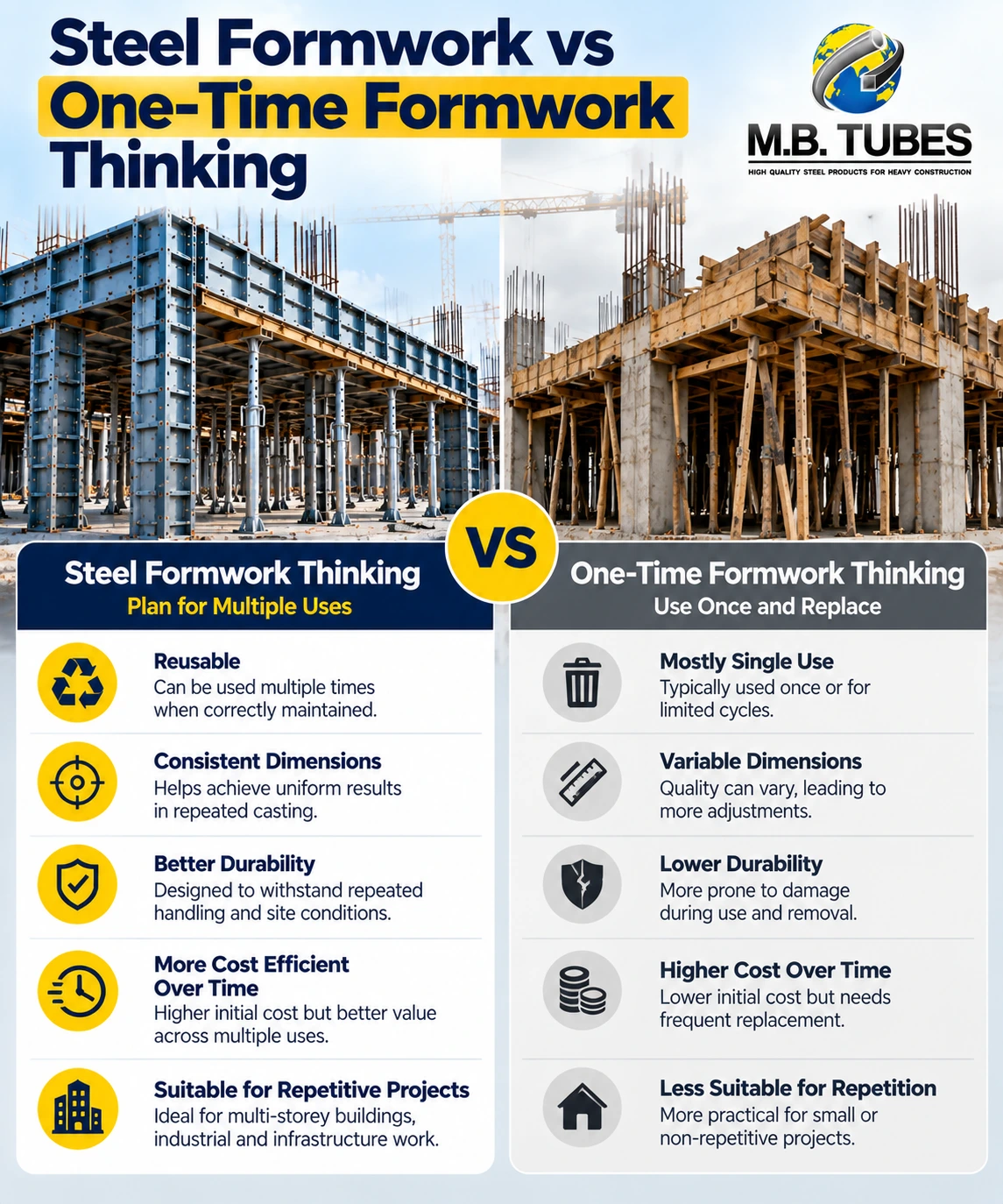
Steel Formwork vs One-Time Formwork Thinking
For repetitive projects, procurement should move away from a simple “lowest initial price” comparison.
Consider instead:
Initial Cost + Number of Planned Uses + Handling + Maintenance + Site Productivity + Replacement Requirement
A cheaper formwork option is not necessarily more economical if components require frequent replacement or create additional work between cycles.
Likewise, Steel Formwork is not automatically the right solution for every project. A small project with irregular shapes and little repetition may have very different requirements from a high-rise building with repeated floor layouts.
The project geometry and expected reuse should guide the decision.
How to Choose Steel Formwork for Repetitive Construction
Before ordering Steel Formwork, start with the project rather than the catalogue.
First identify what will repeat: slabs, walls, columns, beams or complete floor layouts. Then determine the dimensions, number of casting cycles and required formwork area.
Next, evaluate the formwork specification, supporting system and site handling method.
For a more useful supplier discussion, share:
Project Type + Structural Drawings + Required Dimensions + Repetitive Quantity + Formwork Application + Required Customization + Delivery Location
M.B. Tubes offers standard and custom Steel Formwork options and states that customized systems can be manufactured based on project drawings and technical requirements. MB Tubes
Common Mistakes to Avoid
The first mistake is buying Steel Formwork only on price. Material, dimensions, fabrication quality and project suitability matter too.
Another is ignoring the complete support arrangement. Panels alone do not define the performance of the temporary works system.
Poor cleaning and storage between uses can also reduce the practical advantage of reusable formwork.
Finally, avoid assuming that a system used successfully on one project can automatically be transferred to another. Concrete geometry, support requirements, dimensions and site conditions can change.
Steel Formwork from Khambati Steel & M.B. Tubes
Khambati Steel & M.B. Tubes manufactures Steel Formwork for construction and infrastructure applications. Its listed systems use mild steel, modular construction and surface-finish options including painted, primer-coated and powder-coated configurations, with standard and custom thickness options. MB Tubes
The company’s broader construction range includes steel centering plates, shuttering plates, adjustable props, adjustable spans, scaffolding and related support components. MB Tubes
For repetitive projects, buyers can provide drawings and project requirements so the formwork configuration can be evaluated according to the actual construction application.
Final Thoughts
For repetitive concrete construction, the value of Steel Formwork comes from more than strength alone. Reusability, dimensional consistency, systematic installation and compatibility with the overall support system can make it a practical choice for projects where similar structural elements are cast again and again.
The best approach is therefore repetition-first planning: identify what will repeat, calculate the required formwork cycle, select compatible components and plan how the system will be installed, removed, cleaned and reused.
For contractors and procurement teams, this creates a more meaningful basis for comparing Steel Formwork than simply choosing the lowest-priced panel.
Frequently Asked Questions
What is Steel Formwork used for?
Steel Formwork creates a temporary mould that holds fresh concrete in the required shape until it develops sufficient strength. It can be used for slabs, walls, columns and other concrete structures, depending on the formwork design and project requirements.
Why is Steel Formwork suitable for repetitive construction?
Its reusable construction and dimensional consistency make Steel Formwork useful where similar concrete elements are cast repeatedly. Components can be removed, inspected, cleaned and reused for subsequent casting cycles when their condition and project requirements permit.
Can Steel Formwork be reused?
Yes. Steel formwork systems and steel centering plates are designed for repeated use. Actual service life depends on product specification, handling, installation, cleaning, storage, maintenance and site conditions. MB Tubes
What projects can use Steel Formwork?
Applications can include residential and commercial buildings, industrial projects, warehouses, high-rise construction, bridges and infrastructure work. The formwork configuration should be selected according to the geometry and structural requirements of each project. MB Tubes
Can Steel Formwork be customized?
Yes. M.B. Tubes states that customized Steel Formwork can be manufactured based on project drawings and technical requirements. Related formwork components are also available in different or customized specifications depending on the product. MB Tubes