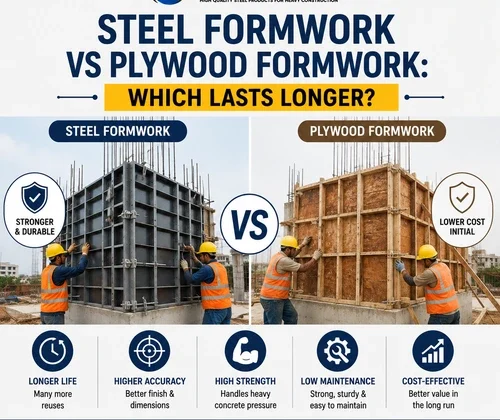

Steel Formwork vs Plywood Formwork: Which Lasts Longer?
Choosing the Right Formwork System for Long-Term Construction Efficiency
In modern construction, formwork plays a critical role in shaping concrete structures and maintaining accuracy during the building process. From residential projects and commercial buildings to bridges, industrial facilities, and infrastructure developments, choosing the right formwork system directly impacts construction speed, quality, cost, and project efficiency.
Among the most commonly used options, steel formwork and plywood formwork are widely considered by contractors and builders. While plywood formwork has been traditionally used due to its availability and lower initial cost, steel formwork has gained popularity for projects that require durability, precision, and repeated usage.
The key question for many construction professionals is:
Which formwork system lasts longer — steel formwork or plywood formwork?
The answer depends on project requirements, usage frequency, maintenance practices, and long-term construction goals.
This guide explains the differences between steel and plywood formwork to help builders make a better decision.
What Is Construction Formwork?
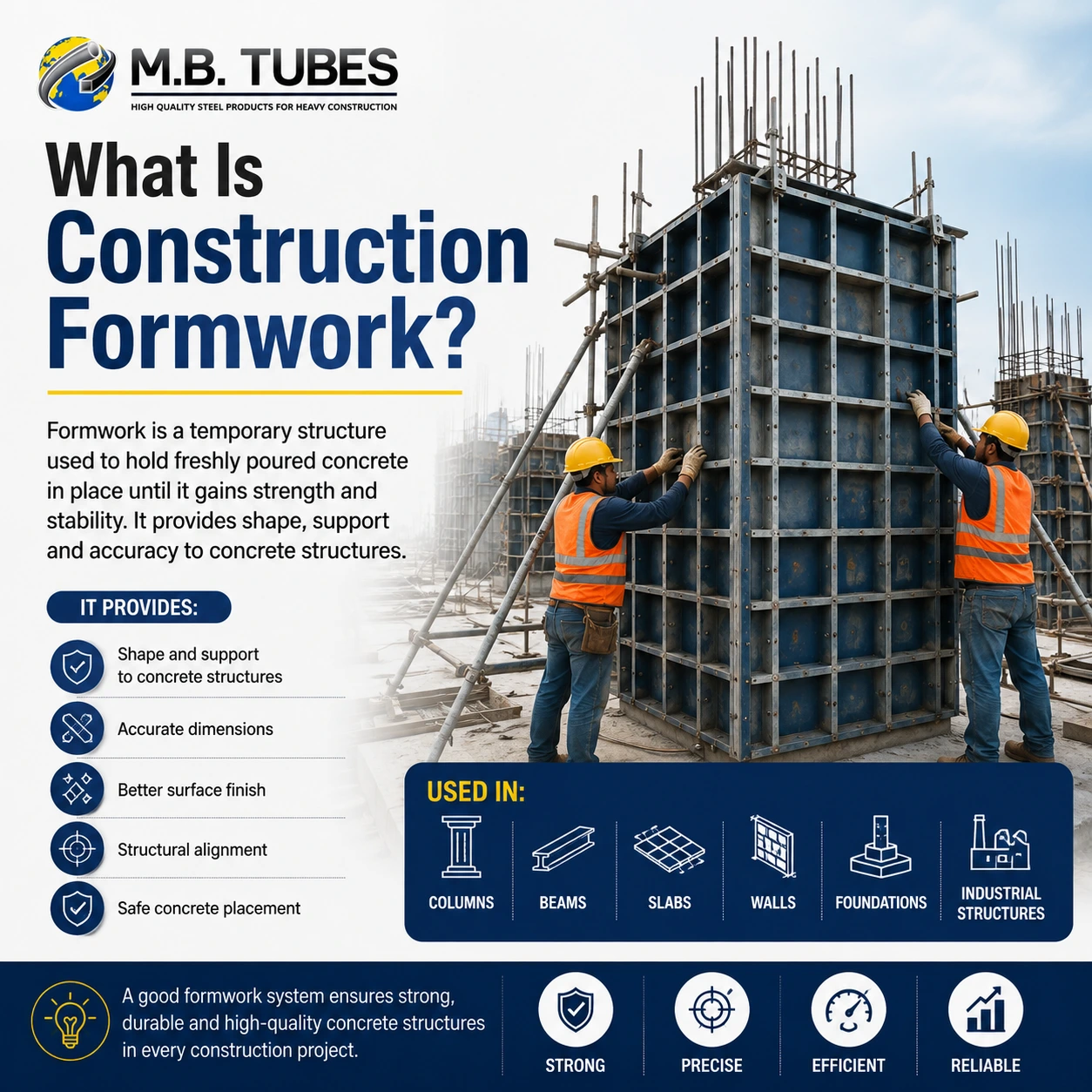
Formwork is a temporary structure used to hold freshly poured concrete until it gains enough strength and stability.
It provides:
- Shape and support to concrete structures
- Accurate dimensions
- Proper surface finish
- Structural alignment
- Safe concrete placement
Formwork systems are used in applications such as:
- Columns
- Beams
- Slabs
- Foundations
- Walls
- Industrial structures
- Infrastructure projects
Selecting the correct formwork material is important because it affects both construction quality and project economics.
Steel Formwork vs Plywood Formwork: A Quick Comparison
| Feature | Steel Formwork | Plywood Formwork |
| Durability | Very High | Moderate |
| Reusability | Many cycles | Limited cycles |
| Strength | High load capacity | Lower compared to steel |
| Dimensional Accuracy | Excellent | Can vary over time |
| Maintenance | Low with proper care | Higher |
| Initial Cost | Higher | Lower |
| Long-Term Value | Better for repeated projects | Suitable for short-term use |
1. Durability: Steel Formwork Has a Longer Service Life
The biggest difference between steel and plywood formwork is durability.
Steel formwork is manufactured using strong steel components designed to withstand repeated construction cycles.
It can handle:
- Heavy concrete pressure
- Multiple installations
- Frequent dismantling
- Transportation between projects
- Long-term construction use
Plywood formwork, on the other hand, is more vulnerable to:
- Moisture absorption
- Edge damage
- Warping
- Surface deterioration
- Reduced strength after repeated use
For contractors handling multiple projects, durability becomes a major factor.
A quality Steel Formwork Manufacturer in Madhya Pradesh provides systems designed for repeated usage and demanding construction environments.
2. Reusability: Steel Provides Better Long-Term Value
Construction companies often evaluate formwork based on the number of times it can be reused.
Plywood may appear economical during the first purchase because of its lower initial cost. However, frequent replacement can increase expenses over time.
Steel formwork can typically be reused for many more construction cycles when:
- Properly handled
- Correctly stored
- Regularly inspected
- Maintained properly
For contractors working on:
- Multiple housing projects
- High-rise buildings
- Industrial structures
- Infrastructure projects
steel formwork can provide better long-term value.
3. Accuracy and Better Concrete Finish
Modern construction demands precision.
Formwork quality directly influences:
- Concrete alignment
- Surface finish
- Structural dimensions
- Overall appearance
Steel formwork offers better dimensional stability because steel maintains its shape during repeated usage.
Plywood may experience changes due to:
- Water exposure
- Temperature variations
- Handling damage
This can affect alignment and finishing quality over time.
For projects where consistency is important, steel formwork provides a more reliable solution.
4. Strength and Load Handling Capacity
Fresh concrete creates significant pressure on formwork.
A formwork system must remain stable during concrete placement to avoid deformation or alignment issues.
Steel formwork provides:
- Higher structural strength
- Better resistance to pressure
- Improved stability
- Stronger support during concrete work
Plywood can perform effectively in many applications, especially when properly designed and supported, but steel generally offers greater strength for heavy-duty requirements.
5. Maintenance Requirements
Maintenance affects the total cost of any construction equipment.
Steel formwork generally requires:
- Cleaning after use
- Proper stacking
- Protection from excessive corrosion
- Periodic inspection
Plywood formwork requires more attention because moisture and repeated handling can affect its condition.
Common plywood maintenance challenges include:
- Swelling
- Surface damage
- Replacement of damaged sheets
- Reduced usability
With proper care, steel formwork can maintain performance over a longer period.
6. Project Speed and Productivity
Construction timelines are becoming shorter, making productivity extremely important.
Steel formwork systems are often preferred for projects requiring repetitive construction cycles because components are designed for systematic installation and removal.
Benefits include:
- Faster preparation
- Consistent assembly
- Reduced adjustment requirements
- Better workflow planning
This can be particularly useful in large-scale projects where the same structural elements are repeated multiple times.
7. Cost Comparison: Initial Price vs Lifetime Value
Many contractors compare only the initial purchase cost.
Plywood formwork usually has a lower starting investment.
However, construction companies should consider:
- Number of reuse cycles
- Replacement cost
- Labour requirements
- Maintenance expenses
- Project duration
- Storage requirements
Steel formwork may require higher initial investment, but its longer service life can make it more economical over multiple projects.
The better question is not:
“Which is cheaper today?”
The better question is:
“Which provides better value throughout the project lifecycle?”
8. Where Is Steel Formwork More Suitable?
Steel formwork is commonly preferred for projects requiring strength, accuracy, and repeated usage.
Applications include:
High-Rise Buildings
Where multiple floors require repeated structural elements.
Industrial Projects
Factories, plants, and infrastructure structures often require durable formwork systems.
Commercial Construction
Large commercial developments benefit from faster and consistent construction processes.
Infrastructure Projects
Bridges, tunnels, and public infrastructure often require strong formwork solutions.
Repetitive Construction
Projects with similar layouts can benefit significantly from reusable steel systems.
9. When Can Plywood Formwork Be a Suitable Choice?
Plywood formwork still has its place in construction.
It may be suitable for:
- Small projects
- Custom shapes
- One-time applications
- Projects with limited budgets
- Areas requiring flexible cutting and adjustment
The right choice depends on:
- Project scale
- Budget
- Required finish
- Number of uses
- Construction timeline
There is no universal solution for every project.
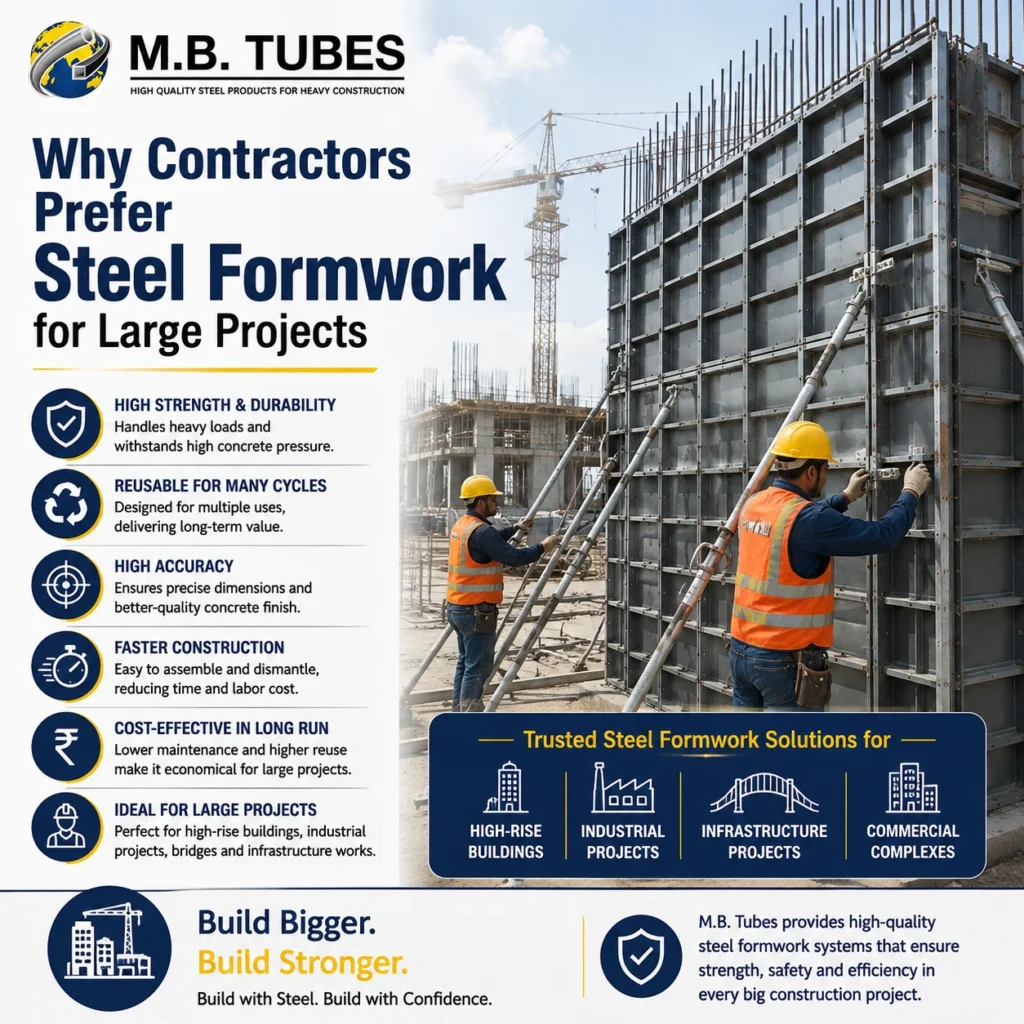
Why Contractors Prefer Steel Formwork for Large Projects
Large construction projects require systems that can deliver consistency throughout the construction process.
Steel formwork offers advantages such as:
✔ Longer service life
✔ Better dimensional accuracy
✔ Higher strength
✔ Multiple reuse cycles
✔ Improved productivity
✔ Lower replacement frequency
✔ Better long-term investment value
For contractors managing multiple projects, these advantages can significantly improve operational efficiency.
How to Choose the Right Steel Formwork Manufacturer?
Choosing the right manufacturer is as important as choosing the right material.
Before purchasing steel formwork, consider:
Manufacturing Quality
Check fabrication accuracy, welding quality, and material specifications.
Product Design
Ensure the system matches your project requirements.
Customisation Options
Different projects may require different dimensions and configurations.
Supply Capability
Large projects require reliable production and delivery.
Industry Experience
Choose a manufacturer with knowledge of construction applications.
A trusted Steel Formwork Manufacturer in Madhya Pradesh can help contractors select suitable solutions based on project requirements.
Steel Formwork Manufacturer in Madhya Pradesh – M.B. Tubes
M.B. Tubes provides quality steel solutions for construction and industrial applications.
For builders, contractors, and infrastructure companies searching for a Steel Formwork Manufacturer in Madhya Pradesh, selecting a reliable supplier helps ensure better product quality, consistent manufacturing, and dependable project support.
Steel formwork solutions are suitable for construction requirements where durability, accuracy, and repeated usage are important.
With a focus on quality steel products and customer requirements, M.B. Tubes supports construction professionals looking for reliable formwork solutions across Madhya Pradesh.
Final Thoughts: Which Formwork Lasts Longer?
When comparing steel formwork vs plywood formwork, steel formwork generally provides a longer service life, higher durability, better accuracy, and greater reuse potential.
Plywood remains useful for specific applications where flexibility and lower initial cost are priorities.
However, for large construction projects requiring repeated usage and long-term value, steel formwork is often the preferred choice.
The right formwork decision should consider:
Project Size + Usage Frequency + Quality Requirements + Long-Term Value
Choosing a reliable Steel Formwork Manufacturer in Madhya Pradesh can help builders achieve better construction efficiency, consistent quality, and stronger project outcomes.
Frequently Asked Questions (FAQs)
1. Which lasts longer: steel formwork or plywood formwork?
Steel formwork generally lasts longer because it offers higher durability and can withstand many reuse cycles when properly maintained.
2. Is steel formwork better for large construction projects?
Meta Boxes
Use up and down arrow keys to resize the meta box pane.
Blog Designer Pack – Settings
Toggle panel: Blog Designer Pack – Settings
Unlock all settings by upgra
Yes. Steel formwork is well suited to large and repetitive projects because of its strength, dimensional accuracy, durability, and reusability.
3. What are the main advantages of steel formwork?
Key advantages include high strength, multiple reuse cycles, consistent dimensions, better durability, and long-term cost efficiency.
4. When should plywood formwork be used?
Plywood formwork can be suitable for smaller projects, customised shapes, limited-use applications, and projects where a lower initial investment is important.
5. How do I choose a Steel Formwork Manufacturer in Madhya Pradesh?
Choose a Steel Formwork Manufacturer in Madhya Pradesh based on manufacturing quality, fabrication accuracy, product specifications, customisation capability, supply capacity, and industry experience.