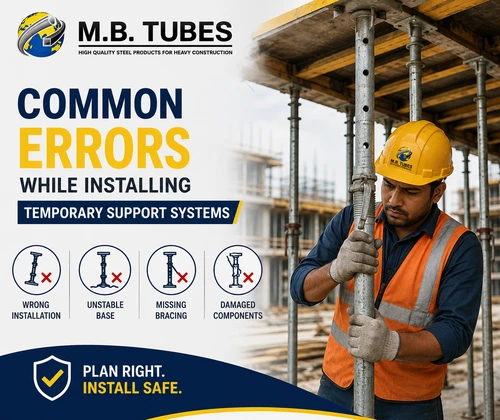

Temporary support systems may not remain visible when a building is complete, but during construction they perform one of the most important jobs on site: supporting loads and maintaining stability while permanent structural elements are being built, cured, connected, or strengthened.
Whether a project involves slabs, beams, formwork, structural alterations, industrial construction, or multi-storey development, even a well-designed support system can underperform if it is assembled incorrectly.
For contractors and project teams, installation quality therefore matters just as much as component quality.
This guide covers common installation mistakes, practical ways to reduce them, and important considerations when selecting a Temporary Construction Support Systems Manufacturer in Madhya Pradesh.
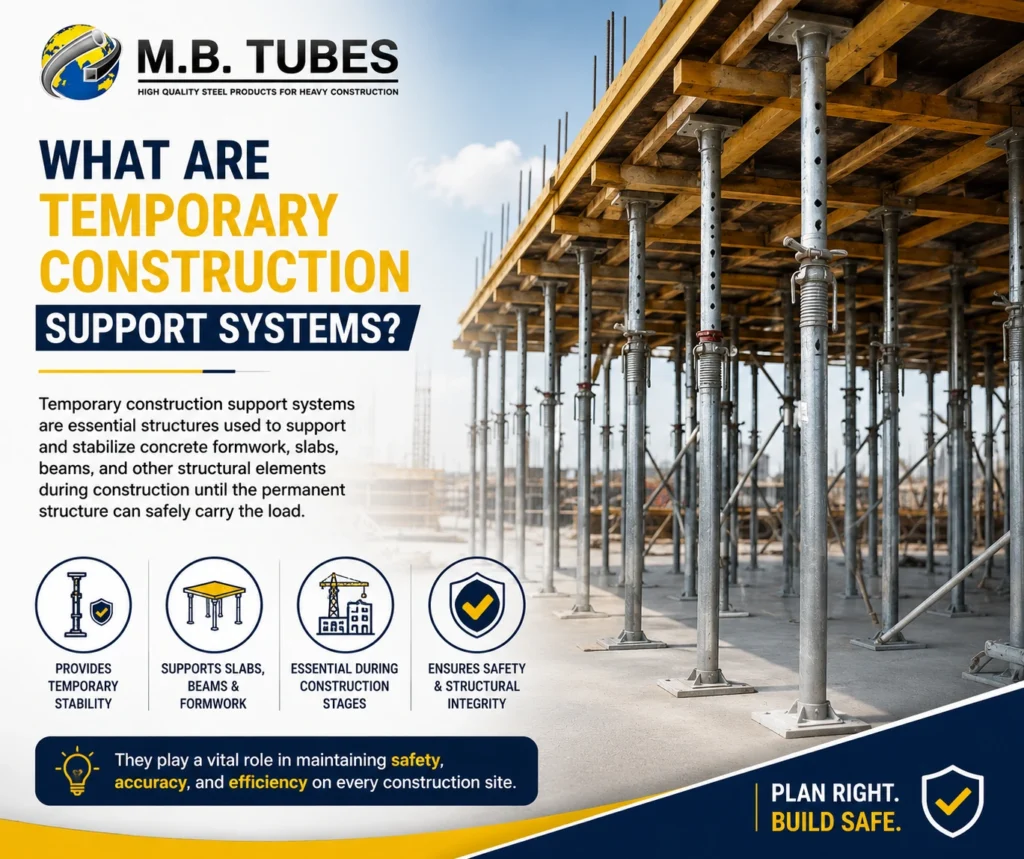
What Are Temporary Construction Support Systems?
Temporary construction support systems are assemblies used to provide temporary stability or load support during different stages of construction.
Depending on the engineering design and project requirements, they may include:
- Adjustable steel props
- Shoring systems
- Scaffolding-based support arrangements
- Formwork support systems
- Bracing components
- Base and head accessories
- Temporary structural supports
These systems may be required until concrete reaches the specified strength or until permanent structural elements are capable of safely carrying the intended loads.
The exact arrangement should always follow the project’s engineering requirements rather than a generic site practice.
Why Installation Quality Matters More Than Many Sites Realise
A common misconception is that using heavy-duty steel components automatically creates a reliable support arrangement.
It does not.
The performance of a temporary support system depends on several connected factors:
Design + Component Quality + Ground Conditions + Correct Assembly + Bracing + Load Control + Inspection
A weakness in any one of these areas can affect the entire arrangement.
This is why professional contractors focus not only on purchasing good equipment but also on ensuring that the system is installed and used according to approved engineering requirements and manufacturer guidance.
1. Starting Installation Without a Clear Support Plan
One of the most avoidable mistakes is beginning installation before understanding the support layout.
Workers may start positioning props or frames based on previous experience rather than the approved project arrangement.
However, every structure can differ in:
- Load
- Height
- Slab thickness
- Beam dimensions
- Support spacing
- Ground conditions
- Construction sequence
Better Approach
Review the approved temporary-works design, drawings, load requirements, spacing, and erection sequence before work begins.
A few minutes spent verifying the layout can prevent much larger corrections later.
2. Ignoring the Condition of the Supporting Surface
A temporary support system is only as dependable as the surface beneath it.
Installing props or standards on soft, uneven, loose, or unsuitable ground can create settlement or instability.
Simply adding stronger steel components does not solve a weak foundation condition.
Before Installation, Check:
- Ground or slab condition
- Level differences
- Load-bearing suitability
- Drainage and water accumulation
- Base plate positioning
- Sole-board requirements where specified
The base must be capable of safely transferring the intended loads according to the engineered design.
3. Incorrect Spacing Between Supports
More supports do not automatically mean a safer system, and wider spacing does not automatically mean better efficiency.
Spacing needs to match the engineered loading arrangement.
If supports are positioned differently from the approved design, load distribution can change.
This is especially important when supporting:
- Heavy slabs
- Deep beams
- Large concrete pours
- Multi-level structures
- Industrial construction
Better Practice
Mark the support positions before erection where practical and verify spacing against approved drawings.
Consistency during installation makes inspection easier as well.
4. Using Damaged Components Because “They Still Look Usable”
Construction equipment experiences demanding handling.
Components can become:
- Bent
- Cracked
- Corroded
- Distorted
- Damaged at welds
- Difficult to adjust
- Missing critical connecting parts
A damaged component should not be accepted simply because it can still be physically installed.
Smart Site Rule
Inspect before you erect—not after the load is applied.
Segregate questionable components and have them assessed according to the project’s inspection procedure and manufacturer requirements.
5. Improper Adjustment of Steel Props
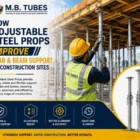
Adjustable steel props are useful because their height can be modified according to the application.
However, adjustment does not mean unlimited extension.
Using a prop outside its specified working range can affect its capacity and stability.
Teams should verify:
- Required support height
- Permitted extension
- Prop specification
- Vertical alignment
- Head and base contact
- Manufacturer’s load information
A suitable Temporary Construction Support Systems Manufacturer in Madhya Pradesh should be able to provide clear product specifications so buyers can select components appropriate for the intended application.
6. Forgetting That Bracing Is Part of the System
This is one of the most important installation mistakes.
Vertical supports may carry loads, but the complete temporary arrangement may also require adequate lateral stability.
Bracing can be essential for controlling movement and maintaining the intended geometry of the support system.
Missing, incorrectly positioned, or improperly connected bracing can compromise the engineered arrangement.
Remember:
Support carries load. Bracing helps maintain stability.
Always follow the specified bracing arrangement rather than improvising on site.
7. Installing Components Out of Plumb
A support intended to act vertically should be installed in the orientation specified by the system design.
Misalignment can introduce unintended forces and affect load transfer.
Common causes include:
- Uneven bases
- Rushed installation
- Incorrect adjustment
- Poor positioning
- Movement during subsequent work
Use suitable checking methods during erection and again before loading.
Small errors are easier to correct before concrete placement than during an active pour.
8. Mixing Incompatible Components
Construction sites often contain equipment from different suppliers or older projects.
This can lead to teams mixing components simply because they appear to fit.
Physical fit does not necessarily mean technical compatibility.
Different products may have different:
- Dimensions
- Connection systems
- Material specifications
- Load capacities
- Tolerances
Use components according to the approved system and manufacturer recommendations.
Improvised combinations should not replace an engineered solution.
9. Overloading the Temporary Support Area
Temporary works may be designed for specific construction loads.
Problems can arise when additional materials are placed in supported areas without considering their effect.
Examples include concentrated stacks of:
- Reinforcement steel
- Blocks
- Formwork material
- Equipment
- Construction supplies
Workers and moving equipment can also contribute to construction loading.
Better Approach
Control material storage and construction loads according to the temporary-works design.
Do not assume unused floor space automatically means available loading capacity.
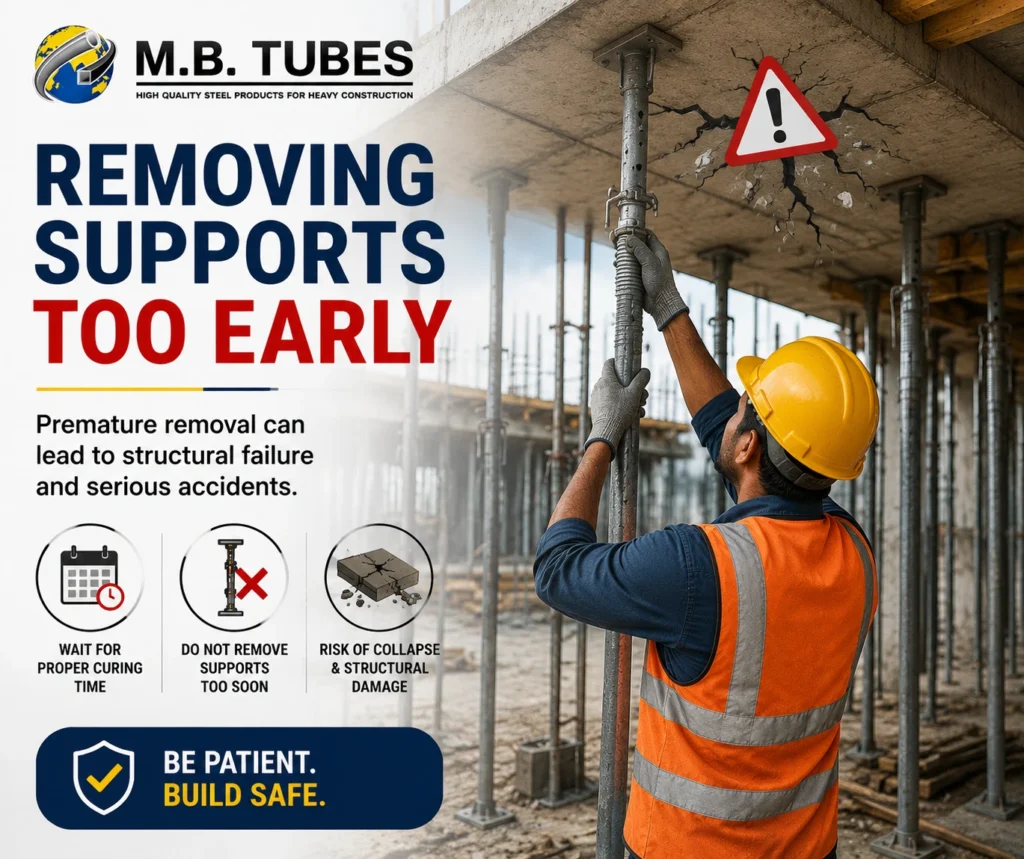
10. Removing Supports Too Early
Installation is only half of the temporary-support process.
Removal matters too.
Premature removal can transfer loads to permanent structural elements before they are ready to safely carry them.
For concrete construction, stripping and reshoring decisions may depend on factors including:
- Concrete strength
- Structural design
- Span
- Loading
- Curing conditions
- Construction sequence
Removal should therefore follow the engineer’s approved procedure—not a fixed number of days based only on habit.
11. Skipping Inspection Before Loading
A system can look complete while still containing important installation errors.
A pre-load inspection can identify issues such as:
- Missing connections
- Incorrect spacing
- Incomplete bracing
- Damaged components
- Poor base conditions
- Misaligned supports
- Unapproved modifications
For significant temporary works, inspection and approval should be carried out by appropriately competent personnel as required by the project.
Erect → Inspect → Correct → Approve → Load
This sequence is much better than discovering problems after loading begins.
12. Ignoring the System During Construction
Inspection should not necessarily end once the initial installation is approved.
Site conditions change.
Heavy rain, nearby excavation, impact from equipment, ongoing construction activities, or unauthorised alterations may affect a temporary system.
Project procedures should define when reinspection is required, particularly after events that could affect stability or configuration.
Temporary support should be treated as an active construction system throughout its period of use.
The Hidden Cost of Poor Installation
Incorrect temporary-support installation does not only create safety concerns. It can also affect project economics.
Potential consequences include:
Rework: Incorrect layouts may need dismantling and rebuilding.
Delays: Concrete pours or subsequent activities may be postponed until issues are corrected.
Material Damage: Improper handling can shorten the usable life of components.
Labour Loss: Installation teams spend additional time correcting preventable errors.
Quality Problems: Movement or misalignment can affect formwork and finished concrete geometry.
For contractors working on tight schedules, correct installation is therefore both a technical and commercial priority.
A Simple Pre-Load Checklist for Site Teams
Before a temporary support arrangement is loaded, the project-specific inspection should be completed. A basic discussion checklist can include:
| Check | Question |
| Design | Does the installation match the approved temporary-works design? |
| Base | Is the supporting surface suitable and properly prepared? |
| Components | Are components correct and free from unacceptable damage? |
| Spacing | Does support spacing match the specified layout? |
| Alignment | Are supports positioned and aligned as required? |
| Bracing | Is all specified bracing installed and connected? |
| Connections | Are required pins, clamps, and connectors secure? |
| Loading | Are planned construction loads within the design assumptions? |
| Alterations | Have any unauthorised changes been made? |
| Approval | Has the required competent-person inspection been completed? |
This checklist is not a substitute for engineering documentation, but it can help reinforce good site discipline.
How to Select Temporary Construction Support Systems
The correct system depends on the project—not simply on which product is available.
Before ordering, provide the supplier and project engineer with relevant information such as:
Application
Is the system supporting a slab, beam, formwork arrangement, or another temporary condition?
Height
What support height and adjustment range are required?
Loads
What loads does the engineered design require the system to accommodate?
Quantity
How many units and accessories are required?
Site Conditions
Will the system operate indoors, outdoors, on a slab, or on prepared ground?
Reusability
Will components be required across multiple construction cycles or projects?
Better information at the procurement stage reduces improvisation later.
Temporary Construction Support Systems Manufacturer in Madhya Pradesh – M.B. Tubes
Construction companies operating across Madhya Pradesh need temporary support products that match their project specifications and site requirements.
M.B. Tubes provides steel products and construction support solutions for contractors, builders, infrastructure companies, and industrial projects.
For buyers searching for a Temporary Construction Support Systems Manufacturer in Madhya Pradesh, important considerations should include product specifications, manufacturing consistency, dimensional accuracy, required accessories, order quantity, and reliable supply.
Project teams in Indore, Pithampur, Dewas, Bhopal, Ujjain and other locations across Madhya Pradesh can evaluate support-system requirements based on their specific construction applications.
The objective should always be simple:
Use the right component, in the right configuration, for the right engineered application.
Final Thoughts: Good Equipment Still Needs Good Installation
Temporary support systems perform critical work during some of the most demanding stages of construction.
Many installation problems are preventable when teams focus on fundamentals:
Plan correctly. Inspect components. Prepare the base. Follow specified spacing. Install required bracing. Control loads. Inspect before use. Remove supports only when authorised.
For builders and contractors, working with an experienced Temporary Construction Support Systems Manufacturer in Madhya Pradesh can help with product selection and supply—but final system design, erection, inspection, loading, and dismantling must still follow the project’s engineering and safety requirements.
The strongest temporary support system is not simply the one made from the most steel.
It is the one that is correctly designed, correctly installed, correctly inspected, and correctly used.
Frequently Asked Questions (FAQs)
1. What are temporary construction support systems?
Temporary construction support systems provide stability and load support to slabs, beams, formwork, and other structural elements during construction.
2. What is the most common mistake when installing temporary supports?
Common mistakes include incorrect spacing, poor base preparation, missing bracing, damaged components, improper alignment, and overloading.
3. Why is bracing important in temporary support systems?
Bracing helps maintain system stability and controls unwanted movement when installed according to the approved design.
4. Can damaged steel props be used on construction sites?
Damaged, bent, cracked, or excessively corroded components should be removed from service and assessed before reuse.
5. How do I choose a Temporary Construction Support Systems Manufacturer in Madhya Pradesh?
Look for a manufacturer offering consistent product quality, accurate specifications, suitable support components, reliable supply, and experience with construction applications.