
How to Calculate MS Pipe Weight? Formula, Examples & Practical Guide
When purchasing mild steel pipes for construction or industrial projects, one important question is: How much does an MS pipe weigh?
Knowing the correct MS Pipe Weight helps contractors, engineers, fabricators, and buyers estimate material quantities, transportation requirements, and project costs.
The good news is that calculating pipe weight is straightforward once you understand three measurements: outside diameter, wall thickness, and pipe length.
This guide explains the formula, provides practical examples, and highlights common mistakes to avoid.
Quick Answer: How to Calculate MS Pipe Weight?
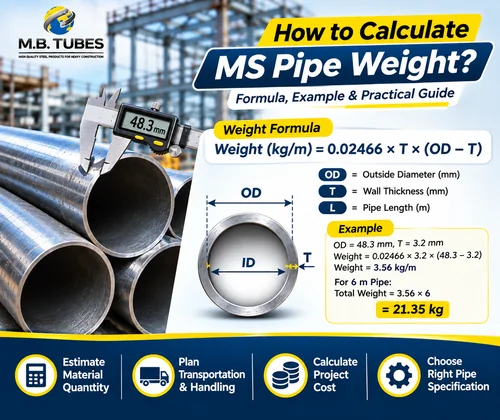
To calculate the theoretical weight of a round mild steel pipe, use this formula:
MS Pipe Weight (kg/m) = 0.02466 × T × (OD − T)
Where:
- OD: Outside diameter of the pipe in millimetres
- T: Wall thickness in millimetres
- 0.02466: Approximate calculation factor for mild steel
The result gives the theoretical weight in kilograms per metre (kg/m).
To calculate the total weight of one pipe:
Total Pipe Weight = Weight per Metre × Pipe Length
For example, a pipe with an outside diameter of 50 mm and wall thickness of 3 mm weighs approximately 3.48 kg/m.
A 6-metre pipe would therefore weigh approximately 20.86 kg.
These values are theoretical estimates, not guaranteed actual weights.
What Is MS Pipe Weight?
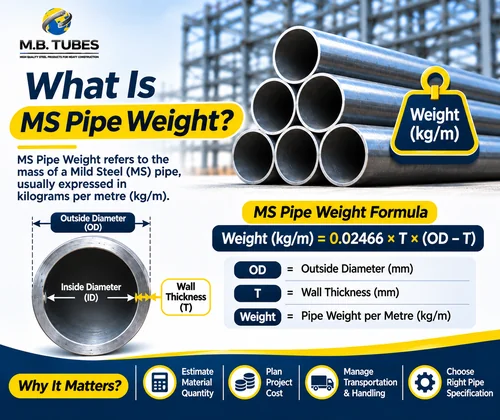
MS Pipe Weight refers to the mass of a mild steel pipe, usually expressed in kilograms per metre.
Mild steel pipes are widely used in construction, fabrication, industrial structures, and engineering applications.
Their weight depends primarily on:
- Outside diameter
- Wall thickness
- Pipe length
- Material density
- Manufacturing tolerances
A larger pipe does not automatically weigh more than every smaller pipe. Its wall thickness also plays an important role.
For example, a pipe with a larger outside diameter but a thinner wall may weigh less than a smaller pipe with a much thicker wall.
Understanding this difference is important when comparing pipe specifications.
Why Is MS Pipe Weight Calculation Important?
Accurate pipe weight estimation supports several construction and procurement activities.
1. Better Material Estimation
Contractors can estimate the total steel quantity required before placing an order.
2. Transportation Planning
Knowing the total weight helps buyers plan vehicle capacity, loading, unloading, and material handling.
3. Cost Estimation
When steel is quoted per kilogram or tonne, theoretical weight provides a useful basis for preliminary cost calculations.
4. Fabrication Planning
Fabricators can estimate the approximate weight of pipe assemblies and plan suitable handling arrangements.
5. Comparing Pipe Options
Weight calculations make it easier to compare pipes with different diameters and wall thicknesses.
Important: Pipe weight is useful for estimating material quantities, but it does not independently determine whether a pipe is structurally suitable for an application.
MS Pipe Weight Calculation Formula Explained
The commonly used theoretical formula for a round MS pipe is:
Weight (kg/m) = 0.02466 × T × (OD − T)
This simplified formula assumes a mild steel density of approximately 7,850 kg/m³.
Let’s understand each measurement.
Parameter | Meaning | Unit |
OD | Outside Diameter | mm |
T | Wall Thickness | mm |
L | Pipe Length | m |
Weight per Metre | Theoretical pipe weight | kg/m |
Total Weight | Weight of the required pipe length | kg |
Always use millimetres for diameter and thickness when applying the formula above.
Step-by-Step MS Pipe Weight Calculation
Consider a round MS ERW pipe with the following specifications:
- Outside Diameter: 48.3 mm
- Wall Thickness: 3.2 mm
- Pipe Length: 6 metres
Step 1: Identify the Measurements
OD = 48.3 mm
T = 3.2 mm
Step 2: Apply the Formula
Weight = 0.02466 × 3.2 × (48.3 − 3.2)
Weight = 0.02466 × 3.2 × 45.1
Weight ≈ 3.56 kg/m
Step 3: Calculate Total Pipe Weight
Total Weight = 3.56 × 6
Total Weight ≈ 21.35 kg
Therefore, one 6-metre pipe weighs approximately 21.35 kg.
For more accurate estimation, retain the unrounded kg/m value until the final calculation.
Step 4: Calculate Weight for Multiple Pipes
Suppose your project requires 100 pipes of the same specification.
Total Weight = 21.35 × 100
Approximate Total Weight = 2,135 kg or 2.14 tonnes
This calculation helps estimate the material quantity for procurement and transportation.
MS Pipe Weight Chart for Common Sizes
The following table provides illustrative theoretical weights for different round mild steel pipe dimensions.
Outside Diameter | Wall Thickness | Approx. Weight (kg/m) |
25 mm | 2.0 mm | 1.13 |
32 mm | 2.5 mm | 1.82 |
48.3 mm | 3.2 mm | 3.56 |
60.3 mm | 3.6 mm | 5.03 |
76.1 mm | 4.0 mm | 7.11 |
88.9 mm | 4.5 mm | 9.37 |
Note: This chart is for preliminary estimation. Actual supplied weights may vary according to manufacturing tolerances, specifications, and surface finish.
What Factors Affect MS Pipe Weight?
Outside Diameter
A larger outside diameter generally increases the amount of steel required when wall thickness and length remain unchanged.
Wall Thickness
Increasing wall thickness increases the quantity of steel in the pipe.
However, thicker pipes also increase overall material weight and usually increase material cost.
Pipe Length
A longer pipe weighs more than a shorter pipe of identical dimensions.
For example, a 12-metre pipe weighs approximately twice as much as a 6-metre pipe with the same specifications.
Material Density
The calculation assumes a typical mild steel density. Different steel compositions may have slightly different densities.
Manufacturing Tolerances
Actual outside diameter, wall thickness, and pipe mass may vary within the tolerances permitted by the applicable product standard.
Theoretical Weight vs Actual MS Pipe Weight
One important point buyers should understand is the difference between theoretical pipe weight and actual pipe weight.
Theoretical Weight: Calculated using nominal dimensions and an assumed steel density.
Actual Weight: Measured by weighing the manufactured pipe.
The two values may differ because of dimensional tolerances, manufacturing variations, and coatings.
For project estimates, theoretical weight is usually useful. For final commercial transactions, confirm the agreed weight basis and applicable product specifications with the supplier.
How to Calculate MS Pipe Weight for a Complete Project
For bulk construction requirements, calculate the total length first.
Suppose a fabrication project requires:
- 250 pipes
- Each pipe measuring 6 metres
- Theoretical weight of 5 kg/m
Step 1: Calculate Total Length
250 × 6 = 1,500 metres
Step 2: Calculate Total Weight
1,500 × 5 = 7,500 kg
Step 3: Convert into Tonnes
7,500 ÷ 1,000 = 7.5 tonnes
This gives the approximate pipe quantity by weight.
A complete project estimate should also consider cutting losses, offcuts, and any additional material required by the fabrication plan.
Does a Heavier MS Pipe Always Mean Better Quality?
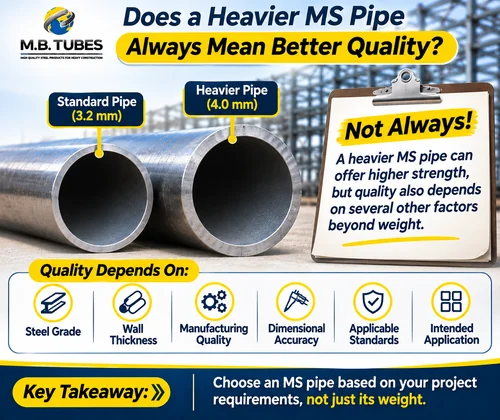
No. A heavier MS pipe is not automatically a better pipe.
Pipe quality and suitability depend on several factors, including:
- Steel grade
- Wall thickness
- Manufacturing quality
- Dimensional accuracy
- Applicable standards
- Intended application
- Structural design requirements
A thicker pipe may be suitable for certain demanding applications, but unnecessary thickness can increase material cost and transportation weight.
The best approach is to choose a pipe that meets the project’s technical requirements rather than selecting one solely because it is heavier.
Common Mistakes in MS Pipe Weight Calculation
Even a simple formula can produce incorrect results when measurements are entered incorrectly.
Mistake 1: Using Inside Diameter Instead of Outside Diameter
The formula requires outside diameter.
Mistake 2: Mixing Units
Enter diameter and thickness in millimetres, not centimetres or inches.
Mistake 3: Ignoring Wall Thickness
Two pipes with the same outside diameter can have significantly different weights.
Mistake 4: Forgetting Total Length
The formula calculates kg/m. Multiply by length to determine total pipe weight.
Mistake 5: Treating Theoretical Weight as Exact
Always consider manufacturing tolerances and supplier specifications.
Mistake 6: Using the Round Pipe Formula for Square Pipes
Square and rectangular hollow sections require different cross-sectional area calculations.
MS Pipe Weight Checklist Before Ordering
Before finalizing your purchase, confirm the following:
- Pipe type and shape
- Outside diameter
- Wall thickness
- Length per piece
- Required quantity
- Steel grade and applicable standard
- Surface finish
- Theoretical or actual weight basis
- Intended construction or industrial application
Providing these details helps suppliers prepare a more accurate quotation.
MS ERW Pipes from M.B. Tubes
M.B. Tubes, a part of Khambati Steel, offers steel pipes and tubes for construction, fabrication, structural frameworks, and industrial applications.
For MS ERW pipe requirements, buyers should confirm the appropriate diameter, wall thickness, length, grade, and quantity according to their project specifications.
Calculating MS Pipe Weight before ordering can simplify material estimation and help buyers communicate their requirements more clearly.
Conclusion
Calculating MS Pipe Weight is an essential part of planning steel requirements for construction, fabrication, and industrial projects.
By understanding the relationship between outside diameter, wall thickness, pipe length, and steel density, buyers can estimate pipe quantities more confidently.
Remember the simple process:
Check Dimensions → Apply Formula → Calculate kg/m → Multiply by Length → Estimate Total Weight
For suitable MS ERW pipe options, specifications, and bulk project requirements, contact Khambati Steel & M.B. Tubes with your technical requirements.
Choose the right pipe specification, calculate the required quantity, and plan your steel procurement with confidence.
Frequently Asked Questions (FAQs)
What is the formula for MS Pipe Weight?
The commonly used theoretical formula for round mild steel pipes is Weight (kg/m) = 0.02466 × T × (OD − T), where OD is the outside diameter and T is the wall thickness in millimetres. Multiply the result by pipe length to calculate total weight.
How do I calculate the weight of a 6-metre MS pipe?
First, calculate the theoretical weight per metre using the pipe’s outside diameter and wall thickness. Then multiply the result by 6. For example, if a pipe weighs 4 kg/m, its approximate 6-metre weight is 24 kg.
Does increasing MS pipe thickness increase weight?
Yes. When outside diameter and length remain constant, increasing wall thickness increases the amount of steel and therefore the pipe’s weight. The additional weight should be evaluated alongside the project’s structural requirements and budget.
What is the density of mild steel used for pipe weight calculation?
A commonly used approximate density is 7,850 kg/m³, equivalent to 0.00785 g/mm³. This value is suitable for typical theoretical mild steel weight calculations, although actual material density may vary slightly.
Is calculated MS Pipe Weight equal to actual weight?
Not necessarily. Calculated weight uses nominal dimensions and assumed density. Actual weight may differ because of dimensional tolerances, manufacturing variations, and surface coatings. For final procurement, verify the supplier’s specifications and agreed weight basis.