
Introduction
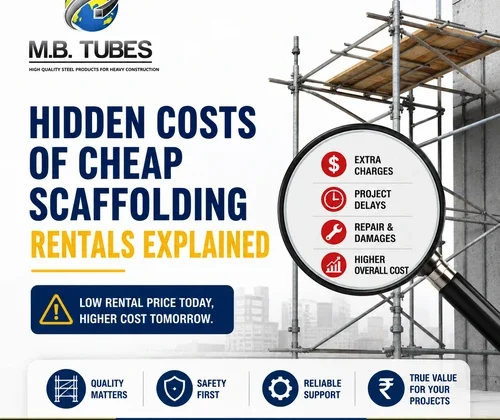
A low scaffolding rental quote can look attractive when a construction company is trying to control project expenses. On paper, renting at the cheapest available rate may seem like an easy way to reduce upfront costs. But the rental price alone does not reveal the true cost of using scaffolding on a construction site.
Poorly maintained components, missing accessories, repeated transportation, additional labour, downtime, and unexpected rental extensions can turn a budget-friendly deal into an expensive decision.
This is why contractors should evaluate Scaffolding Rental vs Purchase based on the total project cost rather than simply comparing the initial rental charge.
This guide looks beyond the quotation and explains the costs that may remain hidden until the scaffolding actually reaches your construction site.
The Rental Rate Is Only the Starting Point
Suppose two suppliers provide scaffolding quotations for the same project. One offers a significantly lower daily or monthly rate.
It may appear to be the better deal—but several questions still need answers:
- What condition is the scaffolding in?
- Are all required components included?
- Who pays for transportation?
- What happens if a component is damaged?
- Is there a minimum rental period?
- Are loading and unloading included?
- What happens if the project gets delayed?
- Are replacement components readily available?
The real cost of scaffolding becomes clear only after these factors are considered.
1. Poor-Condition Equipment Can Increase Site Costs
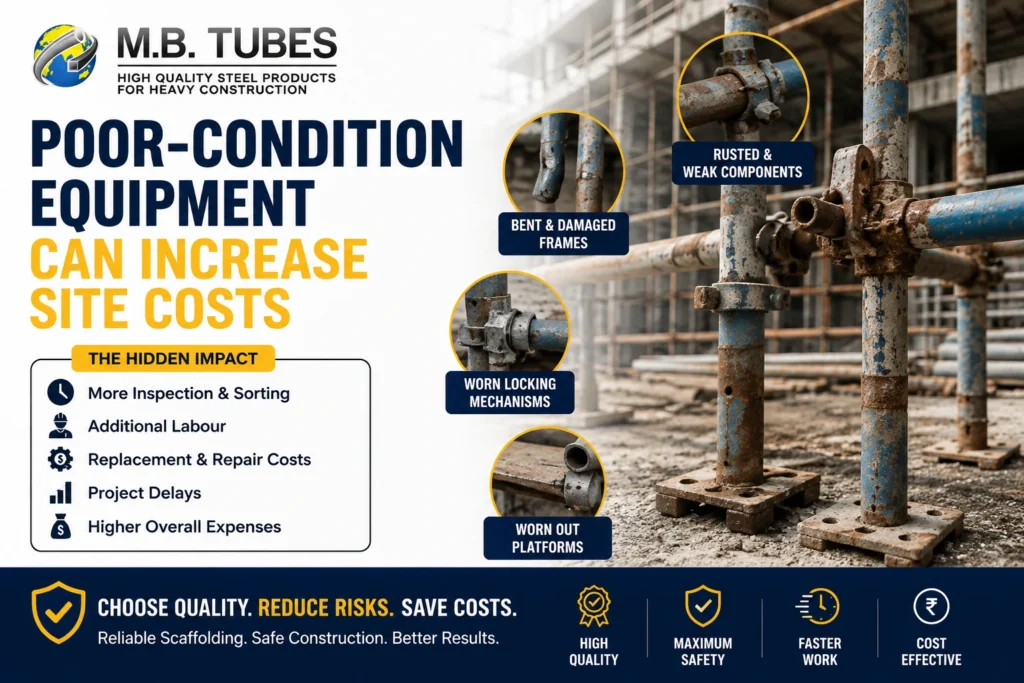
Cheap rental equipment may have already been used across many projects.
Repeated use without adequate maintenance can result in components with:
- Bent frames
- Damaged tubes
- Worn locking mechanisms
- Corroded surfaces
- Distorted connections
- Missing pins or accessories
These problems may require sorting, replacement, or additional inspection before installation.
Instead of saving money, the contractor may spend valuable working hours identifying usable components.
The hidden cost:
More inspection + more labour + possible replacement + project downtime
2. Missing Components Can Stop Installation
A scaffolding system depends on multiple components working together.
If frames arrive without sufficient braces, base plates, locking pins, couplers, or other required parts, workers cannot simply continue installation.
They must wait for replacements.
Even a relatively inexpensive missing component can create a costly delay when an entire crew is waiting.
Before accepting a low rental quote, contractors should confirm exactly what is included in the package.
3. Extra Transportation Charges Can Change the Final Price
Transportation is one of the easiest expenses to overlook when comparing rental quotations.
Scaffolding may need transportation for:
Supplier → Construction Site → Supplier
Additional deliveries may also be required if quantities are insufficient or replacement components are needed.
The situation becomes even more expensive when a project is far from the rental supplier.
When evaluating Scaffolding Rental vs Purchase, transportation should therefore be included in the total cost calculation.
4. Cheap Equipment May Take Longer to Assemble
Labour cost is directly connected to scaffolding condition and system efficiency.
Well-maintained components generally:
- Fit properly
- Connect easily
- Require fewer adjustments
- Allow faster erection
- Simplify dismantling
In contrast, bent or mismatched components can slow installation considerably.
If ten workers spend additional hours trying to assemble difficult components, the money saved on rental charges can quickly disappear through increased labour costs.
5. Project Delays Can Extend the Rental Period
Construction schedules do not always go according to plan.
Weather, material shortages, design changes, approvals, or workforce availability may extend the project timeline.
A scaffolding system rented for 30 days may suddenly be required for 45 or 60 days.
That means additional rental charges.
For longer projects, repeated rental extensions can make ownership financially more attractive.
This is one of the most important considerations when comparing Scaffolding Rental vs Purchase.
6. Damage and Replacement Charges May Be Unexpected
Rental agreements often make the contractor responsible for lost or damaged components.
Possible additional charges can include:
- Bent scaffolding frames
- Missing couplers
- Lost locking pins
- Damaged platforms
- Corroded components
- Missing braces
These costs may not appear in the original quotation.
Before signing a rental agreement, carefully understand the supplier’s damage, loss, and replacement policy.
7. Downtime Can Cost More Than the Scaffolding
One of the biggest hidden expenses is not the equipment itself—it is lost productivity.
Imagine a construction crew arriving in the morning but being unable to work because replacement scaffolding has not arrived.
The company may still be paying for:
- Workers
- Supervisors
- Machinery
- Site operations
- Equipment rentals
while productive work has stopped.
A small saving on scaffolding can therefore create a much larger indirect expense.
8. Poor Compatibility Creates Additional Work
Mixing scaffolding components from different systems, sizes, or manufacturers can create compatibility problems.
Workers may need additional time to:
- Sort components
- Find matching parts
- Adjust connections
- Replace incompatible items
Standardized, properly matched systems make installation faster and easier to manage.
Always verify compatibility before accepting rental equipment.
9. Frequent Rentals Create Repeating Costs
For a contractor handling only occasional short projects, renting can make good financial sense.
However, businesses that use scaffolding continuously may repeatedly pay for:
Rental + Transport + Handling + Inspection + Extensions
Across several projects, these recurring expenses can become substantial.
At this stage, purchasing should be evaluated rather than automatically continuing to rent.
Scaffolding Rental vs Purchase: Look Beyond the Initial Price
There is no universal answer to whether renting or purchasing is better. The correct choice depends on project duration, frequency of use, available capital, storage capacity, transportation, and maintenance capabilities.
| Factor | Rental | Purchase |
|---|---|---|
| Initial investment | Lower | Higher |
| Short-term projects | Often suitable | May be unnecessary |
| Frequent use | Costs can accumulate | Can offer better long-term value |
| Equipment ownership | No | Yes |
| Availability | Supplier-dependent | Available when required |
| Storage requirement | Usually lower | Storage needed |
| Maintenance responsibility | Depends on agreement | Owner manages maintenance |
| Rental extension risk | Yes | No rental extension fee |
| Asset reuse | Limited to rental period | Can be reused across projects |
The most useful comparison is not “Which option is cheaper today?” but “Which option will cost less over the equipment’s actual usage period?”
When Does Scaffolding Rental Make Sense?
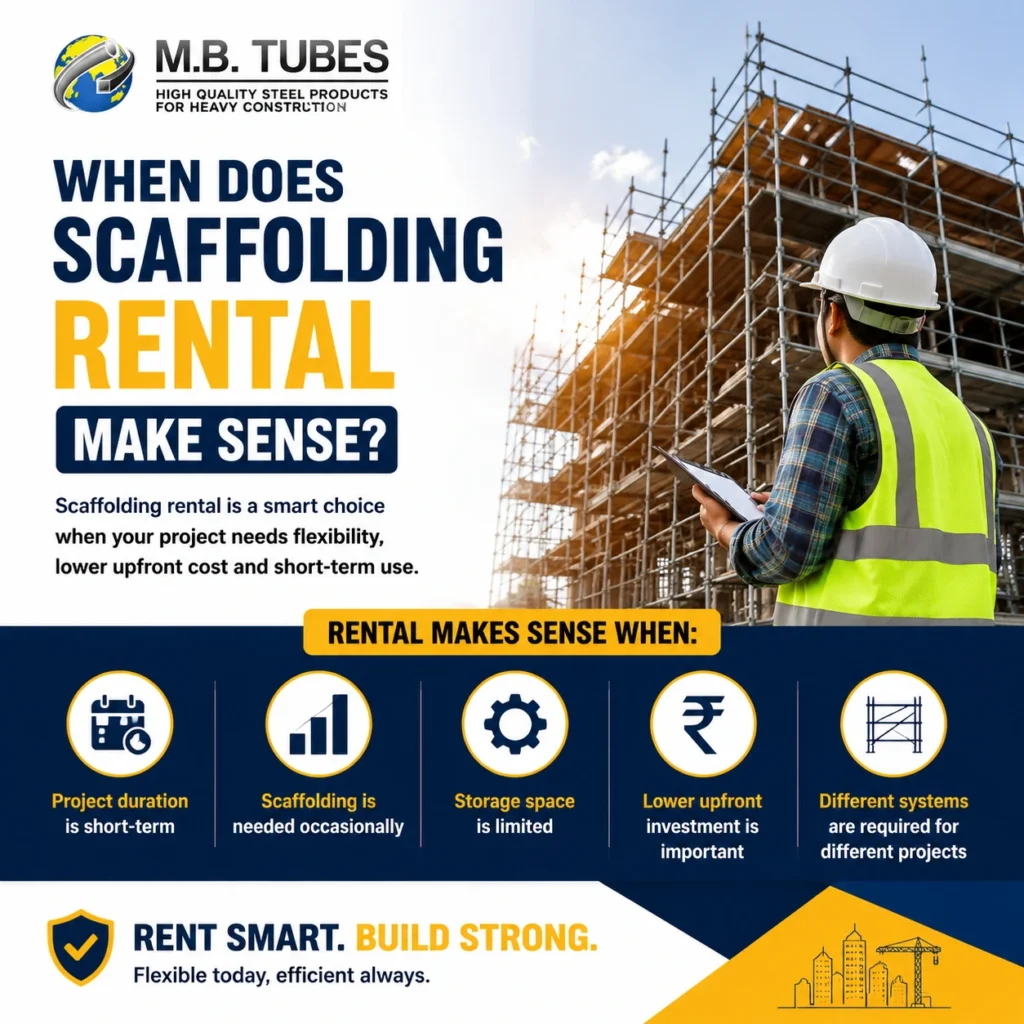
Rental can be practical when:
- The project duration is short
- Scaffolding is needed occasionally
- Storage space is unavailable
- The required system changes between projects
- The business wants to minimize initial investment
A reliable rental supplier and clearly defined terms are essential.
When Can Purchasing Be the Smarter Choice?
Purchasing deserves serious consideration when:
- Scaffolding is required throughout the year
- Multiple projects run simultaneously
- Similar systems are repeatedly required
- The company has adequate storage
- Long-term equipment availability is important
- Repeated rental and transportation expenses are becoming significant
Ownership can also provide greater control over equipment condition and availability.
Calculate the Total Cost Before Deciding
Instead of comparing only rental rate and purchase price, create a complete cost calculation.
Rental Cost Should Include:
Rental charges + transportation + loading/unloading + labour impact + extension charges + replacement/damage charges + downtime risk
Purchase Cost Should Consider:
Purchase price + transportation + storage + inspection + maintenance − expected reusable value
This gives decision-makers a much more realistic comparison.
Don’t Compromise on Scaffolding Quality
Whether scaffolding is rented or purchased, quality should remain a priority.
Construction teams should inspect equipment before use and ensure components are suitable for the intended application. Load requirements, configuration, installation, inspection, and site-specific safety requirements should be assessed by competent personnel.
A low price has little value if equipment creates unnecessary delays or cannot reliably meet project requirements.
Questions to Ask Before Accepting a Cheap Scaffolding Rental
Before finalizing a supplier, ask:
- What exactly is included in the quoted rate?
- What is the condition of the equipment?
- Are transportation charges separate?
- Is there a minimum rental duration?
- What are the extension charges?
- How are damaged or missing components charged?
- How quickly are replacement parts supplied?
- Are all components compatible?
- What inspection and maintenance records are available?
Clear answers help prevent unexpected costs later.
Final Thoughts
Cheap scaffolding rental is not automatically a bad choice. The problem arises when contractors evaluate only the advertised rental rate and overlook the costs surrounding it.
Transportation, labour, missing components, poor equipment condition, rental extensions, downtime, and damage charges can significantly change the final project expense.
A proper Scaffolding Rental vs Purchase analysis should therefore consider the complete lifecycle cost of using the equipment. For short or occasional requirements, rental may remain practical. For contractors with continuous and predictable scaffolding demand, purchasing can become a stronger long-term investment.
The smartest decision is the one that provides the required safety, availability, reliability, and overall value—not simply the lowest quotation.
Frequently Asked Questions
1. Is renting scaffolding always cheaper than purchasing it?
No. Rental generally requires less upfront investment, but repeated rental, transport, and extension charges can make it more expensive over long-term or frequent use.
2. What are the most common hidden scaffolding rental costs?
Transportation, loading and unloading, rental extensions, missing components, damage charges, additional labour, and downtime are common costs to check.
3. When should a contractor consider purchasing scaffolding?
Purchasing may be worth evaluating when scaffolding is used frequently across multiple projects and the business has suitable storage and maintenance arrangements.
4. What should be checked before renting scaffolding?
Check component condition, compatibility, quantity, rental duration, transport terms, replacement policies, and applicable inspection requirements before accepting equipment.
5. How should I compare Scaffolding Rental vs Purchase?
Compare the total cost over the expected usage period rather than only the rental rate and purchase price. Include transportation, labour, maintenance, storage, downtime, and reuse potential.