
When planning an industrial shed, warehouse, factory, or commercial building, roofing sheets are often selected based on colour, profile, finish, and price. But one technical factor can have a major influence on long-term performance: sheet thickness.
Two roofing sheets may look almost identical after installation, yet their performance can differ significantly depending on the base metal thickness, steel grade, coating system, profile geometry, support spacing, and environmental conditions.
Choosing the right thickness is therefore not simply about buying a “heavier” sheet. It is about matching the roofing system to the actual requirements of the building.
For contractors and project owners searching for a reliable Roofing Sheet Manufacturer in Madhya Pradesh, understanding these factors can help prevent premature damage, unnecessary maintenance, and avoidable replacement costs.
What Does Roofing Sheet Thickness Actually Mean?
Roofing sheet thickness generally refers to the thickness of the metal sheet used to manufacture the roofing profile. Depending on how a product is specified, measurements may refer to the base metal or the finished coated sheet.
This distinction matters because coatings can contribute to the final measured thickness.
When comparing roofing products, buyers should therefore avoid judging quality from a single thickness number alone. Ask for clear technical specifications and understand exactly what is being measured.
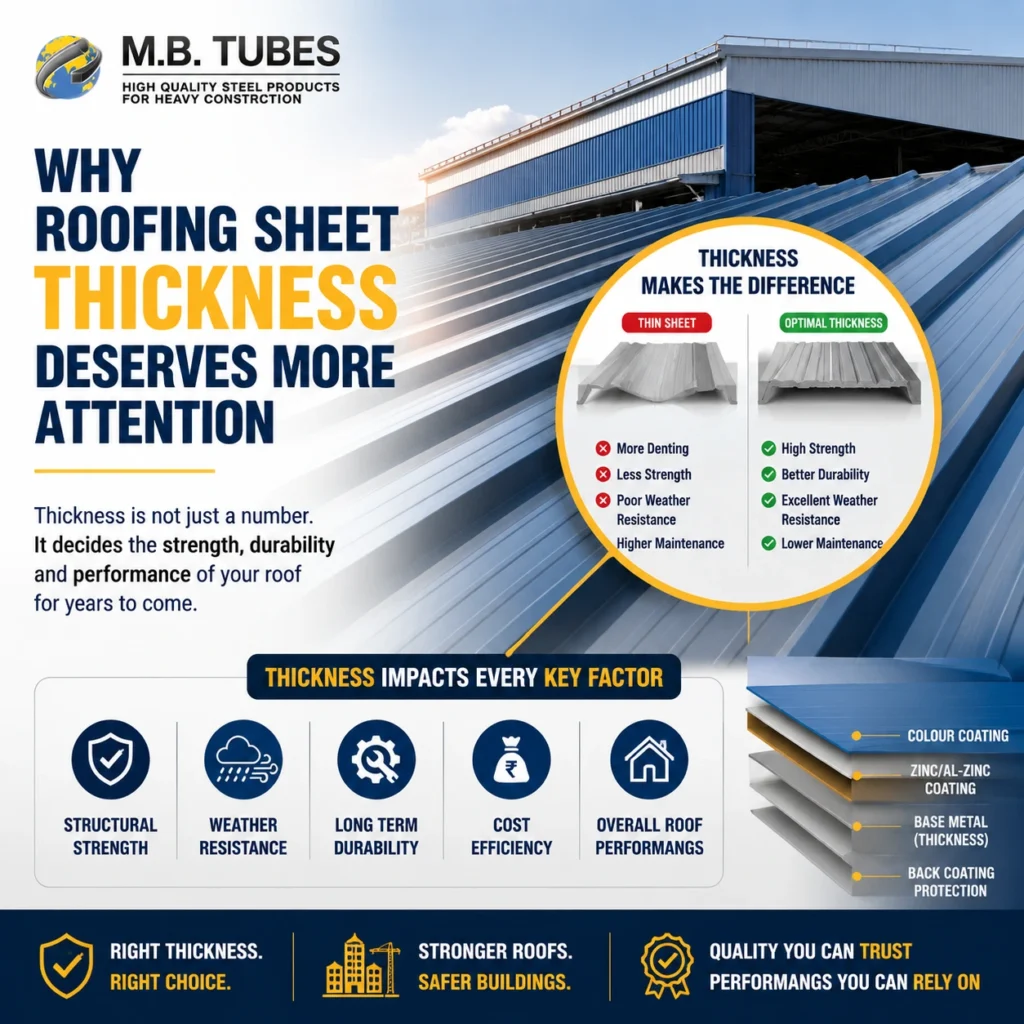
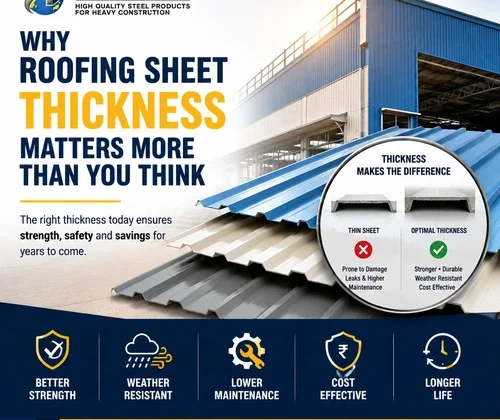
Why Roofing Sheet Thickness Deserves More Attention
A roof remains exposed to demanding conditions throughout its service life. Heat, rain, wind, maintenance activity, fasteners, and environmental exposure can all affect its performance.
Thickness is one part of the overall roofing design that influences how the sheet responds to these conditions.
1. Thickness Influences Structural Performance
Roofing sheets span between supporting members such as purlins. Their ability to perform over that span depends on several factors, including:
- Sheet thickness
- Steel grade
- Profile depth and shape
- Purlin spacing
- Fastening arrangement
- Applied loads
An unsuitable combination can allow excessive movement or deformation.
This is why roofing thickness should be selected according to engineering and project requirements rather than simply choosing the cheapest available sheet.
2. Very Thin Sheets Can Be More Vulnerable to Handling Damage
Roofing materials go through several stages before becoming part of a finished building:
Manufacturing → Loading → Transportation → Unloading → Storage → Installation
During these stages, sheets may be exposed to bending, impacts, scratches, or improper handling.
A sheet that is not appropriate for the intended application may be more susceptible to visible distortion or installation-related damage.
Good material handling remains essential regardless of thickness.
3. Roof Performance Under Wind Requires the Complete System
Industrial and warehouse roofs can experience significant wind pressure and uplift.
It is important to understand that sheet thickness alone does not determine wind resistance. Roof performance depends on the complete system, including:
- Roofing profile
- Sheet material and grade
- Fastener type
- Fastener spacing
- Purlin spacing
- Edge and corner detailing
- Building location and exposure
A professional roofing design considers these elements together.
4. Thickness Can Affect Installation Quality
Roof installation involves walking, positioning, aligning, overlapping, and fastening sheets.
Using roofing material suited to the application can make installation more manageable and help maintain the intended profile.
However, even a high-quality sheet can perform poorly when installation practices are incorrect.
Contractors should pay close attention to:
- Correct overlap
- Proper screw placement
- Suitable fastener tightening
- Sheet alignment
- Flashing installation
- Sealant application where required
Material quality and installation quality must work together.
5. Thickness and Fastener Performance Are Connected
Fasteners transfer forces between roofing sheets and the supporting structure.
If the roofing system is incorrectly specified or installed, areas around fastener points can become vulnerable to movement or damage.
Correct sheet selection combined with an appropriate fastening system helps maintain a secure roof assembly.
This is particularly important for factories, warehouses, and large-span industrial buildings where roof areas can be extensive.
6. Thicker Does Not Automatically Mean Better
This is one of the biggest misconceptions in roofing.
A thicker sheet is not automatically the best sheet for every project.
For example, a project may achieve excellent performance with a properly engineered roofing profile at a particular thickness, while simply increasing thickness without considering the supporting structure may add unnecessary material cost.
The better question is:
What thickness and roofing specification are appropriate for this particular building?
The answer should consider structural design, environment, profile, span, and expected service conditions.
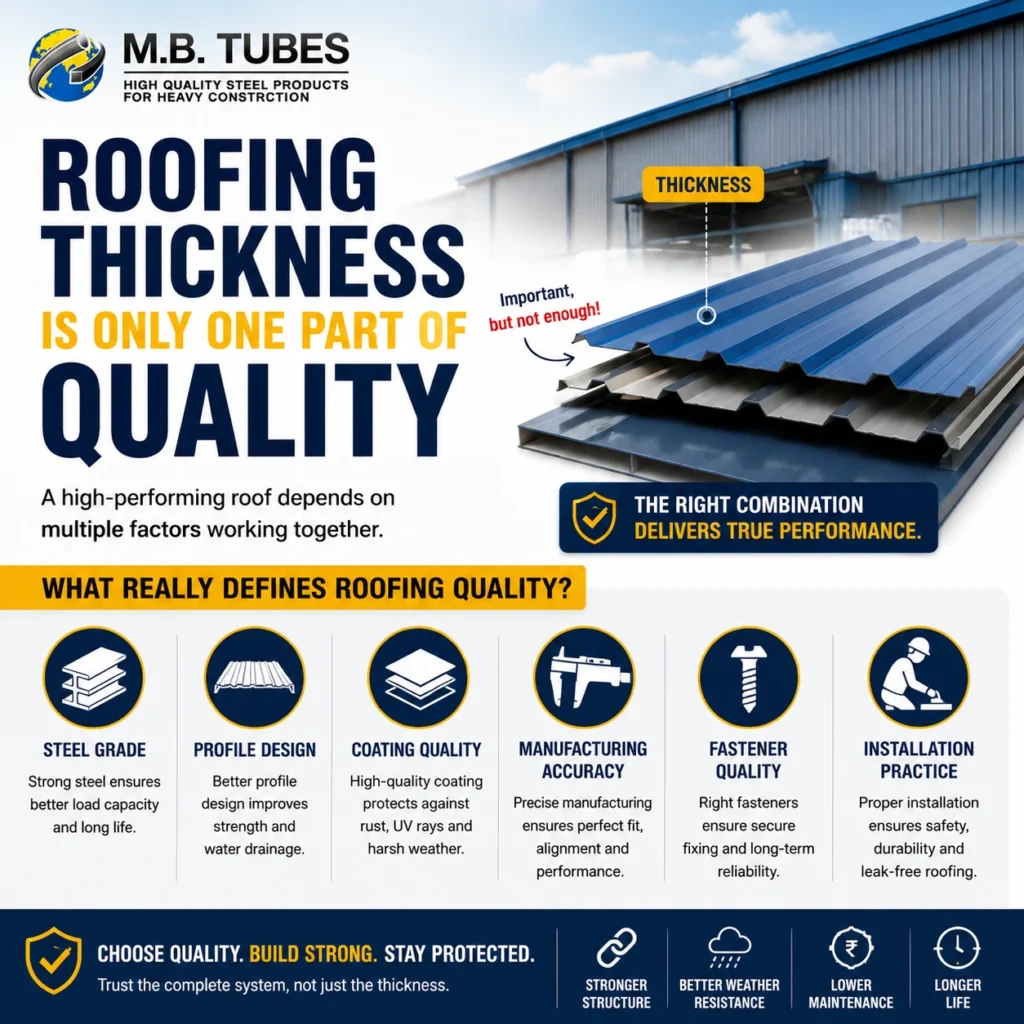
Roofing Thickness Is Only One Part of Quality
Buyers sometimes focus heavily on thickness while ignoring other specifications that are equally important.
A good roofing sheet should be evaluated as a complete product.
Steel Grade
The mechanical properties of the steel influence its structural behaviour.
Profile Design
The geometry of the roofing profile contributes to stiffness and load distribution.
Protective Coating
The metallic and/or paint coating system can play an important role in corrosion protection and appearance.
Manufacturing Accuracy
Consistent profiling helps sheets align and overlap correctly during installation.
Fastener Quality
Even good roofing sheets need suitable fasteners and installation practices.
A dependable Roofing Sheet Manufacturer in Madhya Pradesh should therefore be evaluated on overall product quality—not thickness alone.
How to Select the Right Roofing Sheet Thickness
Instead of selecting thickness based on assumption, consider the actual project conditions.
Understand the Building Application
A small covered area and a large industrial factory roof may have very different requirements.
Identify whether the roofing is intended for:
- Factory buildings
- Warehouses
- Industrial sheds
- Commercial structures
- Workshops
- Agricultural buildings
- Other infrastructure applications
Consider Support Spacing
The distance between supporting purlins is an important part of roofing system design.
The selected sheet profile and specification must be appropriate for the proposed support arrangement and loading conditions.
Evaluate Local Environmental Conditions
Roofing systems may face different levels of:
- Wind
- Rainfall
- Humidity
- Heat
- Industrial pollutants
- Corrosive exposure
Environmental conditions should influence both structural and coating specifications.
Ask for Technical Product Information
Before purchasing, request relevant specifications from the supplier or manufacturer.
Depending on the product and project, this may include:
- Material specification
- Nominal thickness
- Steel grade
- Profile dimensions
- Coating information
- Recommended application
- Applicable manufacturing standards
For engineered projects, final selection should follow the project’s structural requirements.
The Hidden Cost of Choosing Roofing Only by Price
Imagine two quotations for an industrial roof.
Option A has the lowest initial material cost.
Option B costs slightly more but offers specifications better suited to the project’s requirements.
Choosing solely on the first invoice can be misleading.
An unsuitable roofing system may contribute to additional expenses through:
- Repairs
- Replacement sheets
- Labour
- Production disruption
- Water-damage remediation
- Additional maintenance
The correct comparison is therefore not just price per sheet.
It is cost versus expected performance over the roof’s service life.
Common Mistakes Buyers Should Avoid
One of the most common mistakes is asking only, “What is the price?”
Professional procurement should go further. Avoid selecting roofing sheets without checking the technical specification, assuming every sheet of the same nominal thickness performs identically, ignoring coating quality, overlooking profile geometry, or choosing products without considering support spacing and site conditions.
These details can make a significant difference after installation.

Why Work With a Reliable Roofing Sheet Manufacturer in Madhya Pradesh?
For industrial and commercial projects, consistent product specifications are important.
Working with an established Roofing Sheet Manufacturer in Madhya Pradesh can help contractors and project owners source roofing solutions according to their required application and specifications.
When evaluating a manufacturer, look for:
- Consistent manufacturing quality
- Clearly stated product specifications
- Suitable material options
- Accurate profiling
- Quality-controlled production
- Reliable supply capability
- Professional product guidance
The goal should be to purchase the right roofing system for the project, rather than simply the thickest or cheapest sheet available.
Final Thoughts
Roofing sheet thickness may look like a small specification on a quotation, but it can influence the overall performance and suitability of a roofing system.
At the same time, thickness should never be evaluated in isolation.
Steel grade + thickness + profile design + coating + support spacing + fasteners + installation quality all contribute to roofing performance.
For factory, warehouse, industrial, or commercial construction, selecting the right specifications from a reliable Roofing Sheet Manufacturer in Madhya Pradesh can help achieve a roof that is practical, durable, and appropriate for the project’s actual requirements.
Choose roofing by specification—not appearance or price alone.
Frequently Asked Questions
1. Why is roofing sheet thickness important?
Thickness can influence stiffness, handling characteristics, and how a sheet performs as part of the complete roofing system. It should be selected alongside profile, steel grade, support spacing, and design loads.
2. Is a thicker roofing sheet always better?
No. The best specification depends on the project. Using more thickness than necessary may increase costs, while an unsuitable thinner specification may not meet project requirements.
3. What should I check besides roofing sheet thickness?
Check the steel grade, profile design, coating specification, material standards, fasteners, support spacing, installation requirements, and suitability for the project’s environment.
4. How do I choose roofing sheets for an industrial building?
Start with the building design, structural requirements, environmental exposure, roof geometry, and intended service conditions. For structural decisions, follow the project’s engineering specifications.
5. Why choose a Roofing Sheet Manufacturer in Madhya Pradesh?
Working with a reliable Roofing Sheet Manufacturer in Madhya Pradesh can provide better access to consistent specifications, quality-controlled products, suitable profile options, and dependable supply for local industrial and construction projects.