
Before freshly placed concrete can safely support itself, the temporary support arrangement beneath the formwork plays a critical role.
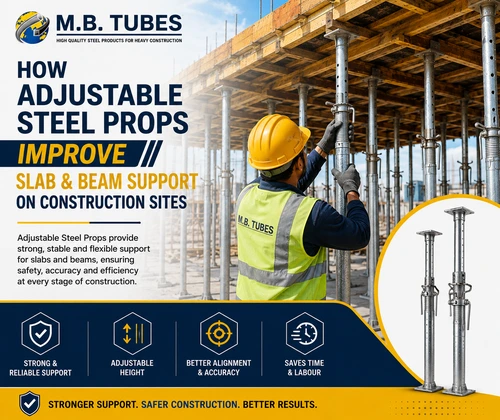
This is where adjustable steel props become highly useful. These telescopic steel supports allow construction teams to achieve the required working height while providing temporary vertical support for slab, beam, ceiling, and shuttering applications. M.B. Tubes lists its adjustable props for RCC slabs, beams, ceilings, and shuttering structures, with mild-steel construction and a threaded adjustment mechanism.
For contractors searching for an Adjustable Prop Manufacturer in Madhya Pradesh, understanding how these products work—and how to select and use them correctly—can help improve site planning, formwork alignment, and overall construction efficiency.
What Are Adjustable Steel Props?
Adjustable steel props are telescopic temporary vertical supports commonly used beneath formwork and structural elements during construction.
A typical prop consists of inner and outer steel tubes, adjustment components, locking arrangements, and top and bottom bearing plates. The telescopic arrangement provides coarse height adjustment, while the threaded mechanism allows finer positioning.
Unlike fixed-height supports, adjustable props can accommodate different working heights within their specified operating range.
They are commonly used for:
- RCC slab formwork support
- Beam shuttering and centering
- Ceiling support
- Temporary vertical support
- Formwork and shuttering systems
- Selected renovation and construction applications
The required prop size, spacing, extension, and capacity should always be determined from the project’s temporary-works design and manufacturer data.
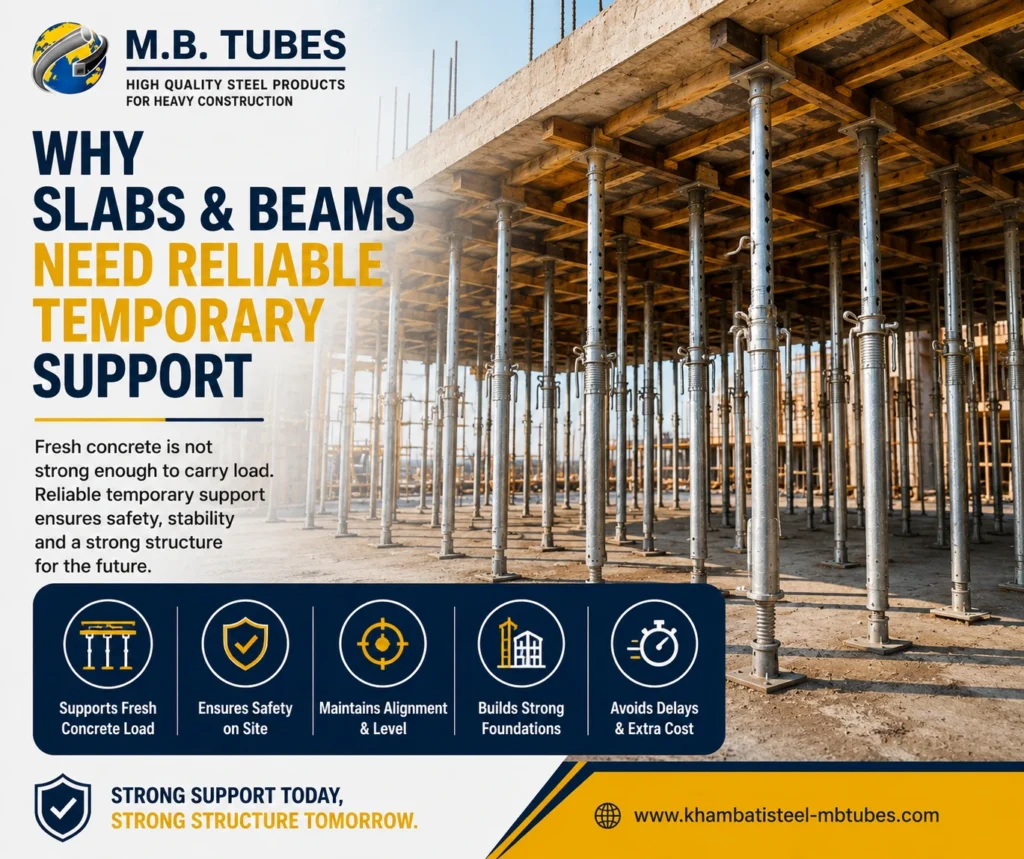
Why Slabs and Beams Need Reliable Temporary Support
Freshly placed concrete does not immediately have its final structural capacity. During casting and early curing, loads from concrete, reinforcement, formwork, workers, and construction activities must be managed by the temporary support arrangement.
Poorly planned support can contribute to problems such as formwork movement, uneven levels, excessive deflection, or construction delays.
Adjustable steel props help create a controlled supporting arrangement beneath the formwork when they are correctly selected, positioned, braced where required, and used according to the engineered design.
1. Accurate Height Adjustment Makes Formwork Easier to Level
One of the biggest practical advantages of an adjustable prop is right in its name: adjustability.
Construction floors are rarely perfect working environments. Required support heights can also vary between different areas of a project.
Telescopic adjustment allows workers to position the support close to the required height, while the adjustment mechanism provides finer control.
This can help teams achieve:
Better formwork levels → better alignment → more consistent concrete work.
M.B. Tubes states that its heavy-duty adjustable prop configuration is available with a closed height of 3 metres and an open height of 5 metres, while customized sizes and specifications are also offered for project requirements.
2. Adjustable Props Provide Direct Vertical Support for Slab Formwork
Large slab areas create substantial temporary loads during construction.
When props are arranged according to an engineered support layout, they transfer loads from the formwork toward the supporting surface below.
Their compact vertical design also makes them practical for repetitive slab construction.
However, simply adding more props is not a substitute for proper engineering. Prop spacing, allowable load, extension length, base condition, bracing, and the supporting structure below all need consideration.
3. They Make Beam Support More Flexible
Beam formwork can require support at different elevations and locations compared with surrounding slab formwork.
Fixed-height support methods can make these variations inconvenient.
Adjustable steel props offer greater flexibility because individual units can be set within their permitted adjustment ranges to suit the designed beam and shuttering arrangement.
This makes them particularly useful for projects containing multiple beam depths or changing floor configurations.
4. They Can Improve Formwork Alignment
Good concrete work starts with accurately positioned formwork.
Even a small difference in temporary support elevation can affect the formwork line and level.
Fine adjustment helps site teams correct minor height differences before concrete placement. That can make it easier to maintain the geometry specified in the construction drawings.
The result is not simply better-looking formwork—it can also reduce avoidable adjustment and correction work before the pour.
5. Steel Construction Supports Repeated Site Use
Construction support equipment is frequently moved, erected, dismantled, stored, and reused.
For this reason, durability is an important procurement consideration.
M.B. Tubes describes its adjustable props as being manufactured from mild steel for strength, stability, and service life in construction and formwork applications.
Reusable equipment can offer better long-term value on contractors’ repetitive projects, provided components are inspected, maintained, stored properly, and removed from service if damaged.
6. Faster Adjustment Can Improve Site Productivity
Construction schedules often depend on how efficiently teams can prepare shuttering before a concrete pour.
Adjustable props can simplify this workflow because the same basic support concept can accommodate different heights within the unit’s approved range.
A typical workflow may involve:
Position → Extend → Lock → Fine-adjust → Check → Inspect
This is considerably more systematic than improvising supports from miscellaneous site materials.
Efficiency, however, should never come at the expense of engineering or inspection.
7. They Work Well With Other Formwork Support Components
An adjustable prop rarely operates as an isolated construction product.
Depending on the formwork design, it may be integrated with components such as:
- Adjustable spans
- Shuttering plates
- Beams
- U-heads or support heads
- Bracing arrangements
- Formwork panels
- Other temporary support accessories
M.B. Tubes also offers MS adjustable spans intended for slab support, centering, beam support, shuttering, and formwork applications, making these products relevant to a broader temporary-support system.
The important point is compatibility: components should be used as part of an approved arrangement rather than mixed together simply because they physically fit.
8. Adjustable Props Can Reduce Unnecessary Material Handling
Traditional improvised support methods can require cutting, packing, wedging, or combining different materials to reach a desired elevation.
A telescopic prop reduces some of this complexity because height adjustment is built into the product itself.
For contractors handling repetitive floor cycles, that can mean:
Less improvisation + easier adjustment + reusable equipment + more organised site operations.
This becomes increasingly valuable on multi-storey, commercial, industrial, and repetitive RCC construction.
Adjustable Steel Props vs Improvised Supports
| Factor | Adjustable Steel Props | Improvised Support |
| Height adjustment | Controlled | Often difficult |
| Reusability | High when maintained | Varies |
| Dimensional consistency | More consistent | Can vary |
| Site organisation | Systematic | Often less organised |
| Fine adjustment | Available | Limited |
| Inspection | Easier with standardized components | More complicated |
| Project suitability | Selected to specification | May be uncertain |
For professional construction, a designed temporary-support system provides a much more controlled approach than ad-hoc arrangements.
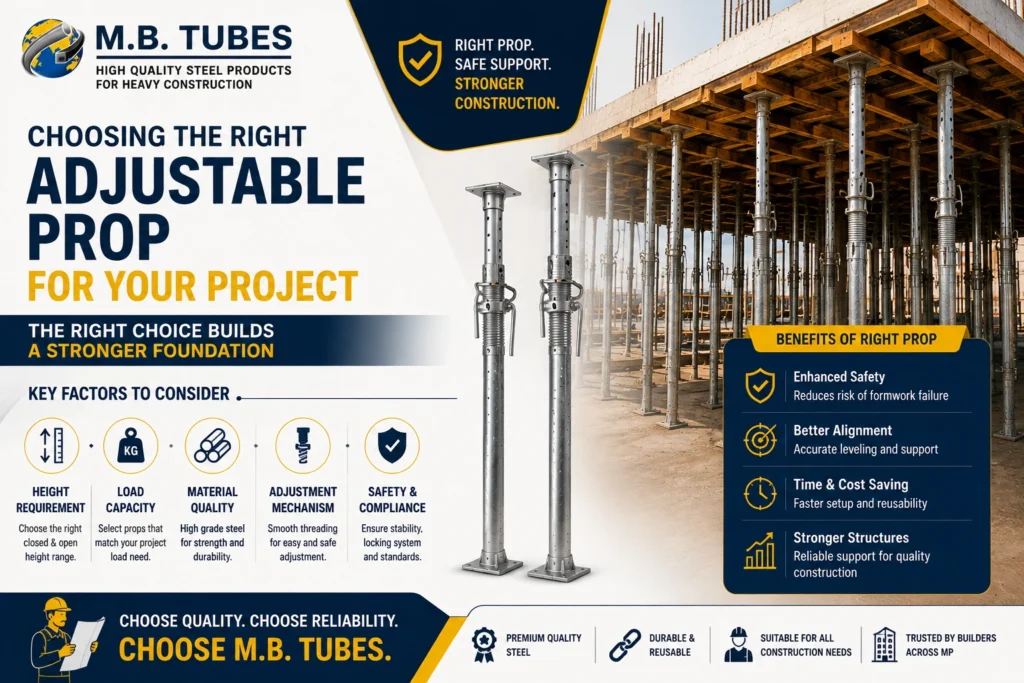
Choosing the Right Adjustable Prop for Your Project
Not every adjustable prop is suitable for every slab or beam.
Before procurement, contractors should evaluate several factors.
Required Height Range
Determine both the minimum and maximum working height required. A prop should operate within its specified adjustment range rather than being extended beyond manufacturer limits.
Load Requirement
The support requirement must be determined by competent temporary-works design. Prop capacity can vary with configuration and extension, so procurement should be based on verified technical data rather than appearance alone.
Material and Tube Quality
Consistent mild-steel tubes, proper fabrication, sound welds, and dimensional accuracy contribute to dependable product performance.
Adjustment Mechanism
The threaded adjustment and locking components should operate correctly and allow controlled positioning.
Base and Head Contact
The support arrangement should provide suitable bearing at both ends according to the system design.
Condition Before Reuse
Props should be inspected for excessive corrosion, deformation, damaged threads, bent tubes, damaged welds, or missing components before reuse.
Common Mistakes to Avoid When Using Adjustable Props
Even good-quality equipment can be used incorrectly.
Construction teams should avoid treating adjustable props as a “fit anywhere” product. Common issues include excessive extension, incorrect spacing, poor base conditions, out-of-plumb installation, damaged components, missing bracing, and premature removal.
M.B. Tubes’ own guidance notes that adjustable height does not mean unlimited extension and recommends checking required height, permitted extension, specification, vertical alignment, head/base contact, and manufacturer load information.
A useful site principle is:
Correct prop + correct spacing + correct extension + correct base + correct inspection.
Where Adjustable Steel Props Are Commonly Used
Their versatility makes adjustable props relevant across several construction environments, including residential buildings, commercial complexes, industrial facilities, warehouses, multi-storey structures, RCC works, and infrastructure-related formwork applications.
The exact application should always be matched to the engineering design rather than assumed from a previous project.
Adjustable Prop Manufacturer in Madhya Pradesh – M.B. Tubes
For construction companies sourcing temporary support equipment locally, product consistency and the ability to match project requirements are important.
M.B. Tubes positions itself as an Adjustable Prop Manufacturer in Madhya Pradesh, supplying mild-steel adjustable props for RCC slabs, beams, ceilings, shuttering, and other temporary support applications. Its product information also states that customized sizes, load capacities, and specifications can be supplied according to project requirements.
For contractors and construction companies working in Indore, Pithampur, Dewas, Ujjain, Bhopal and other parts of Madhya Pradesh, sourcing the correct prop specification can help simplify procurement and site planning.
View M.B. Tubes Adjustable Props
Final Thoughts
Adjustable steel props may look like simple construction equipment, but their role is significant. They provide temporary vertical support while allowing teams to adjust formwork to the required working elevation.
For slab and beam construction, their main advantages include height flexibility, reusable steel construction, systematic installation, better formwork positioning, and compatibility with engineered temporary-support arrangements.
The key is to avoid choosing props only by height or price. Contractors should consider load requirements, extension range, material quality, component condition, compatibility, manufacturer specifications, and the temporary-works design.
Choosing an experienced Adjustable Prop Manufacturer in Madhya Pradesh can support better product selection, but safe performance ultimately depends on correct design, installation, inspection, and use.
Frequently Asked Questions (FAQs)
1. What are adjustable steel props used for?
Adjustable steel props provide temporary vertical support for RCC slabs, beams, ceilings, shuttering, and formwork systems during construction.
2. Why are adjustable props useful for slab and beam support?
They provide controlled height adjustment, helping contractors achieve better formwork positioning, alignment, and temporary support.
3. Can adjustable steel props be reused?
Yes. Steel props can be reused across suitable projects when they are properly inspected, handled, maintained, and stored.
4. What should I check before buying adjustable steel props?
Check the height range, load requirements, steel quality, tube dimensions, adjustment mechanism, welding quality, and project specifications.
5. How do I choose an Adjustable Prop Manufacturer in Madhya Pradesh?
Choose an Adjustable Prop Manufacturer in Madhya Pradesh that offers consistent manufacturing, suitable specifications, reliable supply, and products designed for construction and formwork applications.