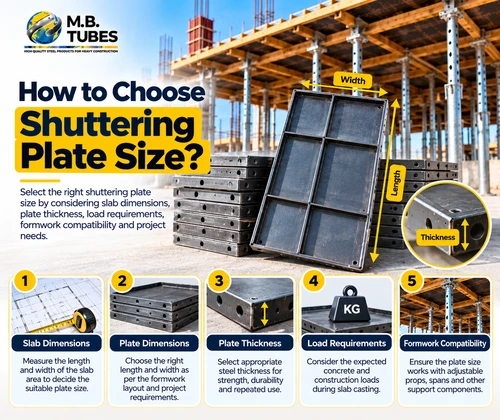

How to Choose Shuttering Plate Size? A Complete Guide for Construction Projects
Choosing the right Shuttering Plate Size is important for smooth, accurate and efficient concrete construction. Whether you are working on a residential building, commercial project or industrial structure, the correct shuttering plate dimensions can help improve formwork alignment, reduce unnecessary gaps and simplify installation.
Steel shuttering plates are commonly used to support fresh concrete during slab casting and other formwork applications. However, choosing a plate only by its price or availability can create problems during installation.
This guide explains how to choose Shuttering Plate Size, which measurements matter, what to check before ordering and how to select suitable steel shuttering plates for your construction project.
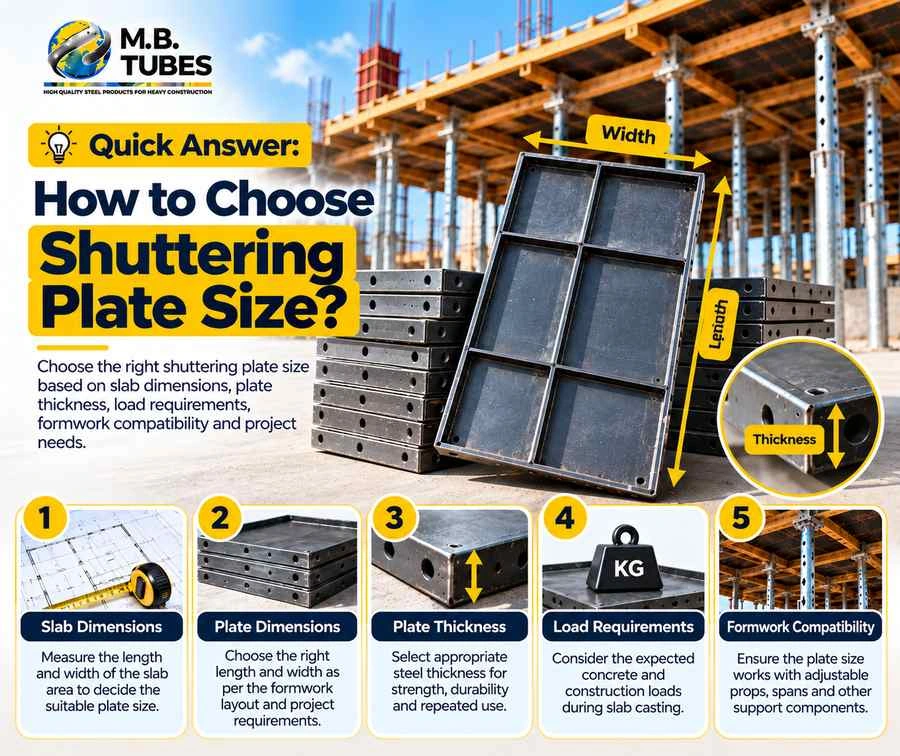
Quick Answer: How to Choose Shuttering Plate Size?
The right Shuttering Plate Size depends on the dimensions of the concrete area, slab layout, required support arrangement, plate thickness and construction requirements.
Before selecting a shuttering plate, check:
- Length and width of the plate
- Steel thickness and structural design
- Slab dimensions and formwork layout
- Load requirements during concrete casting
- Compatibility with adjustable props and spans
- Reusability and handling requirements
The best choice is a plate size that fits the approved formwork design while allowing proper support, alignment and installation.
What Is Shuttering Plate Size?
Shuttering Plate Size refers to the physical dimensions of a steel plate used in temporary concrete formwork.
A shuttering plate generally consists of a steel surface supported by a frame or stiffening arrangement, depending on its design.
Its main purpose is to provide a temporary surface that helps maintain the required shape of fresh concrete until the concrete develops sufficient strength.
The three important measurements are:
Measurement | Meaning | Why It Matters |
Length | Longest dimension of the plate | Determines coverage along the slab |
Width | Shorter dimension of the plate | Helps plan the plate arrangement |
Thickness | Thickness of the steel sheet or specified component | Influences stiffness, weight and suitability |
Important: Plate dimensions alone do not determine load capacity. The complete plate design and supporting formwork system must also be considered.
Common Shuttering Plate Sizes Used in Construction
Steel shuttering plates are available in different dimensions depending on the manufacturer, product design and project requirements.
Examples of commonly encountered nominal plate sizes include:
Shuttering Plate Size | Approximate Dimensions | Typical Consideration |
600 × 900 mm | 2 × 3 ft | Smaller slab sections |
600 × 1200 mm | 2 × 4 ft | General slab formwork |
900 × 1200 mm | 3 × 4 ft | Larger coverage areas |
900 × 1500 mm | 3 × 5 ft | Projects needing fewer plate joints |
These are illustrative market sizes, not confirmed specifications for every M.B. Tubes product. Actual available sizes, thicknesses and capacities should be verified before ordering.
1. Measure the Slab Area Before Selecting Plates
The first step in choosing the correct Shuttering Plate Size is understanding the dimensions of the area where the plates will be installed.
For example, consider a rectangular slab measuring:
- Length: 6 metres
- Width: 4 metres
- Total area: 24 square metres
The basic calculation is:
Slab Area = Length × Width
6 × 4 = 24 m²
This tells you the overall area requiring formwork coverage.
However, slab area alone is not enough to determine the exact number of plates. You must also consider plate arrangement, support spacing, edges, beams and openings.
2. Choose Plate Dimensions That Fit the Layout
Not every slab has the same shape or dimensions.
Some projects have simple rectangular layouts, while others include columns, beams, openings and irregular edges.
A suitable shuttering plate layout should:
- Minimize unnecessary gaps
- Reduce excessive cutting or modification
- Allow proper positioning around structural elements
- Support convenient installation and removal
Practical tip: Prepare a plate layout drawing before placing a bulk order. This can help avoid purchasing unsuitable sizes.
3. Check Shuttering Plate Thickness
Thickness is another important factor when selecting a Shuttering Plate Size.
Steel plate thickness affects the weight and stiffness of the component, but its performance also depends on the frame, stiffeners, support spacing and manufacturing design.
A thicker sheet does not automatically mean that the complete shuttering system can support a higher load.
When checking specifications, ask the manufacturer about:
- Steel sheet thickness
- Frame dimensions
- Reinforcement or stiffener arrangement
- Plate weight
- Approved load and support requirements
Select the plate according to the project’s structural and formwork design.
4. Understand the Load Requirements
During concrete casting, shuttering plates are exposed to loads from fresh concrete, reinforcement, workers, equipment and construction activities.
These loads must be considered when planning the formwork arrangement.
The required capacity depends on factors such as:
Concrete Load + Construction Loads + Formwork Self-Weight + Other Applicable Loads
The actual design must also account for how these loads are transferred through the plates, spans, props and supporting surfaces.
Never select a shuttering plate based only on its dimensions. Follow the approved formwork design and verified manufacturer specifications.
5. Check Compatibility with Adjustable Props and Spans
A shuttering plate works as part of a complete formwork support system.
Other supporting components may include:
- Adjustable steel props
- Adjustable spans
- Steel channels
- Supporting beams
- Formwork accessories
For example, adjustable props provide vertical support, while adjustable spans may be used as horizontal supporting members.
The shuttering plate must fit the designed support arrangement.
Incorrect spacing or incompatible components can affect stability, alignment and load distribution.
6. Consider Installation and Reusability
For projects involving repeated slab casting, selecting a practical shuttering plate size can improve handling and material planning.
Smaller plates may be easier to position in restricted areas, while larger plates can cover more area per piece.
However, larger plates may also be heavier and require additional handling arrangements.
Consider the following:
Smaller Shuttering Plates | Larger Shuttering Plates |
Useful for restricted layouts | Cover more area per plate |
May be easier to handle individually | May reduce the number of joints |
More joints may be required | Handling may need more planning |
Useful around irregular sections | Suitable for repeated regular layouts |
The right choice depends on the project rather than assuming one size is always better.
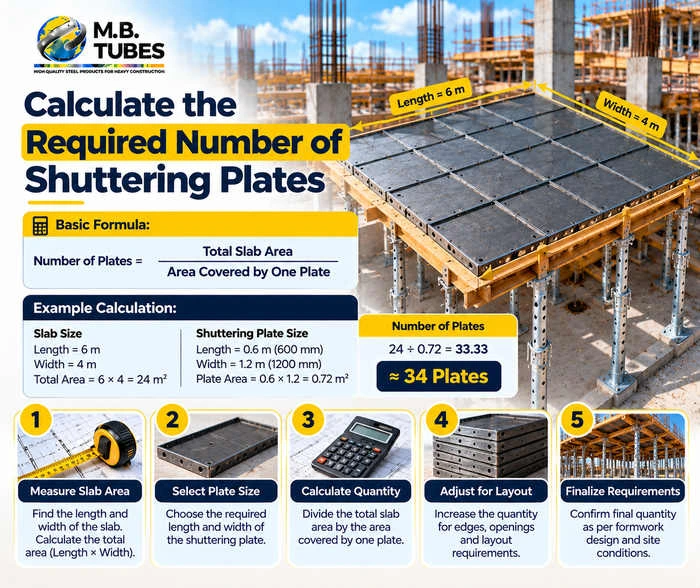
7. Calculate the Required Number of Shuttering Plates
Once the dimensions are selected, estimate the quantity needed.
Basic Formula:
Number of Plates = Total Slab Area ÷ Area Covered by One Plate
For example:
- Slab area: 24 m²
- Plate size: 600 × 1200 mm
- Plate area: 0.72 m²
Calculation:
24 ÷ 0.72 = 33.33
The theoretical area-based requirement is approximately 34 plates.
This is only an initial estimate. The final quantity may be higher because of plate layout, gaps, edge conditions, openings and the approved support arrangement.
A detailed formwork layout should be used for final procurement.
8. Common Mistakes When Choosing Shuttering Plate Size
Avoid these common purchasing mistakes:
Choosing plates only by price: Low initial cost may not represent the best value if dimensions or construction quality are unsuitable.
Ignoring support compatibility: The plate must work with the specified formwork system.
Ordering without a layout: Area-based estimates alone may produce incorrect quantities.
Ignoring handling requirements: Large and heavy plates may be difficult to move in restricted construction areas.
Assuming every plate has the same capacity: Different designs and thicknesses may have different performance characteristics.
Shuttering Plate Size Checklist Before Ordering
Before contacting a manufacturer or supplier, prepare the following information:
Requirement | What to Confirm |
Project Type | Residential, commercial or industrial |
Slab Dimensions | Length, width and layout |
Plate Size | Required length and width |
Plate Thickness | As per approved specification |
Support System | Props, spans and other members |
Quantity | Number of plates required |
Surface Finish | As per project requirement |
Delivery Location | Construction site or warehouse |
A clear specification helps manufacturers understand your requirements and prepare a suitable quotation.
Shuttering Plates from Khambati Steel & M.B. Tubes
Khambati Steel & M.B. Tubes provides steel products and construction support solutions for builders, contractors and industrial projects.
Its construction product range includes steel shuttering plates, centering plates, adjustable props, adjustable spans and scaffolding components.
When selecting shuttering plates, buyers should confirm the required dimensions, material specifications, support compatibility and quantity.
Providing complete project details can help identify suitable products for the intended application.
Conclusion
Choosing the right Shuttering Plate Size involves more than selecting a convenient length and width.
You must consider slab dimensions, plate thickness, load requirements, support compatibility, handling and reusability.
A properly planned shuttering plate arrangement can support efficient installation, consistent concrete formwork and better material management.
For construction projects, Khambati Steel & M.B. Tubes can be contacted with the required plate dimensions, quantity and technical specifications to discuss suitable shuttering solutions.
Frequently Asked Questions (FAQs)
What is the standard Shuttering Plate Size?
There is no single universal size for every construction project. Common nominal sizes include 600 × 900 mm, 600 × 1200 mm and other dimensions. Availability depends on the manufacturer and product design.
Which Shuttering Plate Size is best for slab construction?
The best size depends on slab dimensions, support spacing, formwork layout and load requirements. A plate that fits the approved layout and support system is generally the appropriate choice.
Does shuttering plate thickness affect strength?
Yes. Thickness influences plate stiffness and weight, but the complete load capacity also depends on the frame, stiffeners, material properties and support arrangement.
How do I calculate shuttering plate quantity?
Divide the total slab area by the area covered by one plate for an initial estimate. Then adjust the quantity using a detailed layout that accounts for edges, openings and plate arrangement.
Can shuttering plates be reused?
Yes. Steel shuttering plates are generally designed for repeated use when properly handled, cleaned, inspected and maintained. Their reuse suitability depends on their condition, design and construction requirements.