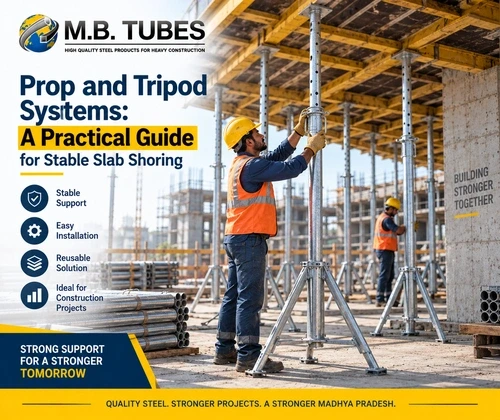

Slab construction may look straightforward once the concrete is finished, but before a slab can reach that stage, it needs a properly planned temporary support system. Props and tripods are commonly used as part of formwork and shoring arrangements to provide temporary support during construction.
For contractors, builders, formwork teams, and procurement professionals, selecting suitable equipment is about more than finding a product that fits the budget. Load requirements, adjustment range, site conditions, installation, component condition, and compatibility with the overall formwork system all matter.
When sourcing from a Prop & Tripod System Manufacturer in Madhya Pradesh, understanding these factors can help buyers make better procurement decisions for projects across MP.
What Is a Prop and Tripod System?
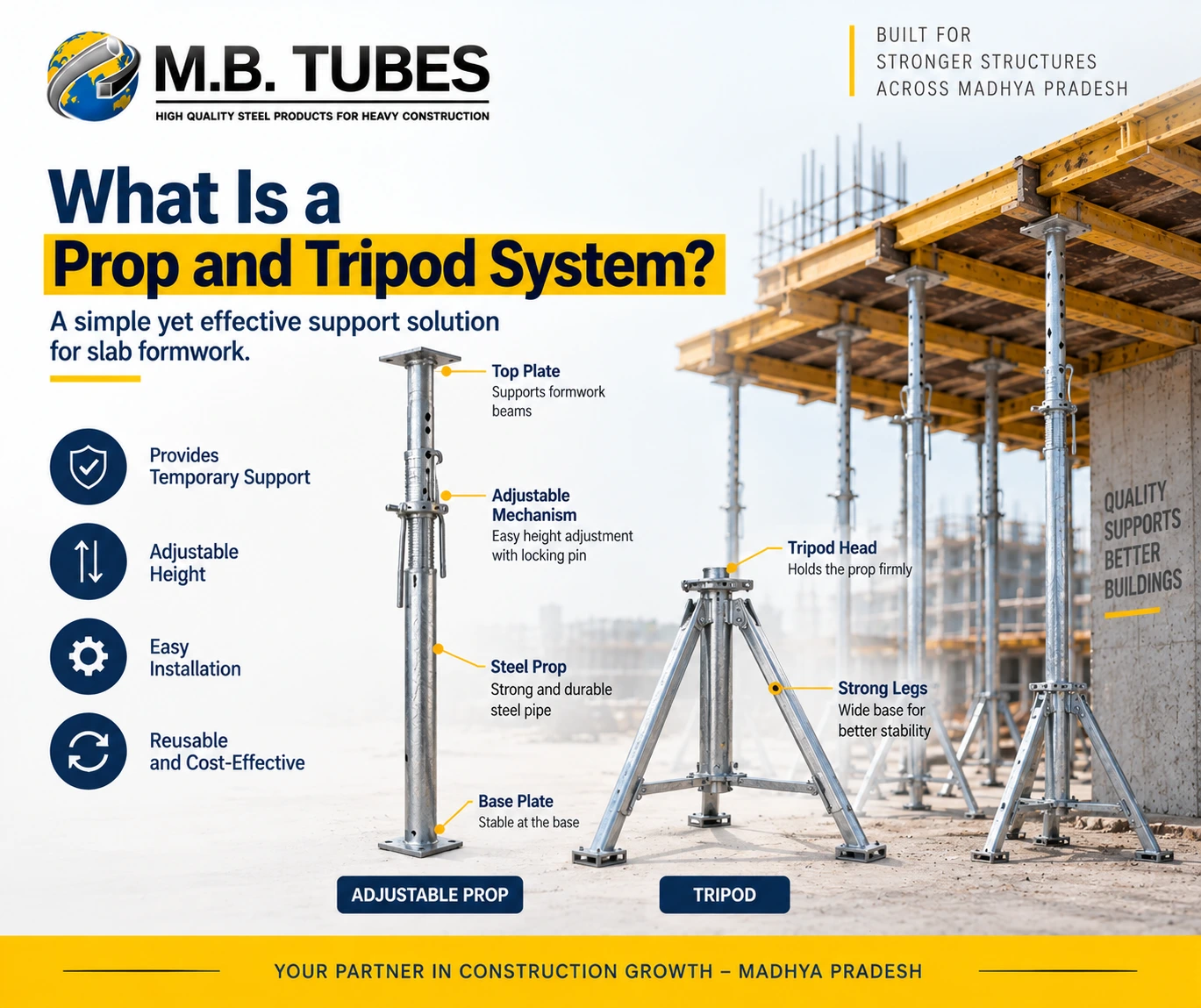
A prop and tripod arrangement typically combines an adjustable steel prop with a tripod support.
The adjustable prop provides vertical temporary support, while the tripod helps hold the prop upright and assists with positioning during setup. Depending on the formwork design, props may work together with beams, heads, shuttering components, and other supporting elements.
This type of system is commonly considered for slab formwork and temporary shoring applications because it offers adjustability and can be repositioned as construction progresses.
However, the complete temporary works arrangement should always follow the project’s engineering and formwork design requirements.
Why Stable Slab Shoring Matters
Fresh concrete and formwork create loads that need to be safely supported during construction. The temporary support arrangement must remain stable while work is carried out and while the concrete develops the required strength.
Poor planning can lead to uneven support, movement of formwork, delays, additional adjustment work, or more serious safety concerns.
That is why slab shoring should never be treated as simply “placing props under a slab.”
A well-planned system considers load distribution, prop spacing, height, bracing, base conditions, formwork configuration, erection procedure, and inspection.
The responsible engineer or competent temporary-works professional should determine the appropriate arrangement for each project.
How Adjustable Steel Props Work
An adjustable steel prop generally consists of inner and outer steel tubes with an adjustment mechanism.
The adjustable design allows the working height to be set within the manufacturer’s specified range. This makes props useful where slab heights or temporary support requirements vary across a project.
For contractors searching for adjustable steel props in Madhya Pradesh, height range is one of the first specifications to check.
A prop should not be selected simply because it can physically reach the required height. Its permitted capacity at that extension and its suitability for the designed support arrangement must also be considered.
What Does the Tripod Do?
The tripod is often misunderstood as the component that carries the complete slab load.
Its primary practical role is generally to help position and stabilise an individual prop during erection, subject to the specific system design and manufacturer’s instructions. It creates a wider temporary footprint around the prop, making setup more manageable.
This can be particularly useful when workers are arranging multiple props before the rest of the formwork system is fully connected.
Tripods should therefore be viewed as part of the installation and support arrangement—not as a substitute for properly designed shoring, bracing, or engineering controls.
1. Check the Required Prop Height
Before requesting a quotation from a Prop & Tripod System Manufacturer in Madhya Pradesh, buyers should identify the required working heights.
Important questions include:
- What is the floor-to-slab height?
- What formwork components will sit above the prop?
- What adjustment range is required?
- Will the same props be used in areas with different heights?
- What extension will actually be used on site?
Providing this information makes it easier to identify an appropriate product configuration.
2. Understand Load Requirements
Height alone is not enough.
The shoring system must be suitable for the loads determined by the temporary works or structural design. Prop capacity can vary according to product design, extension, configuration, condition, and other factors.
Buyers should obtain relevant technical information from the manufacturer and ensure it is reviewed against project requirements.
Avoid choosing a prop based solely on appearance, weight, or generic terms such as heavy-duty prop.
For safety-critical construction support, engineering requirements should take priority over assumptions.
3. Inspect the Adjustment Mechanism
Construction sites require equipment that can be adjusted efficiently and used according to its intended design.
Before bulk procurement, check the adjustment arrangement, locking components, threads, pins, and other relevant parts of the prop.
For reusable equipment, these areas should also be inspected between uses. Damaged, excessively worn, bent, or otherwise unsuitable components should not simply be returned to service without proper assessment.
Smooth and controlled adjustment can help the site team position the system more efficiently.
4. Check the Base and Working Surface
Even a good-quality prop cannot compensate for an unsuitable foundation or unstable supporting surface.
The base needs to transfer load into an appropriate supporting area as required by the design. Uneven, weak, loose, or unsuitable surfaces can affect the performance of temporary works.
Before erection, the site team should assess the supporting conditions and follow the approved shoring plan.
This is particularly important on active construction sites where floor conditions can vary from one area to another.
5. Look for Consistency in Bulk Orders
Large slab projects can require a substantial number of props and associated components.
Consistency becomes important because workers need equipment that fits into a repeatable site process.
When comparing a Prop & Tripod System Manufacturer in Madhya Pradesh, buyers can ask about dimensional consistency, manufacturing controls, available sizes, component compatibility, inspection practices, and repeat-order capability.
A bulk order should not be evaluated only by the condition of one sample.
6. Consider Reusability and Handling
Construction equipment is frequently moved from one slab, floor, or project phase to another.
That makes handling and reuse important commercial considerations.
A reusable prop and tripod system can support efficient project operations when the components are used, inspected, stored, maintained, and handled correctly.
Contractors should establish a simple inspection routine before reuse. Check for visible deformation, damaged adjustment parts, corrosion that may affect suitability, missing components, or other signs of damage.
Reusable does not mean maintenance-free.
7. Plan the Quantity Before Ordering
Ordering too few props can interrupt the formwork cycle. Ordering substantially more than required can increase storage, handling, and capital requirements.
Quantity planning should be linked to the project’s slab area, engineered prop layout, construction sequence, floor cycle, reuse strategy, and available inventory.
For larger developments, phased procurement may also be worth discussing with the supplier.
A regional construction prop supplier in Madhya Pradesh may make repeat-order coordination easier, depending on stock, manufacturing capacity, and delivery arrangements.
8. Think Beyond Product Price
The lowest unit price does not automatically mean the lowest project cost.
Buyers should consider the complete procurement picture:
Product Cost + Transportation + Handling + Availability + Replacement Requirements + Delivery Reliability + Expected Reuse
If a project requires additional props urgently but the supplier cannot provide them within the required schedule, the resulting disruption can outweigh a small saving on the original purchase.
For this reason, supplier reliability deserves serious consideration.
Benefits of Regional Sourcing for MP Construction Projects
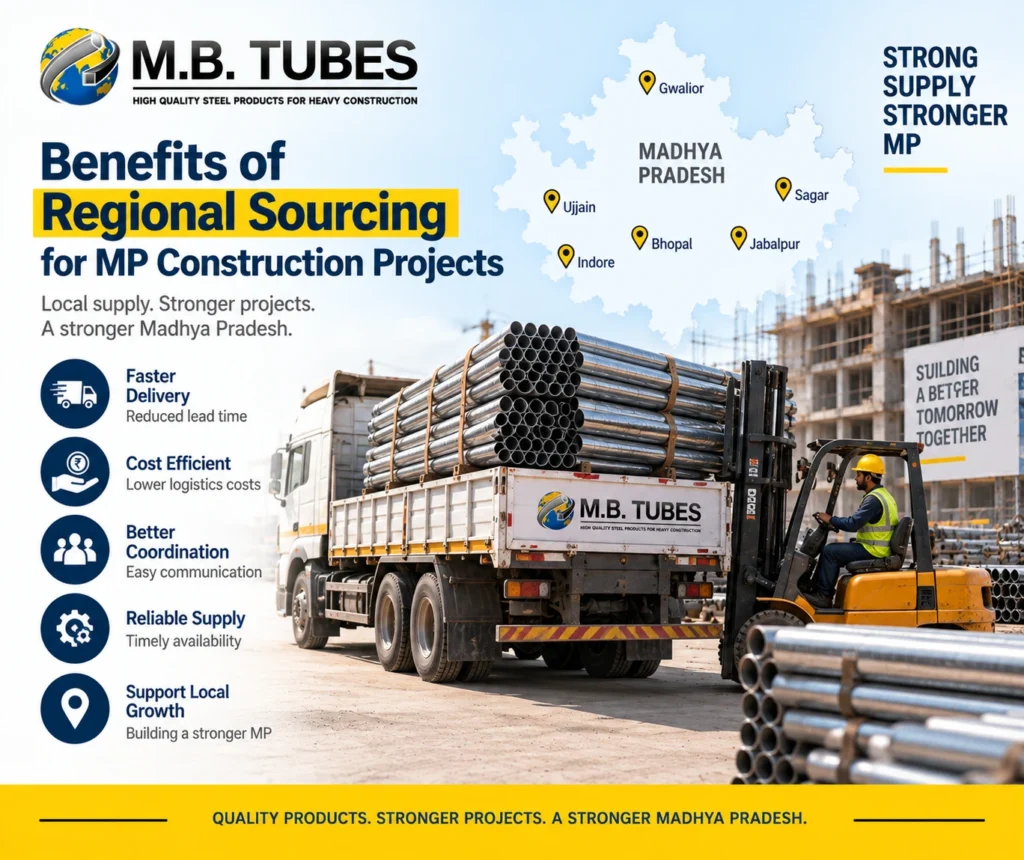
Construction activity across Indore, Pithampur, Dewas, Bhopal, Ujjain, Jabalpur, Gwalior, Sagar, Satna, Rewa, and other Madhya Pradesh markets creates demand for dependable formwork and scaffolding equipment.
Working with a regional Prop & Tripod System Manufacturer in Madhya Pradesh can make communication and logistics more manageable for MP-based buyers.
Regional sourcing may help with:
Faster coordination: Technical and commercial requirements can be communicated more efficiently.
Planned deliveries: Buyers can coordinate quantities according to their construction schedule.
Repeat requirements: Additional components may be easier to arrange when projects progress in phases.
Lower logistics complexity: Shorter supply routes can simplify transportation planning in suitable cases.
The actual benefits will depend on the manufacturer’s capabilities and the project’s location and requirements.
Prop & Tripod System vs Conventional Timber Support
Buyers sometimes compare adjustable steel props with conventional timber-based temporary supports.
Steel prop systems offer controlled adjustability and standardised components, while timber solutions may vary considerably depending on material and site practices.
The correct solution should not be selected simply because one option appears more convenient.
Temporary support must match the project’s engineering design, loads, formwork arrangement, site conditions, and construction methodology.
For many organised formwork operations, standardised reusable components can make inventory and installation processes easier to manage.
What to Ask a Manufacturer Before Ordering
Before placing a bulk order, provide your supplier with enough information to understand the requirement. Discuss the prop size and adjustment range, required quantity, applicable product specifications, project application, tripod compatibility, expected delivery location, documentation requirements, inspection expectations, and anticipated repeat orders.
For technical applications, request relevant product data rather than relying only on marketing descriptions.
A professional Prop & Tripod System Manufacturer in Madhya Pradesh should be able to clearly communicate what is being supplied and its specified characteristics.
Final Thoughts
Props and tripods may appear to be simple construction products, but their role within slab formwork and temporary shoring requires careful planning.
Successful procurement begins with understanding the project’s height requirements, designed loads, system configuration, quantity, site conditions, component compatibility, inspection needs, and construction schedule.
For contractors and construction companies operating across MP, choosing a reliable Prop & Tripod System Manufacturer in Madhya Pradesh can also support better procurement coordination and repeat supply.
The objective should never be to simply purchase more props. It should be to source suitable, consistent equipment that fits into a properly designed temporary support system and helps the project team work in a planned and efficient manner.
Frequently Asked Questions (FAQs)
1. What is a prop and tripod system used for in construction?
A prop and tripod system is commonly used as part of temporary support arrangements for slab formwork. Adjustable steel props provide vertical support, while tripods help position and stabilise props during setup, subject to the system design.
2. How do I choose a Prop & Tripod System Manufacturer in Madhya Pradesh?
Check the manufacturer’s product specifications, available prop sizes, adjustment ranges, manufacturing consistency, quality-control practices, bulk supply capability, delivery coordination, and support for repeat requirements.
3. What is an adjustable steel prop?
An adjustable steel prop is a temporary vertical support component typically made with inner and outer steel tubes and an adjustment mechanism. Its height can be adjusted within the manufacturer’s specified working range.
4. What is the purpose of a tripod with a steel prop?
A tripod generally helps keep an individual prop upright and assists workers with positioning during erection. It should not be assumed to replace engineered bracing or other components required by the temporary works design.
5. Are prop and tripod systems suitable for slab shoring?
They can form part of slab shoring and formwork arrangements when properly selected and configured. The complete support system, spacing and capacity should follow the project’s approved engineering or temporary-works design.