
When Should You Use a Scaffolding Tower? Uses, Benefits & Selection Guide
Construction and maintenance projects often involve working at heights where ordinary ladders cannot provide enough space for workers, tools and materials. In such situations, choosing the right access equipment becomes important for both safety and productivity.
A Scaffolding Tower is a temporary elevated structure designed to provide a working platform for construction, painting, inspection, installation and maintenance activities. It allows workers to access different heights while keeping essential tools within reach.
However, not every project requires a scaffolding tower. Understanding when to use a Scaffolding Tower, its benefits and its limitations can help contractors choose a suitable access solution.
Quick Answer: When Should You Use a Scaffolding Tower?
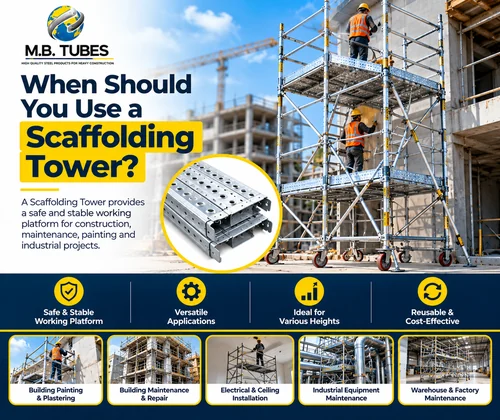
A Scaffolding Tower is useful when workers need a stable, elevated working platform for tasks that take longer than a simple ladder job. It is commonly used for building maintenance, painting, plastering, ceiling installation, electrical work, inspection and industrial repairs.
A tower is particularly suitable when the work area is relatively compact and workers need access to a specific location at height. The tower must be properly configured, inspected and used within its approved working limits.
Lorem ipsum dolor sit amet, consectetur adipiscing elit. Ut elit tellus, luctus nec ullamcorper mattis, pulvinar dapibus leo.
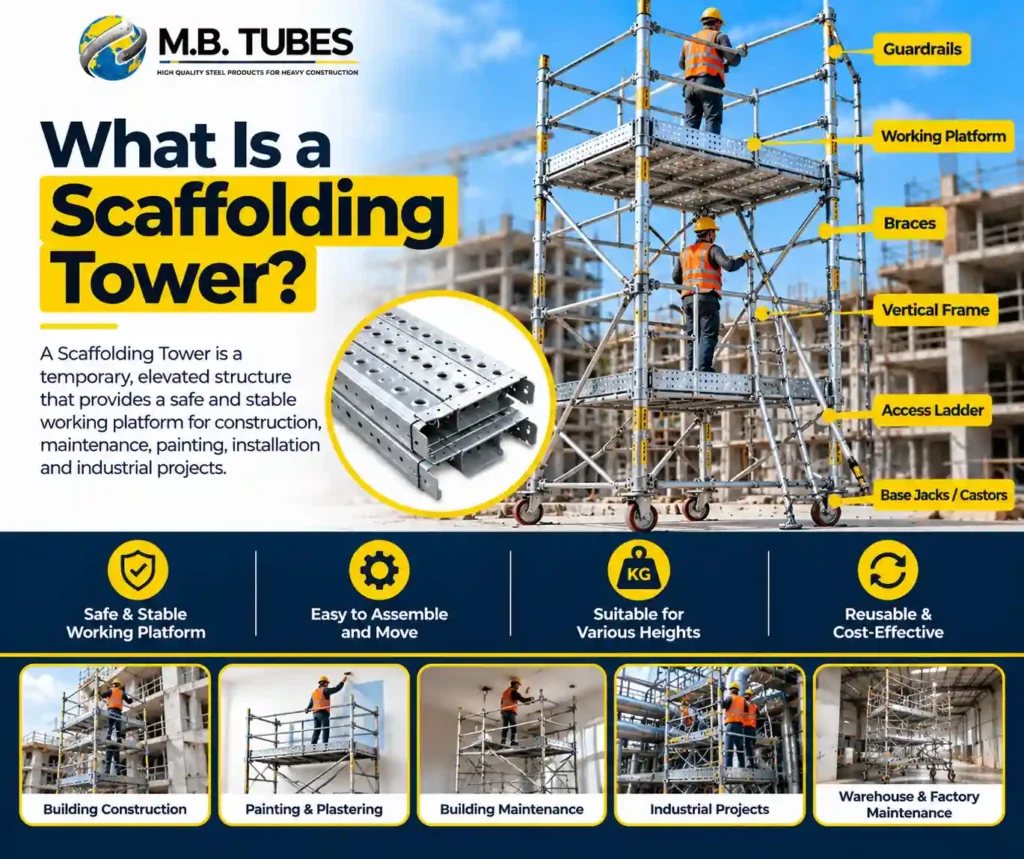
What Is a Scaffolding Tower?
A Scaffolding Tower is a temporary access structure assembled using vertical frames or standards, horizontal members, bracing, working platforms and other compatible scaffolding components.
Unlike scaffolding installed across an entire building, a tower generally provides access to a smaller, defined working area.
Depending on its design, a scaffolding tower may be stationary or mobile.
Common components include:
- Vertical Frames or Standards: Form the main supporting structure.
- Horizontal Members: Connect structural sections.
- Diagonal Braces: Provide stability to the assembled tower.
- Walkway Planks: Create the working platform.
- Base Jacks or Base Supports: Support and level the structure.
- Guardrails and Toe Boards: Provide platform-edge protection.
- Access Components: Allow workers to reach the platform through a designated access route.
Each component must be compatible with the selected tower system.
7 Situations When a Scaffolding Tower Is Useful
1. Building Painting and Plastering
Painting and plastering often require workers to remain at a particular height for extended periods.
A Scaffolding Tower for Painting provides a working platform where workers can position tools and perform finishing activities.
It is useful for:
- Exterior wall painting
- Interior wall finishing
- Plaster repairs
- Surface preparation
The tower should be positioned and secured according to its design and site conditions.
2. Building Maintenance and Repair
Commercial buildings, residential properties and industrial facilities require regular maintenance.
A Scaffolding Tower for Maintenance can provide access to elevated locations for repairing surfaces, inspecting structural areas and replacing building components.
For example, a maintenance team repairing an elevated wall section may benefit from a tower rather than repeatedly repositioning a ladder.
3. Electrical and Ceiling Installation
Electrical installation and ceiling work often involve overhead activities.
A properly selected Scaffolding Tower can provide access for installing ceiling fixtures, cable trays, lighting systems and other overhead components.
Before starting work, contractors must consider electrical hazards, available clearance, platform loading and the suitability of the tower for the task.
4. Industrial Equipment Maintenance
Industrial facilities frequently contain machinery, elevated pipelines and equipment requiring inspection.
An Industrial Scaffolding Tower may be suitable for maintenance work around accessible equipment where sufficient floor space and safe working clearance are available.
Common applications include equipment inspection, mechanical maintenance, surface repairs and selected installation activities.
The tower configuration must match the industrial environment and work requirements.
5. Warehouse and Factory Maintenance
Warehouses and factories often have elevated areas requiring maintenance.
A scaffolding tower can assist with selected tasks involving overhead installations, wall repairs, lighting maintenance and structural inspections.
However, the working area must be checked for moving vehicles, overhead obstructions, floor conditions and other site hazards.
6. Short-Duration Construction Activities
Some construction tasks require elevated access without installing scaffolding along an entire structure.
For suitable locations, a Temporary Scaffolding Tower may provide a practical working platform for inspection, minor finishing or localized repair work.
The duration of the job alone does not determine suitability. Working height, load requirements, ground conditions and access arrangements remain essential.
7. Inspection and Renovation Projects
Renovation projects may require workers to inspect or repair several elevated sections.
A scaffolding tower can be useful for localized inspection, refurbishment and restoration activities.
For larger work areas, continuous scaffolding or another access system may be more appropriate.
Scaffolding Tower vs Ladder: Which Should You Choose?
Both ladders and scaffolding towers provide access to elevated locations, but their applications differ.
Factor | Scaffolding Tower | Ladder |
Working Surface | Elevated platform | Narrow rungs or steps |
Suitable Work | Tasks requiring a working platform | Suitable short-duration, low-risk access or tasks |
Tools and Materials | Within approved platform load | Limited by ladder design |
Assembly | Requires proper erection | Usually simpler to position |
Space Requirement | Requires sufficient footprint | Generally smaller footprint |
Movement | Depends on stationary or mobile design | Repositioned manually |
Key takeaway: Choose a Scaffolding Tower when the task requires a suitable working platform, while considering other access equipment when the tower cannot be safely positioned or configured.
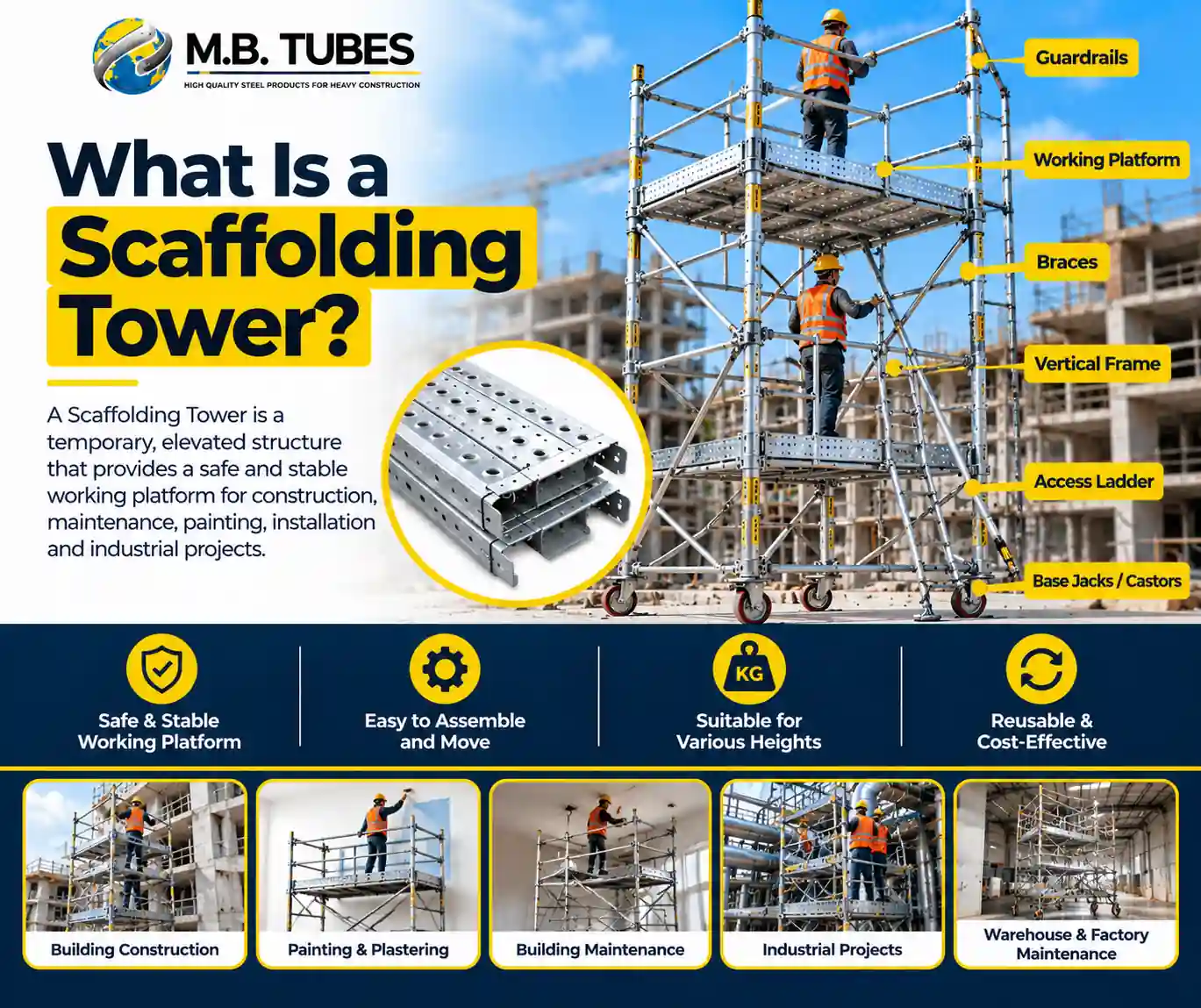
What Are the Benefits of Using a Scaffolding Tower?
Better Working Access
A properly configured tower allows workers to reach elevated locations from a designated platform.
Suitable for Repeated Tasks
Scaffolding towers can support repeated maintenance and finishing activities when assembled and used according to their design.
Flexible Applications
Depending on the system, towers can be used for construction, renovation, maintenance and industrial work.
Reusable Components
Steel scaffolding components can often be reused across suitable projects, provided they remain serviceable and compatible.
Organized Working Space
A properly designed platform can help workers manage permitted tools and materials while performing elevated tasks.
These benefits depend on correct assembly, loading, inspection and use.
How to Choose the Right Scaffolding Tower
Choosing a Scaffolding Tower for Construction requires more than checking its height.
- Identify the Working Height
Determine the platform height needed to reach the work safely. Do not confuse platform height with overall tower height.
- Check the Ground Conditions
The supporting surface must be capable of carrying the intended loads. Uneven, soft or unsuitable ground may require a different arrangement.
- Confirm Load Requirements
Consider workers, tools, materials and other intended loads. Never assume all scaffolding towers have the same load capacity.
- Select the Correct Tower Type
Choose between stationary and mobile configurations according to the task, environment and manufacturer specifications.
- Check Platform Dimensions
Ensure the platform provides adequate working space without exceeding its rated capacity.
- Verify Safety Components
Confirm the required bracing, guardrails, toe boards, access arrangements, base supports and other protective components.
- Consider the Work Environment
Check nearby electrical installations, openings, overhead obstructions, vehicle movements and weather exposure.
Important: Tower height, stability, anchoring, outriggers and permissible loading must follow the specific manufacturer’s instructions and an appropriate site safety assessment.
Common Mistakes to Avoid When Using a Scaffolding Tower
Even a well-manufactured scaffolding tower can become unsafe when used incorrectly.
Common mistakes include using incompatible components, exceeding the rated load, assembling on unsuitable ground, removing bracing, climbing outside the designated access route and using an incomplete platform.
Mobile towers require additional precautions. Workers must not move a tower while people or unsecured materials remain on it, unless a specifically designed system and applicable safety requirements expressly permit the operation.
A competent person should inspect the assembled tower before use and following changes or conditions that could affect its safety.
Scaffolding Towers from Khambati Steel & M.B. Tubes
Khambati Steel & M.B. Tubes offers scaffolding systems and related steel components for construction and industrial applications.
Its product range includes Scaffolding Towers, Cuplock Scaffolding, H Frame Scaffolding, Scaffolding Pipes, Walkway Planks, Adjustable Base Jacks and Scaffolding Accessories.
Contractors and procurement teams should share their project requirements, including working height, platform dimensions, loading conditions, system specifications, required quantity and delivery location, before selecting components.
Conclusion
A Scaffolding Tower can be a practical access solution for construction, painting, maintenance, installation and repair work at height.
The right choice depends on the working height, platform size, load requirements, ground conditions, tower configuration and surrounding work environment.
For contractors and project buyers, the most effective approach is to identify the work requirements first and then select a compatible scaffolding system.
Khambati Steel & M.B. Tubes provides scaffolding products and components for construction and industrial projects, helping buyers source materials according to their project specifications.
Frequently Asked Questions (FAQs)
What is a Scaffolding Tower mainly used for?
A Scaffolding Tower provides temporary elevated access and working platforms for tasks such as painting, plastering, building maintenance, inspection, installation and repairs. It is particularly useful when workers need a platform at a specific working height.
Can a Scaffolding Tower be used indoors?
Yes. A Scaffolding Tower may be used indoors for suitable maintenance, installation and finishing tasks. The available space, floor strength, overhead clearance, access route and tower configuration must be checked before use.
What is the difference between a mobile and stationary Scaffolding Tower?
A Mobile Scaffolding Tower has a purpose-designed arrangement for repositioning, typically including suitable castors and stabilizing components. A stationary tower remains positioned on its designated supports. Both require proper assembly, stability and inspection.
How high can a Scaffolding Tower be built?
The permitted height depends on the tower design, base dimensions, bracing, stabilizers, anchoring arrangements, manufacturer instructions and site conditions. There is no single safe maximum height applicable to every scaffolding tower.
Is a Scaffolding Tower suitable for industrial maintenance?
Yes. An Industrial Scaffolding Tower may be used for selected equipment inspections, elevated repairs and maintenance activities. Suitability depends on working height, loading, clearance, ground conditions and industrial hazards.