
An industrial shed roof does much more than cover a building. It protects machinery, inventory, workers, electrical systems, and day-to-day operations from weather exposure. Because industrial roofs usually cover large areas, even a small mistake in sheet selection can become a significant issue during installation or over the building’s service life.
That is why selecting roofing sheets should not begin with one question: “Which profile looks best?”
A better starting point is: “Which roofing sheet profile suits the building design, roof slope, span, weather exposure, drainage requirements, and installation system?”
For contractors, industrial developers, warehouse owners, fabricators, and procurement teams searching for an Industrial Roofing Sheet Supplier in Madhya Pradesh, this guide explains the practical factors worth checking before placing an order.
What Is a Roofing Sheet Profile?
A roofing sheet profile is the shape formed into a metal sheet during manufacturing. Depending on the product, it may have trapezoidal ribs, corrugations, raised sections, valleys, or other geometries.
These profiles are not created only for appearance. Profile geometry can influence factors such as sheet stiffness, water drainage, fixing arrangements, effective cover width, and compatibility with the supporting structure.
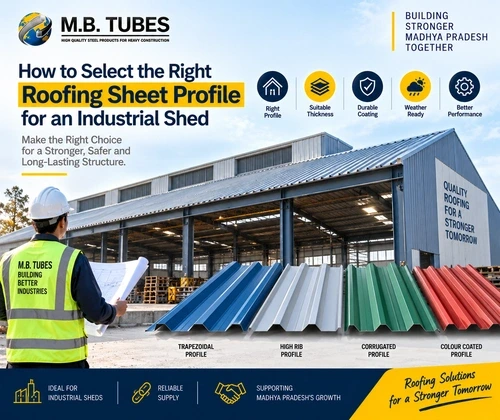
Common industrial roofing options include:
- Profile roofing sheets
- Trapezoidal roofing sheets
- Corrugated roofing sheets
- Colour-coated roofing sheets
- GI roofing sheets
- PPGI roofing sheets
- Metal cladding sheets
The appropriate option depends on the project specification and building design.
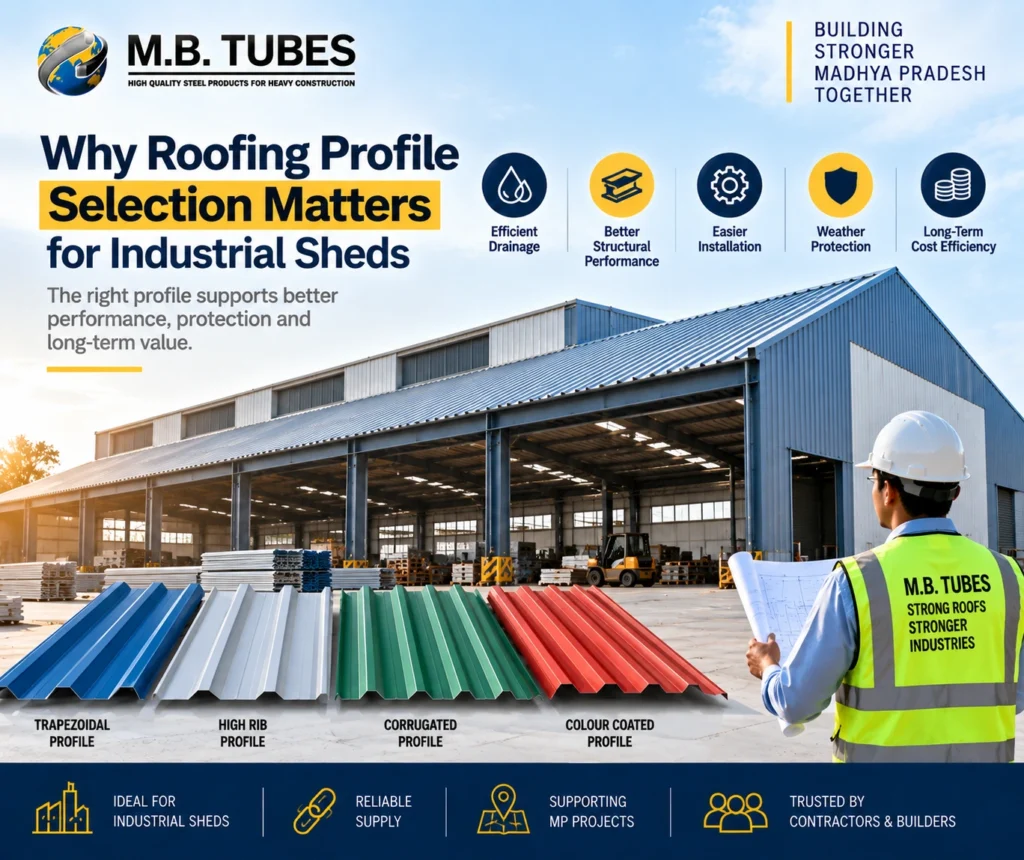
Why Roofing Profile Selection Matters for Industrial Sheds
Imagine a large warehouse during heavy monsoon rainfall.
The roof has to manage water while remaining properly fixed to the supporting structure. Sheet overlaps, fasteners, flashings, gutters, roof slope, and installation workmanship all need to work together.
This is why industrial roofing performance cannot be judged by sheet thickness or colour alone.
The profile, base metal, coating system, roof geometry, structural support, fixing method, drainage design, and installation quality should be considered as a complete system.
A professional Industrial Roofing Sheet Supplier in Madhya Pradesh should therefore be able to discuss technical requirements instead of simply asking which colour the buyer wants.
1. Start With the Industrial Shed Design
Before selecting a roofing profile, understand the building itself.
Is the project a warehouse, factory, workshop, logistics centre, agricultural shed, manufacturing unit, or storage facility?
Each project can have different requirements.
The structural drawings should provide important information such as roof slope, purlin spacing, building dimensions, support conditions, and other design requirements.
These details help engineers and project teams determine which roofing system is suitable.
Avoid selecting a profile based only on what was used on another building. Two sheds that look similar may have very different structural and environmental requirements.
2. Consider the Roof Slope
Roof slope is one of the most important factors in metal roofing.
Rainwater needs to move efficiently toward gutters and drainage points. The suitability of a particular profile and overlap arrangement can depend on roof pitch and the manufacturer’s system requirements.
A profile used successfully on a steeper roof may not automatically be appropriate for a lower-slope application.
Before ordering industrial roofing sheets in Madhya Pradesh, confirm the designed roof slope and ensure that the selected roofing system is appropriate for it.
3. Understand Profile Depth and Geometry
Profiles vary in rib depth, rib spacing, shape, and effective cover width.
These characteristics can affect how the sheet behaves within a roofing system.
Deeper or differently shaped profiles may offer different stiffness characteristics, but it would be misleading to assume that “deeper is always stronger.”
Performance depends on several variables, including:
Profile Geometry + Sheet Thickness + Material Properties + Support Spacing + Fixing Arrangement + Applied Loads
For this reason, profile selection should be based on technical data and structural requirements rather than appearance alone.
4. Check Sheet Thickness Carefully
Thickness is one of the first specifications buyers compare, but it should be interpreted correctly.
Different projects may require different sheet thicknesses depending on profile design, support spacing, loads, and engineering specifications.
When requesting quotations from an Industrial Roofing Sheet Supplier in Madhya Pradesh, clearly state the required thickness and confirm how it is specified.
Do not select a thinner sheet simply because it lowers the quotation. Likewise, choosing unnecessary thickness without a technical reason can increase project cost and weight.
The right thickness is the one that meets the project requirement.
5. Select the Appropriate Material and Coating
Industrial roofing sheets are available with different base materials and protective coating systems.
Depending on project specifications, options may include GI sheets, PPGI sheets, colour-coated roofing sheets, or other coated steel roofing products.
The suitable coating depends on the environment.
A shed in a relatively mild environment may face different exposure conditions than a building near chemical processing, high humidity, industrial emissions, or persistent moisture.
Buyers should discuss environmental conditions with the roofing supplier and follow the project specification when selecting coating systems.
6. Think About Madhya Pradesh Weather Conditions
Madhya Pradesh experiences hot summers and seasonal monsoon conditions, although exposure varies by location.
An industrial roof may face high surface temperatures, rainfall, wind, dust, and repeated weather cycles throughout its service life.
For projects in Indore, Pithampur, Dewas, Bhopal, Mandideep, Ujjain, Jabalpur, Gwalior, Ratlam, Dhar, Sagar, Satna, Rewa, and other MP industrial areas, roofing decisions should account for the project’s specific location and exposure.
Drainage planning becomes particularly important during monsoon periods.
A well-selected sheet is only one part of the solution. Gutters, flashing, overlaps, fasteners, sealants where specified, and installation workmanship also contribute to weather performance.
7. Check Purlin Spacing and Support Conditions
Roofing sheets are supported by structural members such as purlins.
The spacing between supports is important because the sheet must perform within the conditions considered by the roofing and structural design.
Buyers should not assume that one profile can be installed over any purlin spacing.
Before finalising an order, share the relevant structural details with the engineer or responsible technical professional and confirm the roofing product’s applicable technical data.
This becomes particularly important for large-span industrial sheds and warehouses.
8. Consider Wind and Other Design Loads
Industrial sheds can have large roof surfaces, making wind effects an important design consideration.
The roof system must be designed for the applicable loads, including uplift and other actions determined by the project engineer.
Sheet profile alone does not provide the complete answer.
Fastener type, fixing pattern, edge zones, purlin arrangement, sheet properties, building geometry, and local design conditions may all matter.
This is why roofing selection should remain connected to the project’s structural design.
9. Effective Cover Width Affects Quantity Planning
One detail buyers sometimes overlook is effective cover width.
The total physical width of a roofing sheet may not equal the area it covers after the required side overlap or joint arrangement is considered.
This matters when calculating quantities for large industrial roofs.
Accurate quantity planning can help reduce:
- Unexpected material shortages
- Excess ordering
- Installation interruptions
- Unnecessary transport
- Material wastage
Ask your supplier for relevant profile dimensions and effective coverage information before calculating the final requirement.
10. Choose Sheet Length With Installation in Mind
Long sheets can reduce the number of end joints in suitable roof designs, but longer is not automatically better.
Transportation limitations, lifting arrangements, handling space, site access, installation methods, and sheet distortion risk all need consideration.
A roofing sheet that is difficult to unload or safely position can slow down installation even if it reduces the number of joints.
For bulk orders, discuss sheet lengths with both the roofing supplier and installation team before manufacturing begins.
11. Don’t Ignore Fasteners, Flashings and Accessories
A roof is a system—not just a collection of sheets.
Depending on the design, the complete installation may involve:
- Roofing sheets
- Appropriate fasteners
- Washers
- Ridge covers
- Flashings
- Gutters
- Corner trims
- Cladding components
- Closures or sealants where specified
Even a correctly selected roofing sheet can perform poorly if critical accessories are unsuitable or incorrectly installed.
When comparing a Roofing Sheet Manufacturer or Supplier in Madhya Pradesh, consider whether the supplier can clearly coordinate the required roofing components and specifications.
12. Colour Is Important—but It Should Come Later
Colour-coated sheets can contribute significantly to the visual identity of a factory or warehouse.
A coordinated roof and wall-cladding scheme can make an industrial facility look professional and organised.
However, colour should generally be selected after technical requirements have been addressed.
First decide the suitable profile, material, thickness, coating system, support arrangement, and installation requirements. Then choose an appropriate colour and finish from the available product range.
Good industrial roofing combines technical suitability with appearance.
13. Consider Long-Term Maintenance
Industrial roofing is expected to remain functional for years, so maintenance should be considered during procurement.
Roof inspections can identify loose or damaged components, drainage blockages, coating damage, corrosion, or other issues that may require attention.
Keeping gutters clear and addressing localised damage early can help prevent smaller problems from becoming larger maintenance tasks.
The expected service life will vary according to material, coating, environment, design, installation, and maintenance.
No roofing sheet should be treated as completely maintenance-free.
14. Compare Total Value, Not Only Price Per Sheet
Procurement teams naturally compare prices, but the cheapest quotation may not always deliver the best project value.
Consider the broader cost:
Sheet Cost + Transportation + Accessories + Installation + Wastage + Maintenance + Replacement Risk + Project Delays
A slightly different roofing solution may provide better overall value if it matches the design more closely, simplifies installation, or reduces unnecessary wastage.
Ask suppliers to quote against clearly defined specifications so comparisons are meaningful.
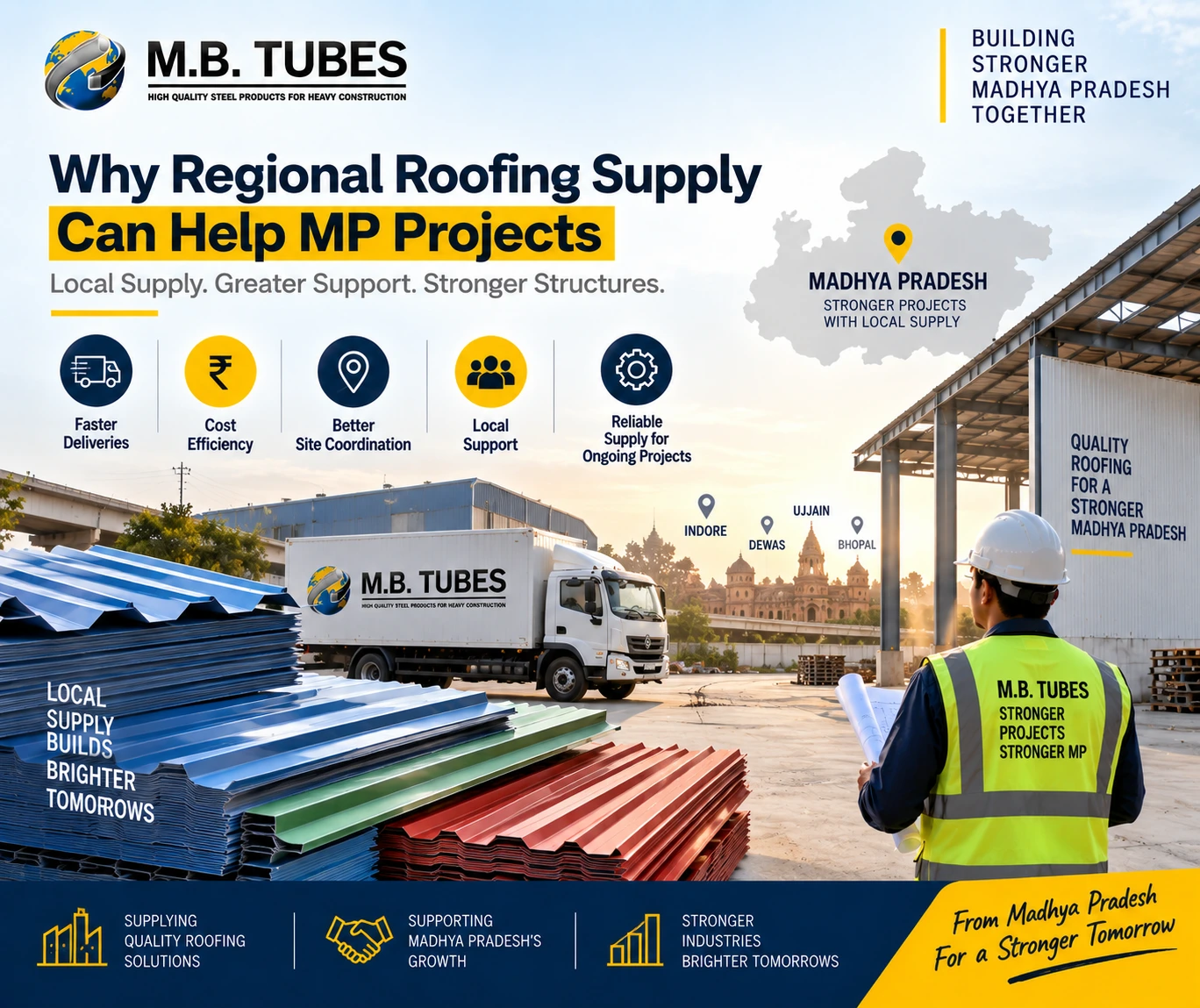
Why Regional Roofing Supply Can Help MP Projects
Industrial roofing projects often involve large quantities and carefully coordinated installation schedules.
Working with an Industrial Roofing Sheet Supplier in Madhya Pradesh may make logistics and communication easier for MP-based projects.
Regional sourcing can potentially support:
Faster coordination: Project specifications and order changes can be communicated efficiently.
Planned deliveries: Sheets can potentially be dispatched according to the installation schedule.
Simpler logistics: Regional supply routes may reduce transportation complexity depending on project location.
Repeat requirements: Additional sheets or accessories may be easier to coordinate if requirements change.
Local project understanding: Suppliers familiar with MP’s industrial markets may better understand common logistics and site requirements.
These benefits depend on the supplier’s actual manufacturing or distribution capabilities, inventory, location, and delivery network.
What to Ask an Industrial Roofing Sheet Supplier Before Ordering
Before placing a bulk order, prepare a proper requirement sheet.
Discuss the profile type, sheet thickness, base material, coating specification, sheet length, effective cover width, quantity, colour, project location, delivery schedule, accessories, and applicable technical requirements.
Also ask for relevant product data and documentation where required by the project.
A dependable Industrial Roofing Sheet Supplier in Madhya Pradesh should be able to communicate clearly about what is being supplied rather than leaving important specifications unclear.
Common Roofing Sheet Selection Mistakes
Several procurement mistakes can be avoided with better planning.
One common mistake is choosing sheets purely on price. Another is copying the profile used on a different building without checking whether the structural conditions match.
Other problems can arise from incorrect quantity calculations, ignoring effective cover width, selecting impractical sheet lengths, failing to coordinate accessories, or finalising material before reviewing the engineering requirements.
The simplest way to avoid these issues is to involve the project engineer, roofing installer, and supplier before the final order is placed.
Final Thoughts
Selecting the right roofing sheet profile for an industrial shed is not about finding one universally “best” profile.
The right choice is the profile that works with the project’s roof slope, structural design, purlin spacing, material specification, environmental exposure, drainage system, installation method, and budget.
For industrial projects across Madhya Pradesh, working with a capable Industrial Roofing Sheet Supplier in Madhya Pradesh can also make procurement, logistics, and repeat supply easier to manage.
A well-planned industrial roof starts long before the first sheet reaches the site.
It starts with the right questions, clear specifications, and a roofing system selected for the building it is expected to protect.
Frequently Asked Questions (FAQs)
1. How do I choose the right roofing sheet profile for an industrial shed?
Consider the roof slope, purlin spacing, sheet thickness, profile geometry, material grade, coating system, environmental exposure, drainage requirements, and installation method. The final selection should follow the project’s structural and roofing specifications.
2. Which roofing sheets are commonly used for industrial sheds in Madhya Pradesh?
Industrial projects commonly use profile roofing sheets, trapezoidal sheets, corrugated sheets, GI sheets, PPGI sheets, and colour-coated roofing sheets. The suitable option depends on the building design, application, environment, and project specifications.
3. What should I check when choosing an Industrial Roofing Sheet Supplier in Madhya Pradesh?
Check the supplier’s available profiles, material specifications, sheet thickness options, coating details, effective cover width, manufacturing consistency, bulk supply capability, accessories, and delivery reliability before placing an order.
4. Why is roofing sheet thickness important for industrial buildings?
Sheet thickness can influence the performance and suitability of a roofing system. The required thickness should be selected according to the profile design, support spacing, structural requirements, applicable loads, and project specifications, rather than price alone.
5. What information should I provide before ordering industrial roofing sheets in bulk?
Provide the supplier with the profile type, required thickness, base material, coating specification, sheet length, effective cover width, colour, quantity, project location, accessories, and delivery schedule. Clear specifications help an Industrial Roofing Sheet Supplier in Madhya Pradesh prepare a more accurate quotation and supply plan.
provide the blog details