
How Do Telescopic Steel Props Work? A Complete Guide to Construction Support
In construction, every concrete slab and beam needs reliable support until it can safely carry its intended loads. This is where Telescopic Steel Props become important.
These adjustable steel supports help hold temporary formwork at the required height during construction. Their simple design, reusable structure, and adjustable length make them useful for residential buildings, commercial projects, and industrial construction.
But how exactly do they work? What makes them adjustable? And how do you choose the right prop for your project?
This guide explains everything in simple language.
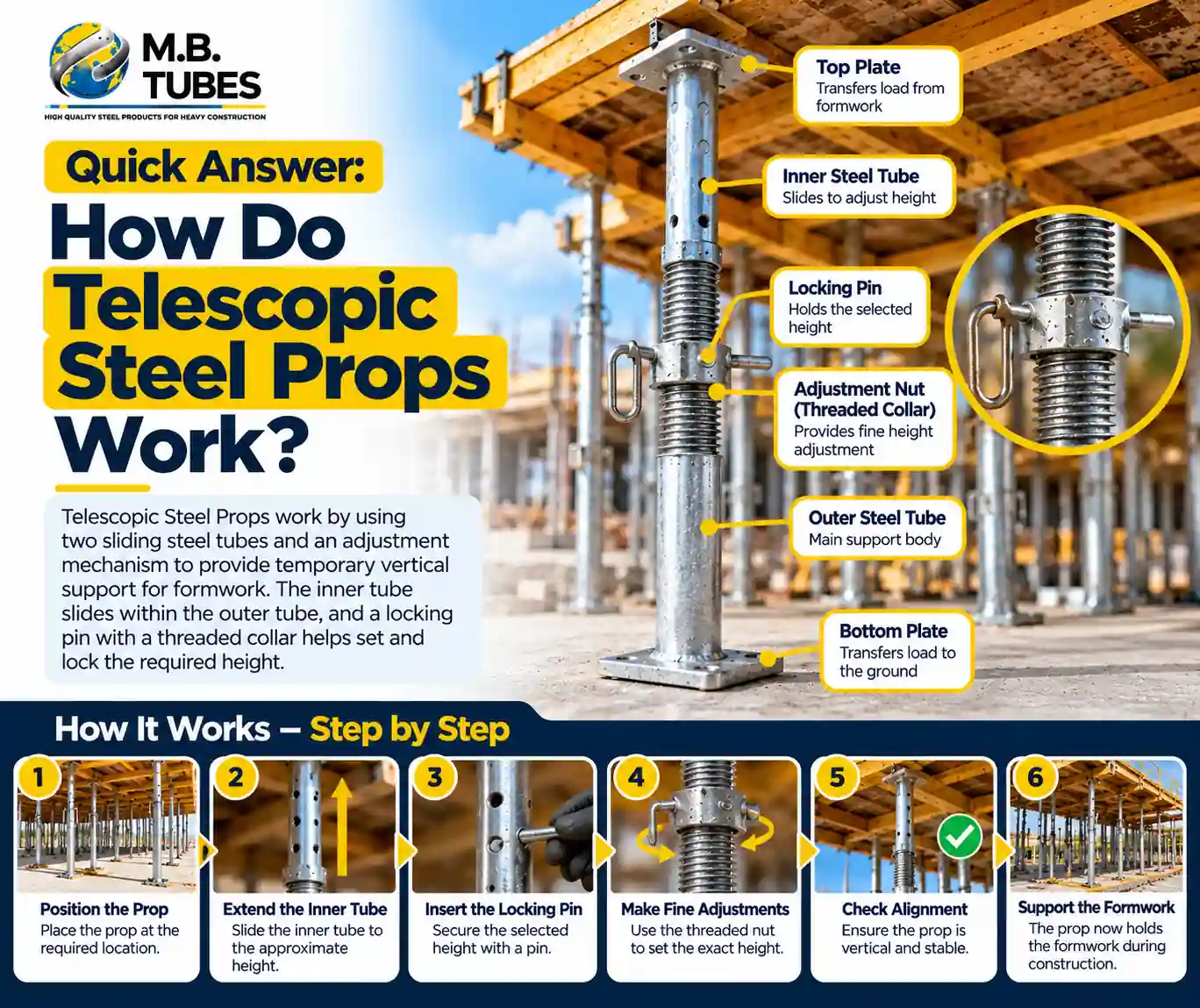
Quick Answer: How Do Telescopic Steel Props Work?
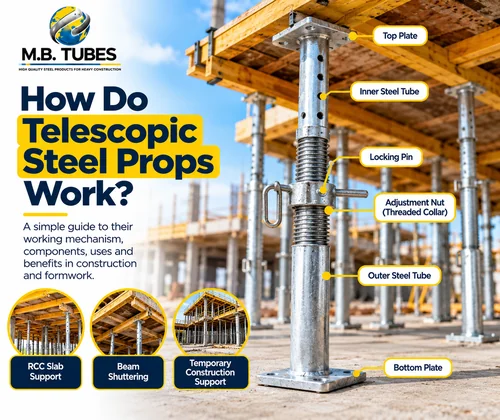
Telescopic Steel Props work by using two sliding steel tubes and an adjustment mechanism to provide temporary vertical support. The inner tube moves inside the outer tube to achieve the required height. A pin or locking arrangement provides coarse adjustment, while a threaded collar or nut allows finer positioning.
Once correctly installed, braced where required, and checked against the approved design, the props help support formwork and construction loads.
1. What Are Telescopic Steel Props?
Telescopic Steel Props are adjustable vertical steel supports commonly used in construction and formwork systems.
Unlike fixed-length supports, telescopic props can extend or retract within a specified working range.
They are generally manufactured using steel tubes, supporting plates, and adjustment components.
Common applications include:
- RCC slab formwork support
- Beam shuttering support
- Temporary construction support
- Concrete casting operations
- Building renovation projects
Their main purpose is to provide controlled temporary support until the supported structure is ready for the next construction stage.
2. What Are the Main Components of Telescopic Steel Props?
Understanding the components makes their working mechanism easier to follow.
Component | Main Function |
Outer Steel Tube | Forms the main lower body of the prop |
Inner Steel Tube | Slides to adjust the overall height |
Adjustment Nut or Collar | Provides fine height adjustment |
Locking Pin | Holds the selected extension position |
Top Plate | Transfers load from the supported formwork |
Bottom Plate | Transfers load to the supporting surface |
Each component contributes to the prop’s performance.
However, the complete assembly must be suitable for the required height, loading, and installation conditions.
3. How Do Telescopic Steel Props Work Step by Step?
The working principle combines height adjustment, positioning, and vertical load transfer.
Step 1: Position the Prop
First, place the prop at the required location according to the approved formwork arrangement.
The supporting surface must be capable of carrying the intended load.
Step 2: Extend the Inner Tube
The inner tube slides upward from the outer tube until the approximate required height is reached.
This is the telescopic movement that gives the prop its name.
Step 3: Secure the Adjustment
A compatible locking pin is inserted into the appropriate adjustment hole.
The pin must be correctly seated and suitable for the particular prop model.
Step 4: Make Fine Adjustments
The threaded adjustment collar allows the installer to position the support accurately beneath the formwork.
Step 5: Check Alignment and Stability
The prop must be correctly positioned, adequately restrained where required, and inspected before loading.
Step 6: Support the Formwork
Once the complete arrangement has been approved, the props help transfer loads from the formwork through their steel bodies to the supporting surface.
Simple working sequence:
Position → Extend → Lock → Adjust → Inspect → Support
4. Where Are Telescopic Steel Props Used?
Telescopic props are useful wherever construction activities require temporary vertical support.
RCC Slab Construction
During slab casting, props support the formwork arrangement until the concrete reaches the strength required for safe removal.
Beam Shuttering
Props can support suitable beam formwork arrangements when used with the necessary supporting members and accessories.
Commercial Building Projects
Repeated construction floors may require adjustable supports that can be repositioned between planned work stages.
Industrial Construction
Factories, warehouses, and industrial buildings may use steel props for temporary formwork support.
Renovation and Repair
Selected repair operations may require temporary supports, but these applications must follow a project-specific engineering design.
5. Why Is Adjustable Height Important?
Construction projects rarely have identical support-height requirements.
Different slabs, beams, and formwork arrangements may require different vertical dimensions.
Adjustable Steel Props provide flexibility because one suitable prop model can cover a specified range of heights.
Two measurements are especially important:
Closed Height: The minimum working height specified for the prop.
Open Height: The maximum working height specified for the prop.
For example, a particular heavy-duty prop model may have a closed height of 3 metres and an open height of 5 metres.
These figures are product-specific, not universal.
Always confirm the manufacturer’s working range before selecting a prop.
6. What Are the Benefits of Telescopic Steel Props?
Flexible Height Adjustment
Their telescopic design makes it easier to accommodate different formwork elevations within the approved adjustment range.
Reusable Construction Equipment
Properly maintained steel props can be reused across multiple construction stages and projects.
Organized Formwork Planning
Standardized adjustable supports help contractors plan quantities, placement, and material movement.
Durable Steel Construction
Steel construction provides a robust supporting component when the correct grade, dimensions, and manufacturing quality are specified.
Practical Handling
Props can be transported, stored, installed, and removed as individual components using appropriate site procedures.
Their actual efficiency depends on the project layout and installation method.
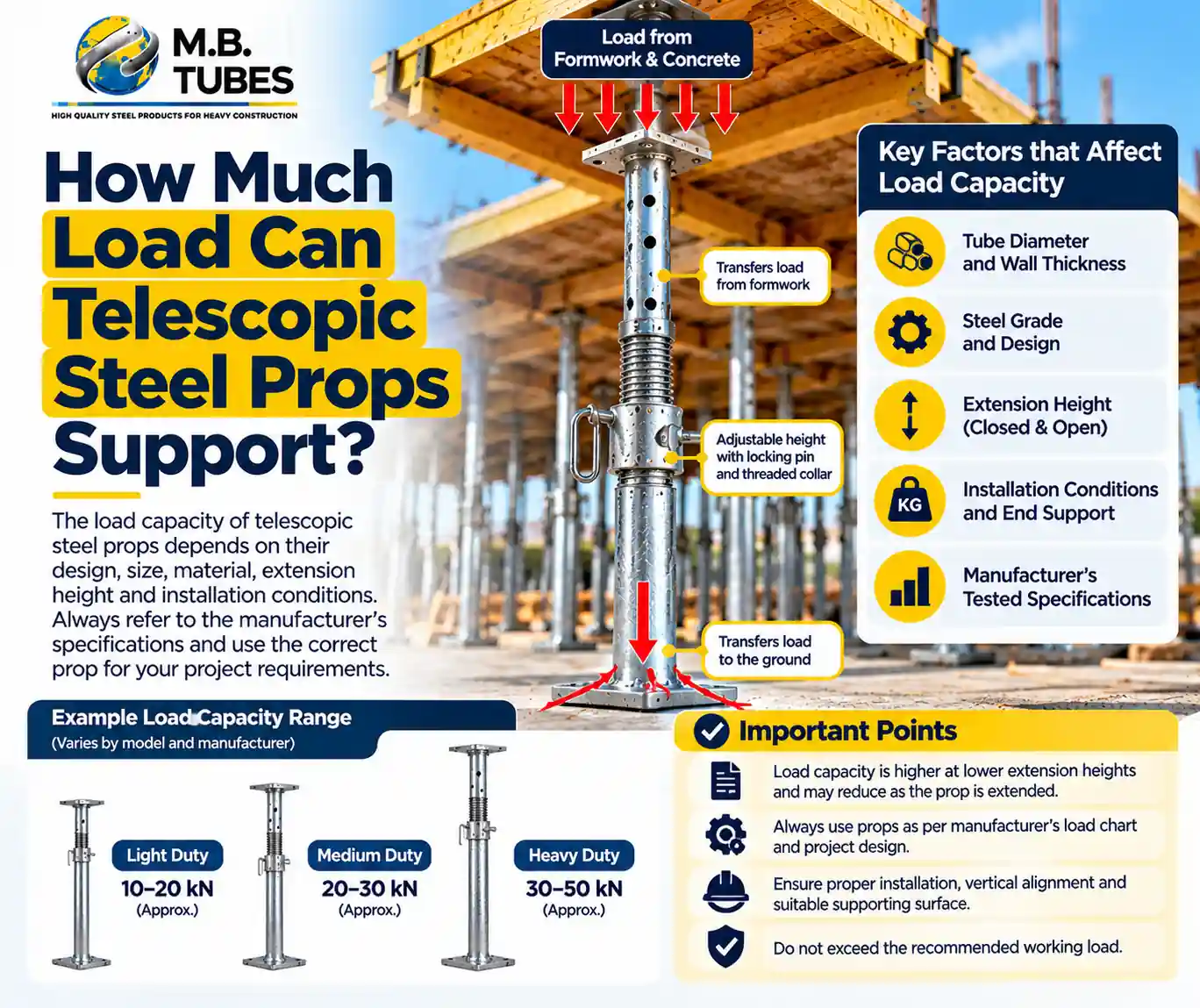
7. How Much Load Can Telescopic Steel Props Support?
There is no single load capacity suitable for every telescopic steel prop.
Load capacity depends on several factors:
- Prop design and steel grade
- Tube diameter and wall thickness
- Extended working height
- Connection and locking arrangement
- Vertical alignment and end conditions
- Bracing and lateral restraint
- Manufacturer’s tested specifications
An important point is that a prop’s allowable load may decrease as its extension increases.
Therefore, contractors should use the manufacturer’s load chart and the approved temporary-works design.
Never assume that two similar-looking props have identical capacities.
8. Telescopic Steel Props vs Fixed Steel Supports
Both provide temporary support, but their working methods differ.
Feature | Telescopic Steel Props | Fixed Steel Supports |
Height Adjustment | Adjustable within a defined range | Generally fixed |
Reusability | Suitable for repeated use | Depends on design |
Installation | Uses adjustment mechanism | May require separate height arrangements |
Flexibility | Useful for varying elevations | Best for predetermined heights |
Selection | Requires extension-specific load verification | Requires design-specific verification |
Which is better?
Telescopic props are practical when different working heights are required. Fixed supports may be appropriate where the design calls for a specific height and configuration.
Neither option should be selected without checking its structural suitability.
9. How to Choose the Right Telescopic Steel Props
Before purchasing, identify the actual project requirements.
Check the working height. Confirm that the required elevation falls within the manufacturer’s approved range.
Verify load capacity. Review the allowable load at the intended extension, not merely the maximum advertised capacity.
Review material specifications. Confirm tube dimensions, steel grade, plates, and adjustment components.
Check compatibility. Ensure the props work with the planned formwork and supporting accessories.
Evaluate site conditions. Consider the supporting surface, restraint requirements, storage conditions, and installation access.
Choose a reliable manufacturer. Request clear product specifications and applicable quality documentation.
10. What Common Mistakes Should Contractors Avoid?
Even a well-manufactured prop can become unsafe when incorrectly selected or installed.
Common mistakes include extending a prop beyond its permitted working range, using damaged locking pins, placing props on unsuitable surfaces, and ignoring lateral restraint requirements.
Another mistake is assuming that a prop rated for a particular load at one height can support the same load at every extension.
Contractors should also avoid mixing incompatible components or removing supports before the required concrete strength and stripping conditions have been verified.
Correct selection and inspection matter as much as product quality.
11. Telescopic Steel Props from M.B. Tubes
M.B. Tubes offers steel support products for construction, shuttering, and formwork applications.
Its broader construction-support range includes Adjustable Steel Props, Adjustable Spans, Shuttering Plates, and Scaffolding Accessories.
When discussing project requirements, buyers should share the required support height, intended application, quantity, load requirements, and relevant drawings.
This helps identify suitable products and specifications rather than selecting props based only on price or appearance.
Conclusion
Telescopic Steel Props make temporary construction support more adaptable through their sliding-tube and threaded-adjustment design.
They are useful for slabs, beams, shuttering, and other engineered formwork applications. However, correct height adjustment alone does not guarantee a safe installation.
For reliable performance, focus on working height, allowable load, component condition, compatibility, and proper installation.
M.B. Tubes offers construction-support products for buyers looking to plan their formwork requirements with suitable steel components.
Frequently Asked Questions
What is the main purpose of Telescopic Steel Props?
Telescopic Steel Props provide adjustable temporary vertical support for construction formwork, including slabs and beams. They help maintain the required support arrangement during planned construction stages.
Can Telescopic Steel Props be reused?
Yes. Steel props are designed for repeated use when their condition, components, and performance remain acceptable. They should be inspected before reuse.
Are Telescopic Steel Props suitable for RCC slabs?
Yes. They are commonly used in engineered RCC slab formwork systems, provided the prop selection, spacing, loading, and support arrangement meet project requirements.
What is the difference between closed height and open height?
Closed height is the minimum specified working height. Open height is the maximum specified working height. The allowable load must be checked for the actual extension.
How do I select the correct Telescopic Steel Props?
Confirm the required height, load, application, formwork arrangement, manufacturer specifications, and site conditions. A competent designer should verify the temporary support system.