
Scaffolding for Power Plant Projects: A Practical Guide to Access, Planning & Selection
Power plant projects are very different from ordinary building construction. Workers may need access around equipment, structural steel, pipe routes, maintenance zones, elevated work areas, and other complex sections of the plant. Because of this, Scaffolding for Power Plant Projects needs to be planned around the actual work location, access requirement, scaffold configuration, and project conditions.
A good scaffolding plan is not simply about building a platform at height. It should help teams reach the required work area while maintaining suitable access, stability, working space, and an organized installation and dismantling sequence.
For construction, maintenance, repair, and shutdown-related activities, steel scaffolding systems can provide adaptable temporary access across different areas of a power plant.
What Is Scaffolding for Power Plant Projects?
Scaffolding for Power Plant Projects refers to temporary access and working-platform systems configured for construction, inspection, installation, maintenance, and repair activities within power plant environments.
Unlike a straightforward building façade, a power plant can contain different structures and work zones. Therefore, the same scaffold arrangement may not be suitable everywhere.
Depending on the project, scaffolding may be required around:
- Structural steel sections
- Equipment and machinery areas
- Pipe and service routes
- Elevated maintenance points
- Plant buildings
- Internal and external structures
- Repair and inspection zones
The better way to think about power plant scaffolding is:
Work Area → Access Requirement → Scaffold Configuration → Components → Inspection → Use
This project-first approach helps avoid treating scaffolding as a one-size-fits-all product.
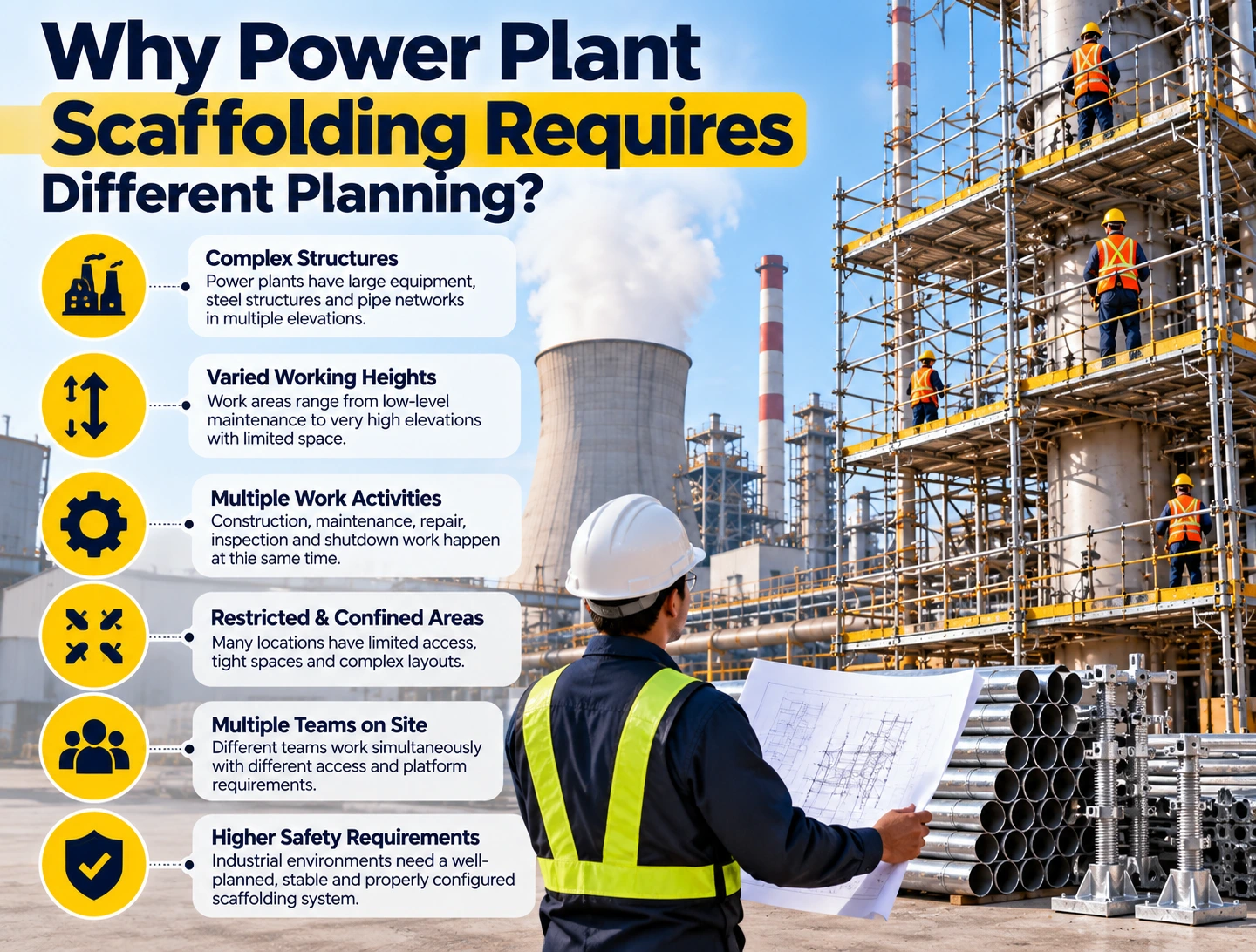
Why Power Plant Scaffolding Requires Different Planning
A regular construction project often progresses in a predictable sequence. Industrial projects can be more complicated because access requirements may change from one location to another.
Power plant scaffolding can involve restricted areas, different working heights, changing platform requirements, and multiple teams carrying out different activities.
This makes planning before installation particularly important.
Before deciding on a scaffold configuration, teams should understand:
Where is access required?
What activity will take place there?
What materials or equipment will be present?
How much working space is needed?
What is the required height and configuration?
How will workers enter and leave the scaffold?
How will the scaffold be inspected and maintained?
The answers help determine the appropriate scaffolding system and component quantity.
Where Is Scaffolding Used in Power Plant Projects?
Scaffolding can support several types of work during different stages of a power plant project.
Construction and Installation
During construction, temporary access may be needed for structural work, installation, fabrication-related activities, and elevated work zones.
Maintenance Work
Power plants require periodic inspection and maintenance. Temporary scaffolding can provide access to areas that cannot be conveniently reached from floor level
Repair Activities
When equipment or surrounding structures require repair, scaffolding can create a temporary working area around the required location.
Painting and Surface Work
Industrial structures may require painting, coating, cleaning, or other surface-related work at different heights.
Shutdown Projects
During maintenance shutdowns, access requirements may need to be completed within a defined project window. In these situations, scaffold material planning, component organization, installation sequence, and dismantling become especially important.
The key point is that Scaffolding for Power Plant Projects should follow the work requirement rather than forcing every task into the same scaffold layout.
Why Cuplock Scaffolding Is Relevant for Power Plant Projects
Cuplock is a modular scaffolding system in which horizontal ledgers connect with vertical standards through a cup-and-blade locking arrangement.
M.B. Tubes identifies power plants among the applications for its Cuplock Scaffolding systems. Its modular arrangement makes Cuplock relevant to industrial projects where scaffold configurations may need to be developed around different work areas.
Common Cuplock components include:
- Cuplock Standards
- Cuplock Ledgers
- Intermediate Transoms
- Diagonal Braces
- Base Jacks
- U Head Jacks
- Steel/Walkway Planks
- Other compatible accessories
Because these components work as a system, procurement should focus on the complete required configuration, not simply the number of vertical standards.
Power Plant Scaffolding Is a System, Not a Collection of Pipes
One of the most important ideas for buyers is that scaffolding performance depends on the complete arrangement.
Think of it as:
Foundation + Standards + Ledgers + Bracing + Connections + Platforms + Access + Required Accessories
If one part of the planned system is overlooked, the scaffold may not match the intended site configuration.
For example, buying standards and ledgers without properly planning base support, bracing, working platforms, and access components can create shortages during installation.
That is why a component-based material list is useful for industrial projects.
Key Components to Consider for Power Plant Scaffolding
Standards
Standards are the main vertical members of a Cuplock scaffolding arrangement.
Ledgers
Ledgers connect standards horizontally and help form the scaffold framework.
Diagonal Braces
Bracing contributes to the rigidity of the scaffold arrangement and helps control unwanted movement.
Base Plates and Adjustable Base Jacks
These components are positioned at the bottom of the scaffold system and are important for base support and adjustment according to the planned configuration.
Walkway Planks
Working platforms provide the surface required for worker movement and work activities.
U Head Jacks
U Head Jacks are typically associated with top-support applications, particularly where formwork or supporting members are involved. They should be selected according to the intended scaffold/support application.
Scaffolding Accessories
Depending on the system and project, additional accessories may be required for connections, access, support, or specific configurations.
Scaffolding Load Planning for Power Plant Projects
Load planning should never be reduced to one universal number.
The required Scaffolding Load Capacity depends on the scaffold system, dimensions, height, components, connections, bracing, platform arrangement, site configuration, and intended loading.
Teams should consider what will be present on the working platform, including:
Workers + Tools + Equipment + Materials + Other Intended Loads
Load should also be considered in terms of its location and distribution.
For example, placing a large quantity of material in one concentrated area is different from distributing the same material across a larger platform.
Therefore, product-specific load figures should only be used for the product and configuration to which they apply.
M.B. Tubes lists specific technical data for particular MS Scaffolding configurations, but these figures should not automatically be transferred to every power plant scaffold arrangement.
How Steel Tube Weight Connects with Scaffolding Planning
Although Steel Tube Weight is not the main design criterion for selecting a power plant scaffold, it can be useful during material and logistics planning.
When large quantities of scaffolding pipes, tubes, and components are supplied to an industrial site, estimated weight can help with:
- Material quantity planning
- Transport planning
- Loading and unloading
- Storage planning
- Handling requirements
- Procurement estimation
For steel tubes, weight is commonly expressed in kg/m.
A basic project estimation approach is:
Steel Tube Weight per Metre × Total Required Length = Approximate Total Tube Weight
For example, if a particular tube has a theoretical weight of 4 kg/m and the project requires 2,000 metres:
4 × 2,000 = 8,000 kg
That equals approximately:
8 tonnes
However, Steel Tube Weight should not be used by itself to determine scaffold strength or suitability. Scaffold design and configuration must consider the complete system and project requirements.
Access Planning Matters as Much as Scaffold Height
When buyers think about industrial scaffolding, the first question is often:
“How high does the scaffold need to go?”
A better question is:
“How will workers safely and practically reach the actual work position?”
A scaffold may reach the required elevation but still be unsuitable if the working platform is poorly positioned for the task.
For power plant applications, consider:
Working height → Platform position → Access route → Working clearance → Scaffold footprint
This produces a much more useful project specification than height alone.
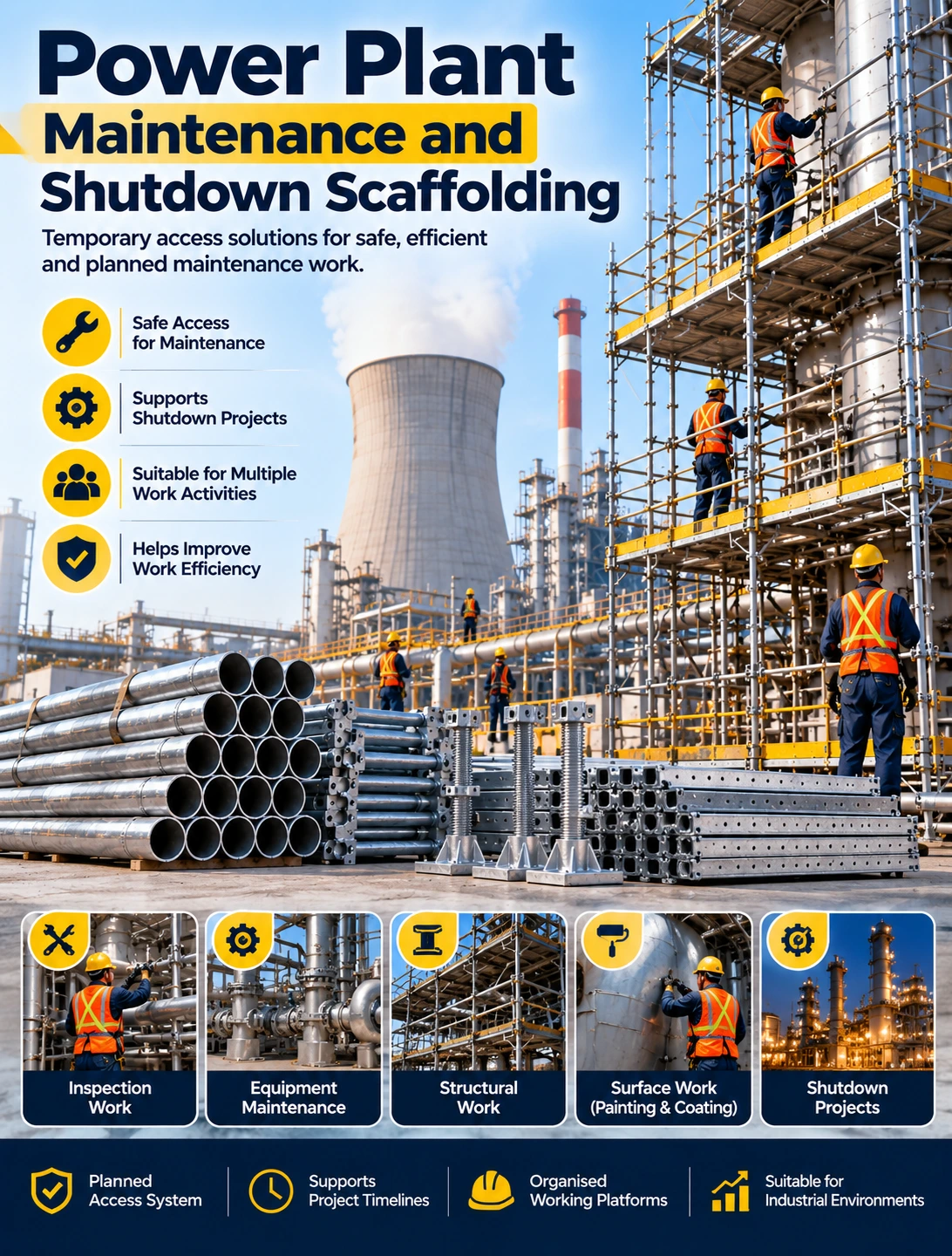
Power Plant Maintenance and Shutdown Scaffolding
Maintenance and shutdown work deserves separate attention because time and access planning can become especially important.
A useful workflow is:
Survey → Plan → Prepare Components → Install → Inspect → Use → Modify if Properly Planned → Dismantle
Material should ideally be organized according to work zones rather than treated as one mixed stockpile.
For example:
Zone A: Standards + Ledgers + Braces + Jacks + Planks
Zone B: Standards + Ledgers + Braces + Jacks + Planks
Zone C: Special configuration components
This type of planning can make component identification and site coordination easier.
Common Mistakes When Planning Scaffolding for Power Plants
Choosing Only by Price
The lowest component price does not automatically mean the lowest overall project cost. Compatibility, required quantity, durability, installation planning, and replacement requirements also matter.
Ordering Without a Component Plan
Industrial scaffolding requires more than standards and pipes. Missing braces, jacks, platforms, or accessories can interrupt site work.
Assuming Every Area Needs the Same Configuration
Different power plant work zones can have very different access and platform requirements.
Ignoring the Base Condition
The scaffold begins at the supporting surface. Base arrangement and adjustment should be part of planning from the beginning.
Treating Steel Tube Weight as Load Capacity
A heavier tube does not automatically mean a complete scaffold system can safely support a particular load. Steel Tube Weight and Scaffolding Load Capacity are different concepts.
Ignoring Inspection
Scaffolding should not be treated as “install once and forget.” Condition, connections, platforms, bracing, and other relevant components need appropriate inspection during use.
Power Plant Scaffolding Procurement Checklist
Before requesting a quotation, prepare a clear project requirement.
Provide the supplier with:
Project Type: Power plant construction / maintenance / shutdown
Work Area: Where scaffolding will be installed
Required Height: Working and access height
Required Length & Width: Approximate scaffold coverage
Scaffold System: Cuplock or other specified system
Platform Requirement: Working platform dimensions/levels
Access Requirement: Planned access arrangement
Load Requirement: According to project/design requirement
Component Quantity: If already calculated
Surface Finish: As required
Project Location: For supply planning
Delivery Schedule: Single or phased delivery
Customization: Any project-specific dimensions or configurations
For steel pipes and tubes, buyers may also provide required dimensions, wall thickness, total length, and Steel Tube Weight information where relevant.
Scaffolding Solutions from M.B. Tubes
M.B. Tubes manufactures scaffolding and temporary construction-support products for construction, industrial, and infrastructure applications, including power plant-related requirements.
The product range includes Cuplock Scaffolding, H Frame Scaffolding, scaffolding pipes and tubes, scaffolding towers, walkway planks, adjustable jacks, adjustable spans, shuttering plates, steel channels, props, and scaffolding accessories.
For power plant projects, the right approach is to match the scaffolding configuration with the actual work area, required access, intended loading, dimensions, and project specifications.
For bulk requirements, providing a detailed component list and project information can make quotation and supply planning more accurate.
Final Thoughts
Scaffolding for Power Plant Projects should be approached as an access and work-planning system, not simply as a collection of steel components.
A practical sequence is:
Understand the Work → Survey the Area → Select the System → Plan the Configuration → Calculate Components → Verify Load Requirements → Organize Supply → Install & Inspect
Cuplock Scaffolding, steel pipes and tubes, walkway planks, adjustable jacks, bracing, and other accessories can form part of an industrial scaffolding solution when selected according to project requirements.
At the same time, procurement factors such as component quantity, delivery sequence, and Steel Tube Weight can support better logistics planning for large power plant projects.
The objective is simple: the right scaffolding system, in the right configuration, for the right work area.
Frequently Asked Questions
Which scaffolding system can be used for power plant projects?
The appropriate system depends on the work area and project requirements. Cuplock Scaffolding is one modular option used for industrial applications, including power plants. The final configuration should be selected according to access, dimensions, loading, working-platform requirements, and project specifications.
Why is Cuplock Scaffolding useful for industrial projects?
Cuplock uses modular standards and ledgers with a cup-and-blade locking arrangement. Its modular configuration allows scaffolding to be planned for different industrial work areas. Bracing, base support, platforms, and compatible accessories remain important parts of the complete system.
Is Steel Tube Weight important for power plant scaffolding?
Steel Tube Weight can be useful for procurement, transportation, storage, and material estimation. However, it should not be confused with scaffold load capacity. Scaffold suitability depends on the complete configuration, components, connections, dimensions, bracing, loading, and project requirements.
What should be checked before ordering scaffolding for a power plant?
Check the work area, required dimensions, working height, platform levels, access needs, intended loading, scaffold system, component quantities, base conditions, project specifications, delivery schedule, and any customization requirements.
Can the same scaffolding configuration be used throughout a power plant?
Not necessarily. Power plants can contain different structures, equipment zones, maintenance points, and access conditions. Each work area should be assessed according to its actual requirements instead of assuming one standard configuration will suit the entire project.