
Adjustable Props: Sizes, Uses & How to Choose the Right Prop for Construction
When a concrete slab or beam is being constructed, the finished structure may look strong and permanent. But before concrete develops the required strength, it needs reliable temporary support underneath. This is where Adjustable Props become an important part of formwork and shuttering work.
Adjustable steel props are telescopic vertical supports that can be set to different working heights. They are commonly used beneath slabs, beams, ceilings and formwork during construction. Unlike a fixed-height support, an adjustable prop allows contractors to adapt the support height to actual site requirements.
Khambati Steel & M.B. Tubes manufactures mild-steel Adjustable Props for construction and formwork applications. Its website lists different prop configurations, including heavy-duty adjustable steel props and prop jacks, with customized specifications also available for project requirements. MB Tubes
This guide explains Adjustable Props sizes, uses, components and selection factors in simple terms for contractors, builders and procurement teams.
What Are Adjustable Props?
An Adjustable Prop is a temporary vertical support commonly used in construction to hold formwork, slabs, beams or ceilings at the required level.
A typical steel prop uses a telescopic arrangement. One tube moves inside another to provide height adjustment, while a threaded mechanism helps achieve controlled positioning.
A prop generally includes:
- Inner and outer steel tubes
- Adjustment mechanism
- Threaded portion and nut
- Top and bottom plates
- Locking or positioning arrangement
The main advantage is simple: instead of manufacturing a separate fixed support for every height, contractors can adjust the prop within its specified operating range.
M.B. Tubes lists its Adjustable Steel Props for RCC slabs, beams, ceilings and shuttering/formwork applications. MB Tubes
Adjustable Props Sizes: What Do the Specifications Mean?
When buyers search for Adjustable Props sizes, they sometimes focus only on height. However, a prop specification contains several measurements that matter.
For example, M.B. Tubes currently lists a heavy-duty Adjustable Steel Prop with the following specifications:
Specification | Details |
Closed Height | 3 m |
Open Height | 5 m |
Outer Tube Diameter | 60 mm |
Load Capacity | 50 kN |
Plate Size | 120 × 120 mm |
Material | Mild Steel |
Prop Type | Heavy Duty |
Thread Type | Cut Threaded |
Surface Finish | Painted |
Prop Weight | 18 kg |
These figures apply to the particular configuration shown on the company’s Adjustable Steel Props page. M.B. Tubes also states that sizes and specifications can be customized according to project requirements. MB Tubes
This is important because Adjustable Prop size should never be understood as height alone.
Tube dimensions, adjustment range, plate dimensions, threading and required load capacity should all be considered.
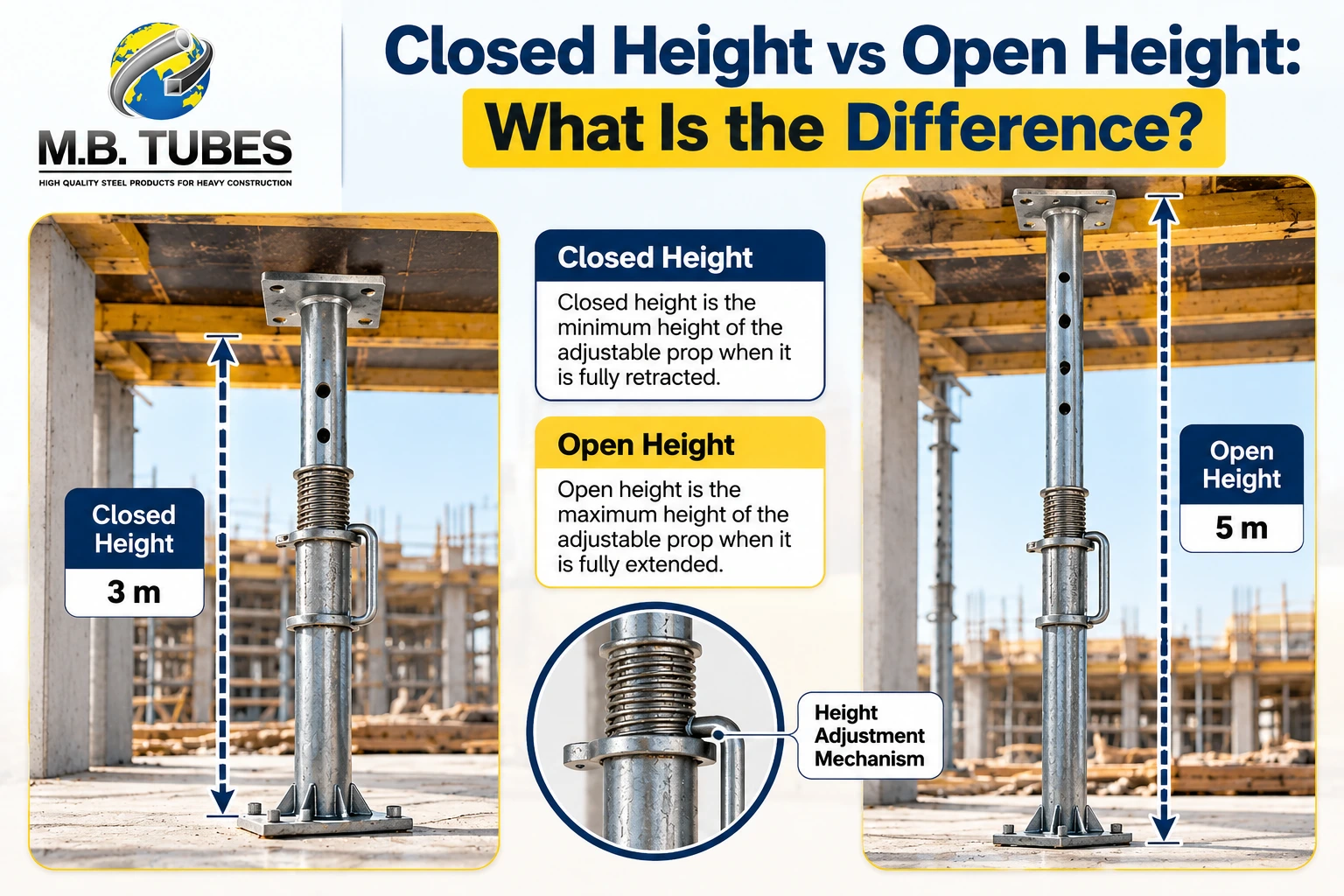
Closed Height vs Open Height: What Is the Difference?
This is one of the easiest specifications to misunderstand.
Closed height is the approximate minimum operating length of the specified prop configuration when it is retracted.
Open height refers to its specified extended height.
For example, a prop with a 3 m closed height and 5 m open height provides adjustment within its specified range. That does not mean it should be extended beyond its designed limit simply because more height is needed.
A useful purchasing rule is:
Required support height → suitable adjustment range → required capacity → correct prop specification.
Selecting a prop just because it can physically reach a certain height is not enough.
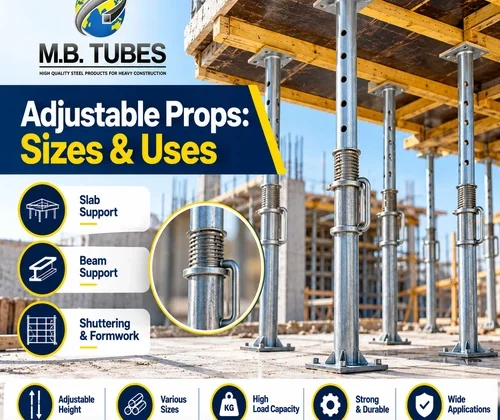
Where Are Adjustable Props Used?
The versatility of Adjustable Props makes them useful across many construction applications.
RCC Slab Support
One of their most common uses is supporting formwork beneath RCC slabs.
Before freshly placed concrete becomes self-supporting, the temporary support arrangement needs to carry the loads associated with the formwork and construction process.
Adjustable Props can be arranged beneath the slab formwork according to the project’s designed support layout.
Beam Support
Beams can have different depths and elevations across the same floor.
The adjustable nature of steel props allows individual supports to be positioned at the required working heights within their permitted range. This makes them practical for beam shuttering and centering work.
Shuttering and Formwork
Adjustable Props are widely used as part of temporary shuttering and formwork systems.
M.B. Tubes lists its props for slabs, beams, ceilings and shuttering structures, while its broader construction-support range also includes adjustable spans and other formwork products. MB Tubes
Ceiling Support
Temporary ceiling and overhead construction work may also require vertical support.
Here again, the ability to adjust height makes props more flexible than fixed-length supporting members.
How Do Adjustable Props Work?
The principle is straightforward.
Think of the prop as a telescopic steel column.
The inner and outer tubes provide the main body. The telescopic movement brings the prop close to the required height, while the threaded adjustment mechanism helps achieve the final positioning.
A typical site sequence can be understood as:
Position → Extend → Adjust → Align → Check → Support
The actual installation, spacing and loading arrangement, however, should follow the applicable temporary-support design and project requirements.
Adjustability provides flexibility; it does not replace proper engineering.
Why Prop Size Matters on a Construction Site
Imagine that a project requires support at several different elevations.
Using a prop with an unsuitable adjustment range can create unnecessary site problems. A prop that is too short cannot reach the required support point, while selecting equipment without considering its intended operating range and load requirement can result in an unsuitable temporary-support arrangement.
Correct sizing can help contractors achieve:
Better height matching: Props can be selected according to the required formwork elevation.
More systematic installation: Suitable dimensions reduce the need for improvised height corrections.
Better procurement planning: Contractors can determine the appropriate specifications and quantities before material reaches the site.
Efficient reuse: Appropriate steel props can be moved and reused for subsequent suitable construction stages after inspection.
Adjustable Prop Size and Load Capacity Are Not the Same Thing
This point deserves special attention.
A taller prop is not automatically a higher-capacity prop.
Similarly, two props that look similar may have different technical specifications.
M.B. Tubes’ website itself shows different prop configurations. Its heavy-duty Adjustable Steel Prop page lists a 50 kN load capacity, while its Scaffolding Props & Spans page lists an Adjustable Prop Jack configuration with a 60 kN load capacity and 48 mm outer tube diameter. MB Tubes
Therefore, never take the load capacity of one model and apply it automatically to another.
Always match the capacity to the exact product specification and project requirement.
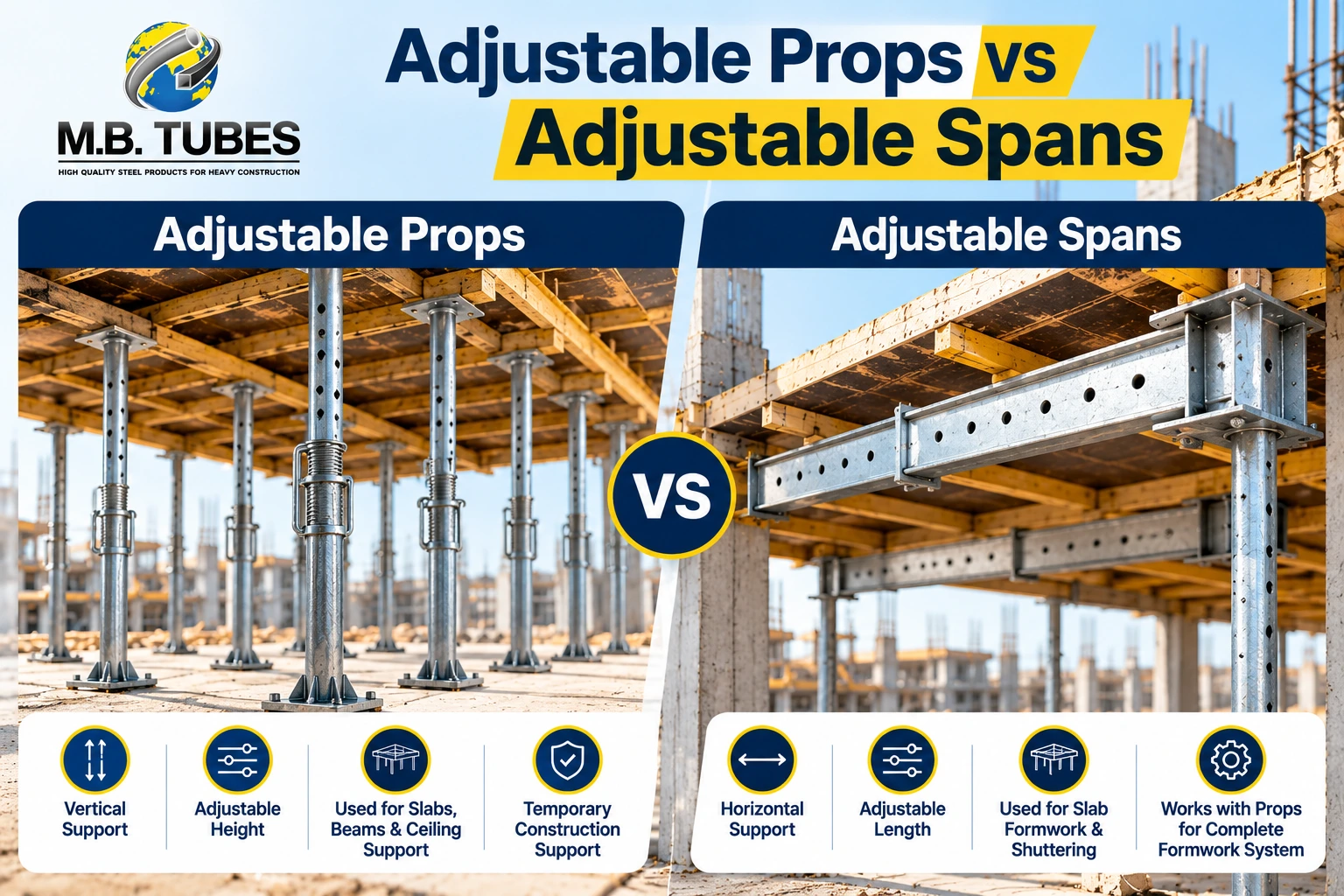
Adjustable Props vs Adjustable Spans
Props and spans are related to temporary construction support, but they do different jobs.
An Adjustable Prop primarily provides vertical support.
An Adjustable Span is generally used horizontally as part of slab, beam, shuttering or formwork support arrangements.
M.B. Tubes manufactures both Adjustable Props and MS Adjustable Spans for construction applications. MB Tubes
In a complete formwork arrangement, different support products may work together according to the project design.
This is why procurement should focus on the complete support system, rather than purchasing each component independently without checking compatibility.
How to Choose the Right Adjustable Prop Size
Instead of beginning with the question, “Which prop is cheapest?”, start with the actual construction requirement.
First determine the required support height. This helps identify the appropriate adjustment range.
Next, understand the expected load and temporary-support design. The load requirement should be matched with the applicable product specification rather than estimated from appearance.
Then check the tube diameter, plate dimensions, material, thread type and finish.
Also consider how the props will interact with shuttering, spans and other formwork components.
Finally, confirm quantity and delivery requirements before placing a bulk order.
A useful enquiry should therefore include:
Required height + application + load requirement + quantity + project specification + delivery location.
That gives the manufacturer much more useful information than simply asking for “adjustable prop price.”
Common Mistakes When Buying Adjustable Props
A common mistake is ordering props only by height.
Another is assuming that maximum extension is the ideal working position for every project. The required extension and allowable capacity should always be checked against the applicable product and temporary-works requirements.
Contractors should also avoid using bent tubes, damaged threads, deformed plates or heavily deteriorated components without proper assessment.
Mixing products with different specifications without checking compatibility can create additional problems.
Finally, price should not be the only buying criterion. For reusable construction-support equipment, dimensional consistency, material, adjustment mechanism, condition and suitability for the intended project can be equally important.
Adjustable Props from Khambati Steel & M.B. Tubes
Khambati Steel & M.B. Tubes manufactures Adjustable Props and other temporary construction-support products for residential, commercial, industrial and infrastructure applications.
Its heavy-duty Adjustable Steel Prop listing features mild-steel construction, a painted finish, threaded height adjustment and a 3–5 m adjustment range for the specified model. The company also states that customized sizes, load capacities and specifications can be manufactured according to project requirements. MB Tubes
Its wider construction-support portfolio includes Adjustable Prop Jacks, MS Adjustable Spans, scaffolding systems, shuttering plates and related components. MB Tubes
For contractors and procurement teams, this makes it possible to discuss the support requirement as a system rather than focusing on one component alone.
Final Thoughts
Adjustable Props may appear to be simple steel supports, but selecting the right one requires more than checking its height.
The correct prop needs to suit the required working elevation, application, load requirement, formwork arrangement and overall temporary-support design.
For contractors and buyers, the most useful approach is to compare Adjustable Props sizes and uses together. A prop should be selected because its complete specification matches the project—not simply because it reaches the required height or offers the lowest price.
Khambati Steel & M.B. Tubes offers Adjustable Props and related formwork-support products with different specifications and customization options for construction requirements. MB Tubes
This specification-first approach creates content that answers both informational searches such as “what are adjustable props?” and commercial searches such as “adjustable prop sizes,” “adjustable steel props for slab support,” and “adjustable prop manufacturer in Madhya Pradesh” naturally, without keyword stuffing.
Frequently Asked Questions
What are Adjustable Props used for?
Adjustable Props are temporary vertical steel supports commonly used beneath RCC slabs, beams, ceilings, shuttering and formwork. Their telescopic construction allows the working height to be adjusted within the specified range according to the construction requirement.
What sizes are Adjustable Props available in?
Adjustable Prop sizes vary according to the manufacturer and product configuration. M.B. Tubes lists a heavy-duty model with a 3 m closed height and 5 m open height, while customized sizes and specifications are also available for project requirements. MB Tubes
What is the load capacity of an Adjustable Prop?
There is no single capacity for every Adjustable Prop. M.B. Tubes lists 50 kN for one heavy-duty Adjustable Steel Prop configuration and 60 kN for another Adjustable Prop Jack configuration. Always verify the exact model and project requirement. MB Tubes
Can Adjustable Props be reused?
Yes, steel Adjustable Props are designed for repeated construction use when they remain suitable for service. Before reuse, their tubes, plates, adjustment mechanism, threads and overall condition should be inspected, and damaged components should not simply be returned to service.
How do I choose the right Adjustable Prop?
Start with the required working height, intended application and project load requirement. Then check the adjustment range, tube dimensions, plate size, material, thread mechanism and applicable product specifications. For project-specific requirements, customized specifications may also be considered.