
Industrial structures are built with long-term performance in mind. Whether it is a manufacturing facility, warehouse, processing plant, infrastructure project, fabrication unit, or heavy engineering site, steel often forms an important part of the structural and operational system.
However, specifying “steel” alone does not define quality.
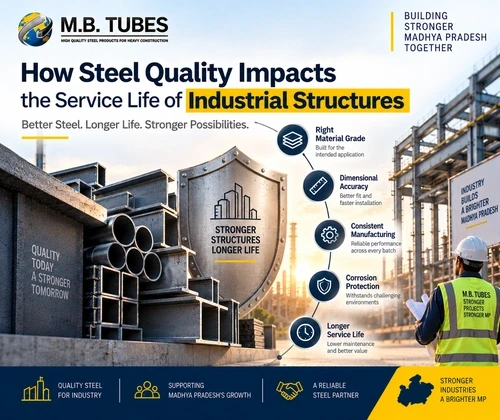
Material grade, dimensional accuracy, manufacturing consistency, fabrication quality, surface condition, corrosion protection, installation, maintenance, and suitability for the intended environment can all influence how a steel component performs over time.
For project owners, engineers, contractors, fabricators, and procurement teams looking for an Industrial Steel Products Manufacturer in Madhya Pradesh, understanding these factors can lead to better purchasing decisions and more dependable project outcomes.
Steel Quality Is More Than Strength
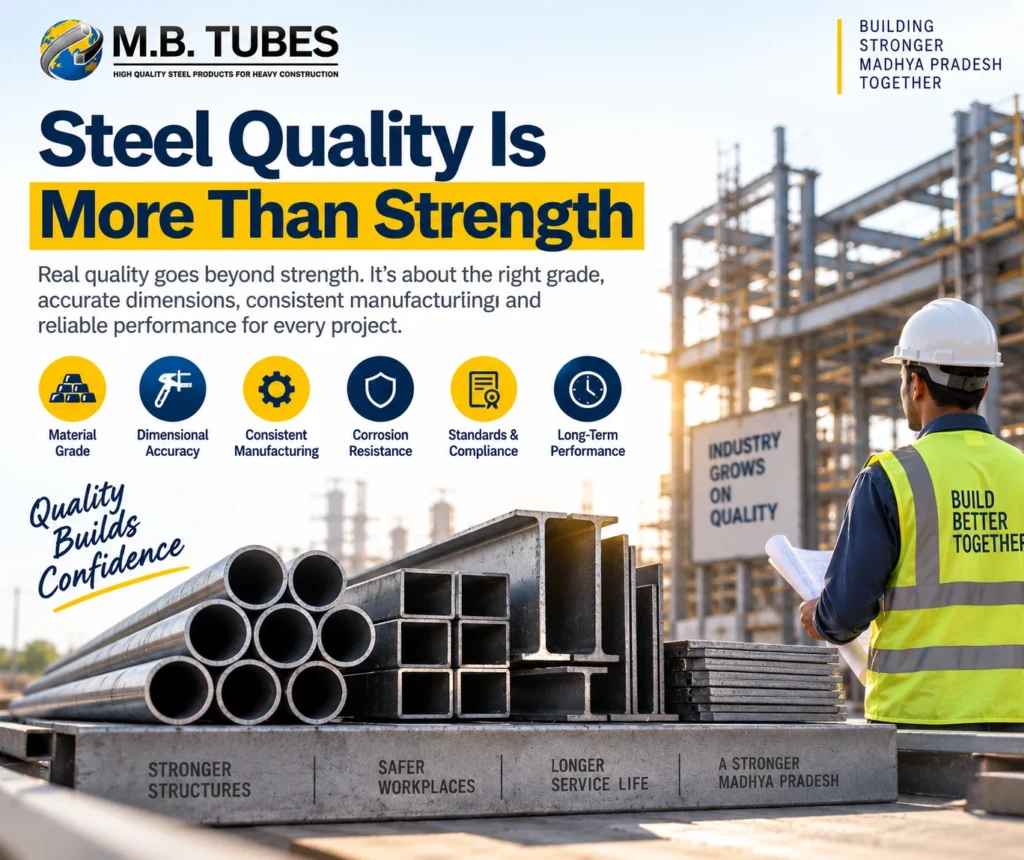
When people hear “high-quality steel,” they often think only about strength. Strength is important, but industrial steel quality involves several characteristics.
Depending on the product and application, buyers may need to consider:
- Material grade and chemical composition
- Mechanical properties
- Dimensions and tolerances
- Wall or section thickness
- Straightness and surface condition
- Weld and fabrication quality
- Applicable standards
- Corrosion protection
- Product consistency across a bulk order
A steel product may look strong from the outside but still be unsuitable if its actual specifications do not match the engineering requirement.
That is why professional procurement should begin with technical suitability rather than appearance or price alone.
1. Correct Material Grade Supports Long-Term Performance
Different industrial applications place different demands on steel.
A structural member in a warehouse, an MS pipe in an industrial installation, and a steel formwork component on a construction site do not necessarily have identical requirements.
Using the specified material grade helps ensure that the product possesses the characteristics considered during engineering and design.
Substituting materials without proper technical evaluation can create unnecessary uncertainty.
When approaching an Industrial Steel Products Manufacturer in Madhya Pradesh, buyers should communicate the required grade, applicable standard, dimensions, intended application, and any project-specific technical requirements.
2. Dimensional Accuracy Matters More Than It Appears
Even small dimensional variations can create problems during fabrication and installation.
Imagine a project where hundreds of steel components need to connect, align, or fit into a predefined arrangement. Inconsistent dimensions can increase adjustment work, fabrication time, material wastage, and installation difficulties.
For industrial steel products such as MS pipes, steel tubes, scaffolding components, formwork systems, shuttering plates, props, and fabricated steel sections, dimensional consistency is especially useful in repetitive applications.
A reliable manufacturer should focus not just on producing steel products, but on maintaining appropriate consistency across the supplied batch.
3. Thickness Can Influence Product Performance
Thickness is another specification buyers should never assume.
For pipes, plates, tubes, and fabricated components, the required thickness depends on the product design and intended application.
Choosing a thinner product simply to reduce initial procurement cost may not meet project requirements. At the same time, unnecessarily specifying heavier material can increase cost and handling requirements without delivering meaningful value.
The right approach is to purchase according to the approved project specification and engineering requirement.
Before ordering, clearly confirm dimensions and relevant thickness specifications with the supplier.
4. Manufacturing Consistency Becomes Critical in Bulk Orders
A single good sample does not guarantee that an entire bulk order will be equally consistent.
Industrial projects frequently require large quantities of similar steel components. Variations between batches can create challenges during fabrication, assembly, erection, and replacement.
Procurement teams should therefore evaluate the manufacturer’s ability to maintain consistent production.
When comparing an Industrial Steel Products Manufacturer in Madhya Pradesh, ask about manufacturing processes, inspection practices, available specifications, production capacity, and quality documentation where required.
Consistency is particularly valuable when projects involve repeat orders over several months.
5. Fabrication Quality Affects the Complete Product
For fabricated industrial steel products, raw material quality is only part of the story.
Cutting, forming, drilling, welding, machining, and finishing can all influence the final component.
Poorly executed fabrication may result in dimensional inaccuracies, difficult assembly, inconsistent connections, or premature maintenance requirements.
For products involving welded fabrication, buyers should evaluate visible workmanship and ensure that any project-specific welding requirements are properly communicated.
Good steel combined with appropriate fabrication creates a more dependable finished product.
6. Corrosion Can Reduce Service Life
One of the biggest threats to many steel products is corrosion.
Exposure to moisture, chemicals, industrial pollutants, outdoor environments, and inadequate drainage can contribute to corrosion depending on the steel type and protection system.
Corrosion does not affect every structure at the same rate. Environmental exposure, design details, coatings, maintenance, and material selection all matter.
Where corrosion protection is required, project teams may consider suitable protective systems such as specified coatings, galvanizing, painting, or other engineered solutions.
The appropriate system should be selected according to the environment and project requirements rather than applying one approach to every application.
7. Good Steel Makes Fabrication and Installation More Predictable
Project efficiency is not only about material price.
Consistent steel products can make downstream work easier for fabricators and site teams.
When dimensions, thicknesses, and other specified characteristics are consistent, teams can plan cutting, fabrication, assembly, and installation with greater confidence.
In contrast, inconsistent materials may require repeated adjustments.
For industrial projects where schedules matter, predictability can be valuable.
This is one reason procurement teams often evaluate steel quality and supplier reliability together rather than treating them as separate issues.
8. Maintenance Plays a Major Role in Service Life
Even correctly specified steel requires appropriate maintenance.
Industrial structures should be inspected according to applicable project and maintenance requirements. Areas exposed to moisture, chemicals, mechanical impact, or aggressive environments may require particular attention.
Maintenance practices can include inspection for corrosion, checking protective coatings, assessing connections and welds where applicable, addressing water accumulation, and repairing damage before it develops further.
High-quality steel is not a replacement for maintenance. Instead, appropriate material selection and proper maintenance work together to support long-term performance.
9. The Lowest Purchase Price May Not Mean the Lowest Lifetime Cost
Industrial procurement decisions are often price-sensitive, but unit price tells only part of the story.
A more useful way to evaluate steel procurement is to consider the total lifecycle impact:
Initial Cost + Transportation + Fabrication + Installation + Maintenance + Repair + Replacement + Downtime Risk
A cheaper material that creates frequent fabrication issues or requires earlier replacement may ultimately cost more than a correctly specified product.
This does not mean that expensive steel is automatically better. It means buyers should compare products on specification, quality, consistency, supplier capability, and overall value.
10. Supplier Reliability Also Influences Project Performance
Steel quality matters, but the ability to supply the correct product at the required time matters too.
Industrial projects often work with carefully planned procurement schedules. Delayed material can affect fabrication, manpower allocation, equipment utilisation, and site progress.
When choosing an Industrial Steel Products Manufacturer in Madhya Pradesh, buyers should therefore evaluate:
Product Quality | Manufacturing Capability | Specification Accuracy | Bulk Supply Capacity | Communication | Documentation | Dispatch Planning | Repeat Supply
A dependable supplier should understand that industrial procurement is not simply a transaction—it is part of a larger project workflow.
Why Regional Steel Sourcing Can Benefit Madhya Pradesh Projects
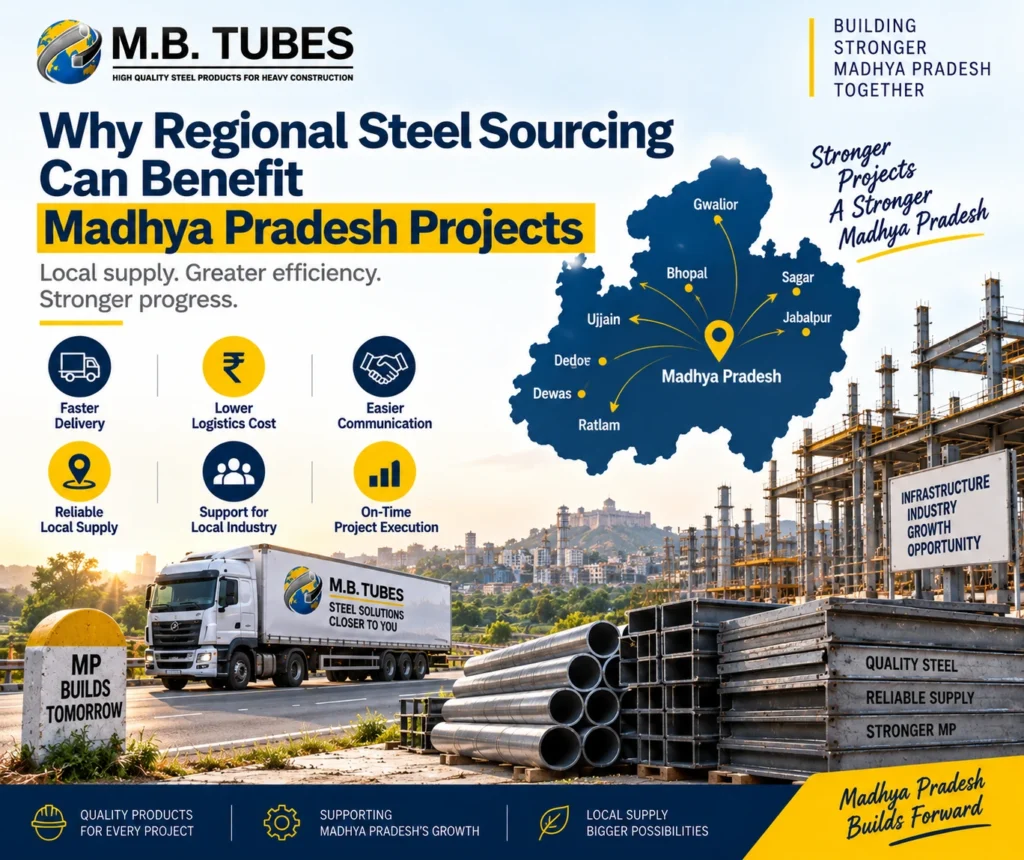
For projects operating across Indore, Pithampur, Dewas, Bhopal, Mandideep, Ujjain, Jabalpur, Gwalior, Sagar, Satna, Rewa, Ratlam, Dhar, and other industrial areas of Madhya Pradesh, regional sourcing can offer practical advantages.
Working with an Industrial Steel Products Manufacturer in Madhya Pradesh may help simplify communication, transportation planning, phased procurement, and repeat-order coordination.
This can be particularly valuable for projects requiring multiple deliveries rather than one large shipment.
However, location alone should never determine supplier selection. Buyers should still evaluate technical capability, product specifications, quality consistency, manufacturing capacity, and delivery performance.
What Should Buyers Check Before Ordering Industrial Steel Products?
Before finalising an industrial steel order, procurement teams should create a clear technical requirement.
Confirm the product type, dimensions, thickness, material grade, applicable standard, quantity, fabrication requirements, surface treatment, documentation, delivery location, and required schedule.
For bulk orders, it can also be useful to discuss inspection procedures, packaging, transportation arrangements, phased delivery requirements, and future repeat quantities.
Clear specifications reduce misunderstandings between buyer and manufacturer.
Choosing an Industrial Steel Products Manufacturer in Madhya Pradesh
The right manufacturer should be able to discuss your requirement beyond simply quoting a rate per kilogram, pipe, plate, or component.
Look for a supplier that understands specifications, maintains manufacturing consistency, communicates clearly, supports bulk requirements, and provides realistic delivery commitments.
For buyers requiring products such as MS pipes, scaffolding systems, steel formwork, centering plates, adjustable props, shuttering components, and other fabricated steel products, supplier capability across multiple categories can also simplify procurement.
The goal is to build a supply relationship where quality, specifications, availability, and project requirements remain aligned.
Final Thoughts
The service life of an industrial structure does not depend on a single factor. Material selection, engineering design, fabrication, environmental exposure, installation quality, corrosion protection, inspection, and maintenance all contribute to long-term performance.
Steel quality is an important part of that equation.
Choosing correctly specified and consistently manufactured steel can help improve fabrication predictability, installation efficiency, maintenance planning, and overall project reliability.
For businesses searching for an Industrial Steel Products Manufacturer in Madhya Pradesh, the better question is not simply, “What is the lowest price?”
It is:
“Which steel product meets our technical requirements and provides dependable value throughout its intended service life?”
That approach turns steel procurement from a short-term purchasing decision into a more informed part of long-term industrial project planning.
Frequently Asked Questions (FAQs)
1. Why is steel quality important for industrial structures?
Steel quality can influence the long-term performance, fabrication accuracy, installation, maintenance requirements, and reliability of industrial structures. The steel should meet the material grade, dimensions, thickness, and other specifications defined for the project.
2. How do I choose an Industrial Steel Products Manufacturer in Madhya Pradesh?
Evaluate the manufacturer based on product specifications, manufacturing consistency, quality-control practices, fabrication capability, bulk supply capacity, documentation, delivery planning, and repeat-order support. Price should be considered alongside technical suitability and overall supply reliability.
3. What factors can affect the service life of industrial steel products?
Service life can be influenced by several factors, including steel grade, environmental exposure, corrosion protection, fabrication quality, installation, loading conditions, inspection, and maintenance. Correct product selection should always follow project and engineering requirements.
4. What should buyers check before ordering industrial steel products in bulk?
Buyers should confirm the product type, material grade, dimensions, thickness, quantity, applicable standards, fabrication requirements, surface treatment, documentation, delivery location, and required schedule before placing a bulk order.
5. Why can regional sourcing be useful for industrial projects in Madhya Pradesh?
Working with an Industrial Steel Products Manufacturer in Madhya Pradesh may simplify communication, transportation planning, phased deliveries, and repeat-order coordination for projects across MP. Buyers should still evaluate the manufacturer’s product quality, technical capabilities, production capacity, and delivery reliability.