
Where Are Large Diameter MS Pipes Used? Applications, Benefits & Selection Guide
Quick Answer: Where Are Large Diameter MS Pipes Used?
Large Diameter MS Pipes are commonly used in industrial construction, structural frameworks, water transmission systems, infrastructure projects, fabrication and heavy engineering applications. Their larger diameter makes them suitable for projects that require substantial pipe dimensions, structural performance or high-volume fluid movement.
However, choosing the right pipe involves more than diameter. Wall thickness, steel grade, load requirements and application are equally important.
What Are Large Diameter MS Pipes?
Large Diameter MS Pipes are steel pipes manufactured from mild steel (MS) with relatively large outside diameters compared with conventional small-bore pipes.
They are available in different diameters, wall thicknesses, lengths and specifications to suit various industrial and construction requirements.
Unlike smaller pipes used in lightweight applications, large diameter pipes are often selected for demanding projects involving structural support, large pipelines or heavy fabrication.
Important: There is no single universal diameter that defines a large diameter MS pipe across every industry. The classification depends on the product standard and application.
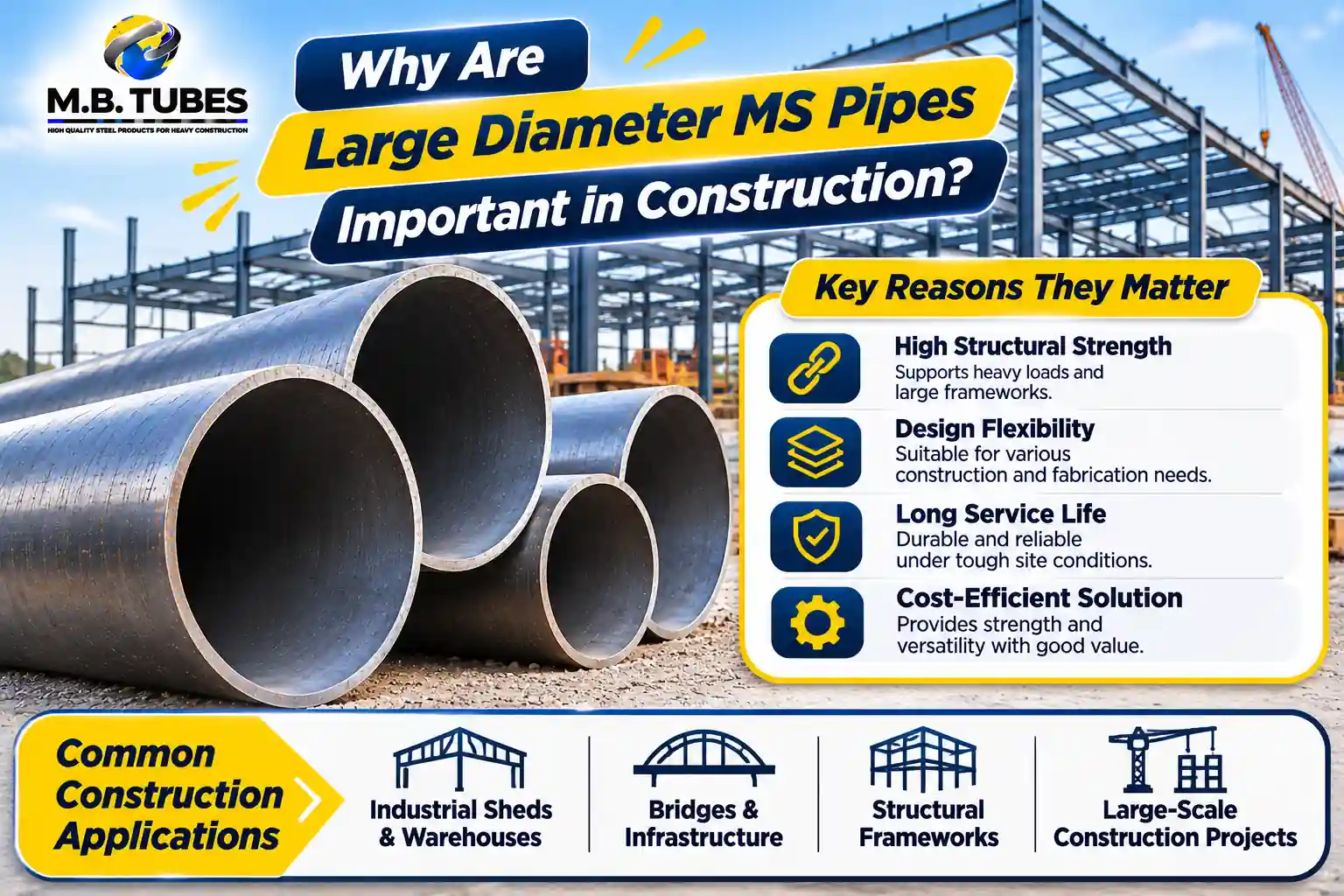
Why Are Large Diameter MS Pipes Important in Construction?
Imagine building an industrial facility where steel components must support equipment, form part of a large framework or carry significant volumes of water.
Using unsuitable pipe dimensions can create design, installation and maintenance problems.
Large Diameter MS Pipes provide a practical option for applications requiring:
- Larger pipe sections for structural or pipeline requirements.
- Suitable strength and stiffness when correctly designed.
- Fabrication flexibility for project-specific assemblies.
- Different wall thickness options for varying operating conditions.
- Customizable dimensions depending on manufacturing capability.
Their performance depends on the complete pipe specification, not simply their size.
Where Are Large Diameter MS Pipes Used?
1. Industrial Sheds and Warehouses
Industrial sheds and warehouses require carefully designed steel frameworks to support roofing, equipment and other structural elements.
Large Diameter MS Pipes may be used in:
- Structural columns and supporting members
- Industrial building frameworks
- Large-span structural assemblies
- Fabricated steel support systems
Why are they used?
Their circular hollow profile can provide useful structural properties, particularly when a design requires tubular members.
The final diameter, thickness and connections must be selected through structural engineering calculations.
2. Water Transmission and Pipeline Projects
One important application of Large Diameter MS Pipes is the transportation of water over long distances.
They may be used in:
- Municipal water transmission pipelines
- Industrial water supply networks
- Raw-water transportation
- Water treatment infrastructure
- Large distribution pipelines
Key advantage: A larger internal diameter can accommodate greater flow under suitable hydraulic conditions.
For pipeline applications, coating, lining, joint design, pressure rating and corrosion protection must also be considered.
3. Bridges and Infrastructure Projects
Large Diameter MS Pipes can be incorporated into engineered infrastructure systems where tubular steel members are specified.
Possible applications include:
- Structural support assemblies
- Fabricated bridge components
- Temporary construction works
- Infrastructure support frameworks
- Engineered tubular structures
Their suitability depends on the project’s structural drawings, applicable standards and required performance.
Remember: Not every large diameter pipe is automatically suitable for bridge construction.
4. Heavy Engineering and Industrial Machinery
Heavy engineering facilities often require customized steel components for machinery and equipment installations.
Large Diameter MS Pipes can be used in:
- Machinery support structures
- Fabricated equipment frames
- Industrial structural assemblies
- Heavy engineering components
- Specialized manufacturing projects
Their weldability and fabrication potential make them useful where project specifications call for mild steel tubular sections.
5. Power Plants and Industrial Facilities
Power plants and industrial facilities contain complex structural and piping systems.
Large Diameter MS Pipes may be used for:
- Suitable industrial utility pipelines
- Cooling-water systems
- Structural support assemblies
- Fabricated industrial components
- Plant infrastructure
The pipe must match the required operating pressure, temperature, fluid characteristics and material specifications.
For example, a pipe suitable for a structural framework may not be appropriate for a pressurized industrial pipeline.
6. Large Steel Fabrication Projects
Fabricators use Large Diameter MS Pipes to manufacture customized steel assemblies.
Applications can include industrial structures, tubular supports, equipment frames and engineered construction components.
Mild steel can be cut, welded and fabricated using suitable processes.
Fabrication tip: Confirm pipe dimensions, material grade, weld requirements and connection details before ordering.
What Are the Main Benefits of Large Diameter MS Pipes?
Benefit | Why It Matters |
Structural versatility | Can be incorporated into engineered tubular frameworks |
Fabrication flexibility | Suitable for many cutting and welding applications |
Size options | Different diameters and thicknesses support project-specific needs |
Industrial applications | Used in construction, infrastructure and engineering |
Pipeline suitability | Larger internal diameters can support substantial fluid flow |
Material efficiency | Appropriate section selection can help optimize material use |
The actual benefits depend on the selected grade, dimensions, manufacturing quality and intended application.
How to Choose the Right Large Diameter MS Pipe
Choosing a pipe only because it looks bigger or heavier is a common mistake.
A better approach is to evaluate the complete project requirement.
Step 1: Identify the Application
Determine whether the pipe will be used for structural support, fluid transportation, machinery fabrication or another industrial purpose.
Step 2: Select the Outside Diameter
The outside diameter (OD) must match the engineering drawings and required connections.
For pipeline projects, the internal diameter also affects flow performance.
Step 3: Check Wall Thickness
Wall thickness influences pipe weight, structural properties and pressure resistance.
A thicker pipe is not automatically the best choice. It must match the design requirements.
Step 4: Confirm Steel Grade and Standards
Check the required material grade, manufacturing standard and inspection requirements.
Different projects may require different technical specifications.
Step 5: Consider Surface Protection
Depending on exposure conditions, the pipe may require painting, protective coating, galvanizing where appropriate, or specialized internal lining.
Step 6: Review Fabrication and Delivery
Confirm pipe length, quantity, handling arrangements, welding requirements and transportation feasibility before placing a bulk order.
Large Diameter MS Pipes vs Regular MS Pipes
Factor | Large Diameter MS Pipes | Smaller MS Pipes |
Diameter | Relatively larger | Relatively smaller |
Common applications | Major pipelines, industrial frameworks, heavy fabrication | General fabrication, smaller structures and utility work |
Handling | May require specialized lifting equipment | Often easier to handle |
Transportation | Requires careful logistics planning | Generally simpler transportation |
Selection | Project-specific engineering requirements | Application-specific specifications |
Which is better?
Neither is universally better. The correct choice depends on the application’s technical requirements.
Common Mistakes to Avoid When Buying Large Diameter MS Pipes
Even experienced buyers can face problems when pipe specifications are incomplete.
Avoid these mistakes:
- Selecting diameter without checking wall thickness: Both dimensions influence performance.
- Assuming heavier means stronger: Steel grade, geometry and structural design also matter.
- Ignoring corrosion protection: Exposure conditions can affect long-term serviceability.
- Ordering without technical drawings: Incorrect dimensions can cause fabrication delays.
- Overlooking transportation requirements: Large pipes may require specialized handling and delivery arrangements.
Buying tip: Request confirmation of the pipe’s outside diameter, wall thickness, material grade, length, applicable standard and inspection requirements.
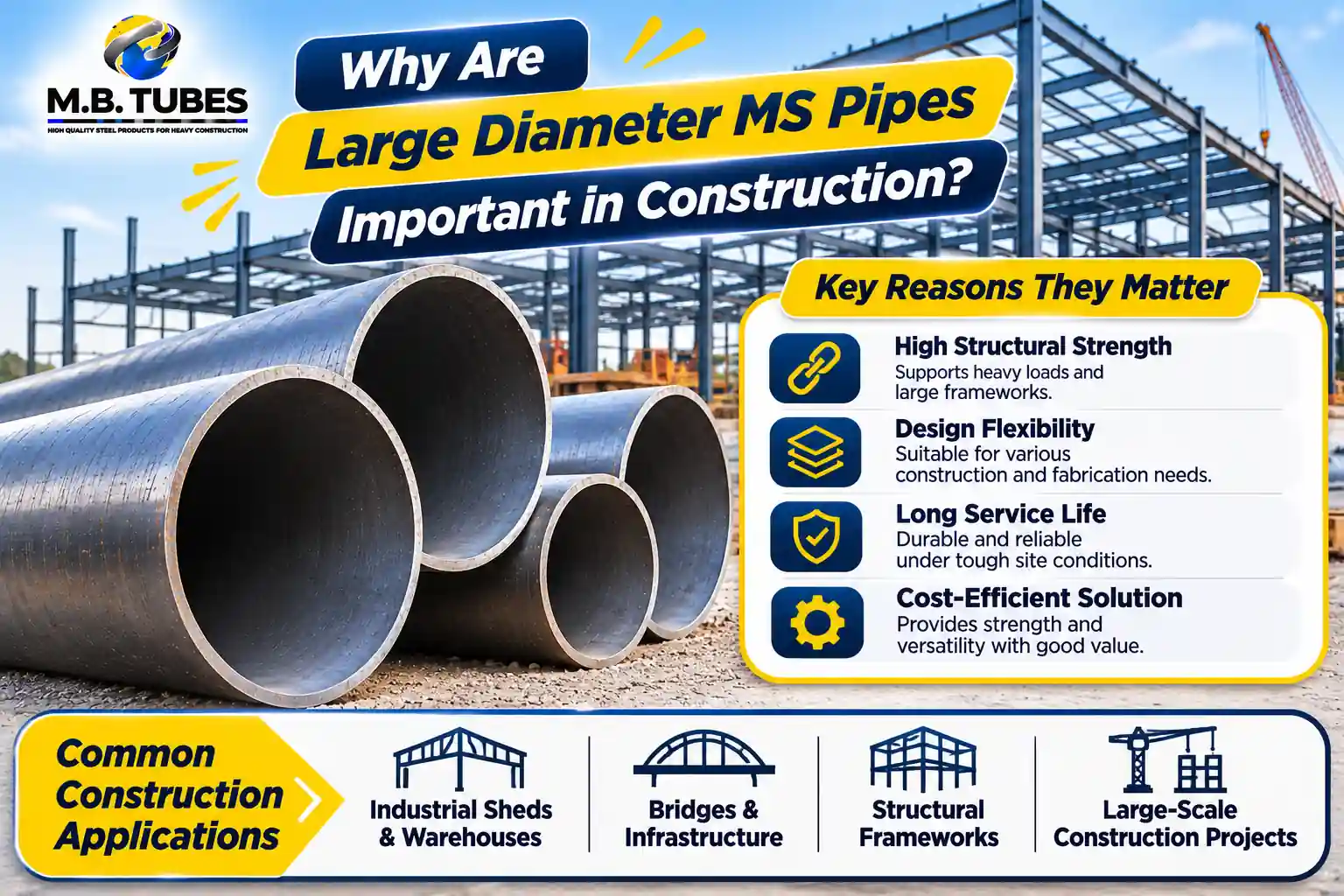
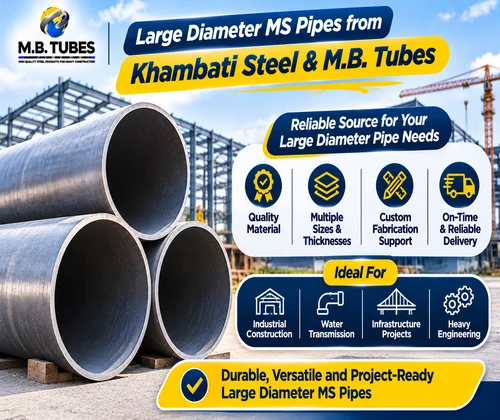
Large Diameter MS Pipes from Khambati Steel & M.B. Tubes
Khambati Steel & M.B. Tubes serves construction, fabrication and industrial steel requirements with a product range that includes MS pipes, ERW pipes, structural steel tubes and other steel products.
When planning a large diameter pipe purchase, buyers should share their project drawings, required dimensions, wall thickness, material specifications, quantities and delivery location.
Clear specifications help ensure the supplied material is appropriate for the intended application.
Conclusion
Large Diameter MS Pipes play an important role in industrial construction, pipelines, infrastructure and heavy engineering.
Their versatility makes them useful across different projects, but the right pipe is not simply the largest or heaviest option.
The best selection starts with the application, followed by engineering requirements, diameter, wall thickness, material grade and suitable surface protection.
For industrial and construction projects, Khambati Steel & M.B. Tubes can be contacted with detailed material requirements to discuss suitable steel pipe options.
Frequently Asked Questions (FAQ)
What are Large Diameter MS Pipes mainly used for?
Large Diameter MS Pipes are used in industrial construction, water transmission pipelines, heavy engineering, structural frameworks and infrastructure projects. Their suitability depends on diameter, thickness, material grade and design requirements.
Are Large Diameter MS Pipes suitable for structural applications?
Yes, they can be used in structural applications when the pipe grade, dimensions, connections and load capacity are verified through appropriate engineering design.
Does a larger pipe diameter mean greater strength?
Not necessarily. Pipe strength and structural performance depend on multiple factors, including wall thickness, steel grade, member length, loading conditions and connection design.
Can Large Diameter MS Pipes be used for water pipelines?
Yes. Suitable large diameter mild steel pipes can be used for water transmission systems when designed with appropriate pressure ratings, joints, protective coatings and internal linings.
What should buyers check before ordering Large Diameter MS Pipes?
Buyers should confirm outside diameter, wall thickness, pipe length, steel grade, manufacturing standard, surface finish, application, quantity and inspection requirements.