
How to Choose Rectangular Tube Size? A Complete Guide for Construction & Fabrication
Choosing the right Rectangular Tube Size is important for any construction, fabrication, or industrial project. Whether you are building a steel framework, manufacturing equipment, or designing a warehouse structure, the dimensions of your rectangular steel tube can affect its strength, weight, performance, and overall project cost.
However, choosing a rectangular tube is not simply about selecting the biggest or thickest section available.
The right choice depends on your application, load requirements, tube dimensions, wall thickness, steel grade, and structural design.
This guide explains how to select the right rectangular steel tube size using practical examples and easy-to-understand steps.
What Is a Rectangular Steel Tube?
A Rectangular Steel Tube, also known as a Rectangular Hollow Section (RHS), is a hollow steel section with four sides, where two opposite sides are longer than the other two.
These tubes are commonly manufactured from mild steel and used in structural frameworks, fabrication, industrial equipment, and construction projects.
Unlike round pipes, rectangular tubes have flat surfaces that make positioning, joining, and fabrication convenient.
Common applications include:
- Industrial sheds and warehouses
- Steel construction frameworks
- Machinery and equipment frames
- Gates, railings, and fencing
- Furniture manufacturing
- Support structures and fabrication projects
Rectangular tubes are available in different widths, heights, wall thicknesses, lengths, and material grades.
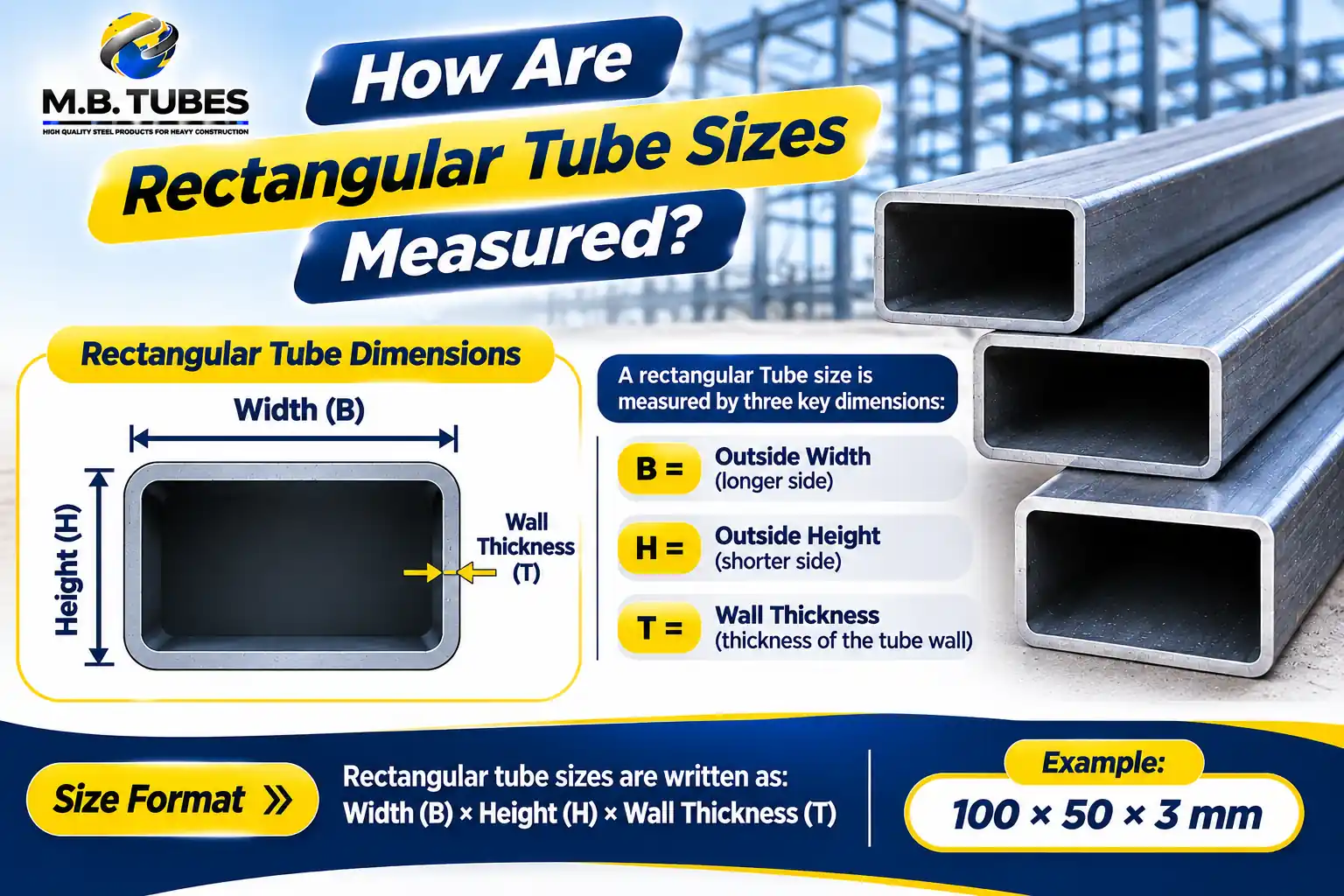
How Are Rectangular Tube Sizes Measured?
Understanding rectangular tube dimensions is the first step toward selecting the correct product.
A rectangular steel tube is generally specified using three measurements:
Width (B) × Height (H) × Wall Thickness (T)
For example:
Illustrative rectangular hollow section cross-section (not to scale).
A 100 × 50 × 3 mm rectangular tube has:
- Outside width: 100 mm
- Outside height: 50 mm
- Wall thickness: 3 mm
The first two dimensions describe the outside shape, while the third indicates the steel wall thickness.
Common Rectangular Tube Sizes and Their Applications
Rectangular steel tubes are available in numerous dimensions. The following examples illustrate common size categories.
Rectangular Tube Size | Typical Applications |
40 × 20 mm | Furniture frames and light fabrication |
50 × 25 mm | Gates, railings, and small structures |
60 × 40 mm | Equipment frames and general fabrication |
80 × 40 mm | Medium-duty structural frameworks |
100 × 50 mm | Industrial fabrication and support structures |
120 × 60 mm | Larger fabricated frameworks |
150 × 100 mm | Engineered structural applications |
200 × 100 mm | Larger industrial and structural projects |
Note: These are illustrative dimensions, not confirmed stock sizes or load ratings. Actual availability, wall thickness, grade, and suitability must be verified.
How to Choose Rectangular Tube Size for Your Project
Selecting the correct Rectangular Tube Size becomes easier when you follow a systematic approach.
1. Understand Your Application
Start by identifying where the rectangular tube will be used.
A tube selected for furniture manufacturing may have different requirements from one used in a warehouse structure.
For example, decorative fabrication may prioritize appearance and ease of handling, while structural applications require verified load-bearing performance.
First identify the application, then choose the dimensions.
2. Evaluate Load Requirements
The amount and direction of loading are important factors in rectangular tube selection.
A tube used as a horizontal beam behaves differently from one used as a vertical column.
Consider the following:
- Expected permanent and temporary loads
- Direction of applied forces
- Unsupported span or member length
- Connection and support conditions
- Potential bending, buckling, and deflection
For load-bearing structures, the final size should be confirmed through engineering calculations rather than appearance or thickness alone.
3. Select the Right Width and Height
Rectangular tubes have different dimensions along their two main axes.
This allows designers to select a profile suited to the direction of bending.
For example, a 100 × 50 mm rectangular section generally has different bending stiffness depending on its orientation.
However, the exact performance also depends on wall thickness, steel grade, member length, and support conditions.
A larger outside dimension does not automatically mean the section is suitable for every application.
4. Choose the Correct Wall Thickness
Wall thickness influences a rectangular tube’s weight, section properties, fabrication requirements, and potential structural performance.
A thicker wall generally increases the amount of steel in a tube of the same outside dimensions.
However, thicker tubes also increase material weight and often cost.
The objective is to select a thickness that meets the project’s technical requirements without unnecessary material consumption.
5. Check the Steel Grade
Not every rectangular steel tube has the same mechanical properties.
Steel grade affects characteristics such as yield strength and suitability for specific structural or fabrication applications.
For structural projects, verify the specified material grade and applicable standard.
Never assume that two tubes with identical dimensions have identical performance.
6. Consider Fabrication and Installation
Rectangular tubes are commonly used because their flat surfaces make them convenient for cutting, welding, positioning, and joining.
Before selecting a size, consider whether the tube can be easily fabricated into the required structure.
Also evaluate connection details, handling, available equipment, and installation conditions.
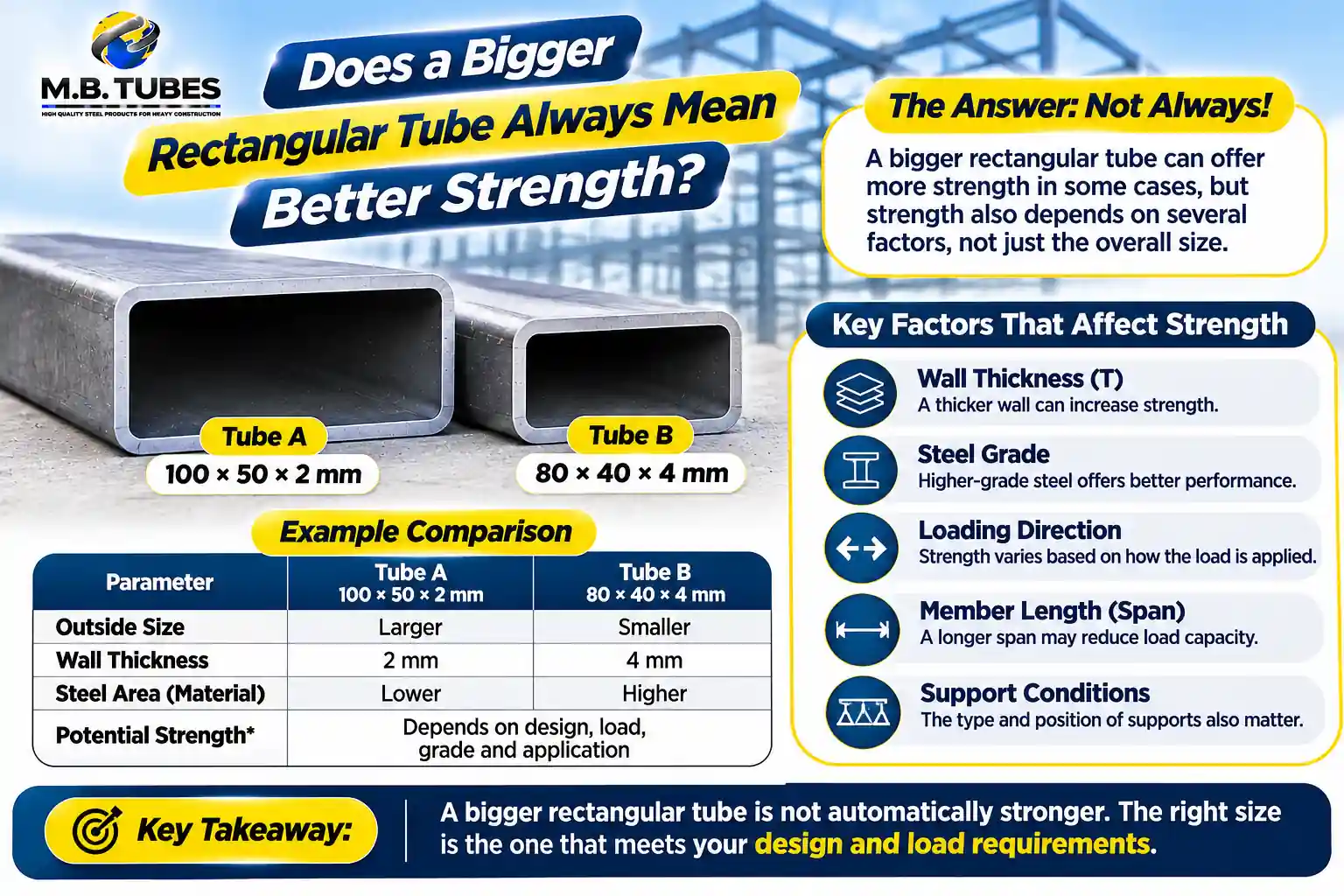
Does a Bigger Rectangular Tube Always Mean Better Strength?
Not necessarily.
A larger rectangular tube may offer greater bending stiffness or load resistance in certain configurations, but its actual performance depends on several factors.
For example, compare:
- Tube A: 100 × 50 × 2 mm
- Tube B: 80 × 40 × 4 mm
Tube A has larger outside dimensions, while Tube B has thicker walls.
Neither can automatically be declared stronger for every application.
Their performance must be evaluated based on section properties, material grade, loading direction, span, and support conditions.
The best rectangular tube is the one that meets the design requirements—not simply the largest tube available.
How to Calculate Rectangular Steel Tube Weight
Calculating tube weight helps with procurement, transportation, handling, and material estimation.
A simplified theoretical formula for mild steel rectangular tubes is:
W=[BH-(B-2T)(H-2T)]0.00785
Where:
- W = Weight in kg/m
- B = Outside width in mm
- H = Outside height in mm
- T = Wall thickness in mm
Example Calculation
For a 100 × 50 × 3 mm rectangular tube:
W=[100(50)-94(44)]0.00785
W6.78kg/m
For a 6-metre tube:
6.78640.7kg
This is an approximate theoretical weight. Actual product weight may vary because of corner radii, manufacturing tolerances, and material specifications.
Rectangular Tube vs Square Tube: Which Should You Choose?
Both rectangular and square hollow sections are widely used in steel fabrication.
Feature | Rectangular Tube | Square Tube |
Shape | Unequal adjacent sides | Four equal sides |
Bending behaviour | Different properties along two main axes | Similar properties along both main axes |
Common uses | Beams, frames, industrial fabrication | Posts, frames, gates, general fabrication |
Fabrication | Flat surfaces for connections | Flat surfaces for connections |
Selection | Based on loading direction and design | Based on loading and design |
Neither profile is universally better. The right choice depends on the structural or fabrication requirements.
Common Mistakes When Choosing Rectangular Tube Size
Avoid these common purchasing and selection mistakes:
- Choosing only by price: Lower upfront cost does not guarantee the required performance.
- Ignoring wall thickness: Outside dimensions alone are insufficient.
- Overlooking steel grade: Material properties matter for structural applications.
- Selecting without load calculations: Structural suitability must be verified.
- Ignoring weight and handling: Heavy sections can affect transportation and installation costs.
- Not checking specifications: Confirm dimensions, tolerances, finish, quantity, and length before ordering.
Rectangular Steel Tubes from M.B. Tubes
Khambati Steel & M.B. Tubes offers steel pipes and hollow sections for construction, industrial, engineering, and fabrication applications.
When sourcing rectangular steel tubes, buyers should communicate their required dimensions, wall thickness, steel grade, quantity, length, and intended application.
Providing complete specifications helps suppliers identify suitable products and prepare more accurate quotations.
Conclusion
Choosing the correct Rectangular Tube Size requires more than comparing dimensions or selecting the thickest available product.
Start by understanding the application, evaluating loads, confirming width and height, checking wall thickness, and selecting the appropriate steel grade.
For structural applications, use approved design calculations and specifications to confirm suitability.
Looking for rectangular steel tubes for your next project? Contact Khambati Steel & M.B. Tubes with your required dimensions, thickness, quantity, and application to discuss suitable options.
Frequently Asked Questions (FAQs)
What is the most common rectangular tube size?
There is no single size suitable for every project. Dimensions such as 40 × 20 mm, 60 × 40 mm, and 100 × 50 mm are examples used across different fabrication and construction applications. Actual selection depends on the design.
How do I choose rectangular tube thickness?
Choose wall thickness according to the expected loading, member length, steel grade, fabrication requirements, and applicable design specifications. Structural applications require engineering verification.
Are rectangular tubes suitable for construction?
Yes. Rectangular hollow sections are widely used in structural frameworks, industrial sheds, support structures, and fabrication. Their suitability depends on the selected section and engineering design.
Which is stronger: rectangular or square steel tube?
Neither is automatically stronger. Strength and stiffness depend on outside dimensions, wall thickness, grade, loading direction, and member configuration.
How is rectangular tube weight calculated?
Theoretical weight can be estimated from the cross-sectional steel area and material density. Multiply the calculated weight per metre by the total length to estimate the tube’s weight.