
What Are Scaffolding Walkway Planks Used For?
Construction work often requires workers to reach elevated areas while carrying tools and performing tasks. A reliable working platform makes these activities more organized and helps workers move between designated work areas.
Scaffolding Walkway Planks are important components of scaffolding systems because they create the surface on which workers stand and move. They are commonly used in building construction, industrial maintenance, painting, plastering, and infrastructure projects.
But what exactly do these planks do, and how do you choose the right ones? This guide explains their uses, benefits, types, and important selection factors.
Quick Answer: What Are Scaffolding Walkway Planks Used For?
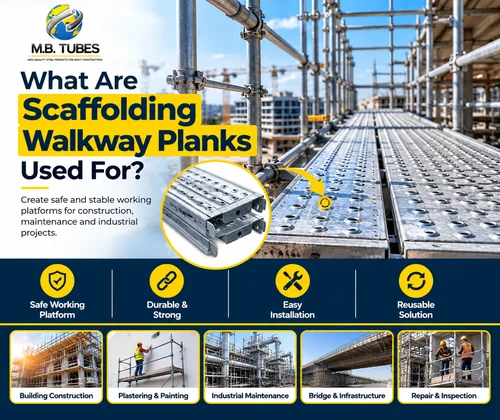
Scaffolding Walkway Planks are used to create temporary working platforms on scaffolding structures. They provide a designated surface for workers to stand, walk, and perform construction or maintenance activities at different heights.
Their main applications include:
- Building construction and renovation
- Plastering, painting, and façade work
- Industrial equipment maintenance
- Bridge and infrastructure projects
- Scaffolding access platforms
- Repair and inspection activities
The planks must be properly supported, secured, and suitable for the intended working load.
What Are Scaffolding Walkway Planks?
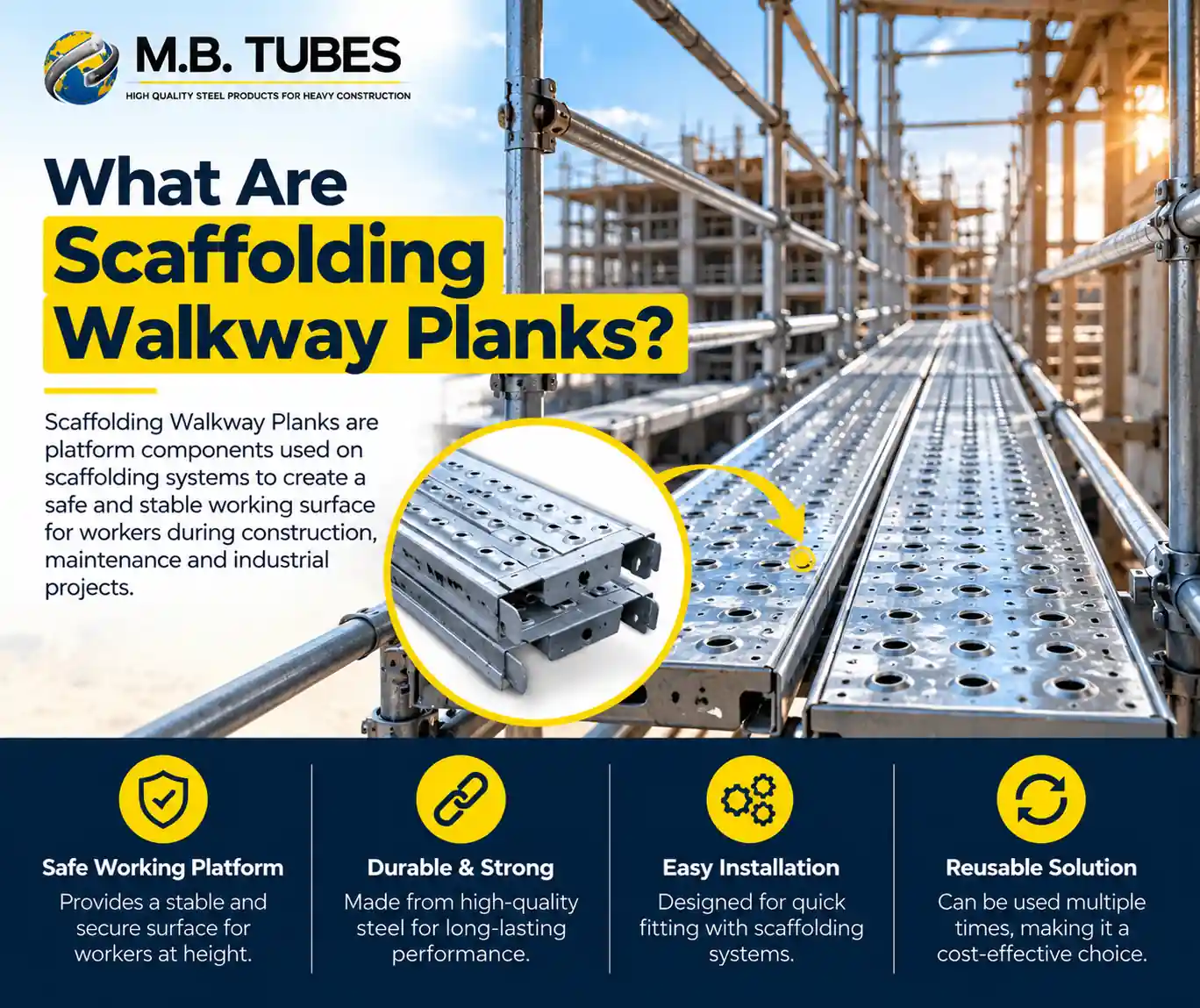
Scaffolding Walkway Planks are platform components installed across suitable scaffolding supports to create a working surface.
They are available in different materials and designs. Steel walkway planks are widely used in construction because they offer a durable, reusable platform option.
A typical steel scaffolding walkway plank may include a formed steel body, a textured or perforated surface, reinforced edges, and compatible end connections.
The exact design depends on the scaffolding system and manufacturer.
Unlike ordinary steel sheets, purpose-designed walkway planks are manufactured for use within specified scaffolding platform arrangements.
Where Are Scaffolding Walkway Planks Commonly Used?
1. Building Construction
During building construction, workers need access to walls, columns, and other elevated sections.
Scaffolding Walkway Planks provide working surfaces within suitable scaffolding arrangements, allowing construction activities to take place at designated levels.
They are commonly used in residential buildings, commercial structures, and multi-storey construction projects.
2. Plastering and Painting
Plastering and painting often require workers to move along large wall surfaces.
Properly installed scaffolding platform planks provide space for workers to position themselves and carry out finishing activities.
They are particularly useful for external walls, building façades, and renovation projects.
3. Industrial Maintenance
Industrial facilities contain equipment, pipelines, and structures that may be difficult to access from ground level.
Scaffolding platforms fitted with suitable walkway planks can provide temporary access for inspection, maintenance, and repair work.
Common applications include manufacturing plants, warehouses, and power plant maintenance projects.
4. Bridge and Infrastructure Projects
Infrastructure construction frequently involves elevated or difficult-to-reach working areas.
Steel Walkway Planks can be incorporated into appropriately designed scaffolding systems used for bridge maintenance, structural inspections, and related construction activities.
Their selection depends on the project layout, platform span, and required load rating.
Why Are Steel Scaffolding Walkway Planks Popular?
Steel walkway planks offer several practical advantages when correctly specified and maintained.
Durable Construction: Steel provides a robust platform material suitable for repeated construction use.
Reusable Design: Properly maintained planks can be used across multiple project cycles, subject to inspection and condition.
Textured Working Surface: Many designs feature perforations or raised patterns that improve traction under suitable conditions.
System Compatibility: Purpose-designed planks can be selected to fit compatible scaffolding arrangements.
Convenient Handling: Standardized dimensions can simplify platform planning, material counting, and site organization.
However, durability alone does not establish a plank’s safe working load. The manufacturer’s specifications must always be checked.
How to Choose the Right Scaffolding Walkway Planks
Selecting the correct plank involves more than comparing prices.
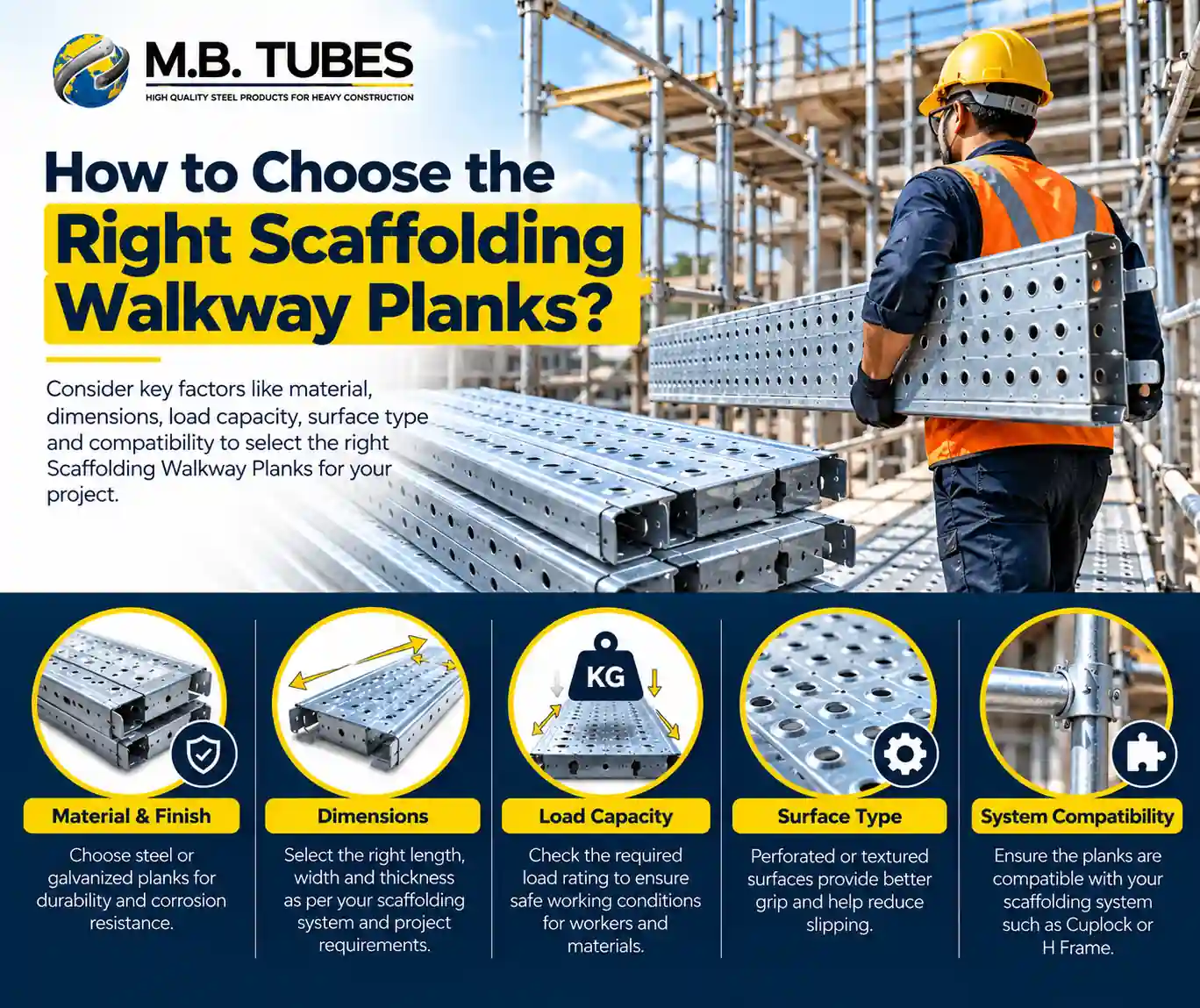
Check the Plank Dimensions
Confirm the required length, width, thickness, and supporting span.
Dimensions should match the scaffolding layout and the manufacturer’s approved installation arrangement.
Understand the Load Rating
The plank must be suitable for the intended loading, including workers, tools, and permitted materials.
Never assume that every steel walkway plank has the same load capacity.
Confirm Material and Finish
Choose the material and protective finish according to the working environment.
Galvanized finishes may be preferable where additional corrosion protection is required.
Check System Compatibility
Verify that the plank’s end connections, bearing arrangement, and dimensions are compatible with the intended scaffolding system.
Inspect Product Quality
Look for deformation, cracks, corrosion, damaged connections, and other defects before installation.
A correctly selected and inspected plank is more important than simply choosing the heaviest option.
Common Mistakes to Avoid When Buying Walkway Planks
Some purchasing mistakes can lead to unsuitable materials or unnecessary project expenses.
Ignoring Platform Span: A plank’s permissible load depends partly on how it is supported.
Choosing Only by Price: Low initial cost does not necessarily provide suitable performance or durability.
Mixing Incompatible Components: Planks should not be assumed compatible with every scaffolding system.
Overlooking Surface Condition: Damaged or excessively corroded planks may be unsuitable for continued use.
Skipping Load Verification: Platform load requirements must be confirmed before selecting products.
A clear purchasing specification helps prevent these problems.
Scaffolding Walkway Planks from M.B. Tubes
Khambati Steel & M.B. Tubes supplies scaffolding products and accessories for construction and industrial applications.
Its scaffolding product range includes walkway planks and supporting components used in temporary access systems.
When requesting Scaffolding Walkway Planks, buyers should share the required dimensions, quantity, application, material preference, and scaffolding system details.
Providing complete project requirements helps identify suitable product specifications and simplifies procurement planning.
Conclusion
Scaffolding Walkway Planks are essential components of temporary working platforms used in construction, industrial maintenance, and infrastructure projects.
They help create designated access and working surfaces, but their effectiveness depends on correct selection, installation, support, and inspection.
Before purchasing, focus on plank dimensions, load capacity, material, surface finish, and scaffolding compatibility.
For construction projects requiring steel walkway planks and scaffolding accessories, Khambati Steel & M.B. Tubes can be contacted with the relevant technical and quantity requirements.
Frequently Asked Questions (FAQs)
What is the main purpose of Scaffolding Walkway Planks?
Scaffolding Walkway Planks create temporary working surfaces within scaffolding systems. They allow workers to stand and move across designated platform areas during construction, painting, maintenance, and repair activities.
Are steel walkway planks suitable for outdoor construction?
Yes. Steel walkway planks can be suitable for outdoor projects when their design, finish, condition, and load rating meet the application requirements. Galvanized options provide additional corrosion protection.
Can walkway planks be reused?
Yes. Many steel walkway planks are designed for repeated use. However, they must be inspected before reuse, and damaged or unsuitable planks should be removed from service.
What determines the load capacity of a scaffolding plank?
Load capacity depends on the plank’s design, material, dimensions, supporting span, connection arrangement, and manufacturer rating. The complete scaffolding platform must also be assessed for its intended loads.
Are Scaffolding Walkway Planks compatible with Cuplock and H Frame Scaffolding?
They can be used with Cuplock Scaffolding and H Frame Scaffolding when the plank design, dimensions, supports, and connections are compatible with the specific system. Compatibility should always be verified before installation.