
H Frame vs Cuplock Scaffolding: Which to Choose?
Choosing the right scaffolding system is an important decision for any construction project. Whether you are working on a residential building, commercial structure, industrial plant, or infrastructure project, the scaffolding system should match your working height, site layout, access requirements, and intended loading.
Two commonly used options are H Frame Scaffolding and Cuplock Scaffolding. Both provide temporary access and working platforms, but their design, components, connections, and applications differ.
So, which one should you choose?
This guide compares H Frame vs Cuplock Scaffolding in simple language to help contractors, engineers, builders, and procurement teams select a suitable system.
Quick Answer: H Frame vs Cuplock Scaffolding
H Frame Scaffolding is generally suitable for straightforward, repetitive building access, while Cuplock Scaffolding offers greater flexibility for modular layouts and varied construction requirements.
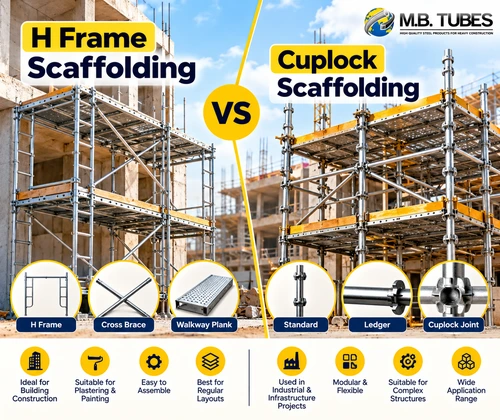
H Frame systems use prefabricated frames connected by cross braces. Cuplock systems use vertical standards and horizontal ledgers joined through a cup-and-blade locking mechanism.
For plastering, painting, and regular façade work, H Frame Scaffolding may be practical. For industrial structures, complex layouts, and projects requiring adaptable scaffold configurations, Cuplock Scaffolding may be more suitable.
However, the final choice depends on project specifications, scaffold design, intended loads, and site conditions.
What Is H Frame Scaffolding?
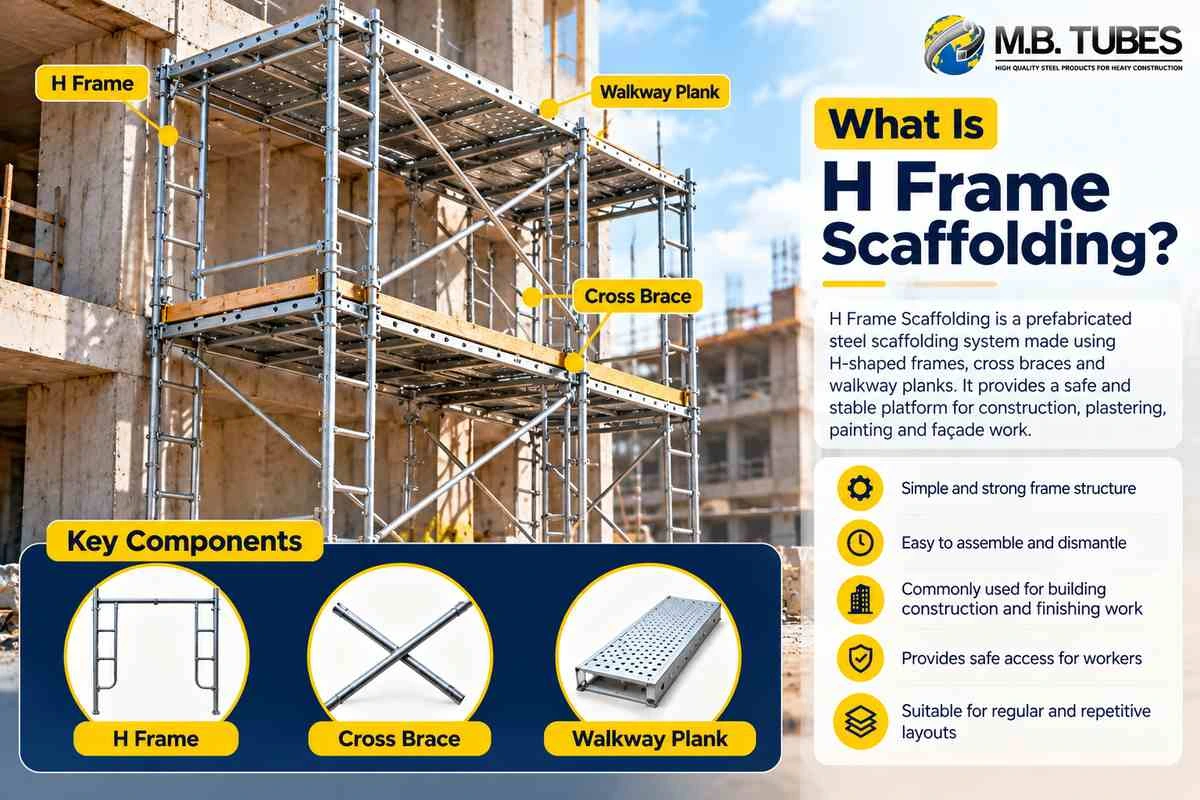
H Frame Scaffolding is a prefabricated steel scaffolding system built using frames shaped approximately like the letter H.
These frames are positioned at planned intervals and connected using cross braces and compatible accessories. Walkway planks or working platforms are installed according to project requirements.
The system is commonly used for building construction, plastering, painting, masonry, façade finishing, and maintenance work.
Why Choose H Frame Scaffolding?
Its prefabricated frame arrangement makes it practical for relatively regular building layouts.
The main advantages include:
- Simple, recognizable frame structure.
- Convenient planning for repetitive access requirements.
- Suitable for straight building elevations.
- Organized assembly using compatible frames and braces.
- Useful for construction finishing and maintenance.
H Frame Scaffolding is particularly relevant when the project requires repeated working platforms along a relatively uniform structure.
What Is Cuplock Scaffolding?
Cuplock Scaffolding is a modular steel scaffolding system assembled using vertical standards, horizontal ledgers, transoms, braces, and compatible accessories.
Its defining feature is the cup-and-blade connection mechanism.
Horizontal members connect to cups positioned along the vertical standards, creating a modular scaffold framework.
Cuplock Scaffolding is commonly used in building construction, industrial projects, infrastructure development, power plants, maintenance, and suitable formwork-support applications.
Why Choose Cuplock Scaffolding?
The system allows different arrangements using compatible modular components.
Its main advantages include:
- Flexible scaffold bay configurations.
- Modular standards and ledgers.
- Suitability for varied construction layouts.
- Applications across industrial and infrastructure projects.
- Adaptability for suitable access and support requirements.
Cuplock is often considered when a project requires more configuration flexibility than a conventional prefabricated frame layout.
H Frame vs Cuplock Scaffolding: Key Differences
Understanding the differences becomes easier when both systems are compared side by side.
Comparison Factor | H Frame Scaffolding | Cuplock Scaffolding |
Basic Structure | Prefabricated H-shaped frames | Modular standards and ledgers |
Connection Method | Frames connected with cross braces | Cup-and-blade locking mechanism |
Main Components | H Frames, braces, platforms | Standards, ledgers, transoms, braces |
Layout Flexibility | Suitable for regular layouts | Adaptable to varied configurations |
Common Applications | Plastering, painting, façade work | Construction, industrial, infrastructure |
Assembly Planning | Frame-based arrangement | Component-based arrangement |
Complex Geometry | May require additional planning | Often offers more configuration options |
Formwork Support | Depends on engineered system | Suitable configurations can support formwork |
Important: Neither system is automatically stronger or safer. Performance depends on the complete scaffold design, component specifications, installation, bracing, foundations, and intended loading.
Which Scaffolding Is Better for Building Construction?
Both systems can be used for building construction, but the project layout influences the selection.
For a residential or commercial building with relatively straight external walls, H Frame Scaffolding can provide a practical arrangement for plastering, painting, and façade finishing.
Cuplock Scaffolding may be preferable when the building includes changing dimensions, varied working levels, or more complex access requirements.
Consider these questions before choosing:
Does the building have a regular façade? Are multiple working levels required? Does the scaffold need to accommodate changing geometry? Will the system be reused across different project layouts?
The answers help determine which arrangement is more suitable.
Which Is Better for Industrial Projects?
Industrial construction often involves equipment, structural steel, pipelines, machinery, and irregular working areas.
These conditions may require scaffolding that can be configured around different obstacles and access points.
Cuplock Scaffolding is often useful for such applications because its modular components provide flexibility when developing suitable scaffold layouts.
H Frame Scaffolding can also serve industrial access requirements where the working area permits a compatible frame-based arrangement.
The selection should follow the actual work location rather than assuming that every industrial project needs the same system.
H Frame vs Cuplock Scaffolding for Maintenance
Maintenance work can involve exterior walls, industrial equipment, elevated surfaces, and structural repairs.
For straightforward building maintenance, H Frame Scaffolding may provide a convenient temporary access solution.
For maintenance around complex equipment or structures, Cuplock Scaffolding may offer greater layout flexibility.
A practical selection method is:
Identify Work Area → Measure Access Requirements → Evaluate Site Geometry → Select Scaffold System → Verify Configuration
This helps avoid ordering unnecessary components or choosing a system unsuitable for the working area.
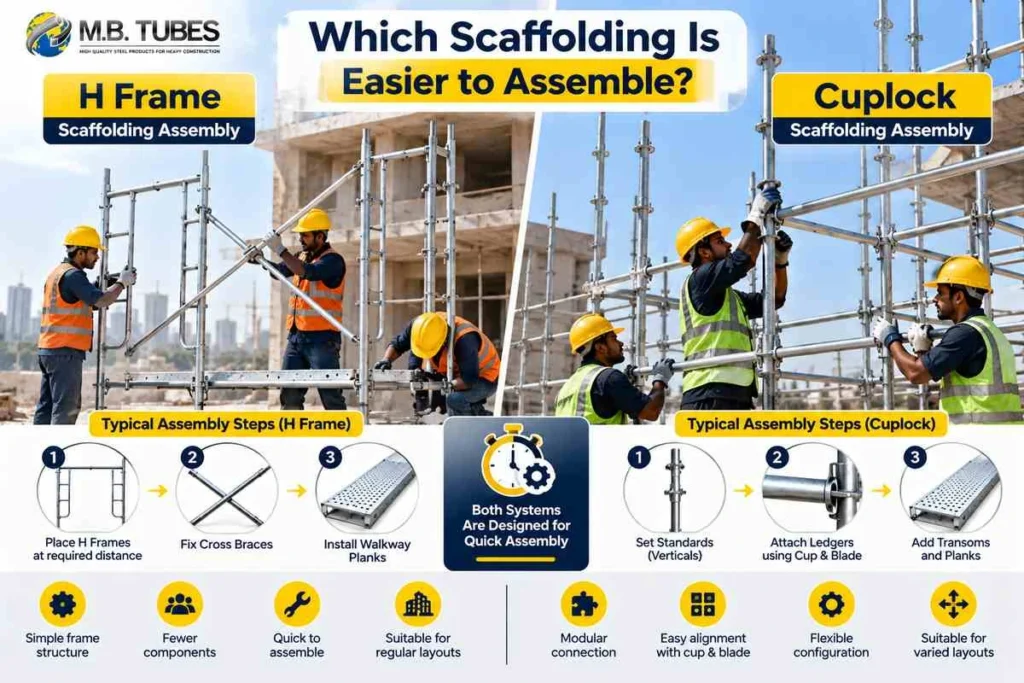
Which Scaffolding Is Easier to Assemble?
Both systems are designed around repeatable components, but their assembly methods differ.
H Frame Scaffolding uses prefabricated frames connected through compatible braces and supporting components.
Cuplock Scaffolding uses standards, ledgers, and locking connections to establish scaffold bays.
H Frame arrangements can be straightforward for regular building elevations, while Cuplock’s modular connections may simplify planning for varied configurations.
Actual assembly time depends on the scaffold dimensions, crew experience, access conditions, component availability, and installation requirements.
Therefore, assembly speed should not be judged only by the scaffolding type.
Which Scaffolding Is More Cost-Effective?
The lowest purchase price does not always mean the lowest project cost.
For H Frame vs Cuplock Scaffolding, compare the complete requirements rather than individual component prices.
Important cost factors include initial material quantity, accessories, transportation, installation, dismantling, storage, maintenance, and planned reuse.
For repetitive façade projects, H Frame Scaffolding may offer a practical material arrangement.
For contractors handling different project types, Cuplock Scaffolding may provide value through its adaptable modular components.
The better comparison is:
Total Project Cost = Material Cost + Handling + Installation + Maintenance + Reuse Requirements
Actual costs should be evaluated using equivalent specifications and complete component schedules.
How to Choose Between H Frame and Cuplock Scaffolding
Before purchasing, prepare a clear project requirement.
Project selection checklist
- Identify the construction or maintenance application.
- Confirm working height, length, and width.
- Evaluate building geometry and site conditions.
- Determine platform and access requirements.
- Establish intended loading and design requirements.
- Check component compatibility and availability.
- Compare complete quotations and future reuse.
For straightforward, repetitive access, consider H Frame Scaffolding. For adaptable modular layouts, evaluate Cuplock Scaffolding.
The final configuration should be verified by a competent scaffold designer or qualified person as required by the project.
H Frame and Cuplock Scaffolding from M.B. Tubes
M.B. Tubes offers H Frame Scaffolding and Cuplock Scaffolding as part of its construction and industrial scaffolding product range.
Related products include scaffolding pipes, walkway planks, adjustable base jacks, U Head Jacks, props, spans, and scaffolding accessories.
Buyers can prepare their requirements according to project dimensions, application, component quantities, and technical specifications.
Choosing compatible components for a properly planned system is more important than purchasing individual scaffolding materials without considering the complete configuration.
Conclusion
The choice between H Frame vs Cuplock Scaffolding depends on the work—not simply the popularity of either system.
H Frame Scaffolding can be practical for regular building elevations, plastering, painting, and maintenance. Cuplock Scaffolding offers modular flexibility for construction, industrial, and infrastructure applications.
Before ordering, assess the project layout, working height, intended loading, component compatibility, and total cost.
Choose the system that fits your project requirements, supports an appropriately designed configuration, and provides practical value throughout its intended use.
Frequently Asked Questions
What is the main difference between H Frame and Cuplock Scaffolding?
H Frame Scaffolding uses prefabricated H-shaped frames connected with braces. Cuplock Scaffolding uses vertical standards and horizontal ledgers joined through a cup-and-blade mechanism. Their main differences involve structural arrangement, connection method, and configuration flexibility.
Which scaffolding is better for plastering and painting?
H Frame Scaffolding is often practical for plastering and painting on relatively regular building elevations. Cuplock Scaffolding can also be used, especially when the work area requires a more adaptable arrangement.
Is Cuplock Scaffolding stronger than H Frame Scaffolding?
Not necessarily. Scaffold strength and load capacity depend on the specific components, configuration, bracing, foundation, connections, and engineering design. Neither system should be considered stronger without comparing verified technical specifications.
Can Cuplock Scaffolding be used for industrial maintenance?
Yes. Cuplock Scaffolding is commonly used for suitable industrial access and maintenance applications. Its modular configuration can help accommodate varied work areas, subject to proper scaffold planning and design.
Which scaffolding system should I buy for multiple projects?
Lorem ipsum dolor sit amet, consectetur adipiscing elit. Ut elit tellus, luctus nec ullamcorper mattis, pulvinar dapibus leo.