
Base Jack vs U Head Jack: What’s the Difference and Which One Do You Need?
On a construction site, a Base Jack and a U Head Jack can look like closely related scaffolding accessories. Both usually have a threaded stem and an adjustment nut, and both help fine-tune height. But they are designed for very different positions and jobs.
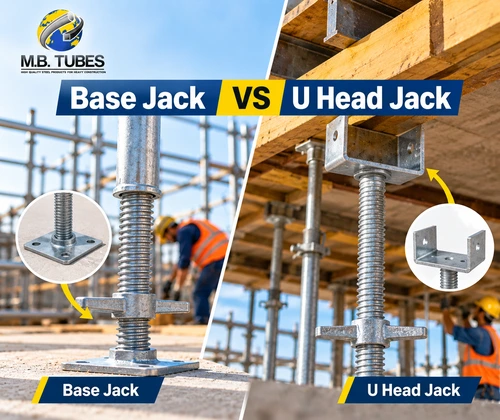
The simplest way to understand Base Jack vs U Head Jack is this: a Base Jack normally works at the bottom of the scaffolding system, while a U Head Jack is generally positioned at the top of a support system to receive beams or formwork members.
For contractors, site engineers and procurement teams, knowing this difference matters. Ordering the wrong component can create compatibility issues, delays and unnecessary rework.
This guide explains how both components work, where they are commonly used and what buyers should check before placing an order.
What Is a Base Jack?
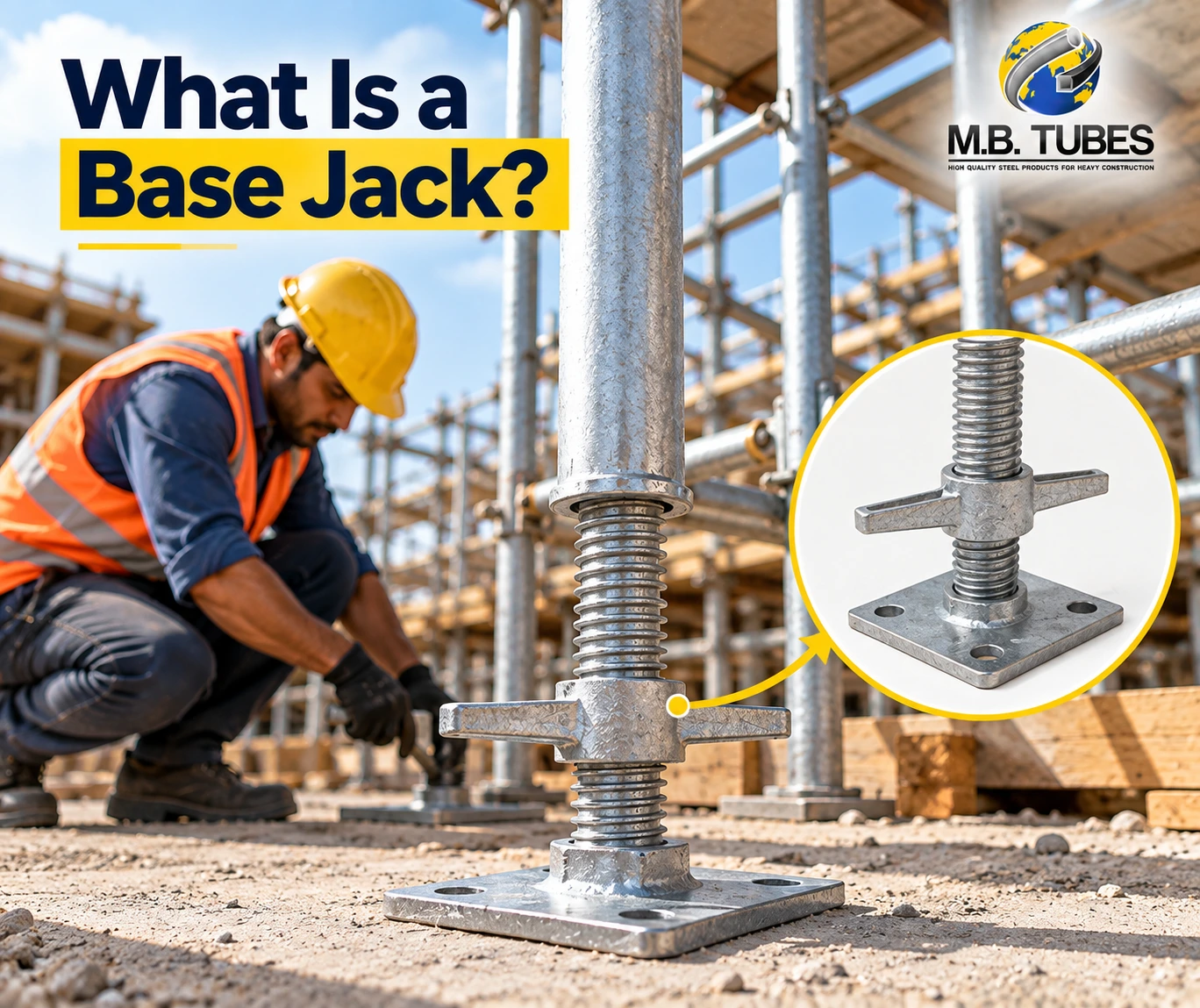
A Base Jack, also called an Adjustable Base Jack, is an adjustable scaffolding component normally installed underneath a vertical scaffold standard.
Its typical construction includes a threaded rod, an adjustment nut and a flat base plate. By turning the nut, the effective support height can be adjusted within the limits of the particular component and scaffolding system.
Construction surfaces are not always perfectly level. A properly specified Base Jack helps accommodate small differences in elevation and establish the scaffold at the required level.
A Base Jack is commonly associated with:
- Scaffolding base adjustment
- Levelling compatible scaffold standards
- Temporary support arrangements
- Construction and maintenance scaffolding
- Modular scaffolding systems
However, a Base Jack should not be viewed as a solution for unsuitable ground. Ground condition, bearing requirements, sole boards or other foundation provisions need to be considered according to the scaffold design and site conditions.
What Is a U Head Jack?
A U Head Jack, sometimes called a U Jack, is another adjustable scaffolding or formwork component, but its function is different.
Instead of a flat plate at the bottom, it has a U-shaped head or cradle. This configuration provides a seating point for compatible horizontal members such as timber beams, steel channels or other formwork/support members.
U Head Jacks are generally installed at the top of vertical scaffolding or shoring supports. The threaded stem and adjustment nut allow the top support elevation to be fine-tuned.
They are commonly associated with:
- Slab formwork
- Beam support
- Shoring systems
- Centering work
- Formwork support
- Temporary structural support arrangements
The U-shaped head is the important distinction: it is intended to receive and position a compatible member at the top rather than form the ground-level base of the scaffold.
Base Jack vs U Head Jack: Quick Comparison
For buyers, the difference becomes much easier to understand when the two are compared directly.
Feature | Base Jack | U Head Jack |
Typical Position | Bottom of scaffolding | Top of support system |
Head Design | Flat base plate | U-shaped head |
Main Purpose | Base levelling and adjustment | Supporting/positioning beams or formwork |
Adjustment | Threaded height adjustment | Threaded height adjustment |
Typical Use | Scaffold base | Formwork and top support |
Contact Point | Supporting surface/base arrangement | Beam, channel or compatible member |
Also Known As | Adjustable Base Jack, Screw Jack Base | U Jack, Adjustable U Head Jack |
Both components provide adjustment, but their location and interface with the rest of the system are different.
The Easiest Way to Remember the Difference
If technical terminology starts becoming confusing, think about the scaffolding system vertically.
At the bottom:
The scaffold needs a properly designed base and level adjustment. This is where a Base Jack is typically used.
At the top:
A support arrangement may need to receive a beam, channel or formwork member while allowing height adjustment. This is where a U Head Jack is typically used.
So, when comparing Base Jack vs U Head Jack, remember:
Base Jack = Bottom adjustment
U Head Jack = Top member support
This distinction is more useful than trying to choose between them based on appearance alone.
Why Is a Base Jack Important in Scaffolding?
Imagine erecting scaffolding on a slab where one support point is slightly higher than another.
Without an appropriate adjustment method, maintaining the required scaffold level can become difficult.
An adjustable Base Jack provides controlled vertical adjustment at individual support points. Its flat base plate also forms the interface through which the support meets the surface or specified base arrangement.
But there is an important limitation.
A Base Jack should not be excessively extended simply to compensate for poor ground preparation. The scaffold should be erected according to its design, manufacturer requirements and applicable site procedures.
The jack is an adjustment component, not a substitute for proper foundation and scaffold planning.
Why Does a U Head Jack Have a U-Shaped Top?
The shape tells you a lot about its job.
A U Head Jack needs to receive a compatible beam or horizontal support member. The U-shaped cradle provides a defined seating area for that member at the top of the support system.
This makes the component useful in formwork and shoring arrangements where horizontal members need to be supported at a controlled elevation.
The threaded portion allows fine adjustment, while the U-head provides the upper interface.
However, the dimensions of the supported member and U-head must be compatible. Buyers should not assume that every U Head Jack will fit every beam or support arrangement.
Can a Base Jack and U Head Jack Be Used Together?
Yes, in some compatible temporary support and formwork configurations, both may form part of the same vertical support arrangement.
Consider a simplified support line:
Supporting Surface → Base Jack → Vertical Support System → U Head Jack → Beam/Formwork
Here, the Base Jack provides adjustment at the lower end, while the U Head Jack provides an adjustable seating point at the upper end.
This does not mean that every scaffolding setup requires both components. The correct configuration depends on the scaffolding/formwork design and application.
Are Base Jacks and U Head Jacks Interchangeable?
Generally, they should not be treated as interchangeable components.
Although the threaded stems may look similar, their end configurations serve different purposes.
A Base Jack has a plate intended for the lower support position.
A U Head Jack has a cradle intended to receive a compatible member at the upper support position.
Using one simply because the other is unavailable ignores the intended interface and complete system design.
For procurement teams, this means the purchase order should clearly state whether the requirement is for a Base Jack or U Head Jack rather than simply writing “scaffolding jack.”
What Specifications Should Buyers Check?
This is where a professional enquiry differs from a basic price request.
When purchasing an Adjustable Base Jack or U Head Jack, buyers should confirm the specifications required by their project and compatible scaffolding system.
Important factors can include:
Threaded rod diameter:
Confirm the required diameter instead of assuming all scaffold jacks are identical.
Rod length:
The required length should match the system and adjustment requirement.
Solid or hollow construction:
Adjustable jacks are available in different constructions, so specify the required type.
Adjustment requirement:
Confirm the allowable adjustment range for the selected system rather than assuming the full threaded length can be used.
Base plate dimensions:
For Base Jacks, confirm the required plate configuration.
U-head dimensions:
For U Head Jacks, check whether the head suits the member it needs to support.
Jack nut:
The nut and thread are part of the adjustment mechanism and should be considered as part of the complete component.
Surface finish:
Confirm the required finish based on the project specification and operating environment.
Compatibility:
Most importantly, make sure the jack is suitable for the scaffolding, shoring or formwork system in which it will be installed.
Don’t Buy a Scaffolding Jack by Price Alone
Suppose Supplier A quotes a lower price for a Base Jack than Supplier B.
That does not automatically mean both quotations are for equivalent products.
The rod diameter, rod length, plate dimensions, construction, finish and other specifications may differ.
The same applies to U Head Jacks.
Instead of comparing:
₹ per piece vs ₹ per piece
first compare:
Specification vs Specification
and then compare the price.
This makes procurement more meaningful and reduces the possibility of receiving components that do not match the project requirement.
Base Jack vs U Head Jack: Which One Should You Choose?
You don’t really choose a winner between the two.
You choose the component according to where and how it will be used.
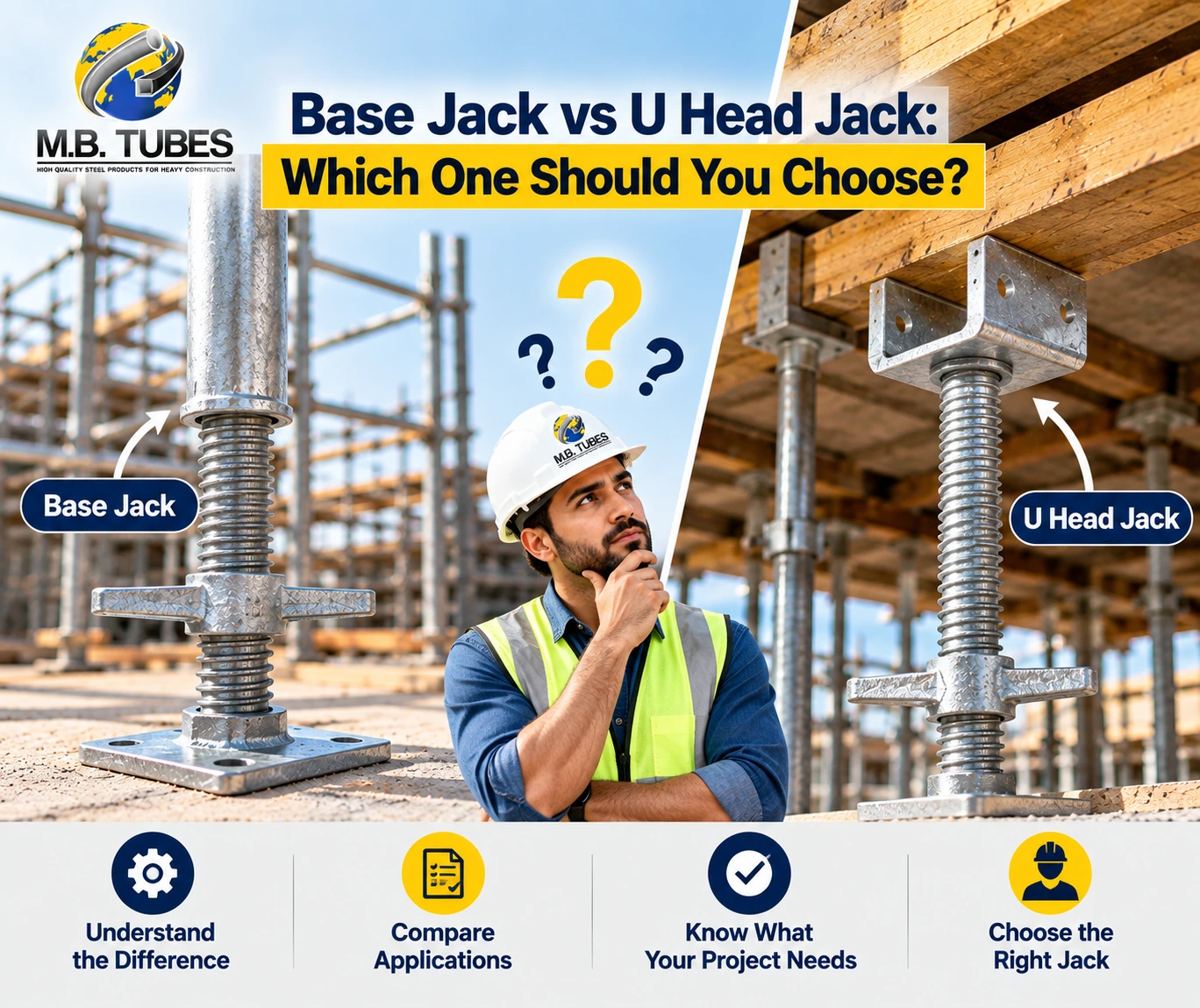
Choose a Base Jack when the approved scaffold configuration requires adjustable support at the bottom.
Choose a U Head Jack when the approved support/formwork configuration requires an adjustable U-shaped seating point for a beam or compatible horizontal member at the top.
For some support arrangements, both may be required.
This is why the better purchasing question is not:
“Which is better: Base Jack or U Head Jack?”
It is:
“What does this support point need to do?”
Once that is clear, the choice becomes much easier.
Common Buying Mistakes to Avoid
A few simple mistakes can turn a small scaffolding accessory into a procurement problem.
Ordering only as “jack”: The supplier may not know whether you need a Base Jack, U Head Jack or another configuration.
Ignoring dimensions: Similar-looking components can have different rod, plate and head dimensions.
Assuming compatibility: Never assume a jack fits an existing system because it looks similar.
Using price as the only comparison: Compare technical requirements first.
Not stating quantity and application: A clearer enquiry helps the supplier understand the project requirement.
Ignoring the complete system: Scaffolding accessories should be selected as parts of a designed system, not isolated products.
A Better Way to Request a Quotation
Instead of sending:
“Need 500 scaffolding jacks. Send rate.”
A more useful enquiry would identify:
Product: Base Jack / U Head Jack
Rod Diameter: As per requirement
Rod Length: As per requirement
Type: Solid/Hollow, where applicable
Base/U-Head Dimensions: As specified
Surface Finish: Required finish
Quantity: Required pieces
Scaffolding/Formwork System: Applicable system
Application: Project use
Delivery Location: Project destination
This gives the manufacturer or supplier enough information to discuss the right product rather than guessing from an incomplete description.
Base Jack and U Head Jack from M.B. Tubes
For construction, scaffolding and formwork projects, adjustable jacks should be selected according to the complete project requirement rather than product name alone.
When sourcing Base Jacks and U Head Jacks, buyers should communicate the required dimensions, configuration, quantity, finish and intended application.
M.B. Tubes / Khambati Steel can evaluate enquiries for scaffolding and formwork accessories based on the project specifications. For existing scaffolding systems, providing details of the current components can also help clarify compatibility before bulk procurement.
Conclusion
The Base Jack vs U Head Jack comparison becomes straightforward once you focus on their position and purpose.
A Base Jack normally provides adjustable support at the bottom of a scaffolding system. A U Head Jack provides an adjustable U-shaped support point at the top for compatible beams or formwork members.
Neither is universally “better,” and they should not be treated as substitutes simply because their threaded mechanisms look similar.
For a successful purchase, define the application, dimensions, configuration, system compatibility and quantity before requesting prices. This helps contractors and procurement teams order components that actually match the project rather than trying to solve compatibility problems after delivery.
Frequently Asked Questions
What is the main difference between Base Jack and U Head Jack?
The main Base Jack vs U Head Jack difference is their typical position and function. A Base Jack is normally installed at the bottom of scaffolding for base adjustment and levelling, while a U Head Jack is typically installed at the top to receive compatible beams or formwork members.
What is a Base Jack used for in scaffolding?
An Adjustable Base Jack is used beneath compatible scaffold standards to provide controlled vertical adjustment and help establish the scaffold at the required level. It normally consists of a threaded stem, adjustment nut and flat base plate.
What is a U Head Jack used for?
A U Head Jack is typically used at the upper end of scaffolding, shoring or formwork support arrangements. Its U-shaped head provides a seating point for compatible timber beams, steel members or other specified horizontal supports.
Can Base Jack and U Head Jack be used together?
Yes. Some compatible support systems can use a Base Jack at the bottom and a U Head Jack at the top, providing adjustment at both ends of the vertical support arrangement. Whether both are required depends on the actual scaffolding or formwork design.
What should I check before buying Base Jacks or U Head Jacks?
Lorem ipsum dolor sit amet, consectetur adipiscing elit. Ut elit tellus, luctus nec ullamcorper mattis, pulvinar dapibus leo.