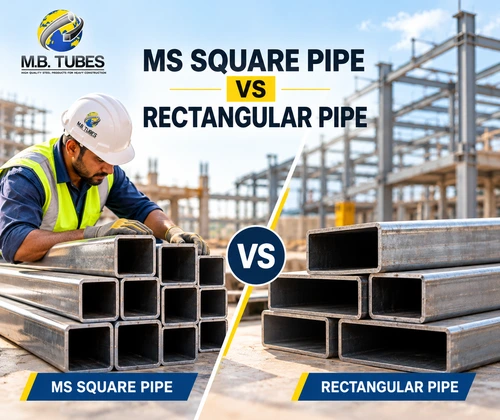

MS Square Pipe vs Rectangular Pipe: Which One Should You Choose?
Steel sections may look simple when stacked at a fabrication yard, but choosing the right shape can make a noticeable difference to a project.
Two of the most commonly considered options are MS Square Pipe and MS Rectangular Pipe. Both are widely used in construction, fabrication, industrial structures, gates, frames, sheds and other applications. However, their shape affects how they fit into a design and how they behave when loads act in different directions.
So, should you choose a square pipe or a rectangular pipe?
There is no single answer for every project. The better choice depends on the load direction, structural design, dimensions, wall thickness, fabrication requirement and intended application.
This guide explains the practical differences between MS square and rectangular pipes so that contractors, fabricators, engineers and buyers can make a more informed selection.
What Is an MS Square Pipe?
An MS Square Pipe, commonly referred to in structural applications as a Square Hollow Section (SHS), has equal outside dimensions on all four sides.
For example, a section may be specified as:
50 × 50 mm
The equal-sided geometry makes the section convenient for applications where a balanced shape, straightforward alignment and clean appearance are important.
MS square pipes are commonly considered for applications such as:
- Structural frames
- Gates and fencing
- Railings
- Industrial fabrication
- Support structures
- Furniture frames
- Sheds and canopies
- General engineering work
Because an SHS has the same outside dimension in both principal directions, its geometry is symmetrical. This can be useful when the design calls for similar sectional behavior about either principal axis.
What Is an MS Rectangular Pipe?
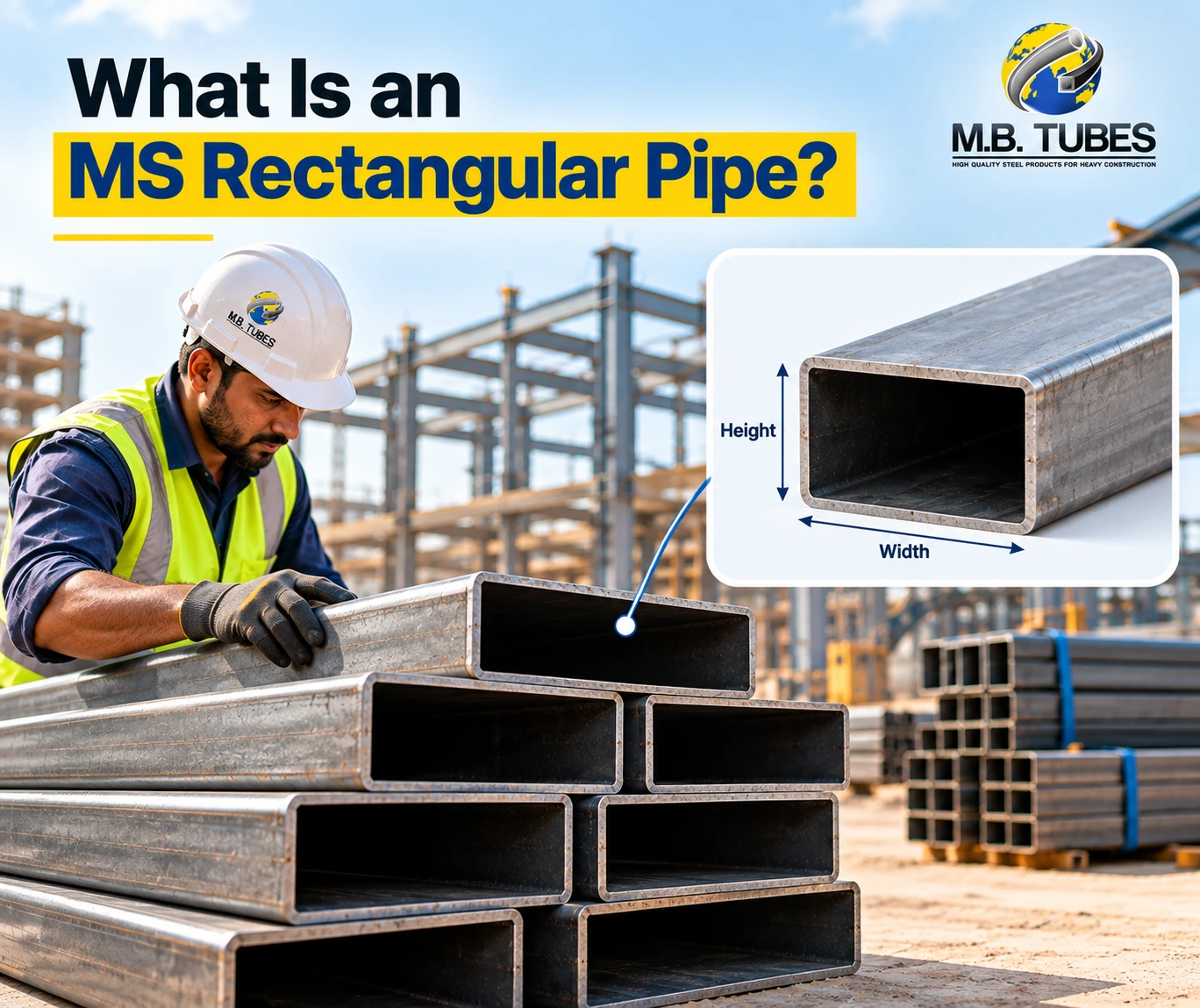
An MS Rectangular Pipe, or Rectangular Hollow Section (RHS), has unequal width and height.
For example:
100 × 50 mm
Unlike a square section, a rectangular section has a long side and a short side. This gives designers the ability to orient the section according to the direction in which bending resistance is required.
RHS sections are commonly used for:
- Beams
- Trusses
- Purlins
- Industrial racks
- Structural frames
- Mezzanine structures
- Fabricated equipment
- Sheds
- Support members
The orientation of a rectangular section matters because its sectional properties differ about principal axes.
MS Square Pipe vs Rectangular Pipe: Key Differences
Although both products are hollow steel sections, their geometry gives them different design characteristics.
Factor | MS Square Pipe | MS Rectangular Pipe |
Shape | Equal width and height | Width and height are different |
Common term | SHS | RHS |
Geometry | Symmetrical | Directional |
Typical selection | Frames, columns, gates, general fabrication | Beams, purlins, racks, trusses |
Orientation | Less orientation-sensitive geometrically | Orientation can be important |
Appearance | Balanced, uniform profile | Wider, flatter profile |
Fabrication | Flat surfaces support straightforward connections | Flat surfaces also support easy fabrication |
Structural selection | Useful where similar geometry is wanted on both axes | Useful where sectional depth is needed in a particular direction |
This is a general comparison rather than a structural design rule. The final section should be selected using the project’s engineering calculations and applicable specifications.
Which Is Stronger: MS Square Pipe or Rectangular Pipe?
This is one of the most common questions buyers ask, but shape alone does not determine which pipe is stronger.
Strength and structural performance can depend on:
Section dimensions + wall thickness + steel grade + member length + orientation + connection details + type and direction of loading.
For example, a rectangular hollow section can provide greater bending stiffness about one axis when its deeper dimension is oriented appropriately. A square hollow section has symmetrical geometry and therefore the same geometric section properties about its two principal centroidal axes.
That does not mean every RHS is stronger than every SHS—or vice versa.
Comparing two pipes simply by looking at their shape can therefore lead to the wrong conclusion.
For structural applications, the required section should be determined by the structural design rather than a general “square is stronger” or “rectangle is stronger” rule.
When Should You Choose an MS Square Pipe?
An MS Square Pipe can be a practical choice when the design benefits from an equal-sided profile.
1. Structural Frames
Square hollow sections can work well in frames where a symmetrical cross-section is desirable.
2. Gates and Railings
Their clean geometry makes square sections popular for gates, fencing, railings and visible fabrication.
3. Columns and Supports
Depending on the structural design, square hollow sections may be specified for columns and support members.
4. Industrial Fabrication
Machine frames, work tables, equipment supports and fabricated structures often use square sections because their flat surfaces make positioning and connections convenient.
5. Architectural Applications
The simple, uniform shape can also provide a clean visual finish where steel members remain visible.
So, if your search is for an MS square pipe for construction, do not choose the size based only on appearance. Check the design load, thickness, grade and application first.
When Is an MS Rectangular Pipe More Suitable?
Rectangular sections become particularly useful when the design benefits from having greater section depth in one direction.
Beams and Horizontal Members
A designer may orient an RHS so its deeper dimension works in the direction required by the structural design.
Trusses and Purlins
Rectangular hollow sections are frequently used in fabricated roofing and structural systems.
Storage and Racking Systems
The rectangular profile can suit horizontal members, racks and industrial storage structures.
Industrial Sheds
RHS sections can be used in different parts of fabricated shed structures depending on engineering requirements.
Equipment Frames
The wider flat face may also be useful where components, plates or other fabricated parts need to be connected.
Again, the intended application alone does not establish the correct size or thickness. Structural requirements should determine the final selection.
What About MS Square Pipe Sizes and Thickness?
Searching only for “MS square pipe size” is not enough when preparing a purchase requirement.
A proper specification may need to identify:
Outside dimensions × wall thickness × length × grade × quantity × applicable standard
For example, two square sections with the same outside dimensions but different wall thicknesses are not equivalent products.
The same applies to rectangular pipes.
For structural hollow sections in India, IS 4923 covers hot- and cold-formed square and rectangular hollow steel sections for structural use. BIS documentation identifies SHS and RHS along with grades including YSt 210, YSt 240, YSt 310, YSt 355, YSt 420 and YSt 460.
The required grade, size and thickness should follow the relevant design/specification rather than being selected merely because a particular size is commonly available.
MS Square Pipe vs Rectangular Pipe for Fabrication
From a fabricator’s perspective, both shapes have an important advantage: flat faces.
Flat surfaces can make it convenient to:
- Position members
- Create welded joints
- Attach plates
- Align frames
- Drill or prepare connections where specified
- Produce clean geometric structures
But fabrication should not be considered separately from structural design.
If an RHS must be installed with a particular orientation, the fabrication drawing should make that orientation clear. With SHS, the equal-sided geometry can simplify certain layouts.
Good fabrication begins with the correct section—not with trying to make the wrong section fit the job.
How to Choose Between Square and Rectangular MS Pipe
Instead of asking, “Which one is better?”, ask these questions.
What Will the Pipe Be Used For?
A gate, column, rack, roof member and machine frame do not have the same requirements.
Start with the application.
In Which Direction Will the Main Load Act?
This can influence whether symmetrical SHS geometry or the directional sectional properties of RHS are more suitable.
What Size and Wall Thickness Does the Design Require?
Never compare sections based only on outside dimensions.
What Steel Grade Is Specified?
Material grade affects mechanical properties and should match the project requirement.
How Will the Section Be Connected?
Consider welding, bolting, plates, brackets and other connections specified in the design.
Will the Steel Be Exposed?
Surface protection and maintenance requirements should be considered for the actual environment.
Does the Product Meet the Required Standard?
For structural square and rectangular hollow sections, verify the applicable standard and project specification before ordering. BIS identifies IS 4923 for structural SHS and RHS.
Common Mistakes When Buying MS Square Pipes
Even experienced buyers can create procurement problems when the purchase order is too generic.
Buying only by size: “50 × 50 pipe” does not communicate every required parameter.
Ignoring wall thickness: Outside dimensions alone are insufficient.
Choosing by price alone: Two quotations may not represent identical specifications.
Not mentioning the application: Giving the supplier context can help clarify the requested product.
Confusing structural hollow sections with other pipe specifications: Different steel tube/pipe applications can fall under different standards.
Ignoring grade: For structural work, material grade can be an important part of the specification.
Replacing SHS with RHS without checking the design: Similar-looking steel sections should not automatically be treated as interchangeable.
A clear purchase enquiry reduces these ambiguities.
A Better Way to Request an MS Square Pipe Quotation
Instead of sending:
“Send price for square pipe.”
A professional enquiry should ideally communicate:
Product: MS Square Hollow Section
Outside Size: As required
Wall Thickness: As required
Grade: As specified
Length: Required length
Standard: Applicable standard/project specification
Quantity: Required quantity
Application: Construction/fabrication/project use
Delivery Location: Project destination
The same approach works for rectangular hollow sections.
This makes quotation comparison much more meaningful because suppliers are pricing against a defined requirement.
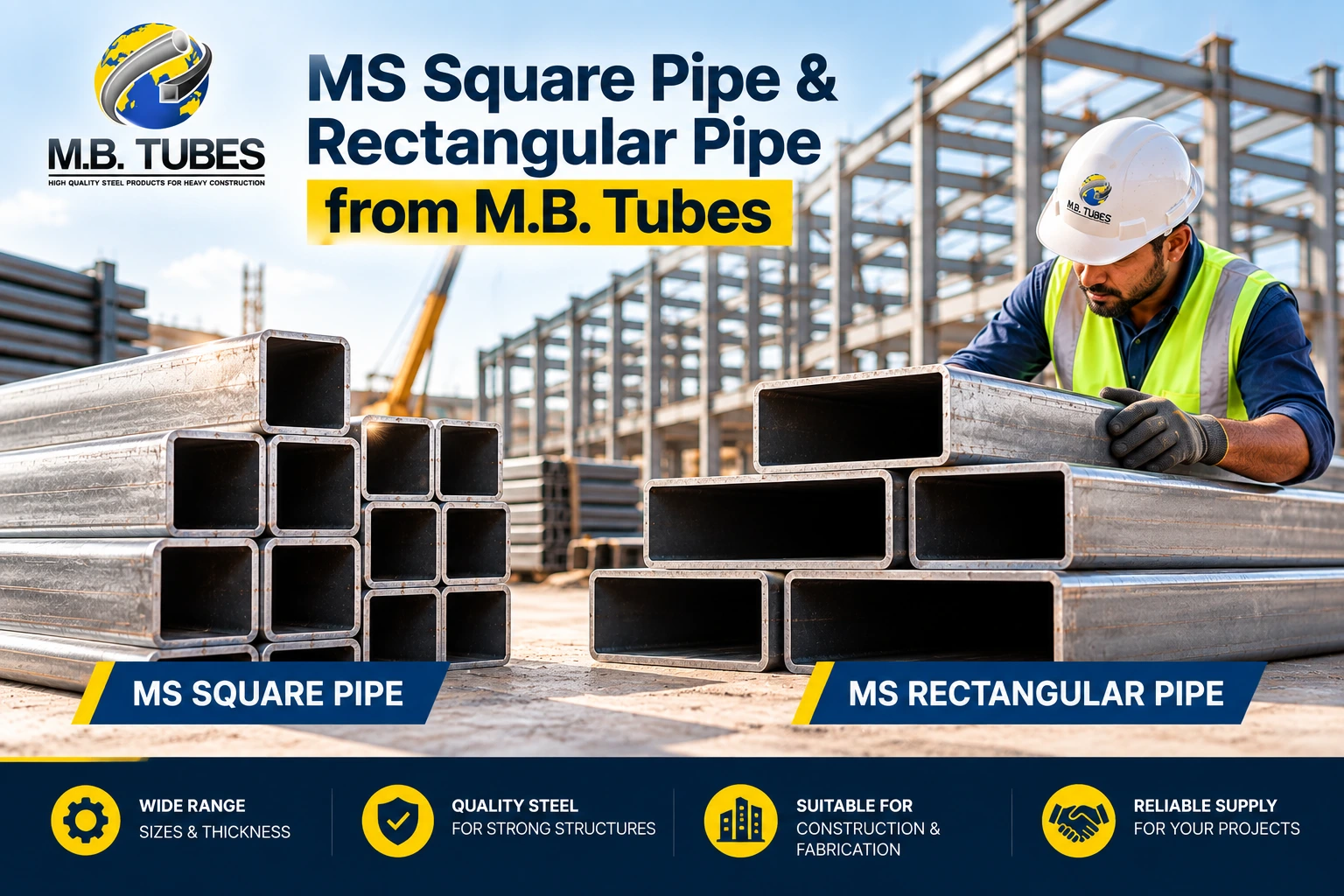
MS Square Pipes for Construction and Industrial Projects
MS square and rectangular hollow sections are versatile because the hollow profile combines useful structural geometry with flat external surfaces.
However, their versatility should not encourage one-size-fits-all purchasing.
For a fabrication job, the priority may be dimensions, appearance and ease of connection. For a structural member, design loads, section properties, grade and compliance become especially important.
That is why the right question is not simply:
“Square pipe or rectangular pipe?”
It is:
“Which section meets the requirements of this particular member in this particular project?”
Once that is clear, procurement becomes much easier.
MS Square Pipe & Rectangular Pipe from M.B. Tubes
For construction and industrial requirements, buyers should select MS hollow sections according to the required shape, dimensions, thickness, grade, quantity and application.
M.B. Tubes / Khambati Steel serves steel requirements for construction and industrial projects. When requesting MS Square Pipe or rectangular hollow sections, sharing complete specifications helps ensure that the enquiry is evaluated against the actual project requirement.
For structural applications, the final section selection should always follow approved engineering drawings, project specifications and applicable standards.
Conclusion
The difference between an MS Square Pipe and MS Rectangular Pipe is more important than simply square versus rectangle.
Square hollow sections offer a balanced, symmetrical profile that works well across many frames, supports, gates and fabrication applications. Rectangular hollow sections provide different section properties along their two axes, which can be advantageous for beams, purlins, racks and other direction-sensitive applications.
But the final decision should consider load, dimensions, wall thickness, grade, orientation, connection details and project specifications.
Before ordering MS square or rectangular pipes in bulk, define these requirements clearly. It helps avoid specification mismatches and makes it easier to compare products and quotations on a like-for-like basis.
For MS Square Pipe and structural steel requirements, contact M.B. Tubes / Khambati Steel with your project specifications and required quantity.
Frequently Asked Questions
What is an MS Square Pipe?
An MS Square Pipe is a mild-steel hollow section with equal outside width and height. In structural applications it is commonly called a Square Hollow Section or SHS. It is used in frames, gates, railings, supports, fabrication and various construction applications.
What is the difference between MS Square Pipe and rectangular pipe?
The main geometric difference is that an MS square pipe has equal side dimensions, while a rectangular pipe has unequal width and height. Square sections provide symmetrical geometry, while rectangular sections can provide different bending properties depending on their orientation.
Which is stronger: square pipe or rectangular pipe?
Neither shape is universally stronger. Performance depends on section dimensions, wall thickness, steel grade, member length, orientation and loading. RHS can offer greater bending stiffness about one axis when appropriately oriented, while SHS provides symmetrical geometry. Structural calculations should determine the correct section.
What are MS Square Pipes used for?
Common MS Square Pipe uses include structural frames, gates, fencing, railings, columns, supports, industrial fabrication, furniture frames, sheds and equipment structures. The appropriate size, thickness and grade depend on the specific application.
Which IS standard applies to MS Square and Rectangular Hollow Sections?
In India, IS 4923 covers hot- and cold-formed square and rectangular hollow steel sections intended for structural use. Buyers should verify the applicable grade and complete project specification before ordering.