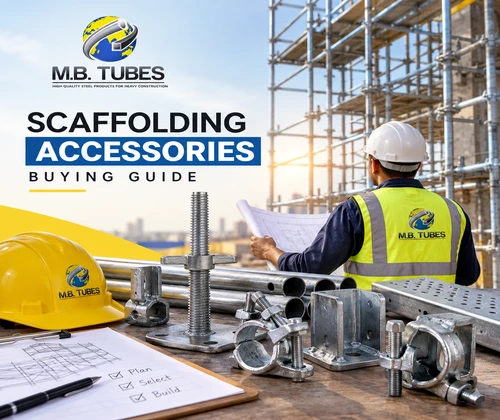

Scaffolding Accessories Buying Guide: What to Check Before You Order
Buying scaffolding accessories may look straightforward until the material reaches the construction site.
A coupler that does not match the tube, a base jack with the wrong specification, missing joint pins, or an incorrect quantity of clamps can slow down an otherwise well-planned project. This is why scaffolding accessories should not be treated as small add-ons to the main scaffolding system. They are working components that help connect, adjust, support and complete the system.
This Scaffolding Accessories Buying Guide explains what contractors, procurement teams and project managers should check before placing an order—from system compatibility and specifications to quantity planning, quality inspection and supplier selection.
What Are Scaffolding Accessories?
Scaffolding accessories are components used with the main scaffolding structure to connect members, provide adjustment, create working platforms and support different site configurations.
Depending on the scaffolding or formwork system, the requirement may include:
- Fixed and swivel couplers
- Joint pins and sleeve couplers
- Base plates
- Adjustable base jacks
- U-head jacks
- Walkway planks
- Ladder clamps
- Beam and girder couplers
- Tie rods
- Wing nuts and anchor nuts
- Bracing and other connecting components
The important point is that not every accessory belongs in every scaffolding setup.
A buyer should therefore start with the system and application—not with a catalogue.
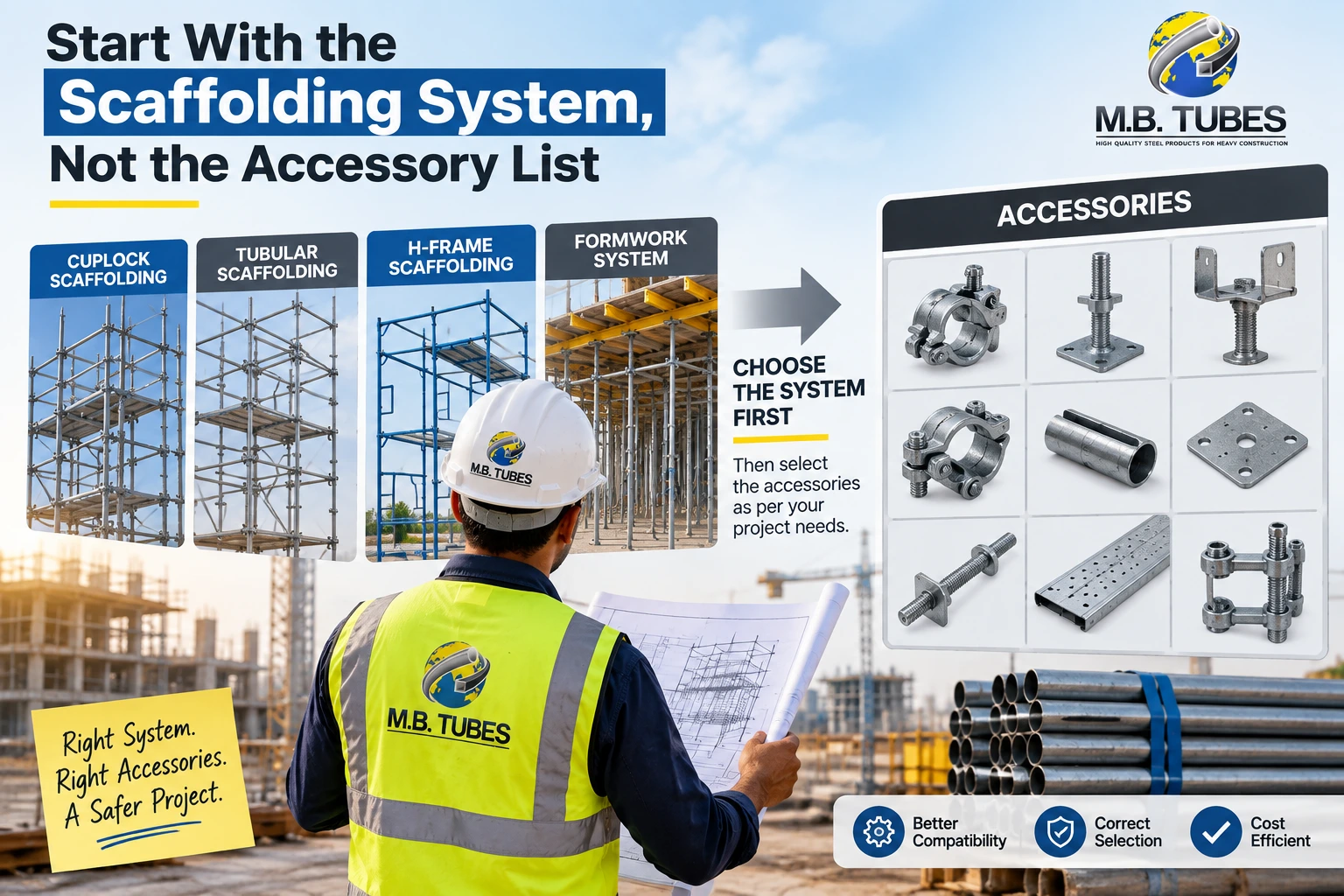
Start With the Scaffolding System, Not the Accessory List
One of the easiest procurement mistakes is preparing a list of accessories before confirming exactly how the scaffolding will be used.
First identify whether the project is using a Cuplock, tubular, H-frame or formwork-based system. Then consider the actual work being performed.
For example, scaffolding required for exterior building work may have different accessory requirements from temporary support for slab formwork. Similarly, an industrial maintenance project can involve access conditions that differ considerably from a straightforward residential construction site.
A better buying sequence is:
Project Application → Scaffolding System → Configuration → Accessories → Quantity
This simple approach can prevent a large amount of unnecessary ordering.
Which Scaffolding Accessories Do You Actually Need?
Different accessories solve different site problems. Understanding their function makes purchasing easier.
Accessory | Typical Function | What to Confirm |
Fixed/Right-Angle Coupler | Connects tubes at fixed angles | Tube compatibility and connection requirement |
Swivel Coupler | Allows angled tube connections | Movement, locking and intended configuration |
Joint Pin/Sleeve Coupler | Connects scaffold tubes | Tube dimensions and joint type |
Adjustable Base Jack | Helps with base-level adjustment | Dimensions, adjustment range and base configuration |
U-Head Jack | Provides top support for beams/formwork | Head dimensions and intended support |
Base Plate | Distributes support at scaffold base | Plate and system specification |
Walkway Plank | Creates a working/access platform | Dimensions, surface and project requirement |
Ladder Clamp | Secures access components | Compatibility with the access arrangement |
Beam/Girder Coupler | Used for specific structural connections | Connection and project specification |
Tie Rod/Wing Nut | Used in formwork applications | Matching dimensions and formwork requirement |
This table should be treated as a starting point. Final selection should always follow the project design, scaffold configuration and applicable technical/safety requirements.
Compatibility Comes Before Price
Imagine receiving hundreds of accessories at a project site only to discover that they do not properly match the scaffolding already in use.
Even when two products look similar, differences in dimensions, thread specifications, connection style or system design can matter.
Before requesting a quotation, share details such as:
Scaffolding system: Cuplock, tubular, frame or formwork
Existing component dimensions: where applicable
Accessory type: exact component required
Quantity: required units/pieces
Application: access, support, formwork, maintenance, etc.
Finish: where a particular finish is specified
Project location: for logistics planning
Delivery schedule: one-time or phased requirement
If replacing or expanding an existing system, supplying drawings, specifications or clear product details can make the discussion with the manufacturer much more precise.
Don’t Buy by Name Alone—Check the Specification
“Need 500 base jacks” is not a complete purchase requirement.
The same principle applies to couplers, U-head jacks, planks and other accessories.
Depending on the component, buyers may need to confirm:
- Material
- Dimensions
- Thickness
- Tube diameter compatibility
- Thread dimensions
- Plate/head dimensions
- Surface finish
- Adjustment requirement
- Weight or other specified parameters
- Quantity
- Applicable project specification
This becomes particularly important in bulk procurement because a small specification mismatch multiplied across hundreds of pieces can become a significant site problem.
Look Beyond How the Product Appears
A clean finish is useful, but appearance alone does not tell you whether a scaffolding accessory is suitable for the intended job.
During evaluation, pay attention to factors relevant to that particular component. These can include dimensional consistency, weld condition, thread movement, locking action, deformation, surface condition and compatibility with mating components.
For adjustable products, adjustment should function as intended.
For connecting components, the connection mechanism should be checked.
For platform components, dimensions and physical condition should be reviewed against the project requirement.
The goal is simple: inspect the features that affect how the accessory will actually be used.
How Should You Plan Accessory Quantity?
Buying too few accessories can interrupt erection work. Buying far too many ties up project capital and creates additional storage and material-handling work.
Instead of estimating accessories as a percentage of the main scaffolding order, calculate them from the actual scaffold configuration wherever possible.
Consider:
- Number of scaffold bays or sections
- Number of connections per configuration
- Required working levels
- Access arrangements
- Base and top support requirements
- Formwork requirements, where applicable
- Project phasing
- Approved contingency or replacement requirement
For a large project, dividing the requirement into immediate, next-phase and reserve quantities can also make procurement easier to control.
The Cheapest Accessory May Not Create the Lowest Project Cost
Procurement teams naturally compare prices. But the lowest unit price does not automatically mean the lowest overall cost.
Consider two quotations.
One may offer a lower price but create issues with inconsistent dimensions, replacement requirements, delivery delays or incompatibility.
Another may cost slightly more per unit but arrive according to specification and project schedule.
The meaningful comparison is therefore not just:
Price per Piece
It is:
Product Specification + Usability + Consistency + Delivery + Replacement Risk + Price
For a construction project, downtime caused by a missing or unsuitable component can matter more than a small saving in the purchase price.
New Project vs Existing Scaffolding: Buying Is Different
This distinction is often overlooked.
For a New Scaffolding System
Accessories can be planned together with the main scaffolding configuration. This makes it easier to coordinate dimensions, quantities and delivery.
For an Existing System
Compatibility becomes even more important.
Before ordering replacement or additional components, confirm what is already at the site. Do not assume that a product with the same general name will automatically fit an existing system.
This is especially useful for projects where scaffolding stock has been purchased in different batches or from multiple sources.
Don’t Ignore Surface Condition and Site Environment
Construction environments vary.
A scaffolding accessory used for a short-duration building project may face different conditions from one repeatedly used in an industrial plant, outdoor infrastructure project or maintenance environment.
When requesting material, discuss the expected operating environment and any required surface finish with the supplier.
Storage also matters. Even correctly manufactured material can deteriorate if it is poorly stored, handled or maintained at the project site.
Ask About Delivery Before Confirming a Bulk Order
The material can be correct and still arrive at the wrong time.
For large scaffolding orders, ask:
- What quantity can be supplied?
- What is the expected dispatch schedule?
- Can material be delivered in phases?
- How will accessories be packed or identified?
- Are custom specifications possible where required?
- What information is needed before production or dispatch?
For multi-stage projects, phased delivery may be more practical than sending the entire requirement at once, particularly when site storage space is limited.
A Simple Scaffolding Accessories Buying Checklist
Before approving your next order, check these questions:
System: Which scaffolding/formwork system are we using?
Application: What job will each accessory perform?
Compatibility: Does it match the main system and existing components?
Specification: Have dimensions, material and other required parameters been confirmed?
Quantity: Is the requirement calculated from the actual configuration?
Quality: What needs to be inspected for this particular component?
Delivery: Does the supply schedule match the construction sequence?
Documentation: Are project-required documents/specifications clear?
Storage: Is there a suitable place to receive and store the material?
Supplier: Can the manufacturer understand and supply the required configuration consistently?
If these questions have clear answers, procurement becomes much more controlled.
Common Scaffolding Accessory Buying Mistakes
Many purchasing problems are surprisingly simple.
Ordering only by product name:
The name may not communicate the complete specification.
Choosing entirely on price:
A lower rate is less useful if the component does not meet the project’s requirement.
Ignoring the existing system:
This can create compatibility problems during replacement or expansion.
Estimating quantities without a configuration:
This often results in shortages or unnecessary surplus.
Ordering everything at once without checking the schedule:
Material may occupy site space long before it is needed.
Skipping receiving inspection:
Problems are easier to identify before accessories are distributed across the site.
Scaffolding Accessories from Khambati Steel & M.B. Tubes
Khambati Steel & M.B. Tubes supplies scaffolding and formwork accessories for different construction requirements. The current product range includes components for Cuplock, tubular, frame and formwork systems, with accessories such as couplers, clamps, joint pins, base plates, U-head jacks, tie rods, wing nuts, anchor nuts, walkway planks and related fittings.
Because accessory requirements can vary by project, buyers should communicate the required product type, dimensions, finish, quantity and application before placing a bulk order.
For projects involving new scaffolding as well as additional components for an existing system, a clearly defined enquiry helps both the buyer and manufacturer work from the same specification.
Final Thoughts
A good scaffolding accessories purchase starts long before the quotation arrives.
The most effective buying process connects the project requirement, scaffolding system, accessory specification, quantity and delivery plan before comparing suppliers.
Instead of asking only, “What is the price of this accessory?”, ask a more useful question:
“Is this the right accessory, in the right specification and quantity, for the way our project will actually use it?”
That one change in approach can make scaffolding procurement more organized and help reduce avoidable material and compatibility problems on site.
For scaffolding accessories and project-specific requirements, buyers can discuss their specifications with Khambati Steel & M.B. Tubes, Indore, Madhya Pradesh.
Frequently Asked Questions
What are the most commonly used scaffolding accessories?
Common accessories include couplers, clamps, joint pins, base plates, adjustable base jacks, U-head jacks, walkway planks and formwork-related fittings. The exact requirement depends on the scaffolding system, configuration and intended application.
How do I choose the right scaffolding accessories?
Start by identifying your scaffolding system and project application. Then confirm compatibility, dimensions, material, required finish, quantity and any project-specific technical requirements. Avoid selecting accessories based only on their name or appearance.
Can the same accessories be used with every scaffolding system?
Not necessarily. Scaffolding systems can have different component designs and dimensional requirements. Compatibility should be confirmed before accessories are ordered, particularly when adding material to an existing system.
What should I check when buying scaffolding accessories in bulk?
Check the complete specification, quantity calculation, dimensional consistency, relevant connection or adjustment features, delivery schedule, packaging and project documentation requirements. For an existing system, compatibility should be confirmed before bulk purchasing.
Where are scaffolding accessories commonly used?
They are used across building construction, industrial projects, infrastructure works, formwork, bridges, maintenance activities and other applications requiring temporary access or support systems.