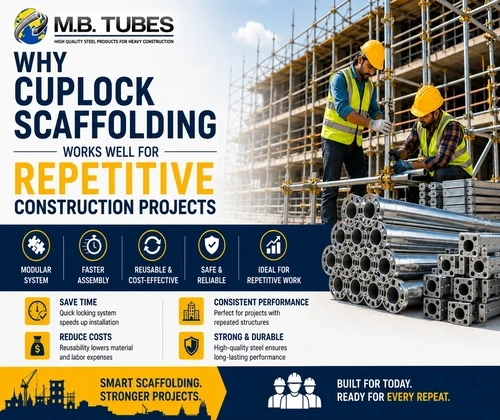

Construction projects with repeated floors, similar structural layouts, or multiple work zones need more than strong scaffolding. They need a system that can be assembled, dismantled, moved, and reused efficiently as work progresses.
This is where Cuplock scaffolding becomes particularly useful.
Its modular configuration and standardized components make it suitable for many repetitive construction activities where teams need a predictable scaffolding arrangement from one work cycle to the next.
For contractors searching for a reliable Cuplock Scaffolding Manufacturer in Madhya Pradesh, it is important to understand not only the product itself but also how the right system can support productivity, material planning, and site organization.
What Is Cuplock Scaffolding?
Cuplock scaffolding is a modular scaffolding system built around vertical standards, horizontal ledgers, and a cup-based locking connection.
Instead of relying on numerous loose nuts and bolts at every standard connection, the Cuplock mechanism allows multiple horizontal members to connect around a vertical standard through its cup arrangement.
Depending on the designed system, components may include:
- Vertical standards
- Horizontal ledgers
- Intermediate transoms
- Base jacks
- U-head jacks
- Bracing components
- Working platforms
- Stair or access components
- Other scaffolding accessories
The exact configuration should always be selected according to the project’s engineering, access, loading, and safety requirements.
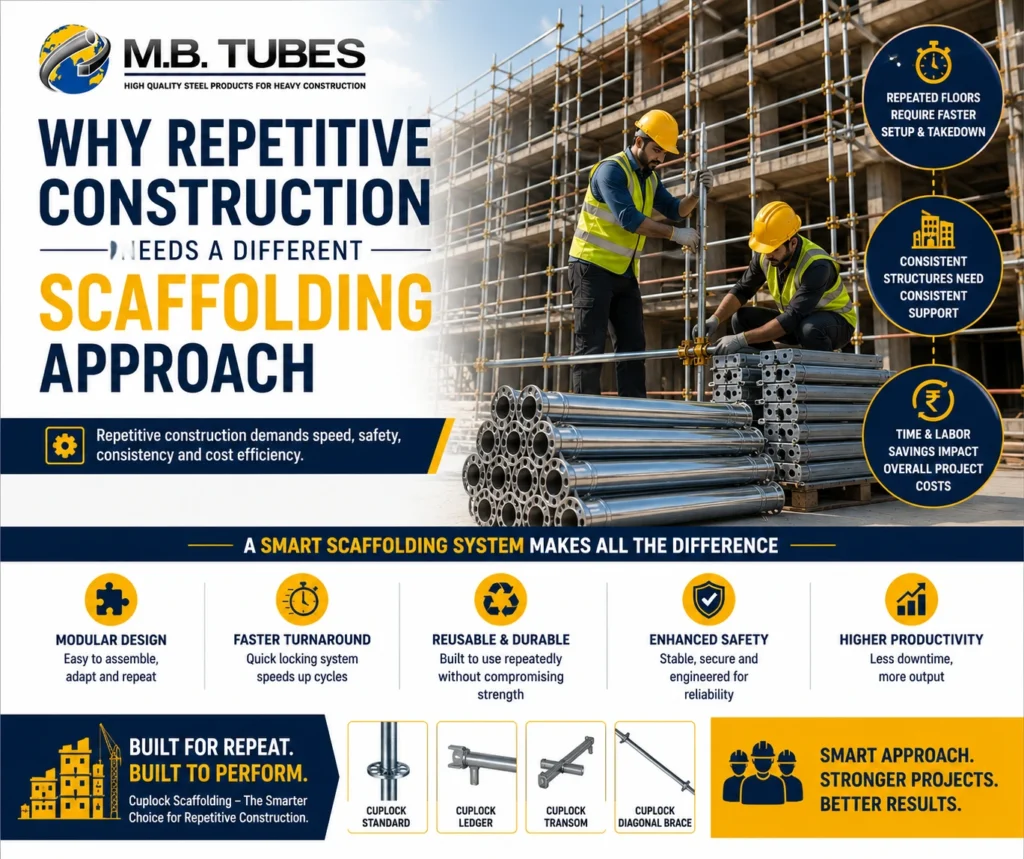
Why Repetitive Construction Needs a Different Scaffolding Approach
Imagine a multi-storey project where several floors have a similar layout.
Once work on one level is complete, the scaffolding may need to be dismantled and moved to the next level. The same process can continue repeatedly throughout the project.
If the scaffolding system is complicated to organize or contains too many non-standard components, every cycle can consume additional labour and time.
A modular system changes the workflow:
Assemble → Use → Inspect → Dismantle → Shift → Reassemble
For repetitive projects, the value of scaffolding therefore depends not only on its initial installation but also on how effectively it performs through multiple construction cycles.
1. Modular Components Simplify Repeated Work
One of the strongest advantages of Cuplock scaffolding is its modular nature.
Standardized vertical and horizontal members can make it easier for construction teams to create repeated scaffolding arrangements where the project design allows.
Once workers become familiar with the approved erection sequence, similar configurations can be reproduced in subsequent work zones.
This can be valuable for:
Multi-storey buildings • Commercial complexes • Industrial structures • Infrastructure works • Large residential developments
A standardized system can also make material planning easier because teams know which components belong to each scaffolding configuration.
2. The Cup-Locking Connection Supports Efficient Assembly
Traditional scaffolding connections may involve multiple loose fittings at individual joints.
Cuplock systems use a recognizable cup connection at the vertical standard. This provides a systematic way of connecting ledgers and other compatible components.
For repetitive construction, the benefit becomes more noticeable over multiple cycles.
Saving a small amount of handling and connection time at one point may seem insignificant. Across hundreds or thousands of connections and repeated erection cycles, however, improved workflow can become meaningful.
This is one reason contractors often consider Cuplock when evaluating scaffolding for larger or repetitive projects.
3. Standardization Can Improve Site Organization
A construction site can quickly become difficult to manage when scaffolding components are mixed together without proper identification.
Modular systems make inventory organization more straightforward.
Materials can be separated by type and size:
Standards → Ledgers → Braces → Jacks → Platforms → Accessories
This helps site teams identify what is available, what is currently in use, and what needs to move to the next construction zone.
Better organization can also reduce time spent searching for components.
4. Reusability Supports Repetitive Construction Cycles
A scaffolding system that is needed for only one construction stage has a different economic profile from one that can be used repeatedly throughout a project.
Steel Cuplock components are designed for repeated construction use when they are properly handled, inspected, maintained, and stored.
Consider a building with multiple similar floors.
Instead of treating every floor as a completely new scaffolding requirement, contractors can plan a circulation cycle:
Floor 1 → Inspection → Floor 2 → Inspection → Floor 3 → Next Work Zone
This can improve utilization of the existing scaffolding inventory and reduce unnecessary procurement.
Damaged or deformed components, however, should never be returned to service simply to maintain the cycle.
5. Cuplock Can Help Create Predictable Workflows
Repetitive construction works best when teams have a consistent process.
If every floor requires a completely different scaffolding method, workers need additional time to understand and organize each setup.
Where the project geometry allows similar configurations, Cuplock scaffolding can support a more repeatable workflow.
The site team can establish:
- Material quantities for each work zone
- Component storage locations
- Erection sequences
- Inspection checkpoints
- Dismantling procedures
- Material transfer plans
This turns scaffolding from an isolated site activity into part of the project’s construction cycle.
6. It Can Support Different Construction Applications
Although repetitive floor construction is an important use case, Cuplock systems can be configured for various construction and access requirements subject to engineering design.
Typical applications may include:
Building Construction
Useful for access and supporting work around multi-storey residential and commercial developments.
Industrial Projects
Can be used for suitable access and maintenance applications around industrial structures.
Infrastructure Projects
Modular scaffolding may be useful for selected bridge, civil, and infrastructure works.
Formwork and Support Applications
Appropriately designed configurations can form part of temporary works and formwork support arrangements.
The configuration, loading, bracing, foundations, and access provisions must be determined for the actual application.
7. Faster Material Movement Between Work Zones
On large sites, scaffolding productivity is affected not only by erection time but also by material movement.
After dismantling, components must be sorted, transported, and made available for the next work zone.
Standardized components make this process easier to plan.
For example, the site team can prepare component bundles for a particular floor or zone rather than moving mixed scaffolding material without a clear sequence.
A well-planned material flow might look like:
Dismantle → Inspect → Sort → Bundle → Shift → Reassemble
This approach can reduce unnecessary handling and help keep work areas more organized.
8. Easier Quantity Planning for Repetitive Areas
Repetitive construction allows project managers to estimate scaffolding quantities using a typical work zone.
Suppose several floors share similar dimensions and working requirements. After the first approved setup, the project team can better understand the quantities required for subsequent cycles.
This can improve:
- Procurement planning
- Inventory management
- Material utilization
- Site storage planning
- Labour scheduling
- Delivery planning
However, each area should still be checked against the relevant drawings and temporary-works requirements rather than assuming that every floor is identical.
9. A Systematic Setup Can Support Better Inspection
Scaffolding safety depends on much more than the type of system being used.
Foundation conditions, vertical alignment, bracing, connections, working platforms, access, guardrails, loading, ties, and other requirements all matter.
A standardized system can make inspection more systematic because the site team is working with recognizable components and established configurations.
A practical inspection routine can include:
Base → Standards → Ledgers → Bracing → Connections → Platforms → Access → Ties → Overall Stability
Inspections should be carried out by competent personnel according to the applicable project and safety requirements.
10. Repeated Use Can Improve Overall Project Value
The cheapest scaffolding system at the purchasing stage is not necessarily the most economical over an entire project.
For repetitive construction, contractors should consider:
Purchase Cost + Assembly Labour + Dismantling Labour + Reusability + Maintenance + Material Loss + Storage + Project Time
A durable modular system that performs across multiple cycles may provide better overall value than a lower-cost option that is difficult to reuse or manage.
This is why procurement decisions should focus on lifecycle value, not simply price per component.
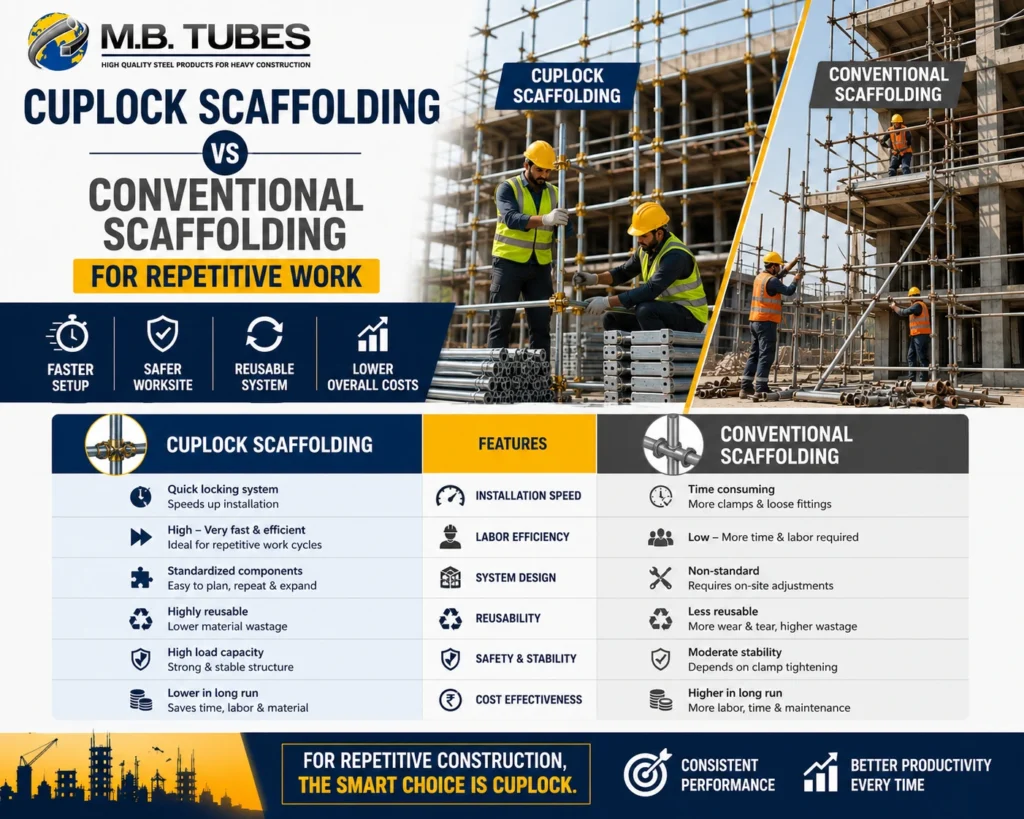
Cuplock Scaffolding vs Conventional Scaffolding for Repetitive Work
| Factor | Cuplock Scaffolding | Conventional Scaffolding |
| System Type | Modular | Depends on configuration |
| Connection Method | Cup-locking mechanism | May use clamps/fittings |
| Repetitive Setup | Well suited to standardized layouts | Can require more component handling |
| Material Organization | Easier with standardized parts | Depends on system |
| Reusability | High when maintained correctly | Varies |
| Inventory Planning | Relatively systematic | May be more complex |
| Large Project Suitability | Strong option when properly designed | Application dependent |
| Configuration Flexibility | Modular | Can be highly flexible depending on type |
Neither system should be selected purely from this comparison. Project geometry, load requirements, working height, access requirements, engineering design, and applicable standards should determine the final system.
How to Choose Cuplock Scaffolding for a Large Project
Before ordering a system, contractors and procurement teams should evaluate several points.
1. Project Application
Determine whether the scaffolding is primarily required for access, construction activity, formwork support, maintenance, or another approved application.
2. Required Height and Layout
Working height and project geometry affect the required component configuration.
3. Expected Loads
Do not estimate loading casually. The designed scaffold must account for its intended loads and use.
4. Steel and Manufacturing Quality
Check material specifications, dimensions, welding, component consistency, and overall manufacturing quality.
5. Component Compatibility
Standards, ledgers, jacks, braces, platforms, and accessories should form part of a compatible system.
6. Quantity Requirements
Calculate material based on the approved scaffolding layout and planned reuse cycles.
7. Supplier Capability
For larger projects, confirm whether the manufacturer can maintain consistent specifications and supply the required quantities according to the project schedule.
Common Procurement Mistakes to Avoid
Even an effective scaffolding system can create problems if procurement is poorly planned.
Avoid:
- Buying only on the basis of lowest price
- Ordering without finalized specifications
- Ignoring accessory requirements
- Mixing incompatible components
- Underestimating quantities
- Ordering excessive material without considering reuse
- Ignoring storage requirements
- Failing to inspect material on receipt
- Using damaged components again without assessment
For repetitive projects, a complete system approach is more useful than purchasing individual components without considering how they will work together.
Why Local Supply Matters for Projects in Madhya Pradesh
Large projects can require additional quantities, replacement components, or phased deliveries as construction progresses.
For projects in Indore, Pithampur, Dewas, Ujjain, Bhopal and other parts of Madhya Pradesh, working with a regional manufacturer can make supplier communication and logistics planning more convenient.
Location alone, however, should not decide the purchase.
Contractors should evaluate:
Manufacturing Quality + Product Range + Technical Specifications + Supply Capacity + Delivery Reliability + Commercial Value
Cuplock Scaffolding Manufacturer in Madhya Pradesh – M.B. Tubes
For builders, contractors, infrastructure companies, and industrial projects looking for a Cuplock Scaffolding Manufacturer in Madhya Pradesh, M.B. Tubes provides scaffolding and related steel construction products for project requirements.
A suitable Cuplock system should be selected according to the project’s layout, required working height, application, loading, quantities, component configuration, and construction schedule.
For repetitive projects in particular, procurement should also consider how efficiently the material can move from one work zone to another.
This is where a planned system can create greater value:
Right Components → Planned Installation → Safe Use → Inspection → Efficient Reuse
Making Cuplock Scaffolding More Efficient on Site
Buying good scaffolding is only the beginning.
To get better performance from a reusable system, project teams should establish a clear material-management process.
Label or segregate components by size, maintain inventory records, inspect material after dismantling, isolate damaged components, plan the next installation before shifting material, and store unused equipment appropriately.
The objective is simple:
Do not just reuse scaffolding. Manage the reuse cycle.
That distinction can have a major impact on repetitive projects.
Final Thoughts
Cuplock scaffolding works well for repetitive construction because its modular configuration, standardized components, reusable steel construction, systematic connections, and organized material flow can complement projects where similar work is performed repeatedly.
Its greatest advantage is not simply faster assembly.
The bigger opportunity is creating a predictable scaffolding cycle that connects erection, inspection, dismantling, material movement, inventory management, and reuse.
For contractors searching for a Cuplock Scaffolding Manufacturer in Madhya Pradesh, product quality should therefore be considered alongside component compatibility, manufacturing consistency, project specifications, supply capability, and long-term usability.
When the right system is combined with proper engineering, trained personnel, inspection, and material planning, Cuplock scaffolding can become an efficient part of large and repetitive construction projects.
Frequently Asked Questions (FAQs)
1. What is Cuplock scaffolding used for?
Cuplock scaffolding is commonly used for building construction, industrial projects, infrastructure work, access scaffolding, and suitable formwork support applications.
2. Why is Cuplock scaffolding suitable for repetitive construction?
Its modular design, standardized components, easy material organization, and reusability make it practical for projects with repeated floors or similar work zones.
3. Can Cuplock scaffolding be reused?
Yes. Cuplock scaffolding can be reused across multiple construction cycles when components are properly inspected, handled, maintained, and stored.
4. What should contractors check before buying Cuplock scaffolding?
Check the steel quality, dimensions, component compatibility, welding quality, project load requirements, required quantities, and manufacturer reliability.
5. How do I choose a Cuplock Scaffolding Manufacturer in Madhya Pradesh?
Choose a Cuplock Scaffolding Manufacturer in Madhya Pradesh based on manufacturing quality, product specifications, supply capacity, component range, delivery reliability, and ability to meet project requirements.