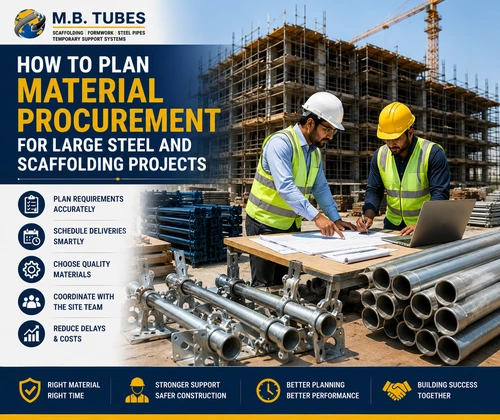

Large construction projects rarely face material problems because someone simply forgot to place an order. More often, the real issue is poor procurement planning—the wrong quantity arrives, critical components are missing, deliveries do not match the construction sequence, or materials reach the site before there is adequate storage.
For projects involving steel pipes, scaffolding systems, formwork, adjustable props, structural steel, and other construction support materials, these problems can directly affect productivity and project timelines.
A well-designed procurement plan connects four important areas:
Project Requirement → Material Specification → Delivery Schedule → Site Utilization
For contractors and developers working in Madhya Pradesh, coordinating with an experienced Scaffolding Manufacturer in Indore can also make sourcing, technical discussions, and phased material supply more manageable.
This guide explains how construction teams can create a practical procurement strategy for large steel and scaffolding projects.
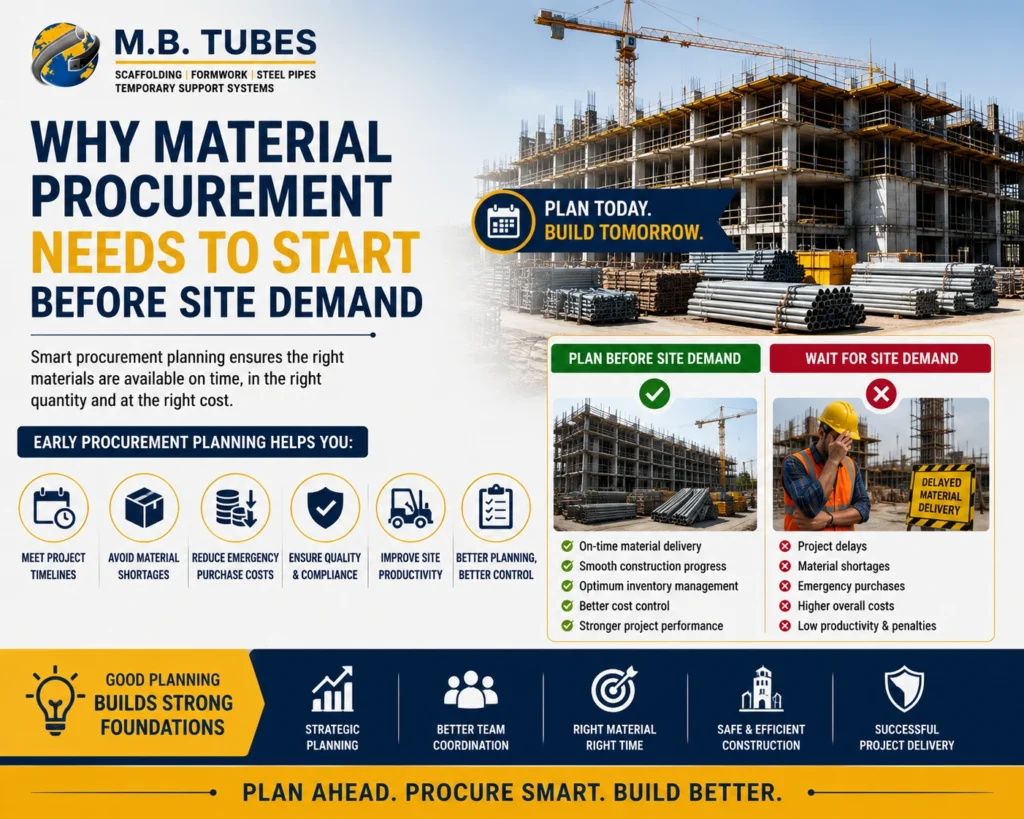
Why Material Procurement Needs to Start Before Site Demand
A common procurement mistake is ordering material only when the site team says, “We need it now.”
By that stage, there may already be pressure on the construction schedule.
Large projects should treat procurement as part of project planning rather than a last-minute purchasing activity. Steel and scaffolding requirements should be mapped against the construction sequence so that the right materials are available before each activity begins.
Good procurement planning helps teams:
- Reduce unnecessary site delays
- Avoid emergency purchases
- Control excess inventory
- Improve material traceability
- Plan storage more efficiently
- Coordinate suppliers and site teams
- Reduce avoidable handling
- Maintain consistent specifications
The objective is not to purchase everything as early as possible. It is to ensure the right material reaches the right location at the right stage of construction.
1. Start With the Project Drawings, Not the Purchase Order
Before requesting quotations, the procurement team should understand what the project actually requires.
Review relevant structural drawings, formwork plans, scaffolding layouts, construction schedules, specifications, and bills of quantities.
Depending on the project, the requirement may include:
Scaffolding Materials
- Cuplock scaffolding
- H Frame scaffolding
- Vertical and horizontal members
- Bracing components
- Base and head arrangements
- Platforms and accessories
Formwork & Support Materials
- Adjustable steel props
- Adjustable spans
- Steel formwork
- Centering plates
- Temporary construction support systems
Steel Products
- MS pipes
- Steel tubes
- Structural steel products
- Other fabricated steel components
Creating a detailed material list at this stage prevents purchasing teams from treating “scaffolding” or “steel” as a single generic requirement.
2. Build a Detailed Material Requirement Schedule
A Bill of Quantities tells you what is required. A procurement schedule should additionally tell you when it is required.
Instead of maintaining only one total quantity, divide the requirement according to construction phases.
For example:
| Construction Stage | Material Requirement | Procurement Priority |
| Foundation / Initial Works | Temporary supports & steel components | High |
| Structural Work | Scaffolding, props, formwork | Critical |
| Upper Floors | Reusable scaffolding & support systems | Planned by cycle |
| External Work | Access scaffolding | Phase-based |
| Industrial Installation | Pipes & structural steel | Schedule-based |
| Finishing / Maintenance | Access systems | As required |
This gives procurement teams visibility into upcoming demand instead of reacting to shortages.
3. Freeze Technical Specifications Before Ordering
Price comparison should never begin before specifications are clear.
Two suppliers may quote similar-looking products that differ significantly in dimensions, weight, steel grade, wall thickness, finish, fabrication quality, or load-related characteristics.
Your procurement specification should clearly define relevant parameters such as:
Material type + dimensions + thickness + length + quantity + finish + applicable specification + required accessories.
For scaffolding and temporary support systems, also confirm component compatibility and project engineering requirements.
This creates an apples-to-apples comparison between suppliers.
4. Calculate Quantity Based on Actual Usage Cycles
Large projects do not always need enough scaffolding or formwork to cover the entire structure simultaneously.
Many materials are reusable.
For example, scaffolding may be dismantled from one completed section and shifted to another. Adjustable props and formwork components may similarly move through planned floor cycles.
Therefore, calculate procurement quantities using:
Total Requirement – Reusable Material Available + Planned Buffer = Procurement Quantity
The exact buffer should be project-specific rather than based on an arbitrary percentage.
A good material circulation plan can reduce unnecessary capital tied up in excess inventory.
5. Create a Procurement Timeline Around the Construction Schedule
Once quantities are identified, map each material against its required-on-site date.
Work backwards from that date to account for:
Approval → Quotation → Negotiation → Manufacturing → Inspection → Dispatch → Transportation → Site Receipt
If customized components are required, additional manufacturing time may be necessary.
This is particularly important for large projects where a delayed steel or scaffolding shipment can affect multiple downstream activities.
6. Choose the Supplier on More Than Price
The lowest quotation is not automatically the lowest project cost.
A supplier offering a slightly lower rate may become expensive if there are problems with inconsistent dimensions, delayed dispatch, incomplete quantities, incompatible components, or poor communication.
Evaluate suppliers using multiple factors:
| Evaluation Factor | Why It Matters |
| Product Quality | Supports consistent project execution |
| Technical Specifications | Ensures material matches requirements |
| Production Capability | Important for large-volume orders |
| Delivery Reliability | Helps protect project schedules |
| Product Range | Simplifies multi-product procurement |
| Customization | Useful for project-specific requirements |
| Location | Can simplify coordination and logistics |
| Support | Important when requirements change |
For projects in central India, working with a reliable Scaffolding Manufacturer in Indore can be advantageous when local coordination and supply responsiveness are important.
7. Plan Scaffolding Procurement as a Complete System
One of the easiest procurement mistakes is focusing only on the main scaffolding frames or verticals.
A usable scaffolding arrangement may require several interconnected components.
Missing even a relatively small accessory can prevent an entire section from being assembled as planned.
Therefore, create a system-wise checklist rather than ordering individual components independently.
For example:
Main Components → Bracing → Base Components → Connections → Platforms → Accessories
Before dispatch, reconcile the complete system quantity against the approved requirement.
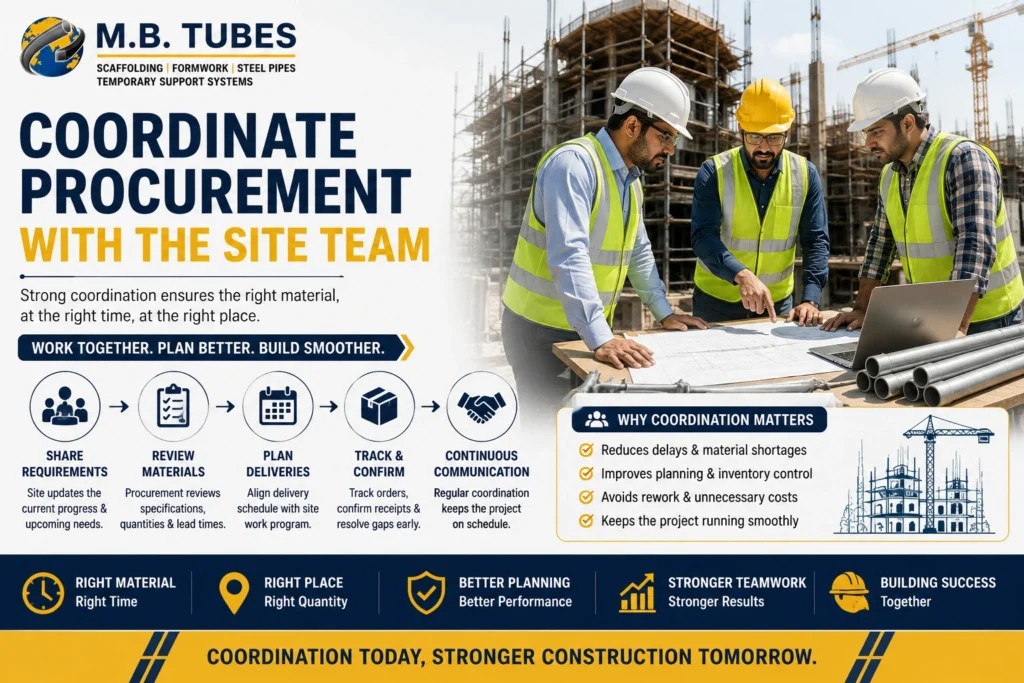
8. Coordinate Procurement With the Site Team
Procurement and site execution should not operate independently.
The procurement team understands purchase orders, suppliers, lead times, and commercial terms. The site team understands actual consumption, construction progress, available inventory, and upcoming requirements.
A short weekly material review can answer:
- What material is currently available?
- What is being consumed?
- What will be required during the next two to four weeks?
- Which materials can be reused?
- Are any components damaged or missing?
- Which purchase orders are pending?
- Are there any schedule changes?
This simple process can prevent many last-minute procurement problems
9. Use Phased Deliveries for Large Orders
Ordering 100% of the project material at once may appear efficient, but it can create another problem: site congestion.
Large quantities of steel and scaffolding require adequate unloading and storage space. Excess inventory can increase handling, make stock control harder, and expose materials to unnecessary site conditions.
For suitable projects, phased delivery can work better:
Phase 1 – Initial structural requirement
Phase 2 – Peak construction requirement
Phase 3 – Expansion or upper-floor requirement
Phase 4 – Replacement/additional requirement
The delivery schedule should match actual construction progress.
10. Plan Storage Before Material Arrives
Procurement does not end when a truck reaches the project gate.
Steel and scaffolding materials need an organized receiving and storage process.
Before delivery, decide:
- Where will the material be unloaded?
- How will different components be separated?
- Is the ground suitable for storage?
- How will identification be maintained?
- Who will verify quantities?
- How will damaged materials be isolated?
- How will material issues be reported?
Good storage practices help reduce unnecessary damage, mixing, loss, and repeated handling.
11. Inspect Material at the Time of Receipt
Do not assume that receiving the correct number of bundles means the order is complete.
The site or quality team should verify the delivered material against the purchase order and approved specifications.
Depending on the product, inspection may include:
Quantity → Dimensions → Condition → Finish → Identification → Accessories → Documentation
Any shortage, transit damage, or specification discrepancy should be documented quickly.
This is easier to resolve at receipt than several weeks later when the material is required for installation.
12. Track Material Consumption and Reusability
Reusable construction systems need different inventory management from consumable materials.
Scaffolding, props, spans, and steel formwork can move repeatedly between work zones.
Maintain a simple tracking process:
Received → Issued → In Use → Returned → Inspected → Reusable / Repair / Rejected
This provides a clearer picture of available stock.
It also prevents unnecessary repeat purchases simply because existing components cannot be located.
13. Keep a Controlled Project Buffer
Large construction projects need some flexibility.
Material may become damaged, quantities can change after design revisions, or additional work fronts may open unexpectedly.
Keeping a project-approved buffer of critical components can help manage such situations.
However, buffer stock should be calculated, not guessed.
Too little creates shortages. Too much ties up working capital and storage space.
14. Consider Total Procurement Cost, Not Just Material Rate
Suppose Supplier A offers scaffolding at a lower basic rate than Supplier B.
That does not automatically make Supplier A cheaper.
A better comparison includes:
Material Price + Freight + Handling + Inspection/Rejection Risk + Delivery Reliability + Replacement Cost + Project Delay Risk
This is essentially the total cost of procurement.
For large projects, reliable supply and consistent product specifications can sometimes deliver more value than a small difference in unit price.
15. Use Local Procurement Strategically
For construction projects in Madhya Pradesh, supplier location can influence communication, freight planning, delivery coordination, and response time.
Working with a Scaffolding Manufacturer in Indore can be particularly relevant for projects around Indore, Pithampur, Dewas, Ujjain, Dhar, Bhopal and other industrial or construction locations across Madhya Pradesh.
Local sourcing does not mean choosing a supplier solely because they are nearby. Technical capability, product quality, manufacturing consistency, and delivery performance should remain central to the decision.
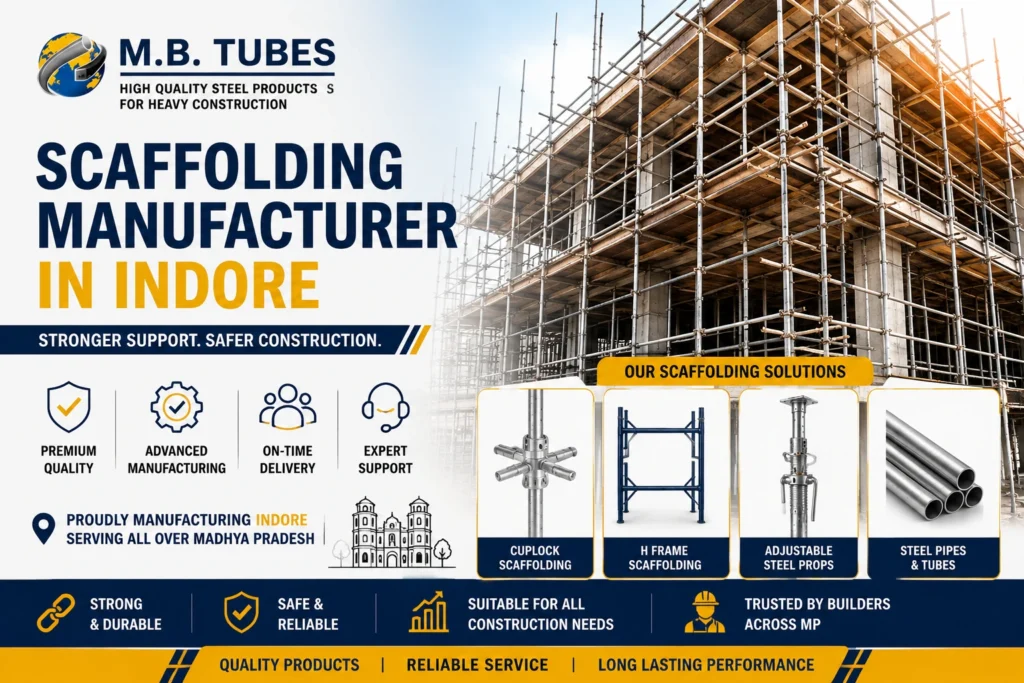
Scaffolding Manufacturer in Indore – M.B. Tubes
For contractors, builders, infrastructure companies, and industrial projects, selecting the right supplier is an important part of procurement planning.
M.B. Tubes serves construction requirements across scaffolding, formwork, temporary support, steel pipes, and related steel products.
For buyers searching for a Scaffolding Manufacturer in Indore, the goal should be to select products according to the project’s technical specifications, quantities, application, and delivery schedule—not simply the lowest initial quotation.
A coordinated procurement approach becomes especially valuable when a project requires multiple construction support products from the same supply chain.
A Simple Procurement Checklist for Project Managers
Before finalizing your next steel or scaffolding order, confirm:
✓ Approved drawings and specifications reviewed
✓ Material quantities calculated
✓ Reusable stock considered
✓ Construction sequence mapped
✓ Supplier capability evaluated
✓ Product specifications confirmed
✓ Complete scaffolding accessories included
✓ Delivery dates agreed
✓ Storage space prepared
✓ Inspection process defined
✓ Buffer requirement calculated
✓ Material tracking system established
If these points are controlled before procurement begins, material management becomes much more predictable.
Final Thoughts
Efficient procurement is not about buying steel and scaffolding as quickly or cheaply as possible. It is about creating a reliable flow of materials that supports the construction schedule.
The strongest procurement strategies connect engineering requirements, quantities, supplier capability, delivery planning, inspection, storage, and site consumption.
For large projects, start planning before the material becomes urgent. Define specifications clearly, calculate requirements around actual construction cycles, coordinate closely with the site team, and evaluate suppliers on overall value rather than price alone.
If your project is sourcing from a Scaffolding Manufacturer in Indore, also consider manufacturing capability, product range, specification consistency, logistics, and the supplier’s ability to support phased project requirements.
Frequently Asked Questions (FAQs)
1. Why is material procurement planning important for large construction projects?
Proper procurement planning helps ensure that steel and scaffolding materials are available at the right stage, reducing delays, excess inventory, and emergency purchases.
2. What should be checked before ordering scaffolding materials?
Check the project specifications, required quantity, dimensions, material quality, component compatibility, delivery schedule, and applicable safety requirements.
3. How can contractors reduce scaffolding procurement costs?
Contractors can control costs through accurate quantity planning, reusable material tracking, phased deliveries, proper storage, and comparing suppliers based on total value rather than price alone.
4. Why are phased deliveries useful for large projects?
Phased deliveries align material supply with construction progress, helping reduce site congestion, unnecessary handling, and excess inventory.
5. How do I choose a reliable Scaffolding Manufacturer in Indore?
Choose a Scaffolding Manufacturer in Indore based on product quality, manufacturing capability, technical specifications, product range, delivery reliability, and ability to meet project-specific requirements.