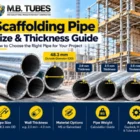

Scaffolding Pipe Size & Thickness Guide: How to Choose the Right Pipe
Choosing the right scaffolding pipe is an important part of construction planning. Whether you are working on a residential building, commercial project, industrial plant, or infrastructure site, the pipes used in scaffolding must match the technical requirements of the complete system.
But how do you select the correct Scaffolding Pipe Size? Is a 48.3 mm pipe suitable for every project? Does a thicker pipe always provide better performance?
These are common questions among contractors, engineers, and construction material buyers.
This guide explains scaffolding pipe sizes, wall thickness, common specifications, material options, and important selection factors in simple language.
Quick Answer: What Is the Standard Scaffolding Pipe Size?
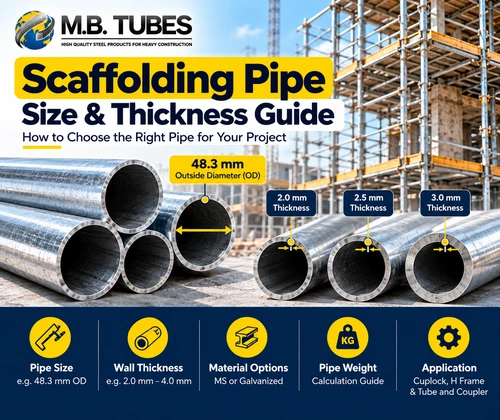
A commonly used Scaffolding Pipe Size is 48.3 mm outside diameter (OD), particularly for many tube-and-coupler and modular steel scaffolding systems.
However, scaffolding pipes are available in different wall thicknesses, lengths, material grades, and surface finishes.
The correct size depends on the scaffolding system, intended application, connection compatibility, structural design, and applicable technical standards.
Remember: A standard pipe diameter does not automatically mean that every pipe of that size is suitable for scaffolding.
What Is Scaffolding Pipe Size?
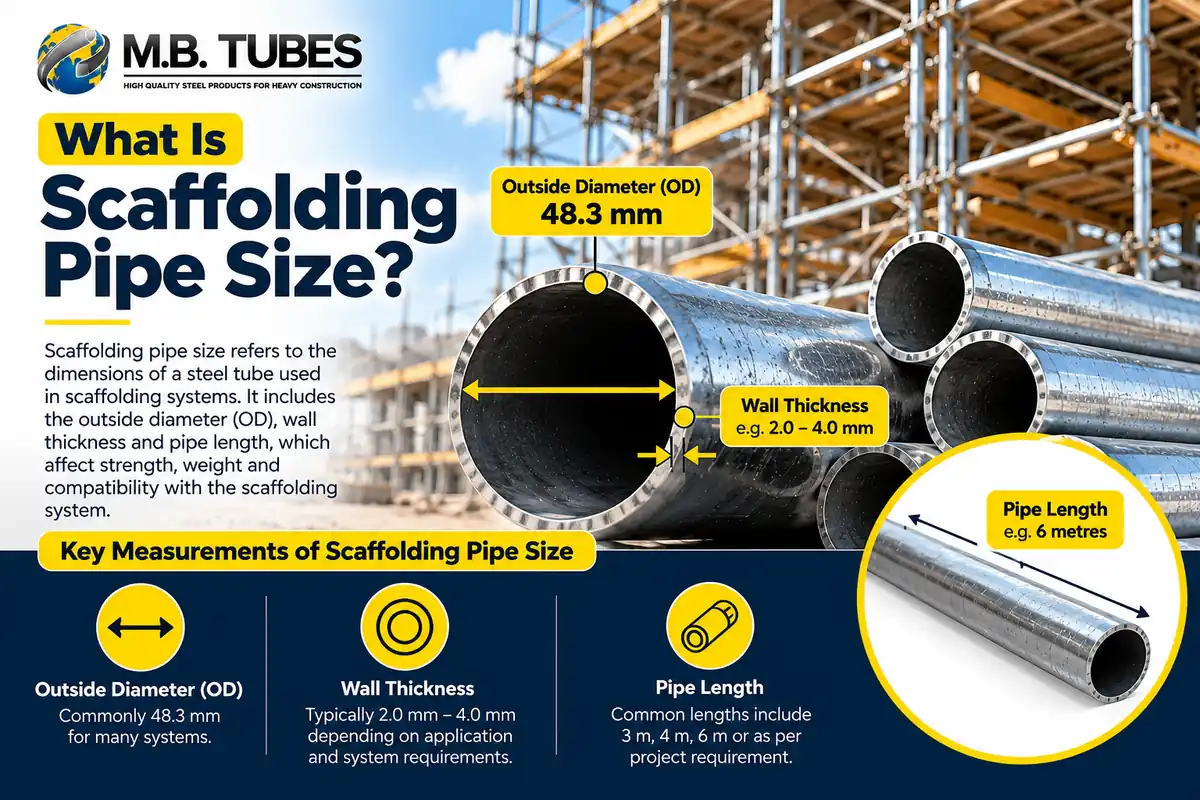
Scaffolding Pipe Size refers to the dimensions of a steel tube used in a scaffolding system.
Three important measurements are:
- Outside Diameter (OD): The distance across the outside of the pipe.
- Wall Thickness: The thickness of the steel forming the pipe wall.
- Pipe Length: The overall length of the tube.
For example, a pipe described as 48.3 mm OD × 3.2 mm thickness × 6 m length has an outside diameter of 48.3 mm, a nominal wall thickness of 3.2 mm, and a length of 6 metres.
These measurements influence pipe weight, structural properties, connection compatibility, and material quantity.
Common Scaffolding Pipe Sizes and Thicknesses
Different scaffolding systems require different pipe specifications.
The following table shows illustrative dimensions used when comparing steel tubes.
Pipe Outside Diameter | Example Wall Thickness | Application Consideration |
48.3 mm | 2.0 mm | Requires verification against the intended system and load requirements |
48.3 mm | 2.5 mm | Suitability depends on product specification and scaffold design |
48.3 mm | 3.0 mm | May be specified for particular engineered scaffold components |
48.3 mm | 3.2 mm | Used in some scaffolding tube specifications |
48.3 mm | 4.0 mm | Requires verification of system compatibility and design requirements |
Note: These are illustrative size combinations, not universal approved scaffolding specifications or confirmed M.B. Tubes stock sizes. A pipe’s suitability must be established through the relevant product standard and scaffold design.
Why Does Scaffolding Pipe Thickness Matter?
Wall thickness is an important factor because it affects the amount of steel in the tube and its structural properties.
1. Influences Structural Strength
For pipes with the same outside diameter and material grade, increasing wall thickness generally increases the tube’s cross-sectional area and certain strength properties.
However, scaffold load capacity also depends on the unsupported length, bracing, connections, foundation, and complete structural arrangement.
2. Affects Pipe Weight
Thicker pipes contain more steel and generally weigh more.
This influences transportation, loading, unloading, storage, and handling requirements.
3. Influences Durability
The wall thickness and condition of a pipe can affect its ability to withstand damage and deterioration.
Corrosion, dents, bending, and other defects must also be considered during inspection.
4. Supports Proper System Selection
Scaffolding systems are designed around specific component requirements.
Using a pipe with an incorrect wall thickness may mean the component does not meet the approved system specification.
The best scaffolding pipe thickness is the one that meets the verified engineering and product requirements—not simply the thickest available option.
How Does Scaffolding Pipe Size Affect Load Capacity?
Scaffolding load capacity is often misunderstood.
Some buyers assume that a larger or heavier steel pipe automatically creates a stronger scaffolding system.
In reality, the complete scaffold determines the allowable working load.
Important factors include:
- Pipe outside diameter and wall thickness
- Steel material grade
- Height and unsupported length
- Horizontal and diagonal bracing
- Couplers and connection details
- Working platform arrangement
- Foundation and base support
- Intended workers, tools, and material loads
For example, two scaffolds using the same nominal pipe size may have different allowable loads because their configurations and support arrangements differ.
Therefore, Scaffolding Pipe Size and Scaffolding Load Capacity are related, but they are not interchangeable measurements.
MS vs GI Scaffolding Pipes: Does Material Finish Matter?
Material selection is another important part of choosing scaffolding pipes.
Mild Steel Scaffolding Pipes
MS scaffolding pipes are commonly used in construction and industrial applications.
Their advantages include availability in different specifications and suitability for properly designed steel scaffolding systems.
Depending on the product, they may be supplied with painted or other protective finishes.
Galvanized Scaffolding Pipes
Galvanized steel pipes have a zinc coating that provides additional corrosion protection.
They may be useful for outdoor construction projects or environments where moisture exposure is a concern.
However, galvanizing does not automatically increase structural load capacity.
Factor | MS Pipe | Galvanized Steel Pipe |
Base Material | Mild steel | Steel with zinc coating |
Corrosion Protection | Depends on surface finish | Zinc coating |
Common Use | Construction and industrial scaffolding | Outdoor and corrosion-exposed applications |
Structural Performance | Depends on grade and dimensions | Depends on grade and dimensions |
Maintenance | Depends on condition and finish | Coating and pipe condition require inspection |
Choose the material and finish according to the project’s environmental and technical requirements.
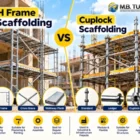
Which Scaffolding Pipe Size Is Used in Cuplock Scaffolding?
Cuplock Scaffolding is a modular steel scaffolding system that uses vertical standards, horizontal ledgers, and cup-and-blade connections.
A 48.3 mm outside diameter is common in many Cuplock scaffolding systems.
However, the correct tube thickness and dimensions depend on the manufacturer’s system design and approved specifications.
Before ordering Cuplock components, confirm the standards, ledgers, connection details, steel grade, wall thickness, and surface finish.
Components from different systems should not be assumed compatible merely because their tube diameters appear similar.
Which Scaffolding Pipe Size Is Used in H Frame Scaffolding?
H Frame Scaffolding uses prefabricated steel frames connected with suitable braces and accessories.
The tube dimensions used in H-shaped frames may differ from those used in conventional tube-and-coupler scaffolding.
Therefore, a 48.3 mm pipe should not automatically be treated as the required size for every H Frame system.
Buyers should verify the manufacturer’s frame dimensions, tube specifications, cross-brace compatibility, working platform requirements, and approved load information.
For H Frame Scaffolding, the complete prefabricated frame specification matters more than choosing a loose pipe by diameter alone.
How to Calculate Scaffolding Pipe Weight
Pipe weight is useful when estimating material quantities and planning transportation.
For a round mild steel tube, an approximate theoretical weight formula is:
Weight (kg/m) = 0.02466 × T × (OD − T)
Where:
- OD = Outside diameter in millimetres
- T = Wall thickness in millimetres
Example: 48.3 mm Scaffolding Pipe
Assume:
Outside diameter = 48.3 mm Wall thickness = 3.2 mm
Weight per metre:
= 0.02466 × 3.2 × (48.3 − 3.2)
= Approximately 3.56 kg/m
For a 6-metre pipe:
3.56 × 6 = Approximately 21.36 kg
This is a theoretical calculation using nominal dimensions and typical mild steel density. Actual weight may vary due to manufacturing tolerances, coatings, and product specifications.
Pipe weight calculations help with logistics and purchasing estimates, but they do not establish safe scaffold load capacity.
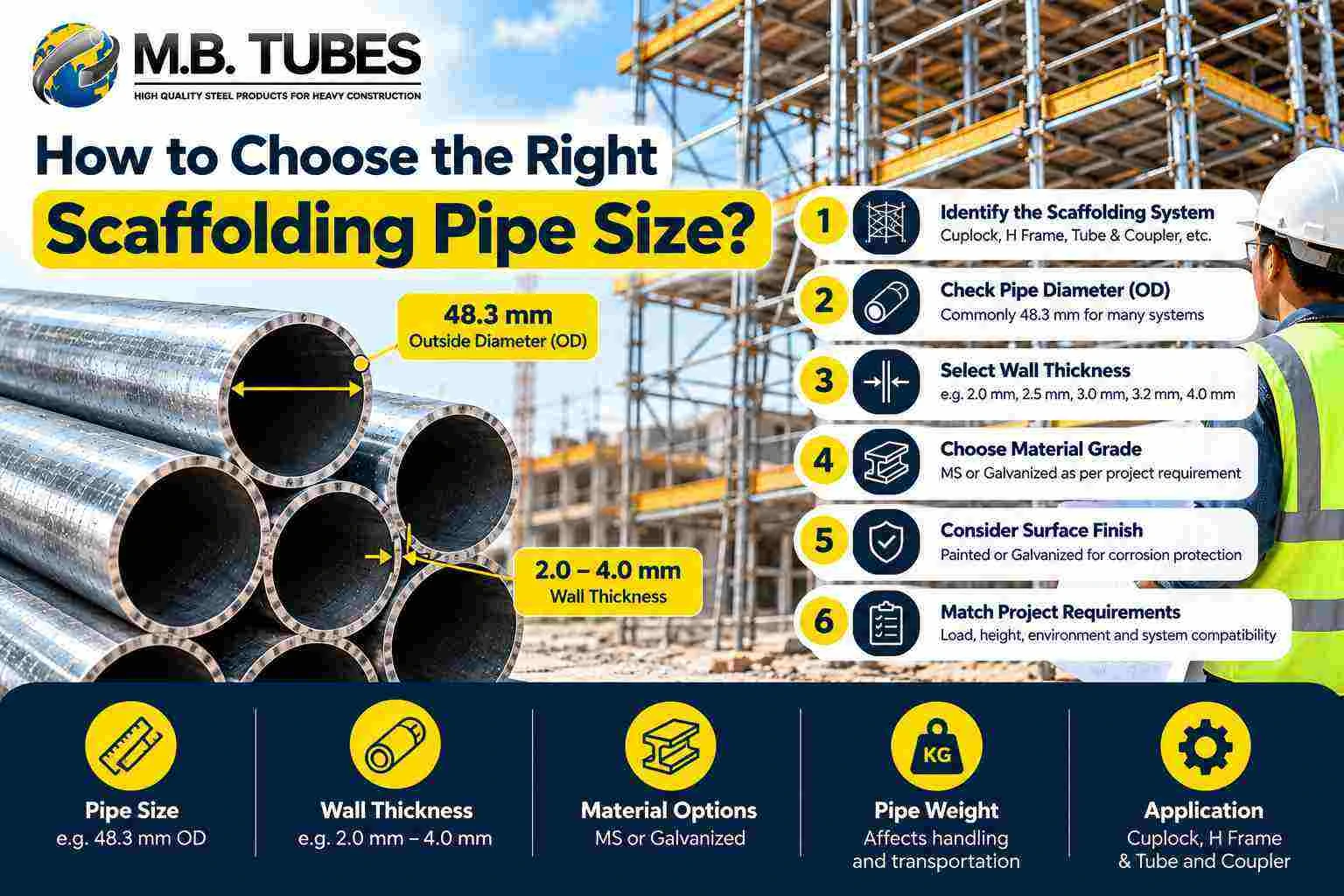
How to Choose the Right Scaffolding Pipe Size
Before placing an order, follow these practical steps.
Step 1: Identify the scaffolding system. Determine whether the project requires Cuplock, H Frame, tube-and-coupler, or another approved system.
Step 2: Confirm the outside diameter. Check the diameter required by the system and its connections.
Step 3: Verify wall thickness. Select the thickness specified in the approved design or product documentation.
Step 4: Check material grade. Confirm the required steel grade, applicable standard, and relevant quality documentation.
Step 5: Choose the surface finish. Consider moisture exposure, corrosion protection, and maintenance requirements.
Step 6: Calculate the required quantity. Prepare a material schedule based on pipe lengths, quantities, and component requirements.
Step 7: Check system compatibility. Confirm that the selected pipes work with the intended couplers, connectors, braces, and other components.
This approach supports accurate purchasing and reduces the risk of incompatible materials.
Common Mistakes When Selecting Scaffolding Pipes
One common mistake is purchasing steel pipes based only on outside diameter.
Another is assuming that a thicker pipe always makes the complete scaffold suitable for heavier loads.
Buyers may also overlook material grade, corrosion protection, pipe condition, connection compatibility, and manufacturing tolerances.
Comparing quotations without matching the same pipe specifications can also lead to misleading price comparisons.
For better procurement decisions, compare the complete technical specification rather than the price per pipe alone.
Scaffolding Pipes from Khambati Steel & M.B. Tubes
Khambati Steel & M.B. Tubes provides steel pipes, tubes, and scaffolding-related products for construction and industrial requirements.
Its product range includes MS steel pipes, galvanized pipes, Cuplock Scaffolding, H Frame Scaffolding, walkway planks, adjustable jacks, and other scaffolding accessories.
For a specific project, buyers should provide the required Scaffolding Pipe Size, wall thickness, material grade, finish, quantity, and application.
Clear technical requirements help suppliers identify suitable products and prepare accurate quotations.
Conclusion
Selecting the right Scaffolding Pipe Size and Thickness requires more than choosing a commonly available diameter.
Although 48.3 mm is widely used in many scaffolding systems, the correct pipe must match the approved design, material grade, wall thickness, connection requirements, and environmental conditions.
Understanding these factors helps contractors and procurement teams compare specifications, estimate quantities, and select appropriate products.
For construction and industrial projects, Khambati Steel & M.B. Tubes can be contacted with the required pipe specifications and project details.
The right scaffolding pipe is not simply the largest or thickest—it is the one correctly specified for the complete scaffolding system.
What is the most common scaffolding pipe size?
A 48.3 mm outside diameter is commonly used in many steel scaffolding systems. However, wall thickness, grade, and other specifications must match the intended application and approved system requirements.
Which thickness is best for scaffolding pipes?
There is no single best thickness for every project. The correct wall thickness depends on the scaffolding system, engineering design, material grade, component specifications, and intended loads.
Is a 48.3 mm pipe suitable for Cuplock Scaffolding?
Many Cuplock systems use 48.3 mm outside-diameter tubes. However, the exact dimensions and connection requirements must be verified against the specific manufacturer’s system.
Does a thicker scaffolding pipe carry more weight?
For otherwise identical steel tubes, greater wall thickness generally increases certain structural properties. However, the safe working capacity of a scaffold depends on its complete configuration and approved design.
What should I check before buying scaffolding pipes?
Check outside diameter, wall thickness, pipe length, steel grade, manufacturing standard, surface finish, condition, system compatibility, and relevant technical documentation before ordering.