Which Pipe Is Best for Scaffolding? Types, Sizes & Selection Guide
Choosing the right scaffolding pipe is essential for construction projects where workers need temporary access and stable working platforms. Whether the project involves building construction, plastering, painting, industrial maintenance, or infrastructure development, the pipe must match the scaffolding system and its technical requirements.
But which pipe is best for scaffolding? Should you choose MS pipes, GI pipes, or another steel pipe?
The answer depends on the application, pipe dimensions, wall thickness, material grade, environmental conditions, and scaffold design.
This guide explains the common types of Scaffolding Pipes, their applications, and the important factors to consider before purchasing.
Quick Answer: Which Pipe Is Best for Scaffolding?
Steel scaffolding pipes manufactured to an appropriate structural or scaffolding specification are generally preferred for conventional steel scaffolding systems.
Mild Steel (MS) pipes are commonly used for construction scaffolding, while Galvanized Iron (GI) pipes provide additional corrosion protection for suitable outdoor environments.
A common scaffolding tube outside diameter is 48.3 mm, but diameter alone does not determine suitability.
The best pipe must meet the required material grade, wall thickness, dimensional tolerances, connection compatibility, and verified load requirements.
What Are Scaffolding Pipes?
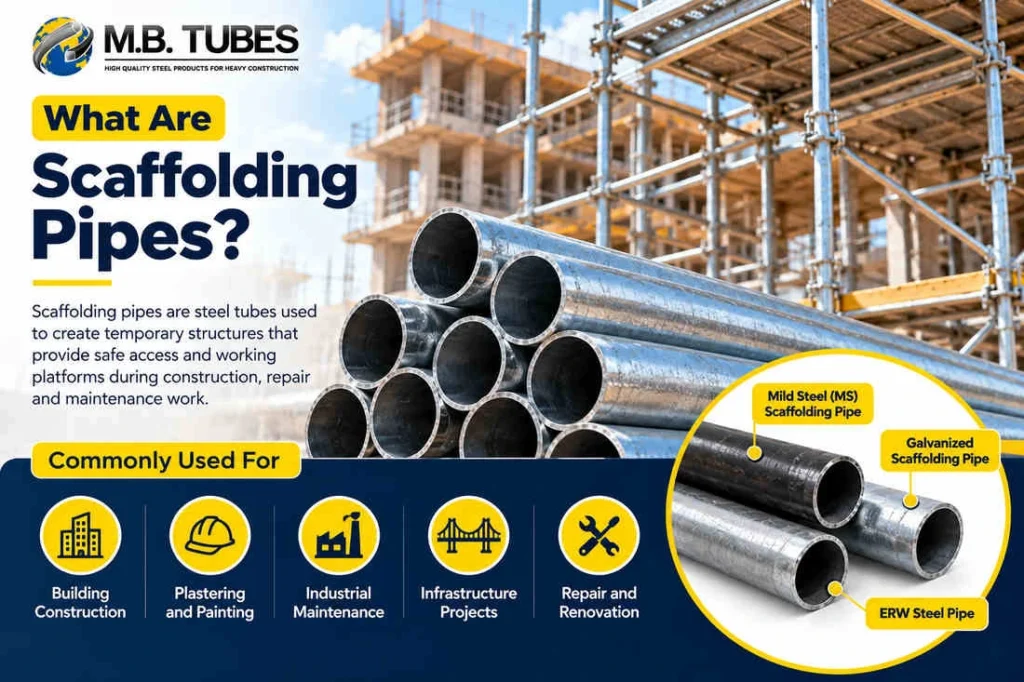
Scaffolding pipes are steel tubes used to create temporary frameworks that provide access and support working platforms during construction and maintenance activities.
Depending on the scaffolding system, these pipes may function as vertical standards, horizontal members, braces, or other structural components.
They are commonly used in:
- Residential and commercial construction
- Industrial plants and warehouses
- Building maintenance and façade work
- Bridge and infrastructure projects
- Power plant maintenance
- Construction repair and renovation
Scaffolding pipes must work together with suitable couplers, connectors, braces, base supports, and platforms to form a properly designed system.
Types of Pipes Used for Scaffolding
Different pipe types offer different advantages. Understanding their characteristics helps buyers make informed decisions.
1. Mild Steel (MS) Scaffolding Pipes
MS Scaffolding Pipes are widely used in steel scaffolding applications.
They are manufactured from mild steel and are available in different dimensions, wall thicknesses, and surface finishes.
Common advantages include good fabrication suitability, availability in different specifications, and compatibility with suitable scaffolding components.
MS pipes are used in construction access systems, industrial scaffolding, and temporary structural arrangements.
However, unprotected mild steel can corrode when exposed to moisture. Appropriate finishing, storage, and maintenance are important.
2. Galvanized Scaffolding Pipes
Galvanized scaffolding pipes are steel tubes protected with a zinc coating.
The coating helps reduce corrosion caused by environmental exposure.
These pipes can be suitable for outdoor construction, humid environments, and projects where corrosion protection is an important purchasing consideration.
However, galvanizing does not automatically increase the structural load capacity of a pipe.
Its suitability still depends on the underlying steel grade, wall thickness, manufacturing standard, and scaffold configuration.
3. ERW Steel Pipes
ERW stands for Electric Resistance Welded.
ERW describes a manufacturing process rather than a separate material grade.
ERW steel pipes are manufactured by forming steel strip into a tube and welding the longitudinal seam.
Suitable ERW pipes may be used in scaffolding applications when their material and manufacturing specifications meet the relevant requirements.
An ERW pipe should not be selected for scaffolding merely because it has the required outside diameter.
MS Pipe vs GI Pipe for Scaffolding
The comparison below explains the practical differences.
Factor | MS Scaffolding Pipe | Galvanized Scaffolding Pipe |
Base Material | Mild steel | Steel with zinc coating |
Corrosion Protection | Depends on applied finish | Zinc coating provides protection |
Common Applications | Construction and industrial scaffolding | Outdoor and corrosion-exposed projects |
Maintenance | May require more coating maintenance | Coating condition still needs inspection |
Cost | Depends on specification and finish | May involve additional coating cost |
Structural Suitability | Depends on grade and dimensions | Depends on grade and dimensions |
Which should you choose?
For projects where corrosion exposure is limited and suitable maintenance is available, MS scaffolding pipes may be practical.
For outdoor projects requiring additional corrosion protection, galvanized scaffolding pipes may be preferable.
What Is the Standard Size of a Scaffolding Pipe?
Scaffolding pipes are available in different dimensions depending on the system and manufacturer.
A commonly used outside diameter is 48.3 mm, particularly in many tube-and-coupler and modular scaffolding arrangements.
However, buyers should not assume that every scaffolding system uses identical tube dimensions.
Important specifications include:
Specification | What to Check |
Outside Diameter | Compatibility with the scaffold system |
Wall Thickness | Required design and product specification |
Pipe Length | Working layout and material schedule |
Material Grade | Applicable structural requirements |
Surface Finish | Painted, black, or galvanized |
Manufacturing Standard | Required standard and compliance documents |
Wall thickness must be confirmed from the actual scaffold design and approved product specifications.
A thicker pipe is not automatically the correct choice for every project.
Why Does Scaffolding Pipe Thickness Matter?
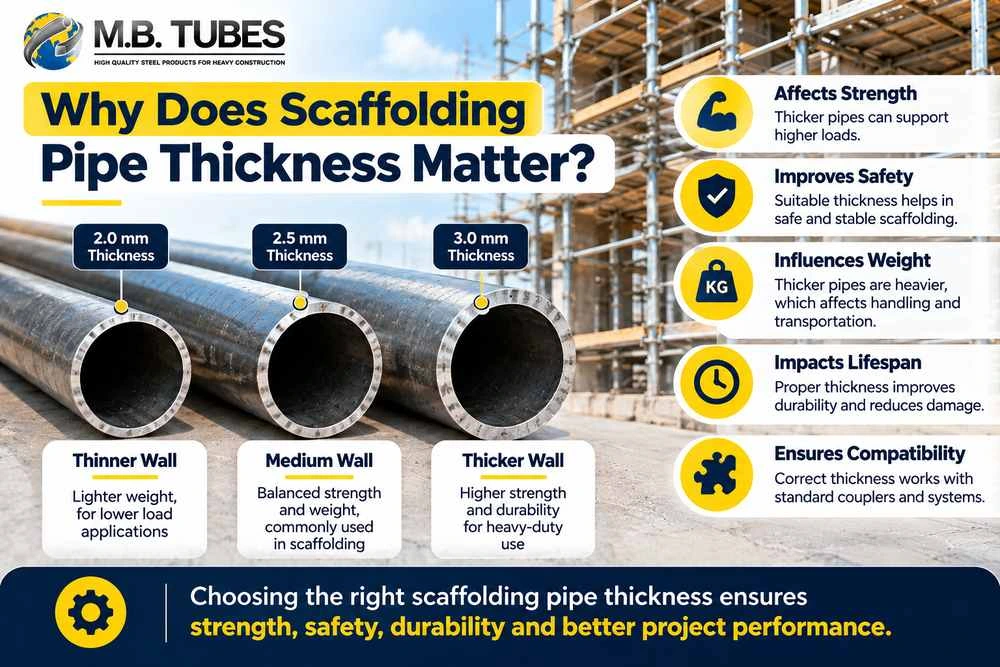
Wall thickness influences the steel tube’s cross-sectional properties, weight, and structural performance.
Two pipes may have the same outside diameter but different wall thicknesses.
For example, a 48.3 mm outside-diameter tube with one wall thickness will have different properties from a tube of the same diameter with a thicker wall.
However, pipe strength cannot be judged using thickness alone.
Material grade, unsupported length, connections, bracing, corrosion condition, and applied loads also influence scaffold performance.
The correct approach is to select pipe thickness according to the approved scaffolding design rather than simply choosing the thickest available pipe.
Which Pipe Is Best for Cuplock Scaffolding?
Cuplock Scaffolding is a modular system that uses vertical standards, horizontal ledgers, and cup-and-blade connections.
The steel tubes used for these components must match the system’s manufacturing specifications.
For example, M.B. Tubes lists a 48.3 mm outside pipe diameter for a particular MS Scaffolding product configuration.
However, this specification should not be applied automatically to every Cuplock component or scaffolding system.
Buyers should confirm the standard and ledger dimensions, steel grade, connection design, surface finish, and system compatibility.
Using unrelated pipes or incompatible components can affect the intended performance of the scaffold.
Which Pipe Is Best for Industrial Scaffolding?
Industrial scaffolding projects often involve equipment, pipelines, machinery, elevated platforms, and complex working areas.
The pipe selection must consider more than the project location.
Important factors include the required scaffold configuration, environmental exposure, intended loading, connection system, working height, and maintenance requirements.
For projects involving moisture or demanding outdoor conditions, galvanized steel pipes may provide useful corrosion protection.
For suitable indoor or controlled applications, correctly specified MS pipes may also be practical.
The final selection should follow the approved scaffold design and applicable technical requirements.
How to Choose the Right Scaffolding Pipe
Before ordering, use this simple buying checklist.
- Identify the scaffolding system. Determine whether the project requires Cuplock, H Frame, tube-and-coupler, or another approved arrangement.
- Confirm pipe dimensions. Check the outside diameter, wall thickness, and required lengths.
- Verify material specifications. Request the applicable steel grade, manufacturing standard, and relevant test documentation.
- Evaluate environmental exposure. Choose an appropriate surface finish based on moisture, weather, and maintenance conditions.
- Check component compatibility. Confirm that pipes, couplers, braces, platforms, and other accessories work together as intended.
- Review total project requirements. Calculate quantities, delivery schedules, handling needs, and future reuse.
This process helps buyers avoid selecting pipes based only on price or appearance.
Common Mistakes When Buying Scaffolding Pipes
One common mistake is assuming that any steel pipe of the correct diameter can be used for scaffolding.
Another is comparing quotations without checking wall thickness, grade, length, coating, and manufacturing specifications.
Buyers may also overlook corrosion damage, component compatibility, and the difference between pipe weight and scaffold load capacity.
Scaffolding pipe weight is not the same as scaffolding load capacity.
A heavier pipe does not automatically make the complete scaffold safer or suitable for a particular load.
Always evaluate the complete system.
Scaffolding Pipes from M.B. Tubes
M.B. Tubes offers steel pipes, tubes, and scaffolding-related products for construction and industrial applications.
Its product range includes MS steel pipes, galvanized pipes, Cuplock Scaffolding, H Frame Scaffolding, walkway planks, adjustable jacks, and scaffolding accessories.
Contractors and procurement teams can prepare their requirements based on dimensions, material specifications, intended application, quantities, and project location.
Choosing compatible products and confirming technical requirements before ordering supports more effective procurement planning.
Conclusion
So, which pipe is best for scaffolding?
Both MS and galvanized steel pipes can be suitable when manufactured and selected according to the required scaffolding specifications.
MS pipes are commonly used for construction applications, while galvanized pipes offer additional corrosion protection where environmental exposure makes it valuable.
The best choice depends on the scaffolding system, pipe dimensions, material grade, wall thickness, surface finish, and intended loading.
Before purchasing from M.B. Tubes, prepare a clear technical requirement and verify that the selected pipes and components are appropriate for the complete scaffolding arrangement.
Choose the right specification, not simply the lowest-priced pipe.
Frequently Asked Questions
Which material is best for scaffolding pipes?
Steel is commonly used for scaffolding pipes because suitable grades and dimensions can provide the required structural performance. MS and galvanized steel pipes are both options, depending on the scaffold design and environmental conditions.
Is a 48.3 mm pipe suitable for scaffolding?
A 48.3 mm outside diameter is common in many scaffolding systems. However, suitability also depends on wall thickness, steel grade, manufacturing standard, connection compatibility, and the approved scaffold design.
Are GI pipes better than MS pipes for scaffolding?
Galvanized pipes offer additional corrosion protection. However, they are not automatically structurally stronger than ungalvanized MS pipes. The better option depends on technical specifications and exposure conditions.
Can ordinary construction pipes be used for scaffolding?
Not automatically. Pipes must meet the relevant scaffolding requirements, including material grade, dimensions, condition, and compatibility. General-purpose construction pipes should not be substituted without appropriate technical verification.
How do I choose scaffolding pipe thickness?
Pipe thickness should be selected according to the approved scaffold design, material specification, intended loading, and system requirements. Thickness alone cannot establish the safe working capacity of a scaffold.